
When you're looking to send money overseas, the Capitec forex rates advertised are really just the tip of the iceberg. The actual amount that lands in your recipient's account is shaped by two things: the upfront transfer fee and, more importantly, a less obvious margin built into the exchange rate. Getting your head around both is essential before you hit 'send'.
A Closer Look at Capitec Forex Rates and Fees
To really figure out the cost of an international transfer, you have to dig deeper than the advertised fee. The real cost is often tucked away inside the exchange rate itself—a standard practice for most traditional banks. This rate isn't pulled out of thin air; it's heavily influenced by big-picture economic factors, like South Africa's monetary policy and the daily fluctuations of global currencies.
These market trends have a direct and noticeable effect on the rates you're offered. For instance, the South African rand (ZAR) to US Dollar (USD) exchange rate has seen some major shifts, moving from around 12-15 ZAR/USD in the early 2010s to approximately 17.7 ZAR/USD by early 2023. Capitec’s rates track these market movements, but they also add their own margin. This can mean the rate you get is 1-3% different from the mid-market rate published by the South African Reserve Bank. It’s always a good idea to check historical rate data to get a feel for these trends.
The Two Parts of Your Capitec Transfer Cost
When you make an international payment with Capitec, what you ultimately pay comes down to two main components. Knowing how they work together is the secret to calculating your true cost.
The Transfer Fee: This is the easy part. It's a clear, fixed amount you pay for the service itself. Capitec is well-known for keeping this fee low and transparent, which is a big part of their appeal.
The Exchange Rate Margin (or Spread): This is where the hidden cost lies. It’s the gap between the mid-market rate (the one you’d see on Google or Reuters, often called the "real" rate) and the retail rate Capitec actually gives you. In simple terms, the bank buys currency at a wholesale price and sells it to you for a little bit more, pocketing the difference.
The Bottom Line: Don't be fooled by a low transfer fee. The exchange rate margin is almost always the biggest chunk of your total cost. A seemingly tiny percentage difference in the rate can have a much greater impact on your wallet than a small, flat fee, especially when you're sending larger sums of money.
How the Exchange Rate Spread Impacts Your Wallet
Let’s put this into a real-world scenario. Say you need to send ZAR 20,000 to someone in the United Kingdom.
If the mid-market rate is a clean ZAR 23.00 to £1, your money should theoretically convert to £869.56. Simple enough.
But what if Capitec’s rate has a 2% margin? Their offered rate might look more like ZAR 23.46 to £1. At this slightly less favourable rate, your ZAR 20,000 now only gets you £852.51.
That difference of over £17 is the hidden cost of the spread. It's often much higher than the advertised transfer fee, which is exactly why you should always compare the final amount the recipient will get, not just the initial fees.
Capitec vs Competitors: A Head-to-Head Cost Analysis
Let's move past the marketing talk and get straight to the numbers. It's easy to be tempted by a low advertised fee, but that number is often a red herring if the exchange rate is poor. To figure out who really offers the best value, you have to look at the total cost—the explicit fee and the hidden cost baked into the Capitec forex rates compared to its main rivals.
This practical comparison will show you the true, all-in cost of sending money overseas. We’ll see exactly how much foreign currency your rands will buy when you use Capitec versus traditional banks like FNB or modern digital players like Wise and Shyft. This is the only way to get a clear picture of who’s who in the market.
Setting the Stage: A Practical Transfer Scenario
To keep things grounded in reality, let's work through a common scenario: sending ZAR 15,000 from South Africa to someone in the United Kingdom. It’s a significant enough amount that even small differences in rates and fees will start to add up, but it's also a typical sum for things like paying a freelancer, sending a cash gift, or covering some travel expenses.
Our focus is on one simple, crucial metric: the final amount in British Pounds (GBP) that lands in the recipient's bank account. At the end of the day, this is the only figure that truly matters, as it reflects the combined impact of the transfer fee and the exchange rate spread.
Remember, the "best" exchange rate isn't just about the number you see advertised. It's about how much foreign currency your rands actually convert into after all costs are taken. A provider might shout about a zero-rand transfer fee, but if they give you a weak rate, you could end up paying more than you would with a service that has a visible fee but a much better rate.
The image below shows the gap between the buying and selling rates. This difference is the "spread"—and it's where the real hidden cost of many forex transactions lies.
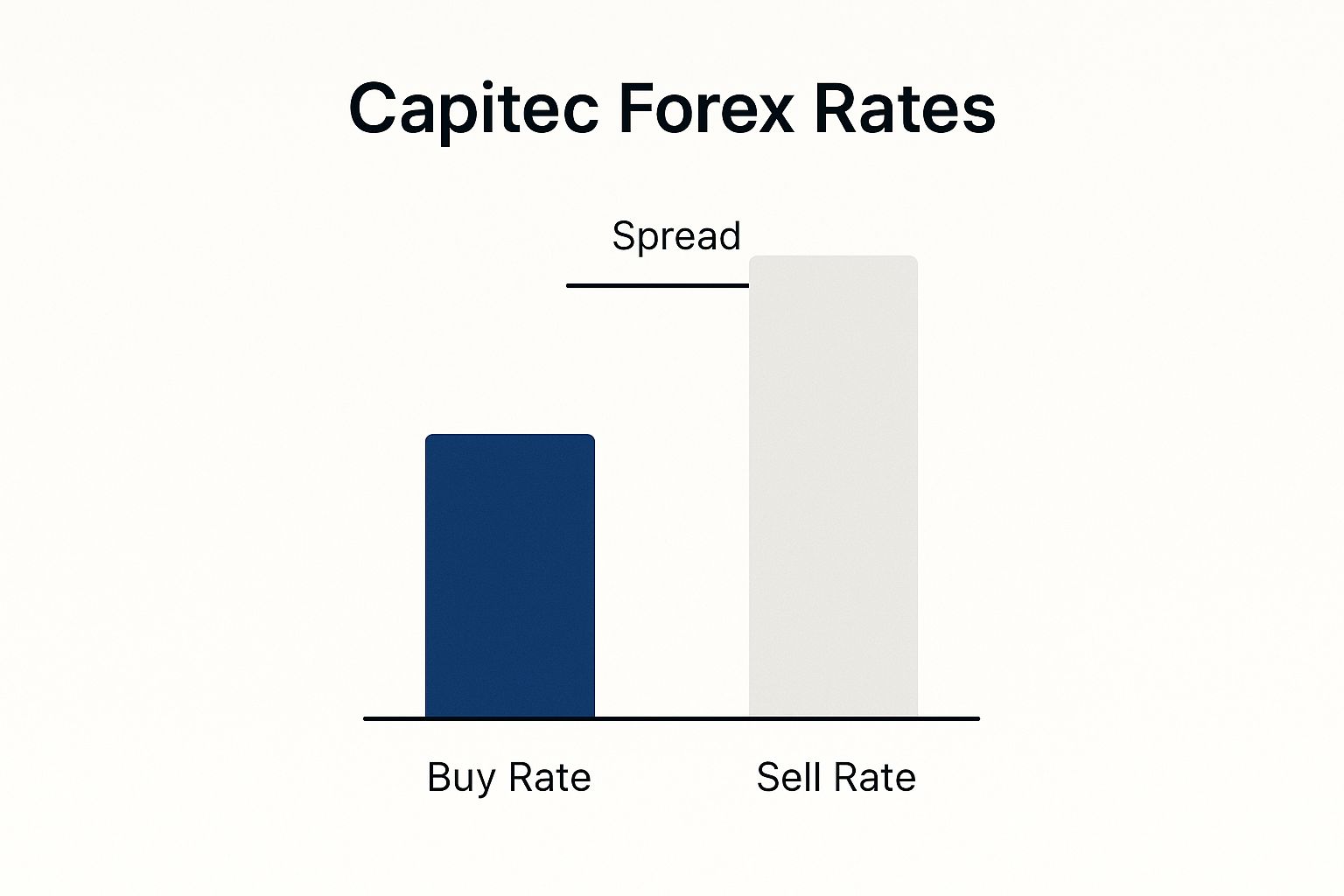
That margin between the 'Buy Rate' and 'Sell Rate' is what the provider pockets. It directly reduces the amount of money your recipient gets.
The Head-to-Head Cost Breakdown
So, how do the different services perform when we send our ZAR 15,000 to the UK? The rates and fees below are based on typical pricing, designed to highlight the fundamental differences in how these companies operate.
Here’s a snapshot of what to expect.
Total Cost Comparison for an International Transfer of R15,000
This table illustrates the total cost, including exchange rate markups and explicit fees, when sending ZAR 15,000 to the United Kingdom (GBP) through different providers.
| Provider | Exchange Rate (ZAR to GBP) | Transfer Fee | Total ZAR Deducted | GBP Received by Beneficiary |
|---|---|---|---|---|
| Capitec | 0.0418 | R160 | R15,160 | £625.32 |
| FNB | 0.0416 | R175 | R15,175 | £622.08 |
| Wise | 0.0425 (Mid-Market Rate) | R145.50 | R15,000 | £631.43 |
| Shyft (FNB) | 0.0421 | R150 | R15,150 | £630.01 |
Note: The figures in this table are examples for illustrative purposes. Always get a live quote before making a transfer.
The results speak for themselves. Let's break down what these numbers actually mean for your wallet.
Interpreting the Results: Who Wins on Cost?
The table clearly shows that while the transfer fees look similar—hovering between R145 and R175—the real game-changer is the exchange rate.
Services like Wise, which are built around using the mid-market rate and charging a completely transparent fee, consistently deliver more money. In our example, the person receiving money via Wise gets over £6 more than the Capitec user and a substantial £9 more than the FNB user.
What's particularly interesting is Shyft. As FNB's own digital app, it offers a more attractive rate and a lower fee than sending money through FNB's standard international payment channel. It cleverly positions itself between the old-school bank model and the pure fintech approach, offering a better deal than its parent company but not quite matching the value of Wise.
Capitec finds itself in the middle of the pack. Its exchange rate is generally better than what you’d get from a big bank like FNB, but the markup it adds means it can't quite go toe-to-toe with specialists whose entire model is built on eliminating that spread.
Ultimately, your choice will likely come down to balancing the convenience of using your main bank against the pure cost savings of a dedicated transfer service. While we're focused on forex here, the skill of looking past headline numbers to find the real cost is crucial for all financial decisions, including things like understanding business loan interest rates. It’s all about knowing where to look for the true costs.
Comparing Transfer Speed and User Experience
While the fees and Capitec forex rates tell you what you’ll pay, they don't account for the cost of your time and effort. The experience of making a transfer—how fast it arrives and how easy it is to send—is just as critical, especially when payments are urgent. A clunky, multi-day ordeal is worlds apart from a smooth, near-instant transaction.
Sending money abroad isn't just about clicking a button; it’s a whole process. From setting up the payment and getting verified to the money actually clearing in the recipient's account, every step matters. Let's look at how the end-to-end journey with Capitec compares to what modern fintechs offer.
How Long Does a Capitec Transfer Really Take?
Capitec’s official timeline for an international payment is between one and five business days. This wide window is standard for traditional banks that rely on the old-school SWIFT network to move money across borders.
So, what determines if your transfer is closer to one day or five?
- The Destination: Sending money to major hubs like the UK or the US is usually faster, often arriving within 48 hours.
- The Recipient’s Bank: The efficiency of the bank on the other side is a big factor. Delays can easily happen on their end, completely outside of Capitec’s control.
- When You Send It: Kicking off a transfer late on a Friday or just before a public holiday (in either country) will almost certainly add days to the waiting time.
This unpredictability can be a serious issue. If you’re paying an overseas supplier with a tight deadline, that potential five-day wait creates a lot of unnecessary risk and stress.
Why the Wait? The main reason for the long and unpredictable transfer time is the SWIFT system. Your money doesn’t go directly from A to B. Instead, it can bounce between several intermediary banks, each adding its own processing time and compliance checks. This is the fundamental bottleneck that separates legacy banking from modern payment platforms.
The User Experience: A Tale of Two Platforms
Speed is one thing, but how easy is it to actually use the service? This is where we see a major difference between using the familiar Capitec app and a purpose-built platform like Zaro or a consumer-focused service like Wise.
Sending Money: The Step-by-Step Reality
| Feature | Capitec App | Digital Specialists (e.g., Zaro, Wise) |
|---|---|---|
| Setup Process | It’s convenient because it’s already in your banking app. But the international payments section can feel a bit bolted on, not a core feature, sometimes making you hunt through menus. | The entire platform is designed for one thing: sending money abroad. The interface is clean, focused, and walks you through a single, logical workflow from start to finish. |
| Recipient Details | You'll need all the standard info: IBAN, SWIFT/BIC codes, and the recipient's full physical address. A small typo here is a common reason for a transfer to fail or get stuck. | They often simplify this. Some platforms let you send money with just an email address, allowing the recipient to securely enter their own bank details. This massively reduces the chance of sender error. |
| Tracking and Updates | Tracking can be a bit of a black box. You get a confirmation that the money was sent, but you rarely get real-time, step-by-step updates on its journey. | You get total transparency. Think of it like tracking a courier package. You can often see exactly where your money is at each stage—from conversion to deposit—giving you complete peace of mind. |
There's no denying the convenience of using the bank you already know and trust. The Capitec app is fantastic for everyday South African banking, but it wasn't built from the ground up for the nuances of global payments.
Fintech platforms, on the other hand, obsess over making this one specific task as painless as possible. For a business that needs to pay multiple overseas invoices, the difference is huge. The streamlined workflow, easy recipient management, and clear tracking offered by specialists can save hours of admin time and eliminate the guesswork of managing cross-border finances.
Evaluating Transparency and Trustworthiness
When sending your hard-earned money across borders, the cost is a big deal, but trust is everything. You need to know, without a doubt, that the quote you see is the price you'll pay and that your funds are safe from start to finish. This is where the ideas of transparency and trustworthiness really come into play.
A big-name bank like Capitec naturally carries the weight and perceived security of an established institution. It's a household name, fully regulated by the South African Reserve Bank, which gives many people a strong sense of safety. Their physical branches and long history offer a traditional kind of reassurance that newer digital platforms can't always match.
However, that traditional model can sometimes fall short on the radical transparency that modern fintech companies are built on. The real sticking point often comes back to the fees.
Unpacking the True Cost
The most significant difference in transparency circles right back to Capitec's forex rates and how they disclose their fees.
Capitec's Approach: The upfront transfer fee is usually stated clearly. The real, less visible cost, however, is buried in the exchange rate margin. You see the final rate you're getting, but the size of the spread—the markup from the real mid-market rate—isn't broken down for you. This is standard practice for most banks, but it makes it tough to know the true cost at a glance.
The Fintech Approach (e.g., Zaro): On the other hand, digital-first providers like Zaro have built their entire reputation on transparency. They typically offer the real, mid-market exchange rate with no markup and instead charge a clear, fixed percentage fee for the transaction. This approach separates the service fee from the exchange rate, leaving no room for hidden costs.
This difference is fundamental. With a bank, you're essentially trusting them to give you a "fair" rate. With a transparent fintech, you don't need to just trust—you can literally check their rate against what you see on Google or Reuters and see the fee listed separately.
Key Differentiator: The question of trust shifts from, "Is my money safe?" (both are generally safe) to, "Is the pricing honest?" The fintech model makes a strong case that true transparency means showing customers the real exchange rate and charging a separate, obvious fee for their service.
Customer Support and Problem Resolution
When a transfer hits a snag or gets delayed, the quality of customer support is what truly shows you who you can trust. Here, the trade-offs between a massive bank and a focused specialist become crystal clear.
Capitec offers support through its app, call centre, and branches. But sorting out complex international payment queries can sometimes be a slow process. Your issue might have to be passed through different departments that don't exclusively handle forex.
In contrast, specialist platforms are built to do one thing and do it well. Their support teams are often far more knowledgeable about the specific quirks of cross-border payments, from SWIFT code errors to compliance flags in certain countries. When you're trying to gauge a service's reliability, it's always a good idea to check independent customer reviews on platforms like Trustpilot.
Market Stability and Regulatory Standing
Capitec's position as a major player on the Johannesburg Stock Exchange also ties its operations to the broader economic climate. Since its listing in 2005, its performance has been linked to currency trends that affect its forex business. For instance, during periods of ZAR weakness between 2020 and 2023, the increased volatility put pressure on Capitec’s forex margins, which in turn influenced the rates offered to customers.
Ultimately, both established banks and licensed fintechs are subject to strict regulations. The choice isn't between a regulated and an unregulated service. It's between a model where trust is based on brand legacy and one where trust is built on radical transparency in both pricing and process.
Choosing the Right Service for Your Needs

When it comes to international money transfers, there’s no single "best" option. The right choice really hinges on what you’re trying to achieve. Are you a freelancer getting paid from overseas, or a larger business paying suppliers abroad? Your priorities will determine whether the familiarity of a bank like Capitec outweighs the focused efficiency of a specialist platform like Zaro.
Let's move beyond generic advice and look at some real-world situations South African businesses face daily. We'll break down which service makes more sense when you're receiving payments from international clients versus when you're sending large sums to suppliers, focusing on what matters most: cost, speed, and how much admin it adds to your plate.
This practical approach will help you match your specific needs to the right tool, making sure your choice genuinely supports your business.
Scenario 1: The Freelancer or Small Business Receiving USD
Picture this: you're a freelance designer or a small consulting firm in Cape Town. Your biggest client is based in the US and sends you $2,500 each month. Your main goal is simple: get the most rands in your pocket with the least amount of fuss.
Using Capitec: To get paid, you’ll give your client Capitec’s SWIFT code and your account number. When the funds land, Capitec will ping you. You then have to log into the app and fill out the mandatory declaration for the South African Reserve Bank (SARB). Once that's done, the dollars are converted at the prevailing Capitec forex rates for that day and dropped into your account.
- The upside? It’s all handled within your existing bank account, which feels safe and familiar.
- The downside? The exchange rate you get isn't the real one; it includes a margin. Over a year, that spread on $30,000 of income can quietly eat away a surprising amount of your earnings.
Using a Specialist Platform like Zaro: With a platform like Zaro, things work a bit differently. You open a dedicated USD account. Your client pays into that account, meaning the money arrives and sits there as dollars. No immediate, forced conversion. You can then watch the market and choose to convert to ZAR when the rate looks good, using the real mid-market rate.
- The big advantage: You're in complete control. You decide when to convert, and you get the real exchange rate, which means more money in your bank.
- The trade-off: You do have to set up and verify an account with a new provider, which takes a little time upfront.
Recommendation: For anyone regularly getting paid in a foreign currency, a specialised platform offering foreign currency accounts is almost always the smarter move. The control to hold USD and convert at the real rate offers a financial advantage that a standard bank account just can’t provide.
Scenario 2: The Importer Paying Multiple Supplier Invoices
Now, let's consider an importer of electronics. They need to pay three different suppliers in China and Germany, with monthly payments totalling around ZAR 400,000. For them, speed, low costs, and a smooth administrative process are critical.
Using Capitec: Your finance team would have to create three separate international payments in the Capitec app. Each payment has its own fee and is subject to the daily Capitec forex rates. This means tracking three different payments, reconciling them individually, and hoping the funds arrive on time.
- The upside? There’s a sense of security that comes with using a major bank for large sums.
- The downside? It’s an admin-heavy task. The exchange rate spread on ZAR 400,000 is significant, and the one-to-five-day waiting period with SWIFT can create real cash flow headaches.
Using a Specialist Platform like Zaro: Here, your business would fund its ZAR wallet and manage all payments from a single dashboard. Features like multi-user access mean a team member can set up the payments and a manager can approve them—a much better system for internal controls. Because these platforms often use modern, local payment networks instead of SWIFT, the transfers can be significantly faster and cheaper.
- The big advantage: Batch payments, user permissions, and clear tracking slash the admin workload. Using the real exchange rate leads to immediate and substantial cost savings.
- The trade-off: Your finance team will need to get comfortable with a new system and workflow.
A Quick Comparison for Importers
| Factor | Capitec | Zaro |
|---|---|---|
| Exchange Rate | Retail rate with a built-in spread | Real mid-market rate, no spread |
| Admin Workflow | Manual, one-by-one payments | Centralised dashboard with batch payments |
| Transfer Speed | 1-5 business days (via SWIFT) | Often faster, using modern payment rails |
| Transparency | Rate includes a hidden markup | Transparent fee, real exchange rate shown |
For any business making regular, high-volume international payments, the operational wins and direct cost savings from a specialist platform are undeniable. Cutting out hidden fees and reducing admin time directly boosts the bottom line.
Capitec Forex FAQs: Your Questions Answered
Sending money overseas can feel a bit like navigating a maze. What are the real costs? How long will it actually take? To clear things up, let's walk through some of the most common questions people have about using Capitec for international payments. This way, you'll know exactly what to expect.
What Are the Fees for a Capitec International Payment?
When you send money abroad with Capitec, you're looking at two different costs. The first is the one everyone sees: a straightforward transaction fee. It’s usually quite reasonable and shown upfront when you start the payment.
The second cost, however, is often the bigger one and it’s tucked away in the exchange rate. This is the exchange rate margin—the difference between the wholesale rate Capitec gets and the rate they offer you. This "spread" can add an effective cost of 1% to 3% to your transfer. So, to get the full picture, you can't just look at the fee; you have to see how much money actually lands in the recipient's account.
A Quick Tip: Don't get fixated on a low upfront fee. The exchange rate spread is almost always where the real cost is. A 2% margin on an R50,000 transfer is an extra R1,000 gone—far more than any small admin fee.
How Long Does a Capitec International Money Transfer Take?
Typically, a transfer sent via Capitec will arrive in one to five business days. The timing isn't set in stone, though, as it depends on a few moving parts common to the traditional SWIFT network.
The destination country is a big factor. Payments heading to major financial hubs in the UK, Europe, or the USA tend to be quicker, often landing within 48 hours. But things can slow down depending on the efficiency of the recipient's bank and any other intermediary banks that handle the money along the way. Don’t forget to account for public holidays, either here in South Africa or in the destination country, as they'll add to the wait.
Can I Receive International Payments Into My Capitec Account?
Absolutely. You can have foreign currency paid directly into your Capitec account. The process is pretty simple, but you must give the sender the correct details to make sure the funds find their way to you.
Here’s what the sender will need:
- Capitec’s SWIFT code: CABLZAJJ
- Your full account number
- Your name, spelled exactly as it is on your bank account
Once the money is sent, Capitec will notify you of its arrival. Before it hits your account, though, you’ll need to pop into the Capitec app and complete a quick regulatory declaration for the South African Reserve Bank. You just need to state the reason for the funds. After that's done, the foreign currency is converted to Rands and deposited.
Is Capitec Cheaper Than a Digital Service Like Wise?
Honestly, it depends on how much you’re sending.
For smaller amounts—let's say under R20,000—digital specialists like Wise are almost always the cheaper option. Their whole model is built around giving you the real, mid-market exchange rate and charging a small, transparent percentage fee. The total cost is usually lower and much clearer from the start.
When you get into much larger transfers, Capitec’s fixed fee can look tempting next to a percentage-based one. But remember that exchange rate spread? It can easily wipe out any savings from the fixed fee. A 1.5% spread on an R100,000 transfer still costs you R1,500. The only way to know for certain is to get a live quote from both Capitec and an alternative right before you send. The final amount the recipient gets is the only number that matters—it tells the real story.
What is a SWIFT Code and Why Does Capitec Need It?
Think of a SWIFT code (sometimes called a BIC) as a postal code for the banking world. It’s a standard code that identifies a specific bank or financial institution anywhere on the globe, making sure your money gets routed to the right place.
When you send or receive money internationally with Capitec, you're using the SWIFT network, which connects thousands of banks worldwide. That SWIFT code is the critical address that guides your payment through this system. Without the right one—CABLZAJJ for Capitec—your transfer could easily be delayed or even bounce back.
For South African businesses tired of unpredictable costs and slow transfer times, Zaro offers a powerful alternative. By giving you access to real exchange rates with no hidden markups and a streamlined platform built for business, Zaro puts you back in control of your international finances. Learn how your business can save time and money with Zaro today.