
Unlike a stock exchange that closes every evening, the global foreign exchange (forex) market is a different beast entirely. It runs 24 hours a day, five days a week, without ever relying on a single, central location. This is possible because trading simply follows the sun, passing from one major financial hub to the next as the business day starts around the world.
Why Forex Trading Hours Matter for Your Business
For any South African business dealing with international payments or receipts, getting a handle on forex trading hours isn't just a "nice-to-know." It's a fundamental part of your financial strategy. Executing a currency conversion at the wrong moment can lead to a poor exchange rate, which directly translates to higher costs and thinner profit margins. In this game, timing is everything.
Think of the global currency market like a massive, non-stop relay race. As one financial centre closes up for the day, another is just opening, seamlessly passing the baton of trading activity across the globe. This ensures the market is always active somewhere, creating a constant flow of both opportunities and risks.
The main runners in this global relay are:
- Sydney: First out of the blocks, kicking off the trading week.
- Tokyo: The major player during the Asian session.
- London: The world's largest and most influential forex hub.
- New York: The final, powerful leg of the daily race.
For a CFO or business owner in South Africa, knowing when these markets are open—and crucially, when they overlap—is the key. It's what turns a routine international payment into a smart, calculated financial move.
The 24/5 Market Cycle
For businesses in South Africa, the forex market officially opens at midnight SAST on Sunday (00:00) and runs continuously until midnight SAST on Friday. That gives you five full days to access global currency markets. This structure is perfect for timing cross-border payments on a platform like Zaro, which lets you lock in real exchange rates when the market is at its most active.
Mastering the rhythm of the global forex clock lets you move from being a passive price-taker to an active strategist, optimising every international transaction to get the most value for your business.
This guide will demystify that global clock. We'll translate the core forex trading sessions into South African Standard Time (SAST) and show you how their schedules impact liquidity, volatility, and ultimately, the final cost of your ZAR conversions. For a deeper dive into the global schedule, this Forex Market Trading Hours Essential Guide is a fantastic resource.
What Are the Four Major Forex Sessions on a SAST Timetable?
The global foreign exchange market is a bit like a relay race that never ends. It operates 24 hours a day, five days a week, with the baton of trading activity passing seamlessly from one major financial hub to the next. For a South African business, understanding this global rhythm is the key to timing your international payments smartly, helping you save money and reduce risk.
Think of each session as having its own unique personality, shaped by the economic pulse and key currencies of its region. Knowing which market is "awake" and buzzing with activity tells you a lot about liquidity and potential price swings.
The market week flows continuously, ensuring that no matter the time, someone, somewhere, is trading.
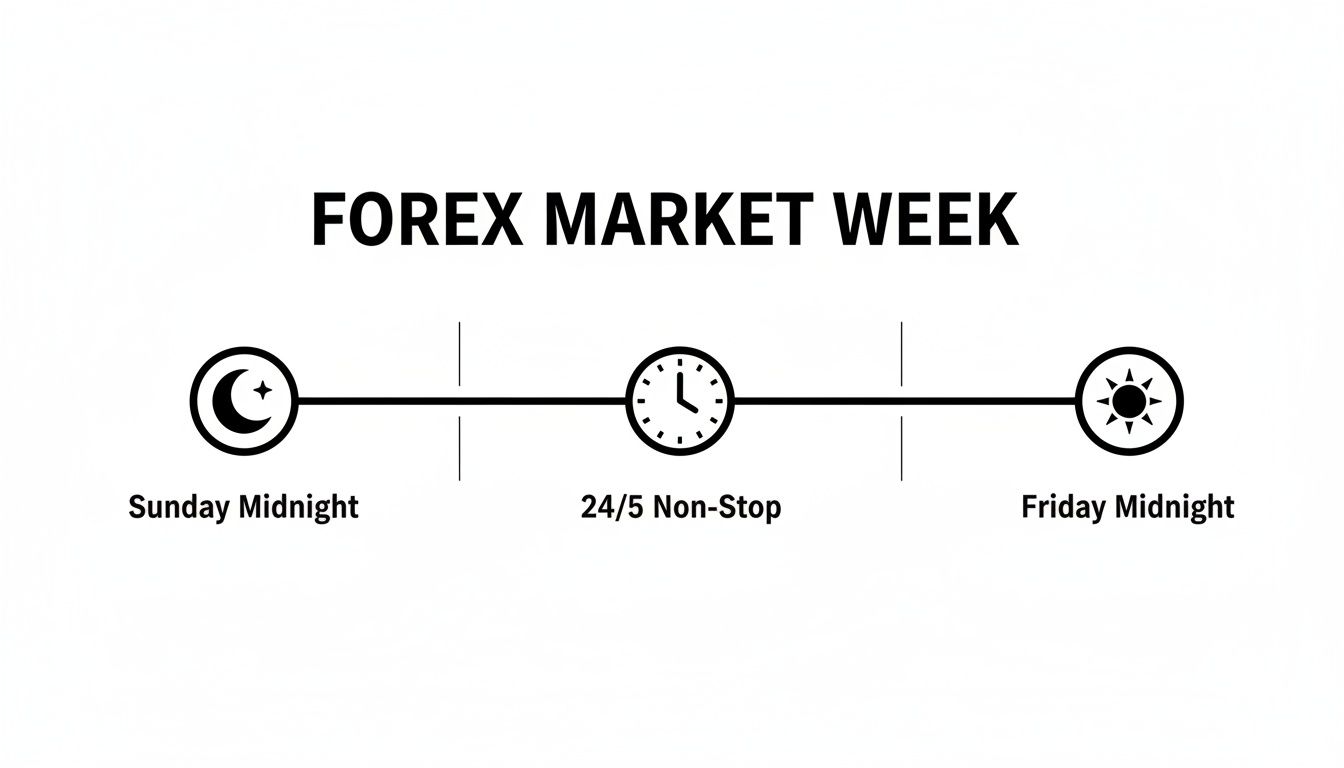
This constant handover from one region to the next means the market is always open for business, from the moment Sydney starts on Monday morning until New York closes on Friday evening.
Let's break down these sessions and what they mean for your business, all viewed from our local South African Standard Time (SAST) perspective. Remember, daylight saving in the Northern Hemisphere shifts these times slightly twice a year, which we'll cover.
The Global Forex Market Hours in South African Standard Time (SAST)
Here's a practical schedule that lays out the four key trading windows. It shows you when they operate in our local time (SAST), both during standard time and when daylight saving is active overseas, and highlights what to look out for in each.
| Session | Standard Hours (SAST) | Daylight Saving Hours (SAST) | Key Characteristics & Currency Pairs |
|---|---|---|---|
| Sydney | 23:00 - 08:00 | 22:00 - 07:00 | The official start of the trading week. It's relatively quiet, setting the initial tone. Watch: Australian Dollar (AUD), New Zealand Dollar (NZD). |
| Tokyo | 01:00 - 10:00 | 00:00 - 09:00 | The first major Asian hub to come online, bringing significant volume. Watch: Japanese Yen (JPY), AUD, NZD. |
| London | 10:00 - 19:00 | 09:00 - 18:00 | The world's FX epicentre. Volatility and liquidity spike as London opens. Watch: British Pound (GBP), Euro (EUR), Swiss Franc (CHF). |
| New York | 15:00 - 00:00 | 14:00 - 23:00 | The final session, dominated by the US Dollar. Major US economic news is often released at the start. Watch: US Dollar (USD) against all majors. |
This table is your cheat sheet for knowing which market is driving the action at any point in the South African business day. Understanding the overlaps, which we'll get into next, is where the real strategic advantage lies.
Sydney and Tokyo: The Asian Session
The trading week officially gets underway down under with the Sydney session. While it's the quietest of the four, it’s responsible for waking the market up after the weekend pause. A few hours later, the financial powerhouse of Tokyo joins in, injecting serious volume into Asian currency pairs.
During this window, currencies like the Japanese Yen (JPY) and the Australian Dollar (AUD) are in the spotlight. So, if your business needs to pay a supplier in Japan, executing that ZAR/JPY transaction during the early SAST morning aligns perfectly with peak liquidity, often resulting in a better rate.
London: The Global Forex Hub
Just as the Asian markets are starting to wind down, the behemoth awakens. The London session is the undisputed centre of the forex universe, handling a staggering 43% of all global forex transactions.
When London’s traders arrive at their desks, the market explodes with activity. Liquidity and volatility surge, and major European currencies like the Euro (EUR), British Pound (GBP), and Swiss Franc (CHF) experience their heaviest trading volumes. For any South African business with partners in Europe, the London session is your prime time.
A major advantage for us is that the London session (roughly 09:00 to 18:00 SAST during their summer) overlaps almost perfectly with our own business hours. This creates a convenient and highly liquid window to execute EUR or GBP payments without having to burn the midnight oil.
New York: The Final Powerhouse
The last leg of the daily relay belongs to New York. This session's opening overlaps with London's afternoon, creating the single most dynamic period of the trading day. Naturally, the New York session is all about the US Dollar (USD), the world's most dominant currency.
Crucial US economic data—like employment numbers or inflation reports—is typically released right at the start of the New York session, often causing immediate and sharp price movements across the board. The few hours when London and New York are both open are when the market is at its busiest and most liquid, offering the tightest spreads and the best pricing. This is the golden window for optimising your currency conversions.
Why Market Overlaps Are Your Best Opportunity
Think about the difference between a quiet suburban street at midday and the Sandton City food court on a Saturday afternoon. One has a slow, sleepy trickle of activity. The other is a hive of energy, buzzing with people coming and going.
In the world of foreign exchange, these market overlaps are the Sandton City of currency trading. They're the specific windows of time when two major financial centres are open for business simultaneously.
When these sessions overlap, trading volume and liquidity go through the roof. For any South African business making international payments, this surge of activity is a game-changer. It turns timing from a simple logistical detail into a powerful tool for saving money.
The Golden Hours for Forex Transactions
The most critical overlap for any business dealing in major world currencies is, without a doubt, the London-New York overlap. Ask anyone in the industry, and they'll tell you this is the "golden hour" of the forex day. And for good reason.
London is the world's largest forex hub, with New York hot on its heels. When their trading floors are both active, the market hits its absolute peak. This creates the best possible conditions for exchanging currency.
- Higher Liquidity: With so many participants buying and selling, it’s much easier to execute large transactions without accidentally pushing the price against you.
- Tighter Spreads: The spread is simply the small difference between the buy and sell price of a currency. When liquidity is high, competition forces this gap to narrow, which translates directly into lower costs for your business.
- Reduced Slippage: Slippage is what happens when the price you get is different from the price you expected when you clicked the button. In a deep, liquid market, orders are filled instantly and accurately, keeping this risk to a minimum.
For a South African business, this golden window typically falls between 15:00 and 18:00 SAST during the Northern Hemisphere's summer.
Capitalising on Peak Market Activity
This isn't just theory; it has a real impact on your bottom line. Timing a large payment to an American supplier to coincide with this overlap can make a substantial difference. The transaction simply becomes more efficient when both the USD and European currency markets are at their most active.
For a CFO, the difference between executing a $100,000 payment at 11:00 SAST versus 16:00 SAST can mean hundreds or even thousands of rands saved, purely because of better spreads and rate stability.
Here in South Africa, the London-New York session overlap from 3:00 PM to 6:00 PM SAST is the undisputed peak of the forex trading day. It delivers the highest liquidity because these two giants—which together handle over 60% of all global trades—are running at full steam. This makes it prime time for major currency pairs like EUR/USD and, crucially for us, USD/ZAR.
For South African exporters and importers using Zaro, this 15:00-18:00 SAST slot is the sweet spot for making cost-effective international transfers. The tighter spreads and massive volume mean you get a better, more reliable rate with minimal slippage. It’s a smart way to bypass the unpredictable costs banks often pass on during more volatile, less liquid times of the day. You can find more details about this in guides on the best forex trading times from industry experts.
Ultimately, understanding and using these forex hours to your advantage transforms a routine payment into a strategic financial win. It’s about protecting your profits from unnecessary currency exchange costs, one well-timed transaction at a time.
How Local Hours and Holidays Can Make or Break Your Deal
While the forex market runs on a global clock, it's the local details that often trip businesses up. Knowing how South African business hours and international public holidays fit into the bigger picture can be the difference between a great deal and an expensive mistake.
For South African businesses, our standard workday lines up perfectly with one of the most important trading windows in the world. This gives us a natural sweet spot for handling any transactions involving European currencies.
Your Prime Time for European Transactions
In South Africa, our local forex market is generally open from 9:00 AM to 5:30 PM SAST on weekdays. This schedule doesn’t just match our business hours; it plugs us directly into the massive London session, which runs from about 9:00 AM to 6:00 PM our time.
This is a huge advantage. It means if you're paying a supplier in Germany or receiving payment from a client in France, you're doing it when the EUR and GBP pairs are at their most active. We're talking peak liquidity and the tightest spreads, which translates to better rates for you. You can find more detail on this alignment by exploring these insights on local market times.
You don't need to burn the midnight oil or set a pre-dawn alarm to get a good rate on your European payments. The best time to act is right in the middle of your normal workday.
The Hidden Trap of Public Holidays
Now, this is where things can get tricky. When South Africa has a public holiday, like Freedom Day, the global forex market doesn't stop. The wheels keep turning in London, New York, and Tokyo. The catch? Your local bank is closed, which means your transaction won't be settled until the next business day.
The real danger, however, is when the bank holidays are happening overseas.
A bank holiday in the UK or the US can be a costly trap for the unprepared. The market is technically still open, but with all the major players offline, liquidity completely dries up. This leads to wider spreads and unpredictable price swings—making it a terrible time to execute a large payment.
Think of it like trying to buy fruit at a farmer's market just as it's closing. The few vendors left know you have limited options, so they can charge a premium. The same thing happens in the forex market on a major international holiday.
To avoid this trap, always have one eye on the public holiday calendars for the countries you're dealing with. A simple bit of planning—scheduling your major transfers to avoid these key dates—is one of the most effective ways to protect your bottom line from poor rates and nasty surprises.
Turning Market Hours into a Business Advantage
Knowing the theory is one thing, but how do you actually use this information to save your business real money? Let's translate this understanding of market hours into a practical playbook for timing your international payments.
Think of it this way: every single transaction has a best-case window. By lining up your activity with these times, you can start treating your currency conversions with the same strategic focus you apply to the rest of your operations. It’s a simple shift that can protect your margins from slipping away.
A Practical Playbook for South African Businesses
Here are a few common scenarios and the timing strategies that work best, specifically for businesses operating in South Africa.
Bringing US Dollars Home (Exporters): If you've been paid in USD and need to convert that revenue back into Rand, the sweet spot is the London-New York overlap. Aim to process these conversions between 15:00 and 18:00 SAST. This is when liquidity for the USD/ZAR pair is at its absolute peak, meaning spreads are at their tightest. You'll simply get more Rand for your Dollars.
Paying European Suppliers (Importers): Need to send Euros to a supplier in Germany or Italy? The London session is your best friend. Look to execute your ZAR to EUR payments during the South African morning, ideally between 09:00 and 12:00 SAST. This taps you directly into the deep liquidity of the European market, giving you access to more stable rates and efficient processing.
Shifting a large payment from a quiet time to a high-volume overlap can genuinely secure a better rate. That small adjustment in timing flows directly through to your cost of goods and, ultimately, your bottom line.
Knowing When to Hit Pause
Smart timing isn’t just about seizing opportunities; it's also about avoiding costly mistakes. Some moments in the market are simply riskier than others. Sometimes, knowing when not to act is the most valuable strategy of all.
One of the biggest pitfalls? Rushing large, non-urgent payments as the weekend approaches.
The Friday Afternoon Trap
Pushing through a significant international payment late on a Friday is a surprisingly common, and risky, habit. As traders in New York start closing their books for the weekend, liquidity drains from the market at an astonishing rate.
This "thin market" creates a trifecta of problems:
- Wider Spreads: Fewer buyers and sellers mean the gap between the bid and ask prices widens. Your transaction instantly becomes more expensive.
- Sudden Volatility: With less trading volume to absorb orders, even a medium-sized transaction can cause the market to jump unexpectedly against you.
- Settlement Risk: A payment made late on a Friday might not actually settle until Monday. This leaves your money exposed to any major news that could break over the weekend, from political events to economic announcements.
Unless a payment is absolutely time-critical, you are almost always better off waiting for Monday morning. The market reopens with fresh liquidity and a clean slate. This simple discipline prevents you from getting caught in the unpredictable churn of a market winding down for the weekend, giving you far more control over the final cost.
How to Sidestep FX Timing Headaches and Hidden Costs
Getting a handle on forex market hours certainly gives your business a strategic edge. But let's be realistic—manually tracking session overlaps and trying to time every single payment is a huge operational drag. Your finance team has better things to do.
The good news is that you don't have to play this game anymore. Instead of constantly watching the clock, modern financial tools can build the benefits of smart timing right into the way you transact. The focus shifts from trying to time the market to simply getting the best possible rate, whenever you need it.
Getting the Real Exchange Rate
The real kicker with traditional international payments isn't just about timing; it's the hidden costs. Banks typically bake a significant markup, or spread, into the exchange rate they quote you. This means you're almost never getting the true market rate, no matter how perfectly you schedule your transaction.
This is where a platform like Zaro changes the game. It provides direct access to the real, zero-spread exchange rate—the very same rate banks use when they trade with each other.
By cutting out hidden markups, you guarantee you get the maximum value from every conversion. You're immediately protected from the inflated costs that silently chip away at your bottom line, particularly on larger transactions.
From Complex Timing to Confident Execution
This approach completely reframes how you manage international payments. The goal is no longer to become a forex trading expert. It’s about using a system that delivers transparency and fairness, 24/7.
This frees you up to:
- Pay with confidence: You know you're getting the genuine market rate, without any hidden fees.
- Dodge expensive SWIFT fees: Say goodbye to the extra charges that traditional banks tack onto international transfers.
- Gain control and predictability: Your FX process stops being a costly variable and becomes a smooth, efficient part of your financial operations.
Ultimately, this lets your business step away from the complex and costly game of market timing. It offers a simple, direct route to real savings and much greater efficiency.
Common Questions About Forex Trading Hours
Let's tackle some of the practical questions that often come up for South African business owners and finance managers. These are the real-world queries we hear all the time, and getting them right can make a big difference to your bottom line.
What Happens on a South African Public Holiday?
While you might be enjoying a braai, the global forex market keeps churning. A local holiday here in South Africa doesn't stop the rest of the world from trading.
The main issue is that your local bank will be closed. This means that while the forex conversion might happen, the actual settlement of your payment could be delayed until the next business day. What you really need to watch out for are major public holidays in financial centres like London or New York. If Wall Street or the City of London takes a day off, trading volume can dry up, leading to wider spreads and making it a tricky day to execute large transactions.
Is Morning or Afternoon Better for Payments?
For the big currency pairs—anything involving the US Dollar or the Euro—the afternoon is usually your best bet.
The sweet spot is typically between 15:00 and 18:00 SAST. This is when the European trading day is winding down just as the North American session is in full swing. The overlap between the London and New York markets creates a surge in activity.
This period of peak liquidity generally means you'll find the tightest spreads and, consequently, a better exchange rate for your business. More buyers and sellers in the market at the same time creates better pricing for everyone.
How Do I Handle Urgent Payments Outside Optimal Hours?
Let's be realistic—business doesn't always wait for the perfect market window. Sometimes a payment simply has to be made right now, even if it's during a quieter, less liquid period.
When you're caught in this situation, the goal is to use a service that insulates you from the higher costs that typically come with it. A platform that gives you the real, mid-market exchange rate without adding a markup is your best defence. It protects you from the inflated rates banks often apply during these quieter times, ensuring your urgent payment doesn't get hit with an unexpected financial penalty.
Stop losing money to hidden markups and poorly timed payments. With Zaro, you get the real exchange rate, zero SWIFT fees, and the power to make intelligent, cost-effective international transfers anytime. See how much you can save with Zaro.