
If you’ve ever dipped your toes into the world of forex trading, you’ve almost certainly come across the term ‘pip’. It’s one of those fundamental concepts that every trader needs to get to grips with, as it’s the bedrock for measuring your success.
So, what exactly is a pip? Standing for 'Percentage In Point', a pip is simply the smallest standard amount a currency pair’s price can change. It’s the basic unit we use to tally up profits and losses on any given trade.
What Are Pips and Why Do They Matter?

Think of it like this: a pip is to a currency pair what a single centimetre is to a metre. It's a tiny, standardised increment that allows traders all over the world to talk about price movements in a consistent way, no matter which currency they’re trading.
For most currency pairs, including popular ones in South Africa like the USD/ZAR, a pip is the change in the fourth decimal place (0.0001). So, if the USD/ZAR exchange rate moves from 18.5000 to 18.5001, that’s a one-pip jump. Simple as that.
There's a notable exception for pairs involving the Japanese Yen (JPY), where a pip is measured at the second decimal place (0.01).
Here’s a quick reference table to make that crystal clear.
Quick Pip Overview for Major Currency Pairs
| Currency Pair Type | Standard Pip Decimal Place | Example Price Movement |
|---|---|---|
| Most Pairs (e.g., EUR/USD, GBP/USD, USD/ZAR) | The 4th decimal place (0.0001) | 1.1205 to 1.1206 = 1 pip |
| Japanese Yen Pairs (e.g., USD/JPY, EUR/JPY) | The 2nd decimal place (0.01) | 109.75 to 109.76 = 1 pip |
This table shows how pips are consistently measured, making it easier to standardise your trading approach across different markets.
The Foundation of Profit and Loss
Getting your head around pips is non-negotiable because every single profit or loss calculation starts here. Before you can even think about the rands and cents, you have to measure the market’s movement in pips.
This makes the concept absolutely critical for:
- Risk Management: You'll set your stop-loss orders based on how many pips you're willing to risk on a trade.
- Profit Targets: Your take-profit levels are also set in pips, determining when you’ll cash out.
- Position Sizing: The value of a single pip changes depending on your trade size, which directly impacts your potential return.
In South African Forex trading, the value of a pip is what translates market movement into actual money. For a standard lot (100,000 units) in a USD-based pair, one pip is typically worth around $10. For pairs involving the Rand, this value will naturally fluctuate with the current exchange rate. You can learn more about how the value of a pip is defined on IG.com.
The core idea is simple: a positive pip movement in your favour means a potential profit, while a negative movement signals a potential loss. Every trading strategy, from quick scalping to long-term holds, is ultimately measured by the number of pips captured.
How to Calculate the Value of a Pip
Knowing what a pip is gets you started, but the real power comes from understanding what it's worth in real money. Figuring out a pip’s value isn't just a mental exercise—it’s the core of managing your risk and sizing up the potential profit or loss on every single trade.
The actual ZAR value of one pip isn't a fixed number; it's a moving target influenced by three things:
- The currency pair you're trading.
- Your trade size, also known as the lot size.
- The current exchange rate at that precise moment.
It might sound complicated, but it boils down to a simple bit of maths.
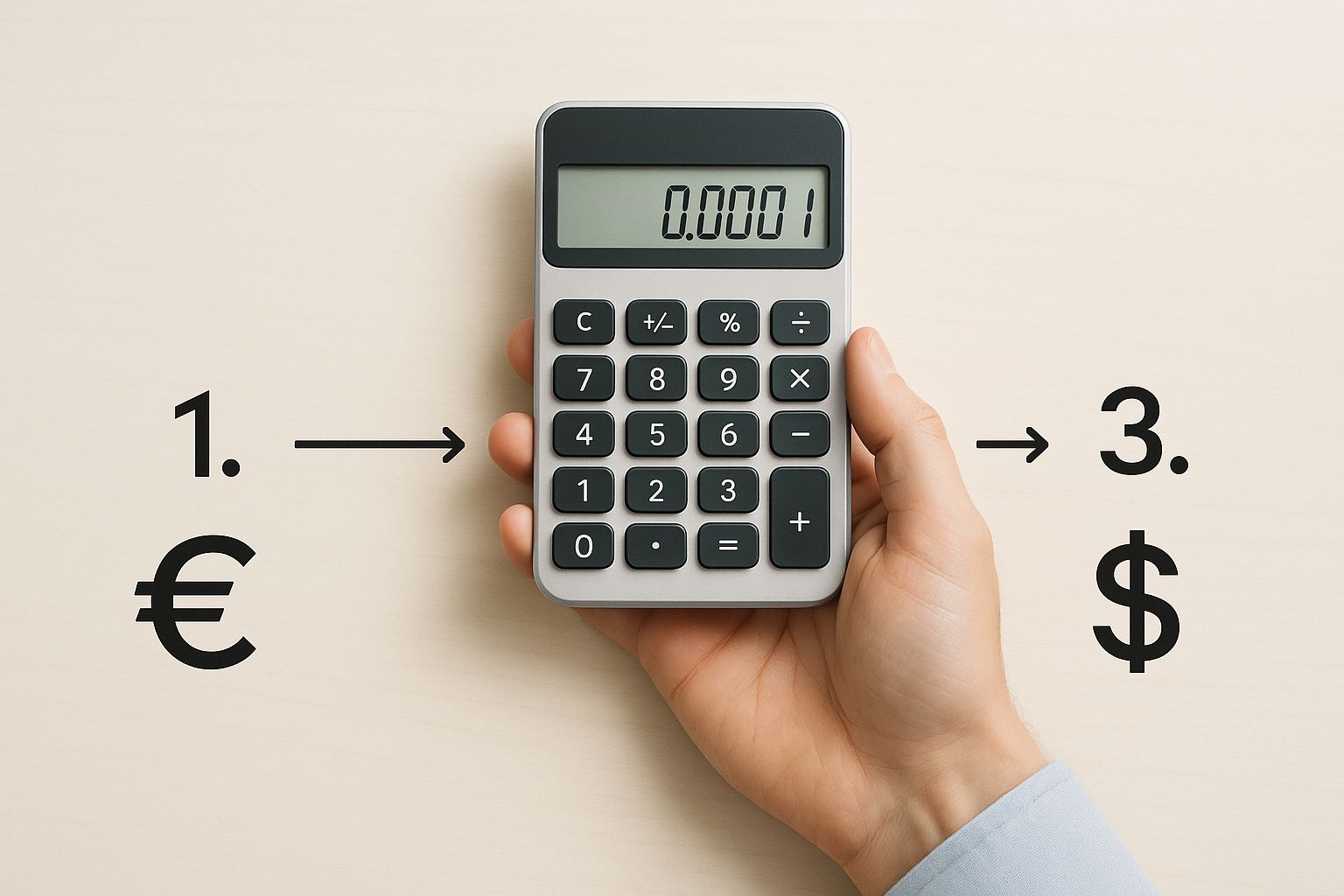
This image nails the starting point for almost every calculation: that tiny 0.0001 unit of movement.
Putting the Formula into Practice
Let's break it down with the standard formula: Pip Value = (One Pip / Exchange Rate) x Lot Size.
Say you're looking to trade the popular EUR/USD pair. You decide to open a standard lot, which is 100,000 units of the base currency, and the exchange rate is sitting at 1.0700.
Here’s how the numbers crunch:
- One Pip: We start with 0.0001.
- Divide by Exchange Rate: 0.0001 / 1.0700 = 0.00009345
- Multiply by Lot Size: 0.00009345 x 100,000 = €9.35
So, for this trade, every single pip of movement is worth €9.35.
If you want that in US dollars, just multiply it by the exchange rate: €9.35 x 1.0700 gives you $10.00.
Key Takeaway: Here’s a handy shortcut. For any pair where the USD is the second currency listed (the quote currency), like EUR/USD or GBP/USD, a one-pip move on a standard lot will always be worth $10. It’s a great rule of thumb for quick calculations.
Of course, in South African Forex trading, things get a bit more dynamic. If you trade a mini lot (10,000 units) of USD/ZAR when the rate is 18.50, each pip is worth about $1. But its value in ZAR will shift as the Rand itself strengthens or weakens—a reality we saw clearly during the Rand’s depreciation against the USD in 2022. For a deeper dive, you can find more details explaining how pips are calculated on sashares.co.za.
Connecting Lot Sizes to Your Profit and Loss

So, you understand what a pip is, but how does that tiny price movement translate into actual rands and cents in your account? The answer lies in your lot size.
Think of your lot size as the volume control for your trade. It determines how much of a currency you're buying or selling, and it directly scales the financial impact of every single pip movement. Getting a handle on lot sizes is crucial; without it, knowing what a pip is gives you only half the picture.
It's a bit like betting on a horse race. Two people can back the same winning horse, but the one who placed a larger bet walks away with a much bigger payout. In trading, the market movement is the horse, and your lot size is the size of your bet.
The Three Main Lot Sizes
In the forex market, you’ll generally encounter three standard lot sizes. This flexibility allows traders of all levels, from beginners with small accounts to seasoned pros, to manage their risk effectively.
Each lot size corresponds to a set number of currency units:
- Standard Lot: This is the big one—100,000 units of the base currency. Trading standard lots means each pip move has a significant financial impact, offering the highest potential for both profit and loss.
- Mini Lot: A mini lot is one-tenth of a standard lot, coming in at 10,000 currency units. It's a popular middle-ground, often favoured by traders who have moved beyond the basics.
- Micro Lot: The smallest of the three, a micro lot represents just 1,000 units. It's the perfect starting point for new traders, allowing you to get a feel for the live market without taking on substantial financial risk.
Let's see how this works with a quick example. Imagine you’re trading the USD/ZAR pair, and the market moves 20 pips in your favour. The amount you earn depends entirely on the lot size you chose for that trade.
A 20-pip gain on a micro lot might earn you a small R37, while the same move with a standard lot could net you R3,700. The market movement was identical; your position size made all the difference.
This is a powerful illustration of why understanding your position size is just as important as correctly predicting which way the market will go. It's the core of effective risk management.
Pips vs. Pipettes: Getting to Grips with the Fifth Decimal
Just when you think you’ve got a handle on pips, you’ll probably notice something a little strange on your trading platform: a currency pair quoted with five decimal places instead of the usual four.
That tiny extra digit can throw you for a loop at first, but it’s just a smaller, more precise unit of measurement called a pipette.
Think of it this way: if a standard pip is a rand, a pipette is the 10-cent piece. It's simply one-tenth of a pip. This extra precision allows brokers to offer tighter spreads and show price movements in much finer detail.
How to Spot the Difference on Your Chart
Let's break it down with a real-world example. Say you see the EUR/USD pair priced at 1.07525.
- The main digits, 1.0752, represent the pips. This is the part you'll focus on most.
- That small, final digit, the 5, is the pipette.
So, if the price moves from 1.07525 up to 1.07535, that’s a move of one full pip. But if it only inches up from 1.07525 to 1.07526, that's a change of just one pipette.
While pipettes offer that extra layer of pricing accuracy, it's the full pips that really matter for your bottom line. Your profit and loss calculations are almost always based on whole pips. It's useful to know what that fifth digit is, but your focus should stay firmly on the pip, as it's the standard unit that truly counts in your trading.
Using Pips to Build Your Trading Strategy
Knowing what a pip is is the easy part. The real skill comes from using them to make smart, disciplined trading decisions. For seasoned traders, pips aren't just a way to track profits and losses; they're the bedrock of their entire trading strategy, especially when it comes to managing risk.
Instead of thinking in rand terms like, "I'm willing to lose R1,000 on this trade," a strategist thinks in pips: "My stop-loss is going 50 pips below my entry point." This simple shift from money to pips helps detach emotion from your decisions and forces you to be consistent.
Your strategy becomes a clear, repeatable plan based on how the market is actually moving, not on the fluctuations of your account balance.
Setting Stop-Loss and Take-Profit Orders
The two most important orders you'll ever place are your stop-loss and take-profit. A stop-loss is your safety net—it automatically closes a losing trade at a predetermined level, protecting you from a major financial hit. A take-profit does the opposite, locking in your gains once the price hits your target.
Both of these should be set in pips. Let's run through a real-world example with the EUR/ZAR pair.
Say you've done your homework and decide to buy EUR/ZAR at 20.5000. Your personal strategy demands a risk-to-reward ratio of at least 1:3, and you've decided you're willing to risk 50 pips on this trade.
Here's how you'd set your orders:
- Your Stop-Loss Calculation: You'd place your stop-loss order 50 pips below your entry price.
- 20.5000 - 0.0050 = 20.4500 (This is your get-out point if the trade goes south).
- Your Take-Profit Calculation: With a 1:3 ratio, you're targeting a profit of 150 pips (50 pips x 3).
- 20.5000 + 0.0150 = 20.5150 (This is where you'll cash in if you're right).
By defining your exit points in pips before you even click "buy," you create a clear, disciplined plan. You know exactly what has to happen for your analysis to be proven wrong (a 50-pip loss) or right (a 150-pip gain), which takes all the emotional guesswork out of the equation.
A solid grasp of wider economic events is also vital here. Things like announcements about the central bank's interest rate decisions can trigger huge pip movements in a matter of minutes. Knowing this helps you set far more realistic and informed stop-loss and take-profit targets, rather than just guessing.
Example Risk-to-Reward Scenarios in Pips
The table below shows how different risk-to-reward ratios work in practice. By defining your risk in pips first, you can easily calculate your profit target, creating a logical framework for every trade you take.
| Risk-to-Reward Ratio | Risk (Stop-Loss in Pips) | Reward (Take-Profit in Pips) | Trade Outcome Goal |
|---|---|---|---|
| 1:1 | 25 Pips | 25 Pips | Breakeven or better |
| 1:2 | 50 Pips | 100 Pips | Double the risk |
| 1:3 | 40 Pips | 120 Pips | Triple the risk |
| 1:5 | 20 Pips | 100 Pips | Significant gain |
As you can see, a higher ratio means your potential reward is much greater than your initial risk. This is a cornerstone of long-term, profitable trading—it means you don't have to win every single trade to come out ahead.
Still Got Questions About Pips? Let's Clear Them Up
Once you've wrapped your head around the basics, a few more practical questions usually pop up. It's totally normal. To make sure you're feeling confident, let's walk through some of the most common things new traders ask about pips.
How Many Pips Should I Aim for in a Day?
Ah, the million-dollar question. But honestly, there's no magic number. A "good" daily profit isn't about hitting a specific pip count; it's about whether your strategy is working. Your trading style, how much risk you're comfortable with, and how much the market is moving all play a massive role.
The real goal is consistency and making sure your potential wins are bigger than your potential losses.
- A scalper, who jumps in and out of the market quickly, might only bank 5-10 pips per trade but make dozens of them in a day.
- A day trader could be perfectly happy with 20-50 pips from a single, well-planned trade.
- A swing trader, holding a position for several days, might be looking for a much larger move of 100+ pips.
Instead of getting fixated on a daily target, focus on your risk-to-reward ratio. A strategy where you consistently risk 20 pips to make 40 pips (a 1:2 ratio) is far more sustainable in the long run than chasing a random number.
Can a Pip's Value Change While My Trade Is Open?
Yes, and this is a really important point for South African traders. If your account is in ZAR but you’re trading a pair like EUR/USD, the value of each pip is constantly shifting in Rand terms.
Here’s why: your profit or loss is happening in US dollars. When you close that trade, those dollars have to be converted back into Rand at whatever the current USD/ZAR exchange rate is. If the Rand has strengthened or weakened against the dollar while your trade was open, the final amount that lands in your account will be different from your initial calculation.
Key Insight: This currency conversion means your final ZAR profit might be a bit higher or lower than you expected. It’s a good reminder of why managing your exposure across different currencies is so important.
Is the Term "Pip" Only for Forex?
Pretty much, yes. The word "pip" is forex lingo. However, the idea behind it—having a standard minimum unit of price movement—is universal across all financial markets. They just use different names for it.
- Stocks: The smallest move is measured in cents.
- Indices and Commodities: You’ll often hear this called a "tick" or a "point".
So, when you hear that an index has moved up by 10 points, it's the exact same principle as a currency pair moving 10 pips. It’s all about having a standardised way to measure price changes and calculate profit and loss.
Why Are Japanese Yen (JPY) Pairs Quoted Differently?
This one is less about a complex financial rule and more about simple practicality. Because the Japanese Yen has a very low value compared to other major currencies, quoting pairs like USD/JPY to four decimal places would be clumsy.
For these pairs, the price is quoted to two decimal places, and the second decimal is the pip. A move from 110.45 to 110.46 is a one-pip move. If we tried to use the standard four decimals, the price would look something like 110.4500, which is just unwieldy. The two-decimal system is just a cleaner, long-established convention for pricing Yen pairs.
For South African businesses managing international payments, understanding exchange rate movements is vital. Zaro helps you bypass the complexities and high costs of traditional forex transactions. With real exchange rates, zero spread, and no hidden fees, you can send and receive global payments with complete clarity. Take control of your cross-border finances by visiting https://www.usezaro.com.