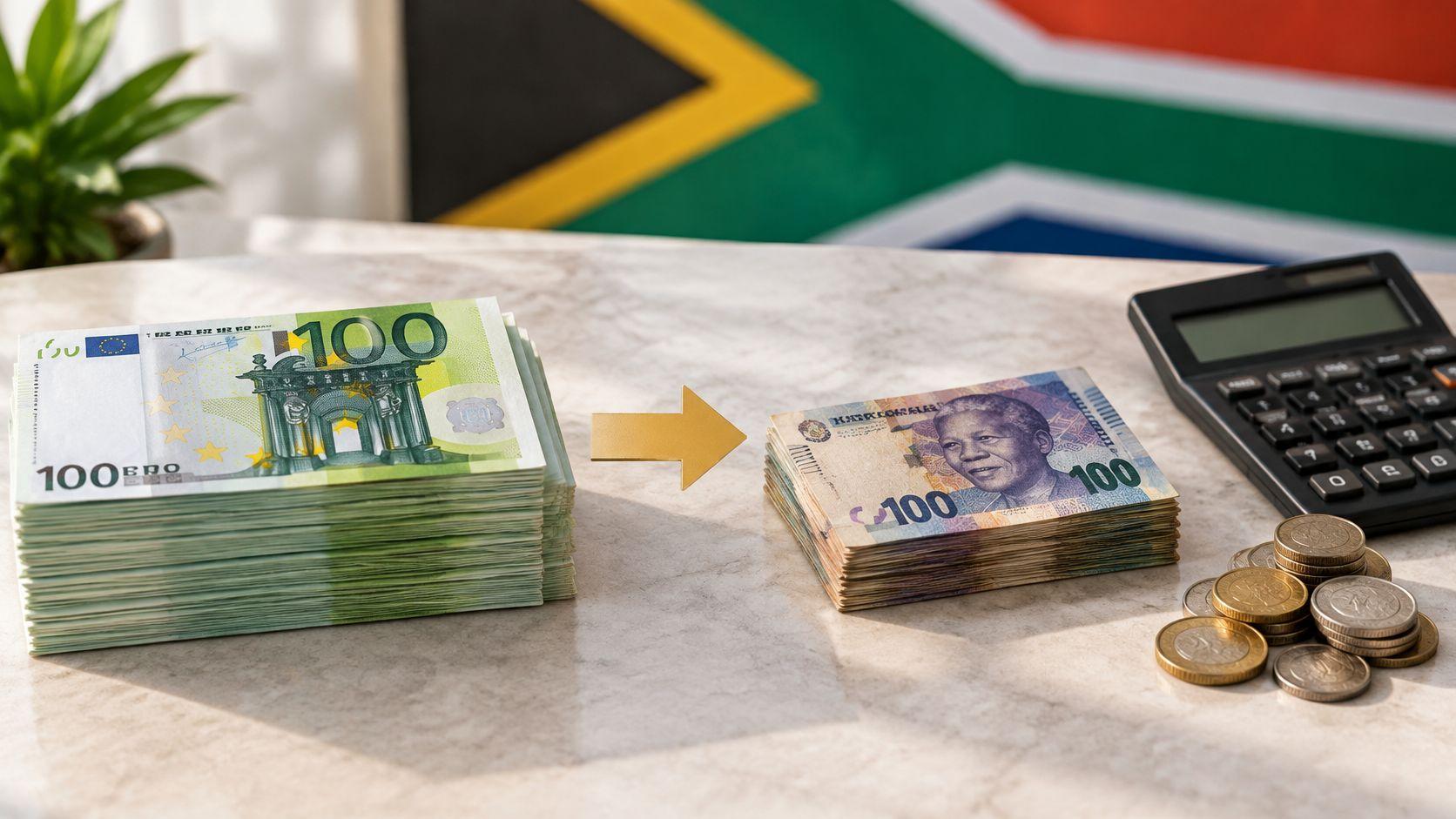
One thousand euros is worth about R18,500 at recent reference rates, and through 2026 the same sum has ranged from roughly R18,400 to R20,500 before any charge. The rand that reaches the recipient is lower once the provider's spread and the fixed fees come off.
That swing is large enough to change a supplier payment or an export receipt. The South African Reserve Bank's January 2026 monthly release reported average rand-per-euro figures of R20.4864, R20.1210, R19.9180 and R19.7260, so €1,000 sat between R20,486.40 and R19,726.00. The gap is R760.40, about 3.7% of the highest conversion, before any bank charge. The same set of observations lists the rand per euro at R18.4581 on 6 November 2026, which values €1,000 at R18,458.10 before transaction costs. A converter that prints only a mid-market number hides both that movement and the charges that follow.
Exporters, importers and firms paying European contractors need the rand that lands on a named day. The figures below are the official ceiling. The amount in the account is what remains after spread and fees.
What 1,000 Euros Is Worth in Rand Today
The South African Reserve Bank's May 2026 monthly release put average rand-per-euro rates at R19.1046, R18.9150, R19.3404 and R19.3531. At those rates, €1,000 equals R19,104.60, R18,915.00, R19,340.40 and R19,353.10, before bank charges, spreads or transfer fees. The lowest and highest of those values differ by R438.50, more than 2.3%, only because the reporting period changed.
Reference values before any fee
| Source and period | Rand per euro | Value of €1,000 before fees |
|---|---|---|
| SARB monthly release, May 2026, period 1 | 19.1046 | R19,104.60 |
| SARB monthly release, May 2026, period 2 | 18.9150 | R18,915.00 |
| SARB monthly release, May 2026, period 3 | 19.3404 | R19,340.40 |
| SARB monthly release, May 2026, period 4 | 19.3531 | R19,353.10 |
| SARB monthly release, January 2026, period 1 | 20.4864 | R20,486.40 |
| SARB monthly release, January 2026, period 2 | 20.1210 | R20,121.00 |
| SARB monthly release, January 2026, period 3 | 19.9180 | R19,918.00 |
| SARB monthly release, January 2026, period 4 | 19.7260 | R19,726.00 |
| SARB daily observation, 6 November 2026 | 18.4581 | R18,458.10 |
| ECB euro reference rate, 6 November 2026 | 18.4649 | R18,464.90 |
Every row is a mid-market or statistical reference, not a payout. Treat it as a ceiling. These SARB averages are official monetary statistics, not a payment firm's promotional rate, so they are a neutral yardstick for euro invoices and receipts. They still are not the quote you will be asked to accept.
Three rate conventions you will meet
Exchange rates move with the market, so the rand value of 1000 euros to rands is a snapshot. Readers usually meet three conventions, and mixing them is how two "correct" answers disagree by hundreds of rand.
- Daily reference rate: The reading published for one calendar day. Use it when you are checking a settlement that happened on that day.
- Monthly average: The official statistics figure for a reporting period. It smooths the days inside that period, which is why the May rows do not match one another.
- Provider quote: The rate a bank or payment firm will apply. It is the only convention that belongs on a payment you are about to confirm.
Practical rule: Write down the source, the date and the rate type before you use any figure to compare transfer offers.
Say a Cape Town studio invoices a German client for €1,000 on two dates in the same quarter. Book a monthly average and the rand revenue looks steady. Book each settlement-day rate and the two receipts can differ by several hundred rand even though the euro fee on the invoice never changed. For an importer paying a European supplier, that same movement changes how many rand must be in the account on the morning of the transfer. If a salesperson shows a converter screenshot and cannot name the day and the rate type, you do not yet have a number you can put in the books.
Why You Receive Less Than the Quoted Amount
"Why did I receive less than the advertised value for €1,000?" The number on the screen was usually a mid-market or reference rate, not the rate a South African business can deal at. Recent reference data placed €1,000 at roughly R18,400 to R18,600, with the European Central Bank euro reference rates recording EUR/ZAR at R18.4649 on 6 November 2026 and a converter showing R18,396.52 at its mid-market rate. The shortfall is the spread, the fixed transfer charge, intermediary-bank deductions and the receiving bank's fee.
A 1% spread reduces the proceeds by about R184 at an R18.40 rate, before any flat charge. Standard Bank's 2026 pricing guide lists a R50 business-online transfer fee and R121 where manual intervention is required. Those two amounts show that the displayed FX result is not the final settlement amount.
Charges that come off before the rand lands
| Fee or markup | How it is charged | Effect on €1,000 at R18.40 |
|---|---|---|
| Exchange-rate spread | Added to the reference rate, so fewer rand per euro | About R184 for each 1% of spread |
| Fixed transfer fee | Flat charge per payment, for example R50 for a business online transfer | R50 whatever the amount |
| Manual intervention fee | Charged when a payment needs staff handling, for example R121 | R121 on that payment |
| Intermediary-bank deduction | Correspondent bank takes a fee before settlement | Subtract the correspondent fee the banks name for that payment |
| Receiving-bank fee | Charged by the South African bank that credits the account | Subtract the credit fee that bank states for the incoming payment |
The "cheapest" provider may not be the one with the lowest advertised fee. A zero-fee transfer with a 1% spread can cost more than a transparent fee paired with a rate close to the reference. You need three numbers on every quote: the reference-rate value, the provider's applied rate, and all fixed or correspondent fees. Ask for each charge in writing before you confirm. If a correspondent will not name its deduction, that line is unfinished, not zero.
How to Calculate the Rand Amount You Will Receive
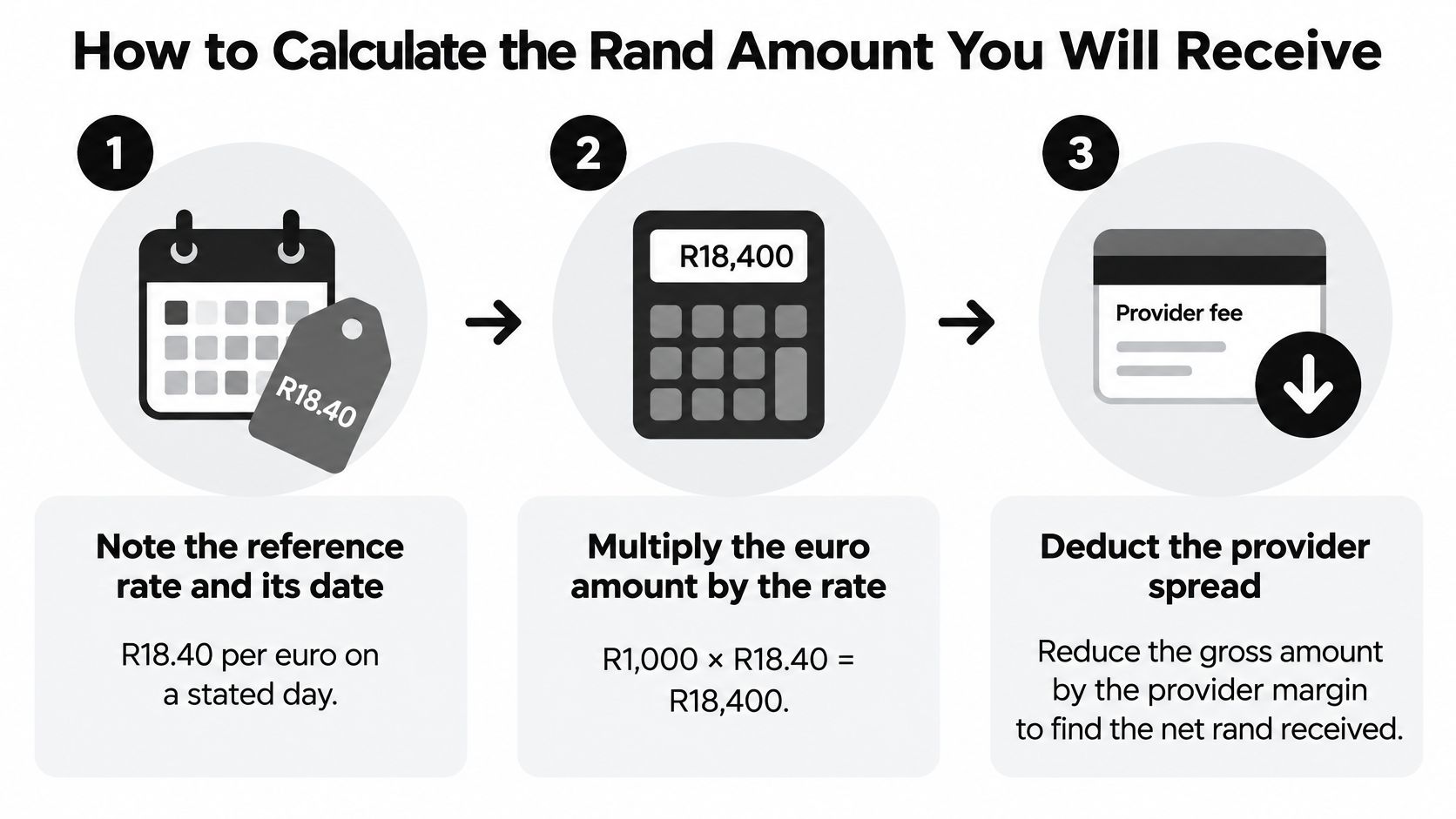
Work one payment of €1,000 at a stated reference of R18.40 per euro. Each step exists so you do not book the ceiling as if it were cash.
- Note the reference rate and its date. Write R18.40 and the day it was taken. Without the date you cannot tell a live quote from an older average.
- Multiply the euros by that rate. €1,000 × R18.40 gives R18,400. This gross figure is the ceiling, not the receipt.
- Deduct the spread the provider applies. At 1%, R184 comes off and R18,216 remains. The usual slip is treating R18,400 as money received, which overstates the receipt by the full spread.
- Deduct every fixed fee. A R50 transfer fee leaves R18,166. A flat fee does not shrink just because the euro amount is modest, so on €1,000 it is a visible slice.
- Deduct any intermediary or receiving-bank charge. If nobody has stated it, write "unknown" rather than zero. An unknown line means the sum is not finished.
- Keep the set together. Reference rate, applied rate, each fee and the settlement date belong on one note, so you can match them to the bank statement.
A correct result sits a little under the reference value, and every deduction is on the page. One lonely number is a slogan, not a settlement.
The same three moves, rate, multiplication and the margin taken off, are walked through in the clip below.
Cheapest Advertised Fee Is Not Always the Cheapest Rand
A transfer that advertises no fee can leave you with fewer rand than one that charges R50. On the same €1,000, at a reference rate of R18.40, the spread often costs more than the fee line people shop on.
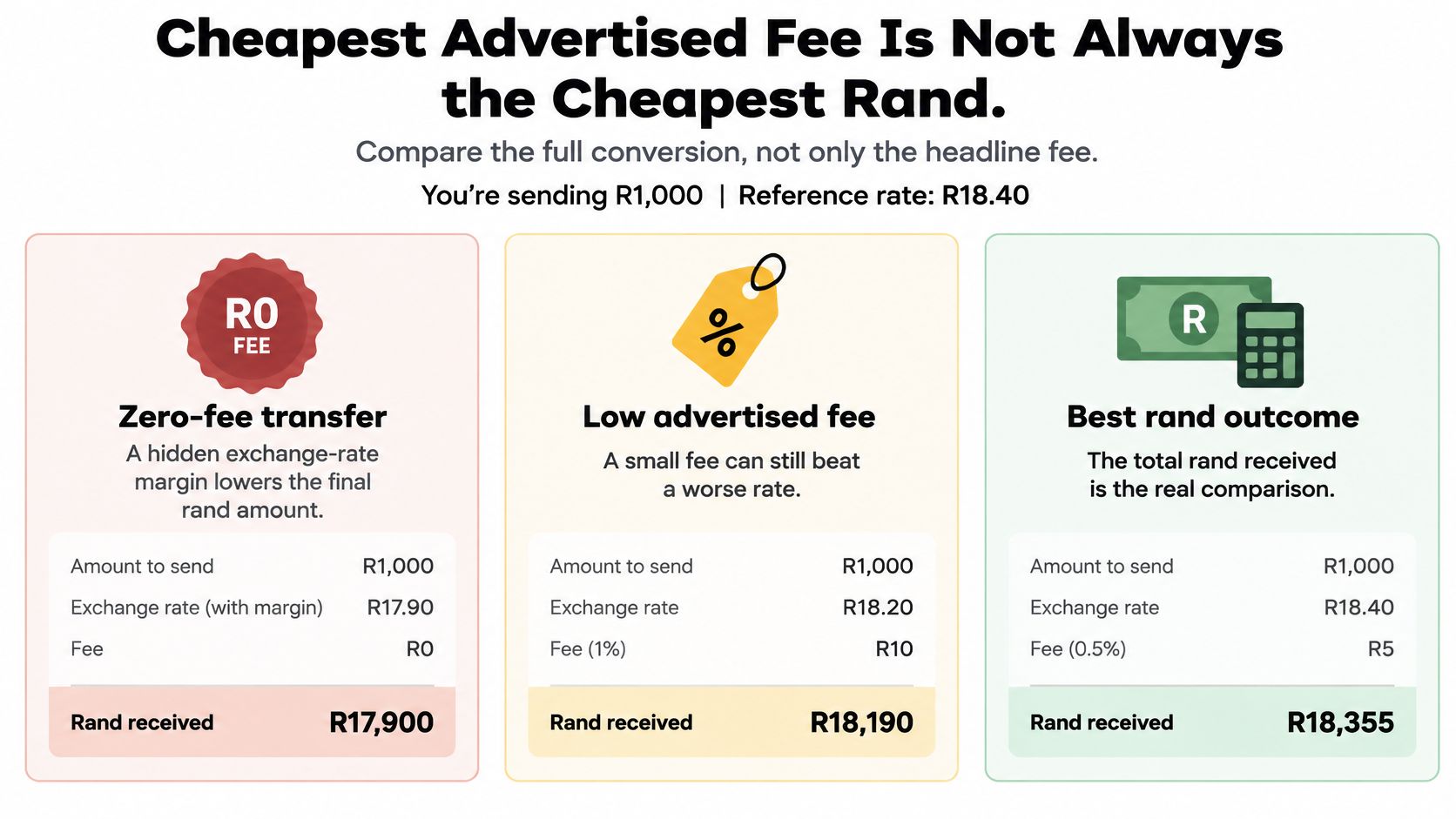
These three rows are illustrative assumptions, not quoted prices. They show the arithmetic so you can drop a real quote into the same columns.
| Transfer option (illustrative) | Spread | Fixed fee |
|---|---|---|
| Zero-fee transfer | 1% | R0 |
| Transparent fee with near-reference rate | 0.2% | R50 |
| Bank transfer with manual handling | 1.5% | R121 |
Run the rand. The zero-fee option delivers R18,216.00. The transparent R50 option, after a 0.2% spread, delivers R18,313.20. The bank option, after a 1.5% spread and the R121 handling charge, delivers R18,003.00. The zero-fee route is about R97 worse than the transparent one, because the margin is the larger cost.
To substitute a live quote, take the provider's rand-per-euro rate, measure it against R18.40, turn that gap into rand on €1,000, then subtract the fixed fee. Payment processing cost data from Rankozo is a useful map of how transfer charges are usually built, but it will not tell you today's landed rand. Ask every provider for the total rand on the same euro sum, on the same day, with every fee included.
The rand received, not the fee line, is the figure to compare.
When a €1,000 Payment Carries Tax Obligations
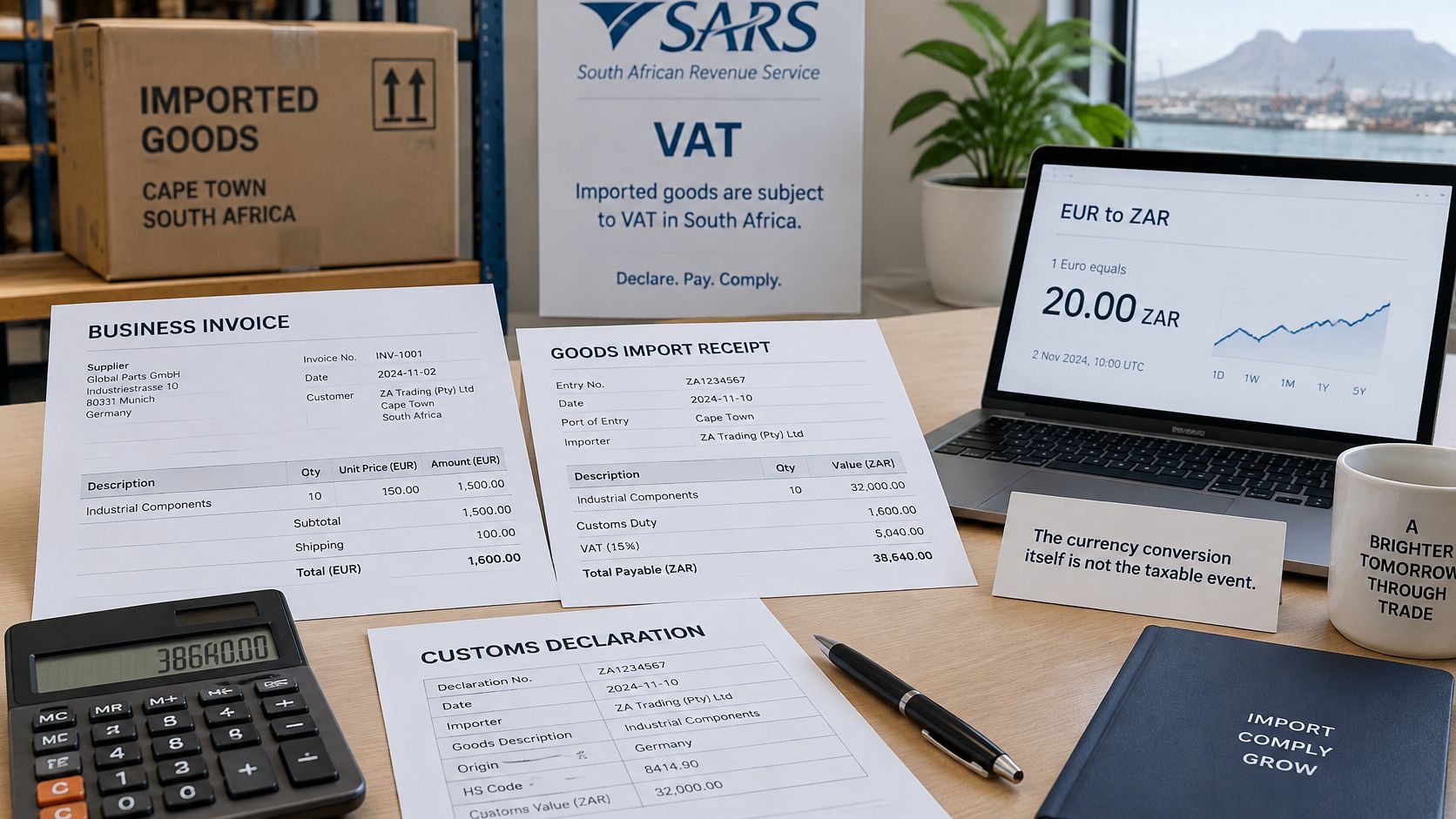
A currency conversion is not the same thing as a taxable supply. The transaction the payment settles may be.
SARS states that VAT is payable on the importation of goods and imported services, and South Africa's standard VAT rate is 15%. At an indicative R18.40 per euro, 15% VAT on a fully taxable R18,400 imported-service value is R2,760, although the actual liability depends on the transaction and the applicable rules. For a business, €1,000 is not automatically "just R18,400".
What the payment represents changes the question:
- Imported goods: VAT can arise on importation, quite apart from the exchange rate used to pay the supplier.
- Imported services: A foreign firm's service to a South African business can be a VAT question even when no goods arrive.
- Contractor work: Classify it by what was supplied, not by the currency printed on the invoice.
- Export proceeds, reimbursements and intercompany transfers: These are not imports. Moving the money into rand still is not, by itself, the tax event.
Whether the recipient is VAT-registered changes the answer again. Invoice currency, settlement date and the accounting exchange rate can produce different ZAR records for the same euro payment. That matters for BPO teams and exporters who receive euro fees and then report rand revenue. Confirm the treatment with a registered tax practitioner or with SARS before you file.
Confirm the Rand Amount Before You Send or Accept
Run this list before you send or accept €1,000, whether the payment is a business transfer or a personal one.
- Get the total rand in writing. The note should include the spread and every fixed fee. A verbal "about" is not a figure you can book.
- Name the rate source and the time. A rate without a clock time can be yesterday's screen, not the one that will settle.
- See every fee before you confirm. If a charge appears only after you press send, you never compared it.
- Ask the receiving bank about its credit fee. If it will not state one, write "unknown" on your note.
- State the purpose of the payment. An import, an export receipt, contractor work or a reimbursement can carry different tax treatment.
- File four items together. Reference rate, applied rate, fees and settlement date, for the books or your own records.
- Take at least two quotes on the same day. Same euro amount, and the comparison figure is the rand received.
Our free converter can be one of those quotes, because it checks the live mid-market rate and sets a bank's FX spread and SWIFT fees beside it, and we serve businesses only after a Know Your Business check, so individuals should use a provider open to them.
A figure you cannot get in writing is not a figure you can rely on.
Zaro gives South African businesses a transparent spread on the exchange rate and no SWIFT fees, so a euro receipt or a supplier payment can be compared on the rand that lands rather than on a headline fee. Pricing follows volume and corridor, and you receive a clear quote when you sign up or speak with the team. For your next €1,000 payment, get that quote from Zaro.