Converting $1,200 USD to ZAR can give you a nice chunk of Rands to work with, but the exact amount you’ll get changes constantly. It’s all tied to the rhythm of the global currency markets.
That rate you see when you Google "USD to ZAR"? That's what's known as the mid-market rate. Think of it as the 'wholesale' price—the rate banks and big financial players use to trade massive sums of money with each other. It’s the purest, most direct reflection of a currency's value before anyone adds their cut.
Understanding the Real Value of Your Dollars
Here's the catch: while the mid-market rate is a great benchmark, it’s almost never the rate you, the customer, actually get. Most banks and traditional currency exchange services bake a markup (or "spread") into the rate they offer you. This is their profit margin, and it's often a hidden cost that can take a serious bite out of your money.
For instance, your $1,200 might be worth R22,800 at the mid-market rate. But after your bank applies its markup, you could end up with only R21,900. That's R900 that simply vanished into the bank's pocket. Getting your head around this difference is the first step to making your money go further.
The key takeaway is simple: the exchange rate you are offered is just as important as the transfer fees. A poor rate can cost you far more than a high fee.
This is where specialist services like Zaro come in. They operate on much thinner margins, meaning they can offer you a rate that’s incredibly close to that true mid-market rate. For South Africans receiving funds—whether for business, investment, or personal reasons—this translates directly into more Rands in your account.
The table below really drives this point home. It shows just how much a seemingly small difference in the exchange rate can impact the final amount you receive when converting $1,200.
How Exchange Rates Affect Your $1,200 USD to ZAR Conversion
| USD Amount | Exchange Rate (USD to ZAR) | Received Amount (ZAR) |
|---|---|---|
| $1,200 | 19.00 (Mid-Market Rate) | R22,800 |
| $1,200 | 18.75 (Zaro's Typical Rate) | R22,500 |
| $1,200 | 18.25 (Traditional Bank Rate) | R21,900 |
See the difference? Choosing a provider with a better rate can put hundreds, or even thousands, of extra Rands in your pocket. It's not just about finding the lowest fee; it's about securing the best possible rate to ensure you get the full value of your money.
Getting to Grips with the USD to ZAR Exchange Rate
So, you want to know what $1,200 USD is worth in Rands? The answer isn't quite as straightforward as a simple number, because where and how you exchange your money makes a massive difference.
Think of it this way: at the very heart of the global financial system, there's a "true" exchange rate. This is called the mid-market rate. It's the real, live rate that big banks use to trade massive sums of money with each other. It’s the closest thing to the wholesale price of a currency.
The catch? Most people, and most businesses for that matter, never actually get this rate. Instead, the rate you see advertised at a bank or a currency kiosk has a hidden markup baked into it.
Unpacking the Real Cost of Sending Money
When you exchange money through a traditional service, they don’t give you the mid-market rate. They give you a less favourable one and pocket the difference. This profit margin is called the spread.
On top of that hidden cost, they’ll often charge a separate transfer fee for the service itself. It's a double-whammy that catches a lot of people out.
The total cost of your currency conversion is never just the fee you see upfront. It's a combination of that fee plus the often much larger cost hidden in the exchange rate spread.
Let's put this into perspective. Say the real mid-market rate is R19.00 for every dollar. A bank might offer you a rate of R18.50. That R0.50 difference doesn't sound like much, but it's pure profit for them on every single dollar you convert.
On a $1,200 transfer, that tiny difference means you instantly lose R600 before you’ve even paid their transfer fee. This is exactly why savvy senders look past the low-fee promises and focus on getting a rate as close to the mid-market as possible. The spread is almost always where the real cost lies.
Why the Rand's Value Is Always Changing

Have you ever checked the exchange rate and noticed that your $1,200 gets you a different amount of Rands than it did last week? One day the Rand looks strong, the next it’s taken a knock. This isn't random—it's the result of powerful economic forces constantly at play.
Think of the USD/ZAR exchange rate like a small boat on a big ocean. Its path is steered by massive "currents" that shift and change, pushing the value up or down. Getting a handle on these forces helps you understand why timing your currency conversion can make a real difference to your wallet.
These currents are shaped by events happening in both South Africa and the United States, creating a constant tug-of-war that influences the Rand's strength every single day.
The Key Drivers Behind the Rate
At its heart, an exchange rate is all about supply and demand. If global investors are keen to buy Rands, its value climbs. But if they'd rather hold onto the US Dollar, which is often seen as a safer bet, the Rand's value will dip.
So, what causes these shifts in sentiment? It boils down to a few key things:
- Interest Rates: When the South African Reserve Bank (SARB) hikes interest rates, it can make investing in SA more attractive to foreigners, which strengthens the Rand. On the flip side, decisions made by the US Federal Reserve can cause investors to flock to the Dollar, affecting currencies worldwide.
- Economic Performance: The overall health of South Africa's economy is a huge factor. Positive news about things like GDP growth, inflation, and employment figures tends to build confidence among investors, giving the Rand a boost.
- Commodity Prices: South Africa is a major exporter of resources like gold, platinum, and coal. When the global prices for these commodities go up, more US Dollars flow into the country to pay for them. This increases demand for the Rand and pushes its value higher.
The constant interplay between these factors is what creates the volatility you see. It’s the reason why the Rands you get for $1,200 can change so much from one month to the next.
To dig deeper into the forces that make currencies fluctuate, it's worth looking into how different macroeconomic indicators shape a currency's value. These are the invisible hands guiding the exchange rate, making it crucial for anyone sending money to stay aware of the bigger picture.
How Market Swings Impact Your 1,200 Dollars
It’s one thing to read about exchange rates, but it's another to see what they actually do to your money. Market volatility isn't just a term for traders; it directly affects how many Rands you get for your 1,200 USD. Timing your transfer can genuinely be the difference between a good deal and a great one.
Let’s look at a real-world example. In mid-April 2025, the USD to ZAR rate hit a high of 19.05. Fast forward just six months to early October, and it had dropped to 17.15. That might not sound like a massive shift, but it makes a huge difference when you're converting a decent sum.
That drop represents a 7.19% appreciation of the Rand. Had you converted your dollars back in April, you would have received R22,860. If you'd waited until October, you would have ended up with just R20,580.
That’s a difference of over R2,200—basically lost money. Think about what that could cover: a weekend getaway, a few weeks of groceries, or a significant chunk of a bill. If you're curious, you can dig into these trends yourself using historical data from sites like Exchange Rates.
Visualising the Financial Difference
To put it into perspective, the chart below shows just how stark the difference is between converting at a high point versus a low one with a $1,200 transfer.
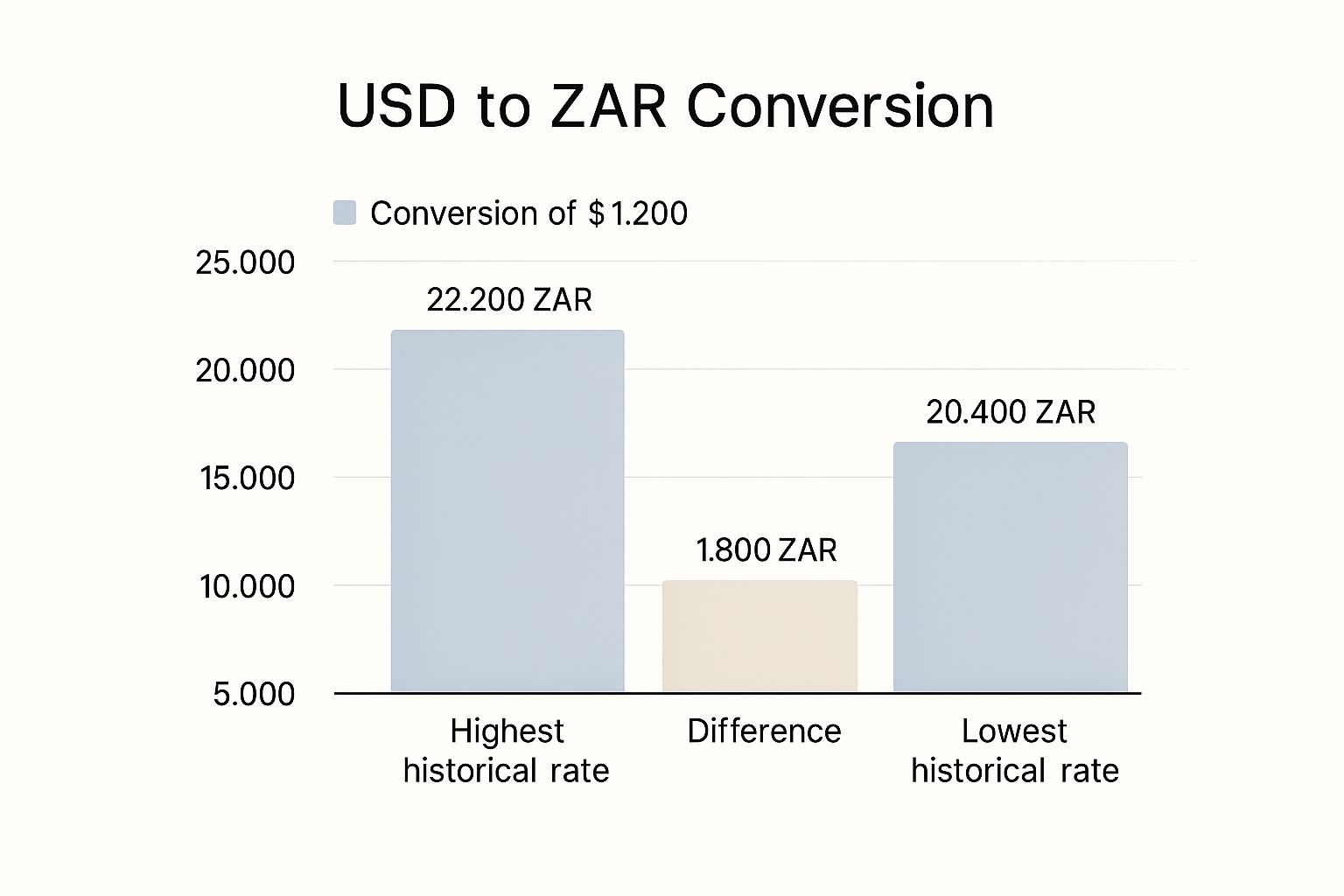
As you can see, a little bit of patience and strategic timing can put thousands of extra Rands right back into your pocket.
Key Insight: You don't need to be a financial expert to watch the market. It's a simple, practical way for anyone to get more value from their money and avoid leaving a surprising amount on the table.
This example really drives home why staying informed is so important. You don't need to become a market analyst, but having a basic awareness of which way the rate is trending can help you decide the best time to make your move and ensure your 1,200 USD stretches as far as it possibly can.
Finding the Best Way to Convert Your Dollars to Rands
When you need to turn $1,200 into Rands, you’ve got a few choices. But let's be clear: not all options are created equal. The route you take can seriously impact how much money actually lands in the South African account, so it pays to look past the obvious and understand where the real costs are hiding.
Most people first think of the traditional players – their high-street bank or maybe an airport currency kiosk. While they feel familiar and safe, they often come with a sting in the tail. Their business model is built on less-than-favourable exchange rates and a cocktail of fees, some of which are not always clearly advertised.
The Old Guard vs. New-School Services
Your local bank branch might be just around the corner, but it's rarely your cheapest bet for sending money overseas. Banks tend to offer what are known as "retail" exchange rates, which can be 3-5% worse than the real rate you see on Google. On a $1,200 transfer, that hidden markup alone could skim over R1,000 off the top before you even factor in their transfer fees.
And airport kiosks? They're even worse. They serve a captive market of last-minute travellers and, as a result, offer some of the poorest rates you’ll find anywhere. Think of them as an expensive emergency-only option.
The biggest cost in any currency exchange is rarely the fee you see upfront. It's the markup hidden in the exchange rate itself, which quietly chips away at the Rands you end up with.
This is where modern online specialists like Zaro have completely changed the game. By using smart technology, they cut out the expensive middlemen and operate with lower overheads. The result? They can offer exchange rates that are much, much closer to the real mid-market rate, meaning more of your dollars actually become Rands.
USD to ZAR Conversion Method Comparison
Choosing the right service to convert $1,200 to Rands really comes down to weighing up the costs, the speed, and how transparent the whole process is. To make it easier, here’s a quick look at how the main options stack up.
| Method | Typical Exchange Rate | Transfer Fees | Best For |
|---|---|---|---|
| Traditional Bank | Mid-market rate + 3-5% markup | High, often with hidden SWIFT fees | Large corporate transfers where the relationship with the bank matters more than the cost. |
| Airport Kiosk | Mid-market rate + 5-10% markup | Often high | Grabbing emergency cash at the last minute when you have no other choice. |
| Online Platforms | Close to the mid-market rate | Low and transparent | Anyone wanting to get the most Rands for their dollars, with total clarity on the costs. |
At the end of the day, the only number that truly matters is the final amount that arrives. By moving past old habits and looking at more efficient, modern solutions, you can make sure your money goes a lot further.
Answering Your Questions About Converting $1,200 to Rands
When you're dealing with a currency conversion, a few practical questions always pop up. Getting straight answers is the best way to move forward confidently and make sure you're getting the most out of your money. Let's tackle some of the most common queries we see.
When Is the Best Time to Convert USD to ZAR?
There’s no magic ball, but you can definitely be strategic about it. The basic goal is to convert when the Rand is weaker against the Dollar, because that means your $1,200 will buy you more Rands. It pays to keep an eye on trends using online charts or by following financial news.
As a rule of thumb, it's often best to avoid converting on weekends. With the markets closed, some services hedge their bets and offer less competitive rates. A smarter move is to set up a rate alert with an online service—they can ping you the moment the exchange rate hits a number you’re happy with.
How Can I Avoid Hidden Fees When Exchanging Currency?
The secret here is to look past the advertised "transfer fee" and focus on the exchange rate markup, often called the spread. This is the difference between the rate you're offered and the real rate. Always compare the rate you're getting to the current mid-market rate, which a quick Google search will give you.
Truly transparent services will show you the exact rate and the final amount your recipient will get before you hit send. You’ll find that online platforms are usually far more upfront about this than traditional banks.
Your Final Checklist: Always double-check the final receiving amount. This single number cuts through all the noise of confusing fees and rate markups, showing you the true cost of your transfer.
Are Online Money Transfer Services Safe?
Yes, the reputable ones are very safe. To protect yourself, always choose a provider that is properly regulated by a major financial authority, like the Financial Sector Conduct Authority (FSCA) here in South Africa.
Look for standard security features like two-factor authentication and check out recent customer reviews on independent sites like Trustpilot. A well-established, regulated online service is just as secure as your high-street bank for sending money.
And to make sure your converted $1,200 in Rands works for your bigger picture, it’s a great idea to read through a guide to realistic financial planning. This can help you manage your funds effectively once they’ve landed.
For South African businesses that want to ditch the hidden fees and get the real exchange rate on international payments, Zaro offers a completely transparent and efficient solution. Get started at https://www.usezaro.com.