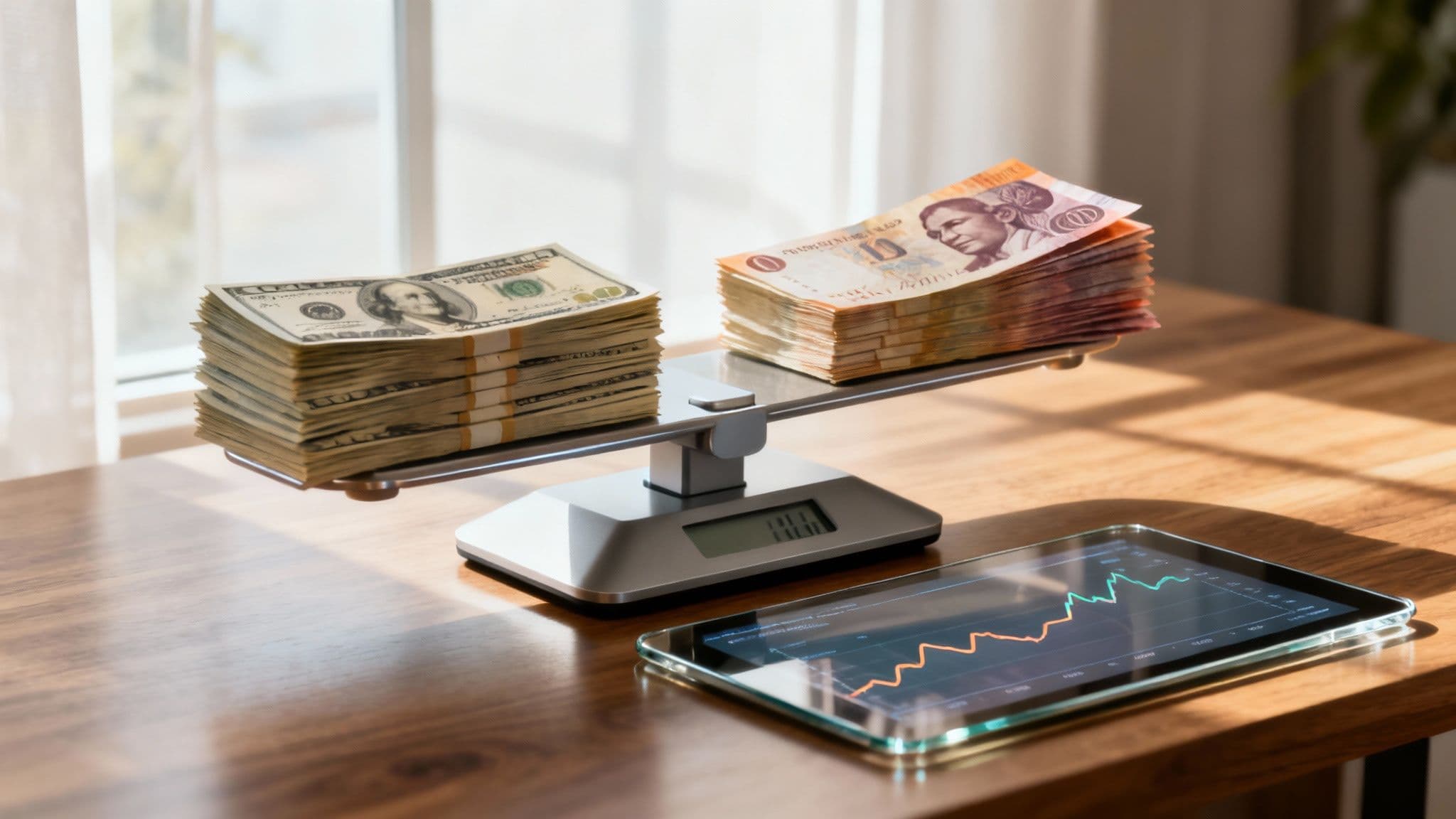
Right now, $1,400 converts to roughly R25,200. But here’s the catch: that figure is based on the live mid-market rate, which is constantly changing. The actual amount that lands in a South African bank account is almost always less, thanks to the hidden fees that traditional banks build into their exchange rates.
What's $1,400 in Rands Today?
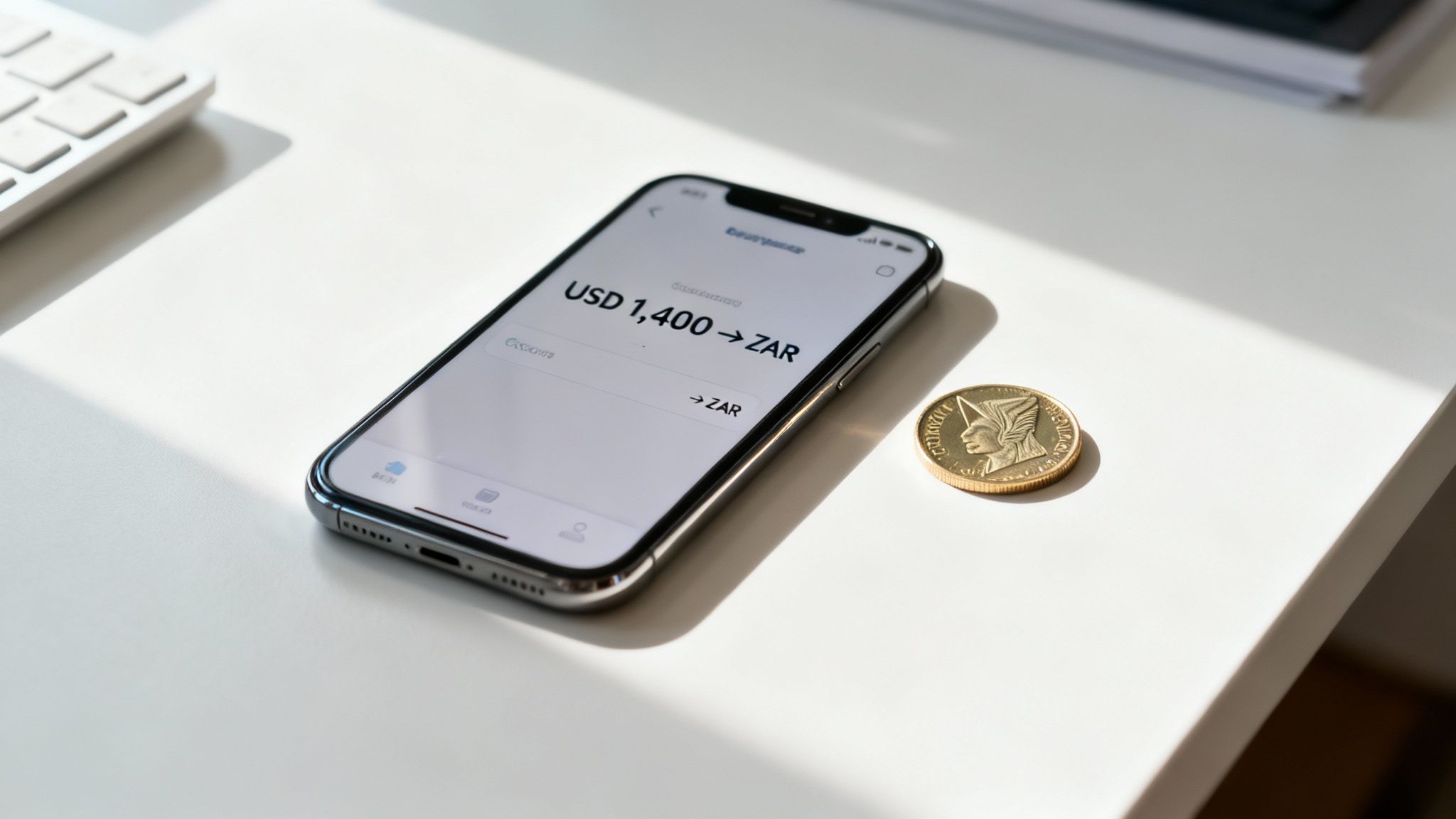
When you google the value of $1,400 in Rands, you’re seeing what’s called the mid-market rate. Think of this as the "true" or wholesale rate—it’s the midpoint between what buyers are willing to pay and what sellers are asking for a currency on the global market. It’s the benchmark you should always have in mind.
The problem is, the rate your bank offers you is rarely the mid-market rate. Instead, they add a markup, often called a "spread," which is essentially a hidden fee. This spread is how they make a profit, but it directly reduces the amount of Rands you end up with.
The difference might seem small, but on a transfer of $1,400, it can easily add up to hundreds of Rands lost.
Key Factors That Affect Your $1400 to ZAR Conversion
The USD/ZAR exchange rate is notoriously volatile, swayed by everything from global economic news to local political events. To put it in perspective, on 24 October 2025, the rate was around 17.2495 ZAR to the Dollar. At that rate, $1,400 would have only been worth R24,149. You can track these kinds of fluctuations yourself on platforms like Trading Economics.
Understanding what influences the final figure is the first step to getting a better deal. Here’s a quick breakdown of what to watch for.
| Factor | How It Impacts Your Transfer | Effect on Final Amount |
|---|---|---|
| Mid-Market Rate | This is the "real" exchange rate without any markups. | This is your baseline—the highest possible conversion value. |
| The Spread | Banks and brokers add a margin to the mid-market rate. This is their profit. | It directly reduces the Rands you receive. The bigger the spread, the less you get. |
| Fixed Fees | Some services charge a flat fee for the transfer, regardless of the amount. | Can be costly for smaller transfers, but might be cheaper for very large sums. |
| Transfer Speed | Faster, "instant" transfers can sometimes come with higher fees or worse rates. | You might pay a premium for speed, which lowers your final amount. |
Ultimately, a transparent service that offers the real mid-market rate is your best bet for maximising how many Rands you get for your Dollars.
Why Does the USD to ZAR Rate Fluctuate So Much?
Ever checked the value of 1400 dollars in rands one day, only to see a completely different figure the next? It’s not just you. This constant movement is the reality of the global currency market.
Think of it as a huge, non-stop auction where currencies are traded. The price of the US Dollar against the South African Rand is set by how many people are buying versus selling at any given moment. This is what’s known as a floating exchange rate—it’s not locked in by a government but moves freely with the market.
Essentially, good news for the US economy can make the dollar stronger, while positive developments in South Africa can give the rand a boost. Every major economic announcement, political event, or shift in investor mood can nudge the rate up or down.
What’s Really Behind the Daily Rate Changes?
Getting a handle on these factors explains why the timing of your transfer can make a real difference. A seemingly small shift in the rate can add up to hundreds of rands, especially on a larger transfer.
Here are the main forces pulling the strings:
- Economic Health: Things like strong GDP growth or low unemployment in a country tend to attract foreign investment, which strengthens its currency.
- Interest Rates: When the South African Reserve Bank raises interest rates, it can make the rand more appealing to global investors looking for a better return, pushing its value up.
- Political Climate: Stability is key. Political uncertainty often makes investors nervous, causing them to withdraw funds and weaken the rand.
These aren't just small wobbles, either. To give you an idea, the USD/ZAR rate dipped to around 17.15 in October 2025, but also climbed as high as 19.93 in April 2025. This means $1,400 could have converted to R23,990 at one point and a staggering R27,802 at another—that's a difference of nearly R4,000.
Looking at past performance really drives home how much value can be gained or lost in just a few months. By keeping an eye on these trends, you can get a much better feel for when it might be the right time to send your money. You can find plenty of historical exchange rate data online to see these patterns for yourself.
Here’s the rewritten section, designed to sound natural and human-written.
Where the Real Cost of Exchanging Currency Is Hiding
When you’re looking to convert 1400 dollars into rands, the most significant cost often isn't the one you see advertised. Many banks and old-school money transfer services love to shout about "zero fees," but they pocket their profit in a much quieter way: through the exchange rate spread.
Think of it like a fruit and veg shop. The owner buys apples from a farmer at a wholesale price, maybe R5 an apple. To make a living, they sell them to you for R7. That R2 difference is their markup, or "spread." Currency exchange works on the exact same principle.
The Rate You See vs. The Rate You Actually Get
The "wholesale price" in the world of currency is what we call the mid-market rate. This is the real, unfiltered exchange rate that banks use when trading massive amounts with each other. It’s the rate you'll find on Google or Reuters—the true midpoint between what buyers are willing to pay and what sellers are asking for a currency.
But here’s the catch: when you, a regular customer, go to exchange your money, you're almost never given that rate. Instead, you're offered a less attractive one.
The gap between the mid-market rate and the rate you're offered is the spread. It’s a hidden fee baked right into the conversion, and it's how most providers make their money.
Let's say the mid-market rate is R18.00 to the dollar. A typical bank might offer to buy your dollars at a rate of R17.50. That 50-cent difference might not seem like a big deal at first, but when you're converting $1,400, it stings.
Here's how that hidden cost plays out in real terms:
- At the Mid-Market Rate (R18.00): $1,400 x 18.00 = R25,200
- With the Bank's Spread (R17.50): $1,400 x 17.50 = R24,500
Just like that, the spread has cost you R700. That's money that simply vanishes before it ever reaches the intended bank account. This is why getting familiar with the mid-market rate is the single most important step you can take to avoid these hidden charges and make sure your money goes where it's supposed to.
Sending $1400 to South Africa? Let's Compare Your Options
So, we've talked about the theory behind spreads and hidden fees. But what does this actually mean for your wallet when you need to convert 1400 dollars in rands? The difference between using your old-school bank and a modern, transparent service like Zaro is often quite shocking.
Traditional banks have a classic move: they'll advertise a low "transfer fee" to get you in the door. The real cost, however, is often buried in the poor exchange rate they offer you. That markup, the spread, is where they make their money, and it directly eats into the rands that land in the recipient's account. It's a frustratingly opaque way of doing business.
On the flip side, newer providers build their entire model on transparency. They give you the real mid-market exchange rate—the one you see on Google—and charge a simple, upfront fee. No guesswork, no hidden costs. You know exactly what you're paying, which means you can make sure the maximum value gets home.
$1400 USD to ZAR Transfer Method Comparison
Let's put some real numbers to this. Here’s a quick comparison showing how a traditional bank stacks up against a modern service like Zaro when sending $1400 to South Africa. For this example, we'll assume the real mid-market rate is R18.00 per USD.
| Feature | Traditional Bank Transfer | Modern Transfer Service (Zaro) |
|---|---|---|
| Exchange Rate Offered | R17.55 (with a sneaky 2.5% markup) | R18.00 (the real, live mid-market rate) |
| Upfront Fee | R250 (what they advertise) | R100 (simple and clear) |
| Hidden Spread Cost | R630 ($1400 x (18.00 - 17.55)) | R0 (no spread, no hidden cost) |
| Total Cost | R880 (R250 fee + R630 spread) | R100 |
| Final Amount Received | R24,320 | R25,060 |
As you can see, the "hidden" spread is where the real damage is done. The recipient in this scenario gets R740 less just because of a poor exchange rate.
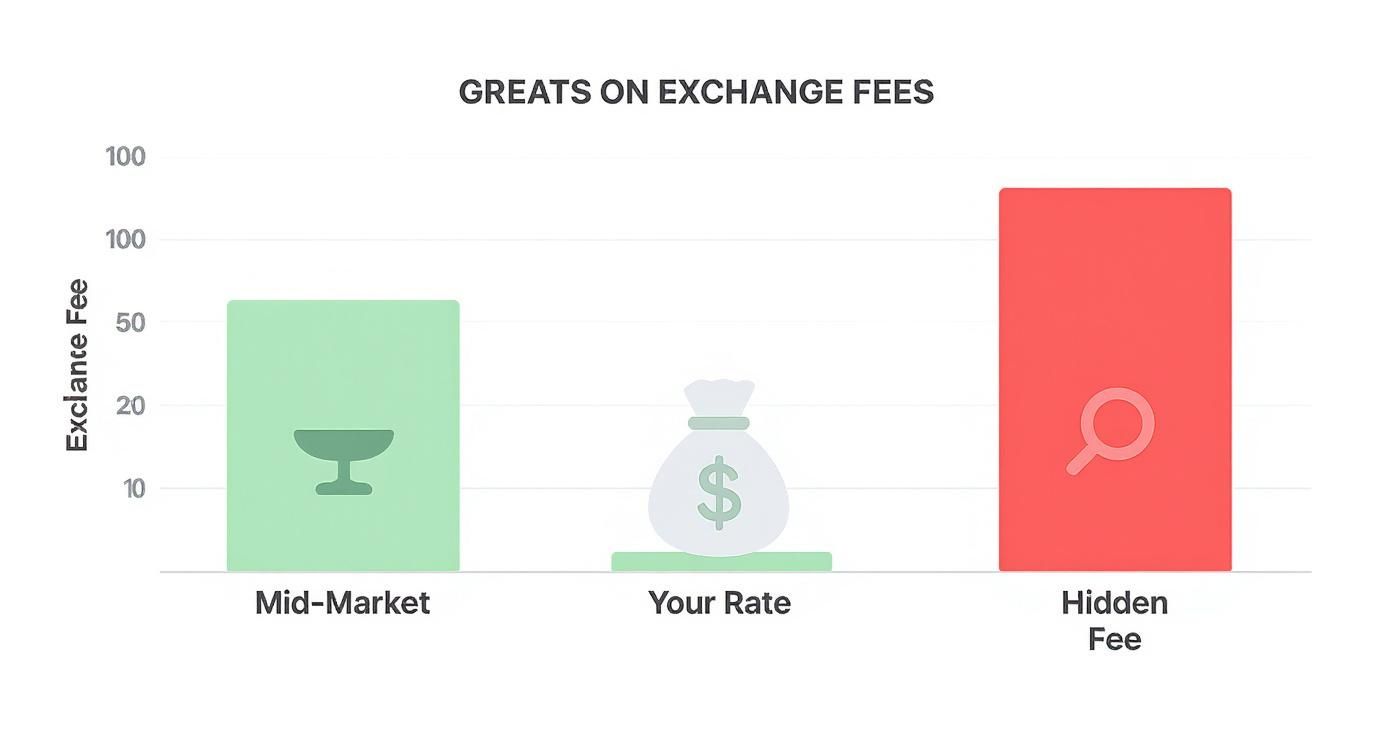
This visual breaks it down perfectly. You have the real rate, the rate you're often given, and that gap between them is pure profit for the bank—and a direct loss for you.
When all is said and done, choosing a service that prioritises transparency isn't just about convenience; it's about making sure more of your 1400 dollars in rands actually gets where it needs to go.
Sending Your Money and Getting the Most Out of It
Alright, so we've covered why you need to watch out for those sneaky hidden fees. Now, let's get practical and walk through how you can actually send your 1400 dollars in rands without losing a chunk of it along the way.
Modern transfer services have thankfully moved away from the confusing, old-school banking model. The whole process is designed to be clear and simple, putting you in the driver's seat. It usually starts with a quick account setup that takes just a few minutes.
A Straightforward Path to a Better Transfer
The entire journey is built around one thing: clarity. From the moment you sign up to the moment the money lands, you know exactly what’s happening. No more guesswork.
Here’s a look at the typical steps involved:
- Create Your Account: You’ll start by signing up online with some basic information. This gets you into the system and ready to go.
- Verify Your Identity: This is a standard security step to protect everyone involved. It’s a legal requirement to prevent fraud and can often be done digitally in minutes with a copy of your ID.
- Lock In Your Exchange Rate: This is where the magic happens. You'll see the live mid-market rate and can lock it in for your transfer. This means the rate you see is the rate you get—no nasty surprises if the market shifts.
- Add Recipient and Send: Pop in the recipient's bank details in South Africa, fund the transfer from your account, and hit send.
What really sets this apart is the transparency. With a modern platform, you see the exact Rand amount your recipient will get before you commit. There are no hidden deductions or "receiving fees" shaved off at the other end.
This simple, clear process means you can send your money with confidence, knowing the maximum possible value is making it home safely.
A Few Final Questions About Sending Dollars to Rands
It's completely normal to have a few last-minute questions when you're sending money internationally. Making sure you've got all the facts helps you feel confident you're making the right call for your USD to ZAR transfer.
How Quickly Will My Money Get There?
Speed is almost always top of mind. If you’ve ever used a traditional bank for a wire transfer, you know the waiting game – it can often take a frustrating 3-5 business days for the money to actually show up.
Thankfully, newer financial platforms have changed the game. Depending on the service you choose and when the receiving bank processes its payments, your funds can often land on the same day.
Is Sending Money Online Actually Safe?
Putting your money in the hands of an online service can feel like a leap of faith, but it doesn't have to be. Reputable platforms are regulated financial institutions, not just tech startups. They use the same kind of heavy-duty, bank-level security and encryption to keep your money and your personal details locked down.
A good rule of thumb? Always go with a provider that's upfront about its security measures and who regulates them.
A fantastic feature to look out for is the ability to lock in your exchange rate. This is a big deal. It means your 1400 dollars in rands conversion is protected from the usual ups and downs of the market while your transfer is being processed. The amount you're quoted is the exact amount that arrives.
This simple feature takes the guesswork out of the equation and gives you some much-needed peace of mind.
Ready for a smarter, more transparent way to handle your international payments? With Zaro, you get the real exchange rate, clear fees, and faster transfers. See how much you can save today.