
Your finance manager is staring at a held international transfer on a Friday afternoon. The invoice sits in one inbox, the client's company registration lives in a shared drive, and nobody is quite sure who approved the last rate change or why the bank is asking for a new Balance of Payments code. Most South African export businesses and BPO firms don't fail compliance because they ignore the law. They struggle because their checks are scattered across spreadsheets, emails, and memory.
When business owners look for an automated compliance management system, comparison sites usually hand them a long checklist of software features. Know Your Business checks, sanctions screening, and transaction alerts all sound reassuring on a sales page. Yet none of those features prove to a regulator that your controls work when an unusual payment lands on your desk.
What separates a dependable compliance setup from an expensive checkbox is the evidence trail it produces and the operating measures you use to run it. Every rule needs a clear owner, every alert needs a recorded decision, and every cross-border payment needs to reconcile cleanly with your accounts.
What an Automated Compliance Management System Does
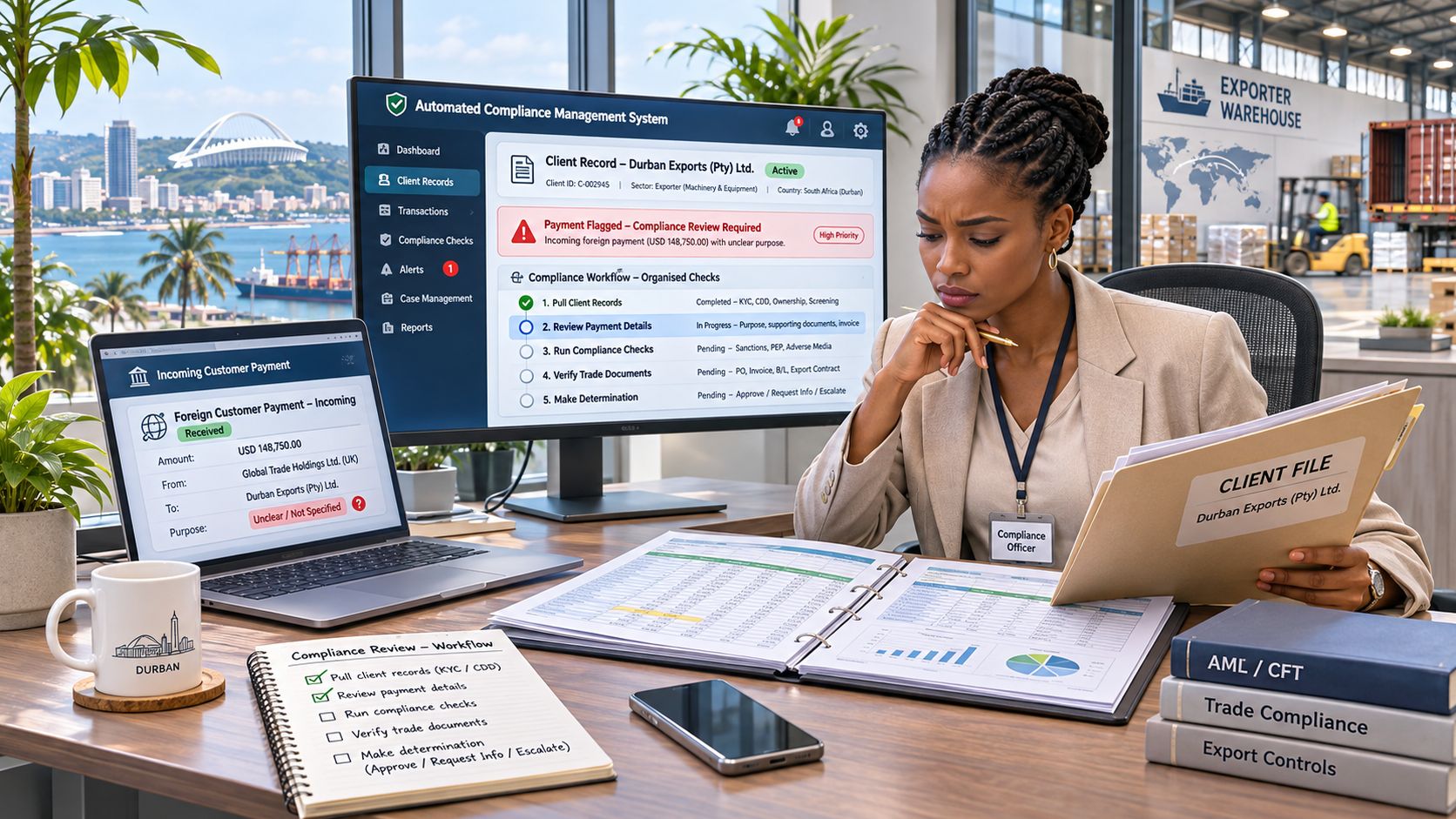
Say a Durban machinery exporter receives a foreign customer payment with a vague reference line that reads "settlement." The compliance officer opens three spreadsheets to check who owns the paying company, hunts through email threads for the signed pro-forma invoice, and phones the sales rep to ask why the funds came from a different country than the shipping address. By the time the team pieces the story together, two days have vanished and nobody has logged why the payment was eventually cleared.
An automated compliance management system fixes that fragmentation by keeping your compliance rules, client files, screening outputs, and reviewer decisions in one controlled platform. It works like a commercial building's fire-alarm panel. Sensors across every floor feed signals into one central panel; the panel logs every trigger, records which warden acknowledged it and at what time, and escalates unresolved alarms to someone senior. The panel doesn't put out the fire on its own, and compliance software doesn't replace human judgement. It makes sure nothing goes unnoticed and nothing gets cleared off the record.
Manual processes buckle quickly once reporting volumes climb. According to the Financial Intelligence Centre's 2024/25 annual report media release, registered South African institutions submitted approximately 13.5 million regulatory reports in the 2024/25 financial year, up roughly 82% from more than 7.4 million in 2023/24. That 2024/25 total included more than 570,000 suspicious and unusual transaction reports and over 3.1 million cash-threshold reports, alongside 556 compliance inspections that resulted in remedial-action requirements for 330 institutions and R2.228 million in administrative sanctions. Compliance in South Africa isn't a one-time onboarding task. It's a high-volume, continuous operation.
Where Software Stops and Human Judgement Starts
A common mistake is treating automation as a hands-off switch. Software excels at automated execution: pulling company registers, matching names against watchlists, applying scoring formulas, and stamping timestamps on every action. Human judgement stays with a named reviewer who weighs context, resolves ownership mismatches, clears or escalates alerts, and signs off on overrides.
| Module | What It Handles | Automated Step Against Human Step |
|---|---|---|
| Customer onboarding (KYB) | Business registration, directors and beneficial owners | Automated document extraction and register checks; a reviewer resolves mismatches and incomplete ownership |
| Risk rating | Jurisdiction, activity, corridor, payment purpose and expected volume | Automated scoring from set factors; a reviewer approves the tier and records any override |
| Sanctions and watchlist screening | Names, banks and countries against sanctions and PEP lists | Automated matching on every payment; a reviewer dispositions each potential match before release |
| Transaction monitoring | Unusual amounts, corridors, split payments and patterns | Automated rule triggers and timestamps; a reviewer decides whether the alert is a real concern |
| Alert management | Routing alerts to reviewers and escalating | Automated queues, routing and timers; a reviewer records the decision, reason and escalation path |
| Regulatory reporting | FIC reports and exchange-control filings such as the IFTR | Automated data assembly and validation; a reviewer confirms, submits and stores the reference number |
| Audit trail | Every decision, override and configuration change | Automated logging of user, time and rule version; a reviewer owns the reason for each override |
Before shopping for software, run a quick inventory inside your own business. List those seven modules on a sheet of paper and mark which ones your finance team currently handles by hand, in email, or inside a spreadsheet. Anywhere a manual hand-off sits between two modules is where alerts slip through and audit trails break.
How a Cross-Border Payment Passes Through the System
To see how those modules work together, trace a single outgoing payment from a Johannesburg SaaS exporter to a software development contractor in Kenya. Instead of treating compliance as a hurdle at the bank counter, the workflow checks the business, the counterparty, and the payment purpose in sequence before funds ever move.
The process diagram below shows how those stages connect from initial onboarding through to the final archived record.
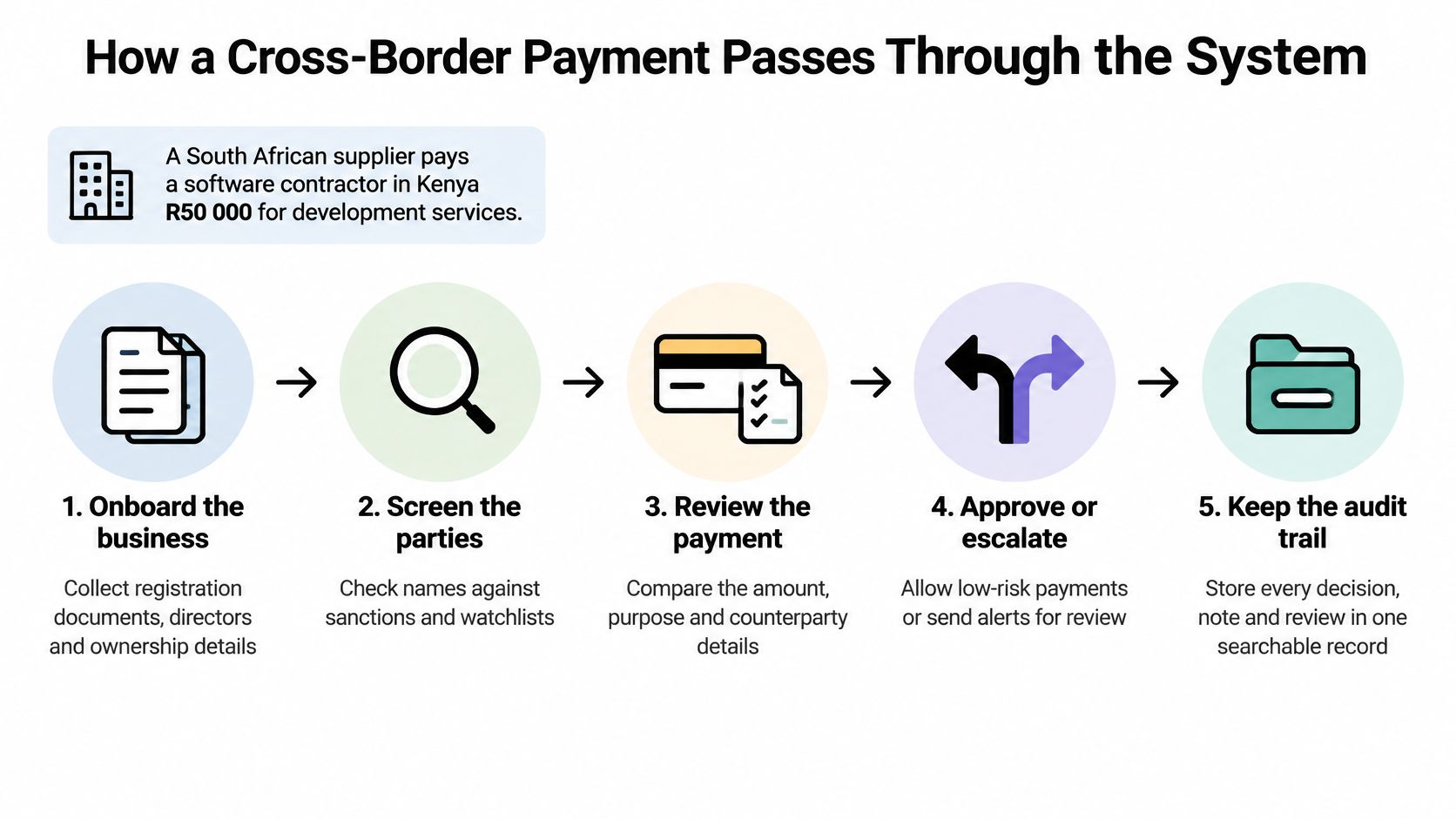
Eight Stages From Onboarding to Archive
Each stage protects the one that follows it. Skip a detail early, and every downstream rule either fires false alarms or misses genuine exposure.
- Onboard the business first: Collect the South African company's registration documents, director details, and beneficial owners before activating the account. At Zaro, we're built strictly for businesses and onboard South African companies only after a complete Know Your Business (KYB) check, because unverified ownership stalls every subsequent review. The frequent slip is letting an urgent first transfer go out while waiting for a missing shareholder declaration.
- Assign an initial risk rating: Score the business using its jurisdiction, payment corridors, stated payment purpose, and expected monthly transfer volume so future checks fit its actual profile. If a finance team leaves every client on a default score, routine contractor payments get the same scrutiny as high-risk transfers.
- Screen the beneficiary and bank: Run the Kenyan contractor's legal name, directors, receiving bank, and destination country against sanctions lists and Politically Exposed Person (PEP) watchlists prior to release. Teams often screen the contractor cleanly on invoice one, then forget to re-screen when the contractor switches to a new bank account in month four.
- Match the invoice to the BoP category: Pair the contractor's invoice or master services agreement with the correct Balance of Payments (BoP) category and supporting proof. A mismatch between the service described on the contract and the code entered on the payment instruction is one of the fastest ways to trigger a hold. Understanding how compliance layers sit alongside payment processing infrastructure helps here; the Comredix guide to checkout payment layers breaks down how gateways and processors divide technical transaction steps, which clarifies where compliance rules must sit in your stack.
- Aggregate linked transfers against thresholds: Check whether this transfer joins earlier payments to the same Kenyan contractor within your configured window. Grouping related transfers catches split payments that would otherwise slip below reporting limits.
- Route alerts and log human decisions: Send any flagged item to a designated queue where a reviewer chooses to clear, hold, or escalate the transfer. The system must force the reviewer to type a concrete reason before closing the ticket, rather than allowing a one-click dismissal.
- Release funds and file required reports: Once cleared, execute the transfer and submit any mandatory regulatory report, saving the filing reference number directly onto the payment record. Losing that reference in a separate portal creates headaches during an inspection.
- Archive the complete packet with timestamps: Lock the KYB file, risk score, screening output, invoice, reviewer notes, and report reference together in one searchable record.
A clean run leaves zero guesswork. Anyone opening that Kenyan contractor payment six months later can see its risk rating, screening pass, documented purpose, named approver, and filing reference on one screen.
For a broader look at how automated compliance workflows handle monitoring and reporting across business operations, the short walkthrough below illustrates the core mechanics in action.
Risk-Based Checks Instead of One Rule for Everyone
Applying identical compliance checks to every transaction is a recipe for backlog. If your compliance officer spends twenty minutes collecting source-of-funds letters for a long-standing domestic printing supplier, they'll have far less focus when a newly formed offshore intermediary sends a large, unexpected invoice. Uniform rules burn reviewer hours on safe payments while letting risky activity blend into the noise.
Under the Financial Intelligence Centre's compliance framework, accountable institutions must identify, assess, monitor, mitigate, and manage money-laundering, terrorist-financing, and proliferation-financing risk at both the institutional and client level. The FIC explicitly recognises manual or automated risk-rating calculations and requires ongoing monitoring of accounts and transaction patterns against what the business knows about each client's risk profile.
Factors Behind a Customer Risk Tier
A practical risk model weighs several concrete inputs rather than relying on guesswork: jurisdiction, beneficial-ownership complexity, business activity, expected payment corridors, payment purpose, source of funds, and historical behaviour. The resulting score shouldn't act as a blunt pass-or-fail gate. It should sort each relationship into a due-diligence tier that governs how much verification and monitoring that client receives.
| Risk Tier | Typical Profile | Checks Applied | Review Trigger |
|---|---|---|---|
| Simplified | Established domestic supplier with stable, low-value payments | KYB at onboarding and standard screening | Annual review or material change |
| Normal | Regular exporter or contractor with steady corridors | KYB, beneficial-owner capture and standard monitoring | Periodic review set in the RMCP or material change |
| Enhanced | New high-risk corridor, complex ownership or large unusual payments | Source-of-funds evidence, senior approval and closer monitoring | Shorter review cycle and each material change |
Review intervals aren't fixed statutory calendars. They're deliberate design choices that belong in your business's own Risk Management and Compliance Programme (RMCP), scaled to the exposure each client tier actually brings.
When a Risk Score Must Recalculate
A static onboarding score loses value the moment a client's business evolves. An exporter who only paid German equipment suppliers for three years might suddenly begin routing funds through an unfamiliar jurisdiction or add layered offshore holding companies to its shareholder register.
Your rules engine should automatically recalculate a customer's score whenever a material change occurs: a new director, a change in beneficial ownership, an untested destination country, or a sudden jump in monthly payment volume. Just as important, the platform must log the exact triggering rule, input data, model version, and timestamp behind the score shift. That gives your finance team a defensible answer when an auditor asks why a client moved from normal to enhanced due diligence on a specific Tuesday.
Benefits and Limits of Automating Compliance
Software vendors love to sell automation as a cure-all. Buy the platform, plug in your bank feeds, and compliance takes care of itself. In practice, automation brings real operational gains, yet it introduces a subtler set of failure modes that catch finance teams off guard.
Before trusting a rules engine with live international settlements, weigh what the software improves against the limits it can't remove.
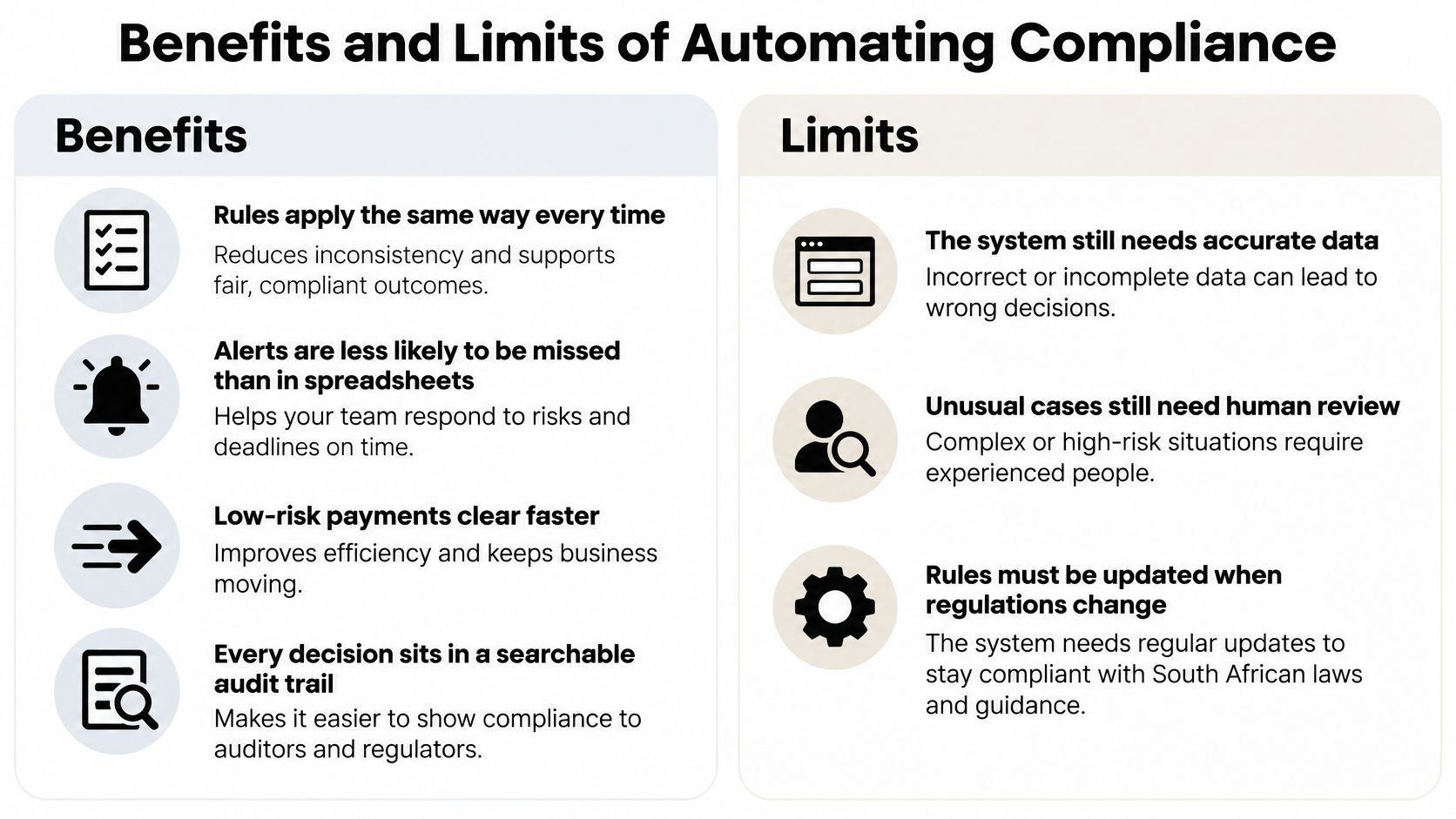
Where Automation Helps and Where It Breaks Down
On the positive side, an automated compliance management system applies your rules consistently across every shift and every branch. It catches matches and threshold breaches that disappear inside manual spreadsheets, clears routine low-risk settlements faster, and stores every review step in a searchable audit trail instead of scattered folders.
Those gains come with hard boundaries. Poorly tuned rules generate false positives that stall legitimate exporter settlements and strain supplier relationships. Static rules also drift out of date when sanctions lists update or regulatory guidance shifts. Worse still, garbage data typed into a supplier onboarding form feeds straight into the scoring engine, producing a clean-looking low-risk score built on wrong facts.
Consider a common failure pattern in export finance. Suppose a Cape Town wine exporter pays the same European freight forwarder every month, and an overly narrow keyword rule flags the forwarder's bank name on every single transfer. Nobody tunes the rule. By month four, the reviewer stops checking the invoice and clicks "approve" out of habit. That single noisy rule has just trained the team to rubber-stamp alerts, meaning they're far more likely to wave through a real anomaly next quarter.
Automated Execution Versus Demonstrable Effectiveness
Running automated checks isn't the same as proving your programme works. According to a Polity regulatory snapshot on South African financial services and AML, 2025 regulatory inspections found firms unable to demonstrate that their risk-management and compliance programmes (RMCPs) had been effectively implemented, with shortcomings tied directly to non-compliant RMCPs.
Many local business owners hoped scrutiny would ease after South Africa was removed from the FATF grey list on 24 October 2025, as noted in that same snapshot. The opposite is happening. Supervisory focus has shifted from passing policy checklists toward proving sustained, day-to-day control effectiveness ahead of the next mutual-evaluation cycle.
The exception test: Judge any compliance platform by how cleanly it governs exceptions and overrides, not by how many automated features appear on its brochure.
Audit-Ready Records to Keep After Automation
When an inspector sits across from your finance team, they don't ask for a tour of your software dashboard. They pull a sample of past transactions and ask you to prove why each payment was allowed to leave South Africa. If your system ran the checks properly but failed to preserve the decision trail, you're effectively starting from zero.
Enforcement numbers underline how seriously regulators treat missing documentation and missed filings. The FIC's 2023/24 annual report records 558 compliance inspections during that financial year; 269 inspections specifically examined whether institutions submitted required regulatory compliance reports, and 191 institutions were found non-compliant with that obligation. Under the applicable South African framework cited in the report, administrative penalties can reach R50 million for a legal person and R10 million for a natural person.
Seven Records Examiners Expect to See
Every automated check needs a matching evidence artefact mapped back to your FICA obligations and your documented RMCP. Software often saves the outcome ("Cleared") while dropping the evidence behind it. Watch out for the specific gaps listed below.
| Record | What It Proves | Common Gap |
|---|---|---|
| Risk-rating decision | The client was rated and the rating set the checks applied | Score saved without the factors behind it |
| Beneficial-owner verification | Ownership was identified and checked | Ownership chart predates the last director change |
| Alert disposition | Each alert was reviewed and cleared or escalated | Alerts closed with no reason recorded |
| Override log | A reviewer changed the system output and why | Overrides made under a shared login |
| Escalation timestamps | Escalations happened within the time set in procedures | Timestamps missing or overwritten |
| Staff review log | Named people performed and approved each review | Approvals by staff without the authority to approve |
| Rule and model version | Which rules applied on the date of the payment | Rules edited without version history |
Shared logins and overwritten timestamps deserve special attention. If three finance clerks share a single "compliance@" username to clear urgent supplier payments, your audit log can't prove whether an authorised officer approved an override. Likewise, if updating a transaction rule edits historical alert records retroactively, you lose proof of the controls that were running when the money moved.
The Ten-Minute Three-Payment Reconstruction Test
You don't need an external consultant to check whether your records hold up. Run this exercise with your finance team tomorrow morning:
- Select three recent payments: Pick one simplified-tier local supplier payment, one normal-tier recurring export or contractor transfer, and one enhanced-tier or flagged exception from the last quarter.
- Set a ten-minute timer: Ask a team member who didn't process those transactions to rebuild each approval decision using only the records stored inside your system.
- Verify every link in the chain: Confirm they can produce the risk factors, current ownership verification, alert reasoning, named approver, active rule version, and regulatory filing reference without phoning anyone or searching personal inboxes.
If the team runs out of time or hits a dead end on any of the three payments, your records aren't audit-ready yet. Build one essential habit right away: retain the official report reference number for every regulatory filing submitted, and link that reference directly to the exact payment record it covers.
How South African SMEs Should Evaluate a System
Generic anti-money laundering advice rarely fits how South African exporters and BPO companies move money. Local SMEs aren't just screening counterparties for sanctions; they're navigating exchange controls, bank settlement windows, and tight working-capital margins at the same time.
As outlined in SME South Africa's guide to cross-border transactions, international payments from South Africa are governed by the Currency and Exchanges Act and Exchange Control Regulations, processed through authorised dealers, and subject to FIC reporting rules. That guidance also highlights the R20,000 threshold for reporting electronic cross-border transactions via an International Funds Transfer Report (IFTR).
When evaluating a compliance or payments platform, don't fall for the myth that more alerts equal stronger protection. An overly sensitive system floods a small finance team with false alarms, delays supplier settlements, and tempts staff into informal workarounds outside the platform. Better systems optimise for precision, speed on clean payments, and complete evidence.
Operating Metrics That Reveal Real Performance
Ask prospective providers for operational numbers rather than feature brochures. The six measures below show how a system performs under real payment volume.
| Measure | What It Tells You | Question to Ask |
|---|---|---|
| Alert precision | Share of alerts that lead to a real concern | What share of last quarter's alerts led to escalation? |
| Review time | How long an alert waits for a decision | What is the median time from alert to decision? |
| Payment-release delay | How much compliance slows settlement | How many payments were held, and for how long? |
| Evidence completeness | Whether each decision has its supporting record | What percentage of closed alerts have a reason and timestamp? |
| Resolved without escalation | Whether low-risk cases clear efficiently | What share of alerts closed at first review? |
| Threshold aggregation | Whether related or split transfers are combined | How are linked transfers grouped against the R20,000 IFTR threshold? |
Supplier Data, Accounting Reconciliation, and Provider Credentials
Beyond metrics, check how the operating model handles everyday cross-border administration. Look closely at five operational details before committing:
- Foreign supplier data capture: Confirm your onboarding workflow captures each foreign supplier or contractor's legal name, registration or tax number, bank name and account details, country, payment purpose, underlying contract, and source of funds. Missing even one field causes repeated back-and-forth before settlement.
- Recurring supplier monitoring rules: Regular monthly payments to the same overseas vendor shouldn't trigger identical manual reviews indefinitely. Your system needs dedicated rules that establish an expected baseline for recurring suppliers, then fire an alert only when the amount spikes, the frequency shifts, or the beneficiary bank details change.
- Clear ownership of the IFTR decision: Decide who determines whether a transfer or grouped series of transfers requires an IFTR. Make sure the software logs that decision along with the reviewer's name and reasoning rather than burying it in a silent background setting.
- Accounting ledger reconciliation: Ask how compliance evidence connects to your books. Each completed payment should carry a unified reference tying together the supplier invoice or contract, the BoP category, the screening result, and any regulatory report reference, so your finance team can match a compliance packet to an accounting ledger entry without re-keying data.
- Verifiable regulatory credentials: Always check that any payments partner handling your cross-border flows holds proper local registrations. At Zaro, we're FIC registered and meet FICA requirements for anti-money laundering and know-your-customer compliance, and we're an authorised Financial Services Provider (FSP) registered with the FSCA under FSP number 55133, which any business owner can verify directly on the regulator's public register.
Governance check: Assign the IFTR reporting decision to a named role in your finance team, never to an unmonitored software default.
Confirm Your Compliance Setup Before the Next Payment
Choose the automated compliance management system that can show exactly how each alert was raised, reviewed, and closed, not the vendor with the longest feature list. If your team can't rebuild a payment decision cleanly from stored records alone, your automation isn't yet audit-ready.
Use the visual checklist below as a final gate before releasing your next cross-border settlement.
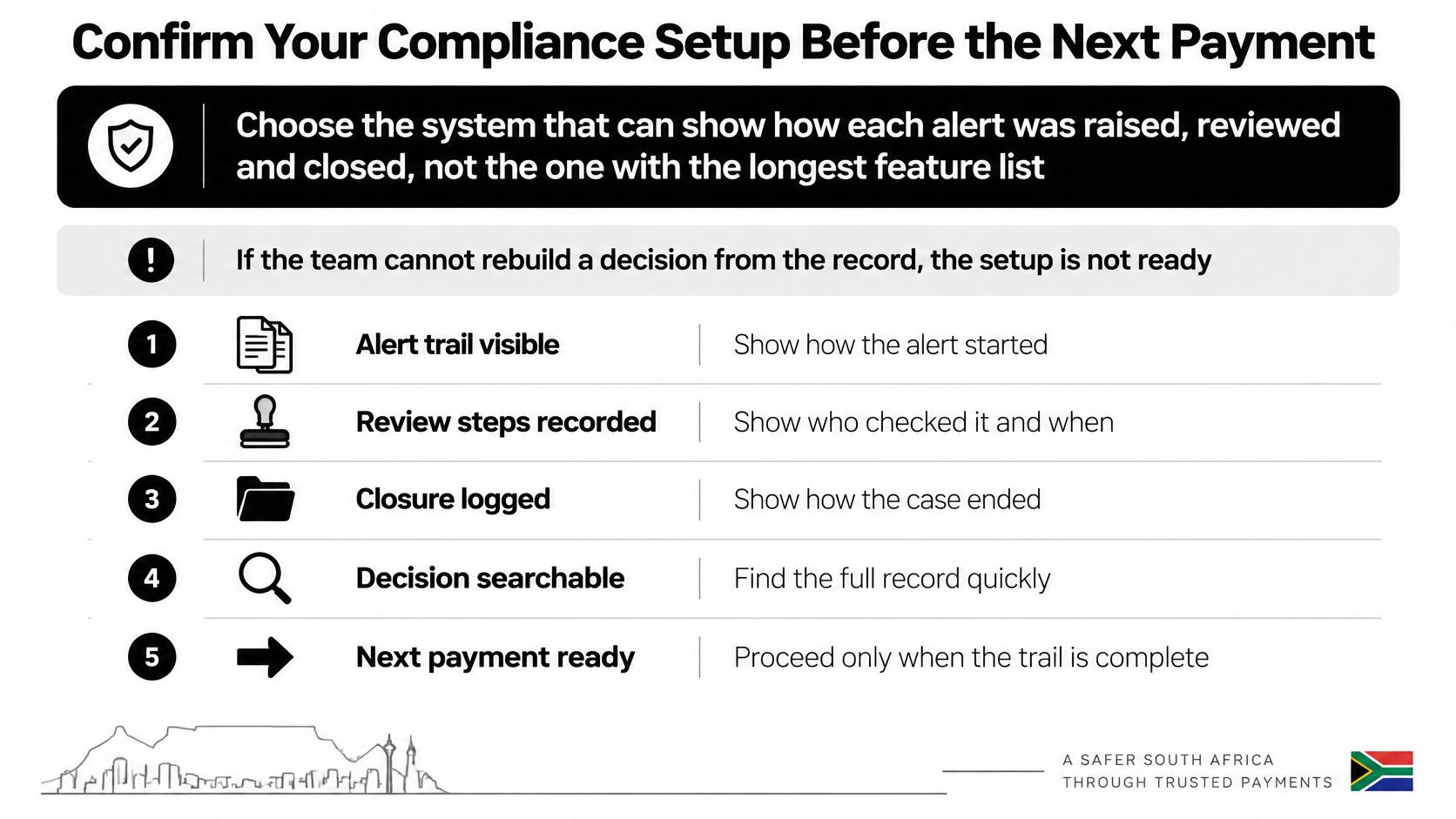
The test is simpler than it sounds. Open one completed payment and ask whether a stranger could follow it end to end: who approved it, what the screening returned, which BoP category was applied, and why. Wherever the answer depends on someone's memory rather than a stored record, you have found a gap.
If describing a cross-border payment accurately is where your finance team stalls most often, start by standardising your payment codes upfront. We offer a free BoP code checker at Zaro that identifies the likely BoP category for an export receipt or import payment, copies bank-ready wording, and lists the exact supporting documents to keep on hand.
Take one concrete step this week. Pick your business's highest-value or highest-volume international payment corridor, pull the single transaction you'd least like to explain to a regulator, and rebuild its entire trail from business onboarding to final report reference. Sort every gap you uncover into three buckets: software gaps become questions for your provider using the performance measures above, record gaps become an immediate retention fix, and procedure gaps become a written update to who is authorised to approve what.
Expect the rebuild to feel slow the first time. That friction is the point, because it shows you exactly which steps live only in inboxes and spreadsheets. A system that records each decision as it happens turns the same exercise into a ten-minute retrieval instead of a day of digging.
Zaro helps South African businesses send and receive cross-border payments at real exchange rates with zero spread and no SWIFT fees. Companies onboard through a Know Your Business (KYB) check, then manage ZAR and USD accounts with multi-user access and customisable team permissions. Zaro is FIC registered, meets FICA requirements, and is an authorised Financial Services Provider registered with the FSCA under FSP number 55133. Explore Zaro to see how your finance team can handle international transfers with cleaner records.