
You've approved a supplier invoice, released the payment on Monday, and by Thursday your supplier is emailing to ask where the money is. Your bank statement shows it left your account, the amount looks wrong once converted, and nobody can tell you which step it's stuck on. That's the everyday frustration behind B2B payments for many South African finance managers, and it usually comes down to three things: the route you chose, the data you sent with the payment, and charges you never saw in the quote.
This guide walks through those three issues step by step. You'll see how the main methods compare, how a payment moves from invoice to settlement, what it really costs once every fee is counted, and why compliance preparation often decides speed more than the rail itself does.
B2B Payment Methods Compared at a Glance
A B2B payment is money one business sends to or receives from another business, usually against an invoice, for goods, services, contractors or tax. It isn't like tapping a card in a shop. Values are larger, someone other than the payer usually approves it, and the reference must match the invoice so the receiver can allocate the cash without phoning you.
South Africa already operates account-to-account transfers on a large scale. The South African Reserve Bank snapshot reports approximately R167 trillion in total annual settlement value, including R148 trillion in wholesale payments and R19 trillion in retail payments. In that snapshot, EFT credits alone accounted for about R37 trillion across roughly 1 billion transactions, which shows supplier settlement, payroll, and invoice payments are well established in bank-based rails rather than cash or cheques.
Reading the methods side by side
| Method | Typical settlement | Best for | Main cost driver |
|---|---|---|---|
| Local EFT (ZAR) | Same or next business day | Domestic supplier, payroll and contractor payments | Bank transfer fee per payment |
| PayShap | Immediate, within seconds | Urgent low-value domestic payments | Participating bank fee |
| SWIFT wire transfer | Usually 1 to 3 business days | International suppliers and service providers | Intermediary deductions and FX spread |
| SADC-RTGS settlement | Real time between participating banks | Regional payments within SADC | Charges set by each participating bank |
| Business debit or credit card | Immediate for the merchant | Small recurring purchases abroad | FX markup and card fees |
| Documentary letter of credit | Several days to weeks | High-value export or import deals with a trust gap | Issuing and document handling fees |
Read down each column rather than across one favourite row. Settlement tells you when the receiver can use the money, not when it leaves you. Best for tells you the job the rail was built for. Main cost driver tells you where to look when the final amount surprises you.
Choosing a row today
- Local EFT: Use it for routine ZAR payments where next day is fast enough and you want a predictable per payment fee.
- PayShap: Use it when a small domestic payment can't wait for the next EFT cycle.
- SWIFT wire: Use it for suppliers outside the region, accepting that intermediaries may deduct charges along the way.
- SADC-RTGS: Use it where both banks participate in the region and you need real time settlement between them.
- Business card: Use it for small recurring offshore purchases, such as software, where convenience beats FX cost.
- Letter of credit: Use it when you don't yet trust the counterparty on a large trade deal and need documents checked before release.
Three questions pick the method: Where does the payee's bank sit? How fast must the cash be usable? How much value is moving? A faster rail isn't always the cheapest one, because speed, FX and fixed fees pull in different directions.
How a B2B Payment Moves From Invoice to Settlement
Think of a payment as a chain where each stage inherits the errors of the stage before it. If the invoice amount is wrong at step one, no banking rail can fix it at step six. Work through the chain in order and stop the run whenever a check fails.
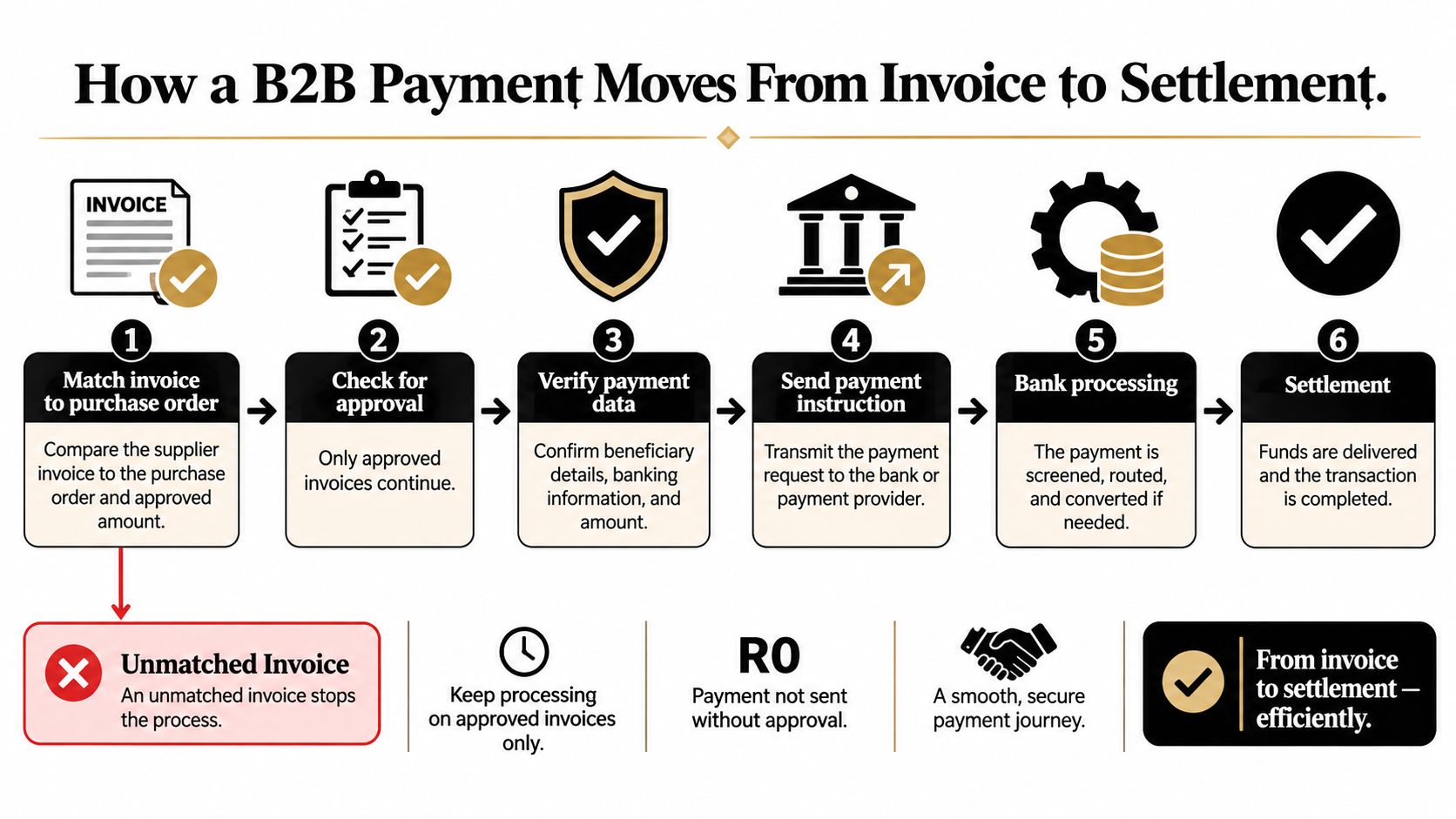
The seven steps and why each one exists
- Match the invoice to the purchase order and approved amount. Compare supplier, quantity, price and VAT treatment line by line. An unmatched invoice should stop the run, because paying first and querying later turns a simple correction into a refund chase.
- Validate the beneficiary's bank details against a stored record. Check account number, branch code or SWIFT identifier against a record you verified when the supplier was onboarded. A single transposed digit is a common cause of returned payments, and a changed account number is also a classic fraud signal.
- Confirm the currency and choose the route by corridor. Pay domestic suppliers by local EFT, use SADC-RTGS where the payee bank participates, and use SWIFT for other international payees. The corridor decides which identifiers and purpose codes the receiving bank expects.
- Attach a unique end to end reference and structured remittance data. Use one reference that appears on your payment instruction, ideally in an ISO 20022 compatible format, plus the invoice number in a consistent field. Structured data travels through screening systems cleanly, while free text often gets truncated.
- Approve at the agreed authority level. The person who captured the payment shouldn't be the only person who can release it. Set approval by amount, so routine invoices move quickly and large ones get a second pair of eyes. For teams formalising these controls, Procright's accounts payable guide sets out practical approval and separation of duties procedures you can adapt.
- Release and track until the beneficiary is credited. Release is the halfway point, not the finish. Track status through screening, routing and beneficiary credit, and chase exceptions the same day rather than at month end.
- Reconcile the credit against the invoice and close it in the ledger. Match amount, reference and date to the open invoice, then investigate any shortfall as a deduction or FX difference. Closing promptly keeps your aged payables honest.
What a healthy flow looks like
Healthy flow: One reference appears unchanged on the bank statement, the supplier's remittance advice and your ledger, so nobody has to guess which invoice the money settled.
That single reference is doing heavy lifting. It lets the supplier's finance team allocate cash without emailing you, it lets your team prove payment during an audit, and it lets both banks trace the transaction if it stalls. When references are missing or recycled, reconciliation becomes manual detective work and suppliers mark invoices unpaid even though the cash arrived.
A practical habit helps here. Never capture beneficiary details and invoice details in the same sitting from the same email. Load and verify the beneficiary once, store it, and then capture invoices against that trusted record. It feels slower on day one and saves you repeatedly after that.
The Real Cost of a B2B Payment
The advertised transfer fee is rarely the price you pay. The figure that matters is the landed cost, meaning everything deducted between the amount you approve and the amount the receiver can spend. If you only compare headline fees, you'll regularly choose the route that looks cheap and lands expensive.
Recent South Africa focused research in the Wise G20 2026 South Africa report estimates that sampled FX markups range from 0.47% to 4.84%, with SMEs projected to lose about US$782 million in hidden FX fees in 2026. That range is the lesson. Two quotes for the same payment can differ several times over once the exchange rate is included, even when both providers advertise a low transfer fee.
The five components of landed cost
| Cost component | How it is charged | Who it hurts most |
|---|---|---|
| FX spread | Percentage markup on the exchange rate | Large payments, where small percentages add up |
| Minimum commission | Flat floor charged on every payment | Small invoices and low-value contractor payments |
| Communication charge | Fixed fee per payment message | Frequent small payments |
| Correspondent-bank deduction | Amount taken by intermediary banks before credit | The receiver, who gets less than the amount sent |
| Delayed settlement | Cash tied up while the payment is pending | Businesses with thin working capital |
Percentage pricing isn't always the main problem, and many comparisons go wrong on that point. A minimum commission is a floor. If the percentage fee on a small invoice falls below that floor, you pay the floor anyway, so the effective percentage climbs sharply as the invoice shrinks. Fixed communication charges behave the same way. On a large payment they're trivial, on ten small contractor payments they're charged ten times.
The FX spread works in the opposite direction. On a small payment, even a wide spread costs a modest rand amount. On a large supplier payment or export receipt, a small percentage difference becomes real margin. That's why small and large invoices need different checks rather than one house rule. For small payments, interrogate the fixed charges. For large payments, interrogate the rate against the mid market rate at the moment of the quote.
A comparison method that tells the truth
Don't ask, what is your fee? Ask instead, if I send this exact amount in this currency today, what will the receiver get, and when? Write down the amount sent, the rate applied, every fixed charge, any intermediary deduction you expect, and the final credited amount. Do the same exercise on a second route with the same sending amount and compare the two credited figures.
Say you're paying a small offshore invoice. Route one advertises a lower transfer fee but applies a minimum commission that exceeds the percentage fee, plus a fixed communication charge. Route two advertises a higher visible fee but has no minimum on that corridor. Once you compare credited amounts, route two can easily win. The warning is simple: a cheaper looking transfer becomes more expensive the moment a minimum commission is applied to a small payment.
Why Cross-Border Supplier Payments Take Longer
Your bank's stated processing window doesn't tell the whole story, because it usually describes only the leg the bank controls. Across sub-Saharan Africa, the South African Reserve Bank G20 data insights paper reports that only 54% of wholesale cross-border payments reached the intended recipient within one hour, versus a 75% global target. That gap is not an abstract benchmark. It shows up as suppliers holding stock, contractors pausing work, and export collections you can't forecast.
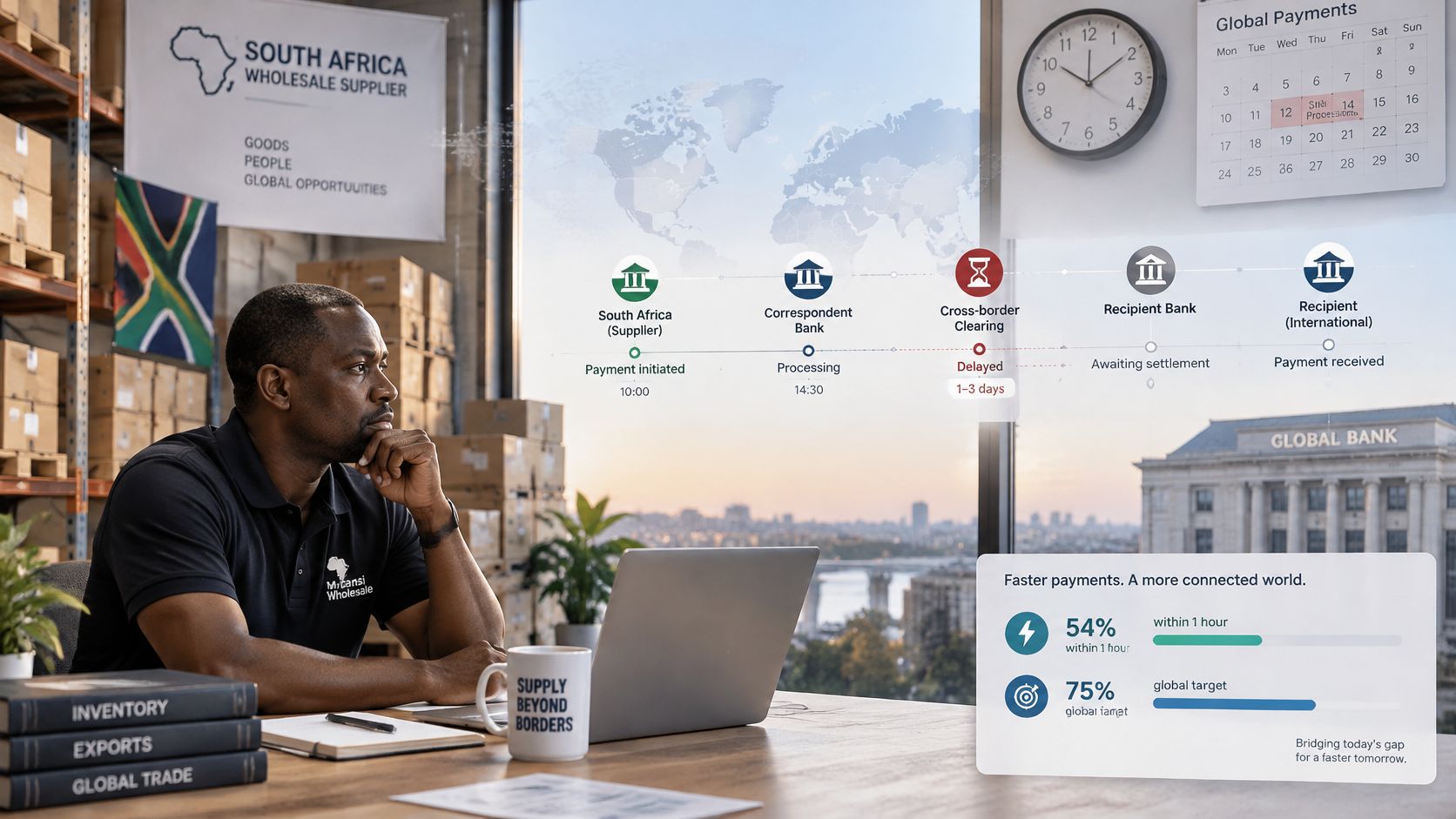
Where the hours actually go
Delays accumulate at four stages. Initiation is your capture, approval and release, including cut off times you may have missed. Compliance screening checks sanctions, purpose and documentation, and it can happen at more than one institution. Correspondent processing is where intermediary banks pass the payment along, each with its own queue and data requirements. Beneficiary credit is the final posting by the receiving bank, which may wait for complete remittance details before releasing funds.
Every extra intermediary adds a queue. Every manual repair, such as a missing beneficiary identifier or an unclear purpose of payment, sends the transaction to a person, and people work in batches during office hours. Finance teams comparing newer routes sometimes look at models like institutional asset transfers on Primevault to understand how reducing intermediaries and manual steps changes settlement design, even when their own payments still run on banking rails.
Measure timestamps, not promises
Record a timestamp at each of the four stages for your cross-border B2B payments. Then calculate one simple measure each month: the share of payments credited to the beneficiary within one hour of release, and the median time for the rest. That turns a vague complaint about slow payments into evidence about where your corridor loses time.
Say a Gauteng exporter pays a regional contractor on a Tuesday morning. The payment leaves on time, passes the sending bank, then sits for two days because the beneficiary's bank details needed manual repair before the receiving bank would credit it. The bank's processing window was technically met. The contractor still wasn't paid.
A payment isn't fast when it leaves your account. It's fast when the receiver can spend it.
Before your next run, ask any bank or platform three direct questions. Can I see end to end status, including beneficiary credit? Do you support structured beneficiary data so my validated records travel intact? How much manual exception handling does this corridor typically involve, and who contacts me when a repair is needed? Vague answers to those questions predict slow payments.
Compliance Checks That Decide Your Payment Speed
Speed is not the only goal, because a fast submission that gets held or rejected is slower than a prepared one. Compliance checks don't exist to frustrate you. They exist so each institution in the chain can satisfy itself about who is paying, who is receiving, and what the money is for. Prepare the evidence once, before the payment run, and the checks mostly happen in the background.
Four items to have ready before you pay
- Company verification through Know Your Business checks. Complete KYB before the first payment, not during an urgent one. We make our services available to businesses that pass Know Your Business (KYB) and compliance checks, and users must be authorised to bind their organisation.
- Beneficiary verification against a validated record. Confirm the receiving business name and bank details match the record you approved at onboarding. Treat any change request as a new verification, confirmed through a channel you already trust.
- Purpose of payment documents. Keep the invoice, contract or customs paperwork that explains the payment attached to the transaction record. Screening teams ask for the document that matches the value and counterparty, not a general explanation.
- An audit trail showing who prepared and approved the payment. Log preparer, approver, amount, rate and reference. When a payment is queried months later, the trail answers in minutes.
Set approval limits by amount so payments above your threshold need a second approver, and name one person who clears holds within a set time each day. Log why each payment was delayed, using plain categories such as missing document, beneficiary mismatch or screening query. After a month, that log tells you exactly which preparation step to fix.
Why late receipts make this urgent
Public sector payment data reported by Zawya on South Africa's late payment costs shows that at the end of Q2 2025, 95,399 invoices older than 30 days, worth R12.4 billion, remained unpaid, and the total increased 17% from the previous quarter. For a small firm, one late customer receipt like that ripples straight into payroll, supplier settlement and contractor payments. You can't control a customer's payment run, but you can control whether your own receipts and payments stall on avoidable documentation gaps.
Automation alone doesn't guarantee faster settlement. If your business documents are incomplete or inconsistent, friction moves from the payment screen into back-office review, where it's slower and less visible. Different flows also need different controls. A low-value recurring contractor payment needs a validated beneficiary and a clean reference. An export receipt needs purpose evidence and accurate category coding. A multi-user finance workflow needs approval limits and permissions that reflect who may release what.
For context on the standards to expect, we're FIC registered and meet FICA requirements for anti money laundering and know your customer compliance, and we're an authorised Financial Services Provider registered with the FSCA, FSP number 55133. Ask any provider you assess how it runs KYB and beneficiary checks, and how it reports holds to you while a payment is in flight.
Three South African Payment Scenarios and What Works
The scenarios below are illustrative, built from common B2B payments patterns rather than real clients. The figures are examples to show the arithmetic, so focus on the decision in each case.
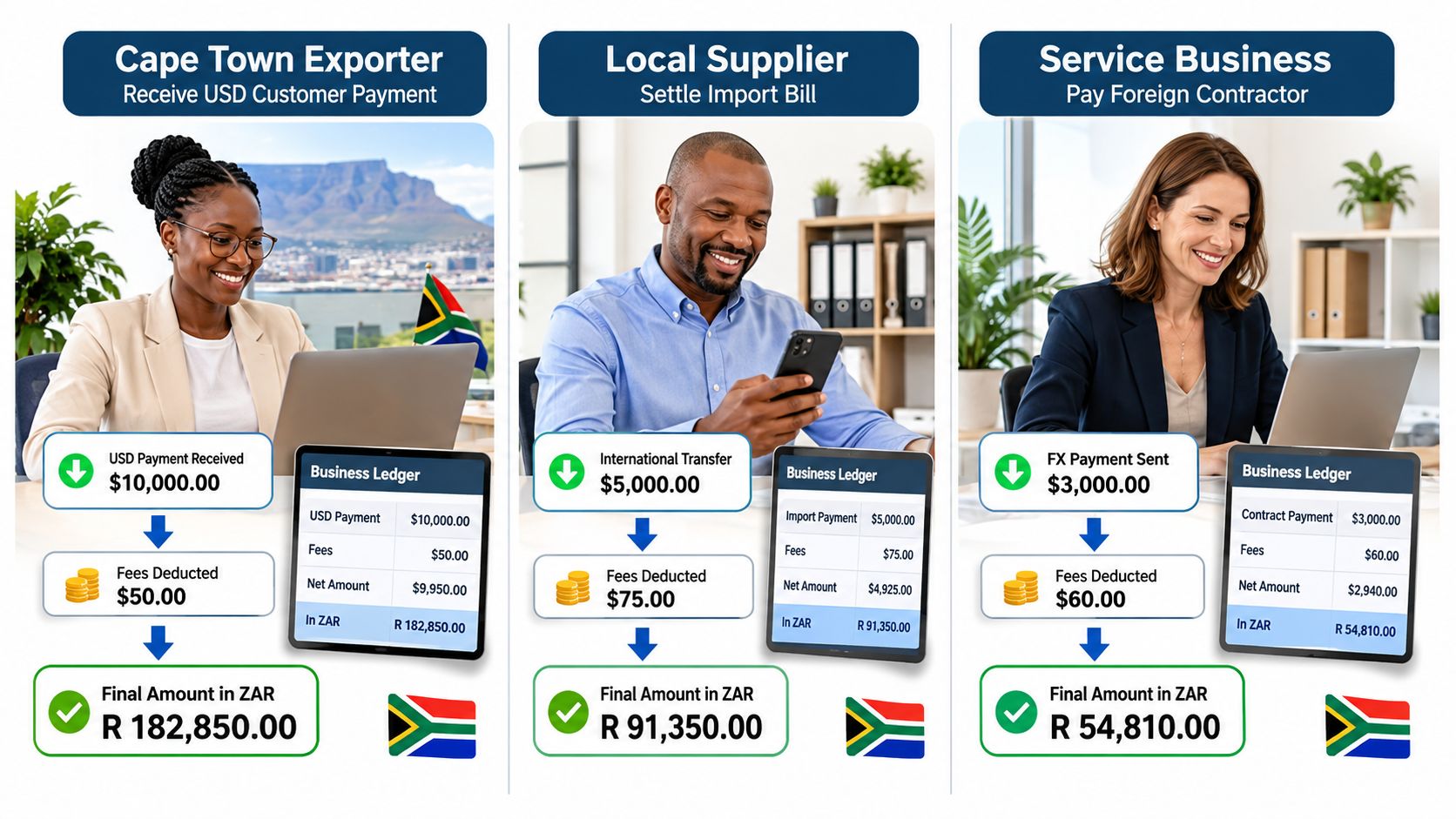
Scenario one, the Cape Town exporter receiving USD
A Cape Town exporter invoices a US customer and the customer pays by international wire. The money arrives, but the ZAR amount credited is noticeably less than the invoice value converted at the rate the finance manager saw online. Two things happened: the receiving bank applied its own FX spread, and intermediary deductions came off before credit.
The fix is to compare like with like. Record the USD amount sent, the mid market rate at the time, the rate applied, and any deductions. That difference is the true cost of receiving on that route. With that figure in hand, the exporter can decide deliberately whether to hold USD for upcoming offshore costs or convert immediately, instead of accepting an automatic conversion at an unknown rate.
Scenario two, the Johannesburg BPO firm paying a contractor
A Johannesburg BPO firm pays a freelance contractor abroad every month on small invoices, around R2,000 in this illustration. The route with the lowest advertised fee turns out to be the most expensive, because a minimum commission applies to every payment and the floor exceeds what the percentage fee would have been. Add a fixed communication charge each month and the effective cost per rand paid is high.
The fix is structural, not negotiable at the counter. Batch two or three invoices into one payment where the contract allows it, so the fixed charges are spread over a larger amount, or move that corridor to a route with lower minimums. The result is a lower cost per payment and fewer transactions to reconcile.
Scenario three, the manufacturer paying a regional supplier
A manufacturer pays a supplier elsewhere in the region and chooses the regional settlement route, expecting same day value. The payment stalls because the beneficiary's bank identifier on the supplier record is incomplete, so the receiving side can't process it automatically. The rail was fast. The data wasn't.
The fix is a validated beneficiary record, confirmed once with the supplier and locked against casual edits, plus a unique reference on every payment. The next payment on the same route processes without repair, because nothing needs a human to interpret it.
What recurs in every case: Hidden cost decides the margin, timing decides the relationship, and data quality decides whether either of them behaves as quoted.
Notice that none of these fixes required a new rail first. Each team got results by measuring the credited amount, restructuring small payments, or cleaning one beneficiary record. Change the measurement before you change the provider, and you'll know whether a new route is better.
Choose Your Route Before the Next Payment Run
You don't need another general checklist. You need a decision for the next payment run, made corridor by corridor. Work through three questions for each flow you pay regularly, and write the answers down where the person capturing payments can see them.
Three questions for each corridor
1. Which flow is it? Name the rail before you discuss price. Is this a domestic EFT, a regional payment suited to SADC-RTGS, a SWIFT payment to a supplier further afield, or an export receipt coming in? Naming the flow tells you which identifiers, documents and cut off times apply, and it stops teams forcing every payment through one familiar route.
2. What does the receiver get on two routes? Take the same sending amount and work out the credited amount on each route after FX spread, minimum commission, communication charges and expected correspondent deductions. We offer a free USD to ZAR converter that checks the live mid-market rate and compares what a bank may take in FX spread and SWIFT fees, and a free BoP code checker that finds the likely BoP category for an export receipt or import payment, copies bank ready wording, and shows which documents to have ready. Use tools like those to anchor the comparison in a live rate rather than a remembered one.
3. Does the cheaper route still meet the timing need? Compare your own stage timestamps against the one hour benchmark for beneficiary credit. A route that saves a small amount but routinely credits two days later may cost you supplier goodwill or early settlement discounts worth far more. Where timing protects revenue, pay for reliability knowingly rather than by accident.
Two rules to apply at capture time
- Where a minimum commission would take a large share of a small payment, batch invoices into fewer, larger payments or switch that corridor to a route with a lower floor. Don't let a fixed charge design your payment pattern by default.
- Where the payee's details are unverified, hold the payment until the record is validated, even if the invoice is urgent. A returned or misdirected payment is slower and riskier than a short verification delay.
Then make the decision concrete. Choose the route for the next payment on that corridor, record the sending amount, the rate, the charges and the time the beneficiary was credited, and compare the result with what you predicted. Repeat the test at the next run, because rates, minimums and corridor performance shift over time.
Our process follows the same discipline: sign up and complete KYB verification, fund your ZAR and USD accounts via bank transfer, make and receive cross-border payments, and receive cards, coming soon. Whatever route you choose, let the landed cost figure and the beneficiary credit time make the decision, not the headline fee on a pricing page.
If your next run includes export receipts, supplier invoices or international contractor payments, Zaro lets South African businesses hold ZAR and USD accounts, see the costs before confirming, and manage approvals with team permissions built for finance teams. Visit us to compare what your receiver would get on your busiest corridor, then decide your route with that figure in hand.