
Your Durban export business has been paid by a buyer in Texas. The bank advertised no commission, but the rand arriving in your account is noticeably below what you expected from the live exchange rate. Your finance manager now has to explain whether the difference came from currency conversion, intermediary deductions or a receiving fee.
The cheapest-looking transfer is often the most expensive. A waived payment fee tells you very little if the provider earns its margin through the exchange rate. For an exporter funding local salaries, what matters is the net rand available to spend, not the fee printed most prominently on the quote.
Finding the best bank to transfer money internationally therefore starts with your actual payment route. A service that can deliver rand into South Africa may not accept a South African business funding an overseas payment from its local account.
The options below include established banks and specialist payment platforms. Compare them on the same basis: the foreign-currency amount sent, the total rand debited or received, the settlement conditions, and the controls your finance team needs. Don't move your payment workflow until the provider confirms that your business and corridor are eligible.
1. Zaro
Best suited to South African businesses prioritising transparent FX pricing and fast cross-border cash flow. We provide a specialist payment route rather than a conventional business current account, with particular relevance to exporters, BPO businesses and companies paying international suppliers or contractors.
Our onboarding process starts with Know Your Business verification. Once verified, businesses fund their ZAR and USD accounts by bank transfer, then make and receive cross-border payments. Funds from the US typically reach a South African account in a matter of minutes, although that typical experience shouldn't be treated as a guaranteed deadline for every payment.
Compare the quoted spread, not a zero-fee headline
We charge a transparent exchange-rate spread and no SWIFT fees. Pricing depends on transaction volume and corridor, with a clear quote provided during sign-up or through our team; applicable fees are disclosed before confirmation.
That distinction matters. No SWIFT fees doesn't mean no conversion cost, and a live mid-market reference isn't automatically the rate at which your transaction executes. Compare the quoted net rand receipt against a bank's executable offer at the same time.
Our free USD-to-ZAR converter helps you check the live mid-market rate and compare potential bank FX spreads and SWIFT fees. Our BoP code checker also suggests a likely payment category, bank-ready wording and documents to prepare, reducing avoidable preparation work without replacing transaction-specific compliance checks.
- Advantages: Low FX spreads, no SWIFT fees, fast settlement and bank-grade security support routine business payments.
- Finance-team controls: Multi-user access and customisable permissions help separate payment preparation from approval.
- Eligibility: The service is designed for South African businesses that complete KYB verification; the exact corridor still needs to fit your payment.
- Limitations: Pricing is quote-based rather than a universal published tariff, and card spending is coming soon, not a current feature.
I'd shortlist this route when recurring export receipts or overseas payments make conversion cost and cash availability more important than keeping every service inside your existing bank. Compare the actual quote with your current arrangement before changing beneficiary instructions.
2. Capitec Business
Capitec Business is a practical shortlist option when you want payment processing, foreign-currency accounts and currency-risk tools under a banking relationship. Its international payments for business service requires an active Capitec Business Banking Global Biz account.
The online Capitec Forex System supports payment submission and tracking, while specialist forex support assists with exchange-control documentation. Spot deals, forward exchange contracts and customer foreign-currency accounts make this a broader proposition than a basic transfer service.
For an importer, the useful question isn't whether today's payment is cheap. It's whether the account structure lets you plan future supplier obligations without repeatedly converting funds or handling every payment manually.
Pricing discipline: Treat a published processing fee as a component of the cost, not the final answer.
A South African Reserve Bank assessment of South Africa-to-SADC pricing found that comparable weighted average transfer costs to Zimbabwe were 6.6% in 2024, with observed prices ranging from 0.5% for a non-bank provider to 35.4% for a bank. Those aren't Capitec quotes, but they demonstrate why the destination and payment route belong in every comparison.
- What works: Online tracking, specialist support and hedging tools can suit a business with recurring imports or exports.
- What needs scrutiny: The executable exchange rate and possible intermediary deductions still affect delivered value.
- Who can use it: Businesses with the required active Global Biz account, subject to onboarding and payment documentation.
Before choosing Capitec, compare a straightforward payment quote with a foreign-currency-account workflow. Holding currency can be useful when you'll spend it later, but it doesn't remove account costs or currency exposure.
3. FNB Business Forex
A business that receives foreign currency and then pays overseas suppliers shouldn't automatically convert everything into rand first. FNB Business Forex deserves consideration when incoming and outgoing currency flows overlap, particularly where a qualifying foreign-currency account could help manage conversion timing.
FNB's business global payments service supports international payments and receipts through its online banking channels. Its tools include saved beneficiaries, document uploads and Balance of Payments reporting, with batch-payment file uploads available through Online Banking Enterprise.
Business Global Accounts can hold selected currencies. That can help a finance team distinguish money needed for local operating expenses from money intended for foreign-currency obligations, rather than converting every receipt by default.
Best for repeat payments and controlled workflows
The operational attraction is repeatability. Saved beneficiaries and file uploads can reduce rekeying, but the finance team still needs controls over beneficiary changes, supporting documents and payment release.
The FSCA's digital banking review identifies cybersecurity, consumer education and data privacy or misuse as important concerns. For a business, the relevant test is whether the platform supports reliable access controls and usable transaction records, not whether the interface looks modern.
The trade-off is setup and total cost. You need a qualifying FNB account, and some foreign-currency or enterprise functionality may require additional activation or support. The quoted exchange rate and third-party bank charges remain part of the comparison.
I'd assess FNB using a representative batch of supplier payments, not just a standalone transfer. Check whether approvals, document handling and reconciliation work for your team, then compare the total rand cost of delivering the required foreign currency.
4. Standard Bank Business International Payments
Send R30,000 to a supplier and the minimum fee decides the effective percentage; send R200,000 and the cap does. The Standard Bank 2026 business pricing guide lists electronic outgoing international payments at 0.502%, subject to a R210 minimum and R760 maximum, and incoming payments at 0.448%, subject to a R180 minimum and R600 maximum. On the smaller payment the effective charge climbs to 0.7%, while on the larger one the capped R760 works out to roughly 0.38%. Either way, the tariff covers only the payment instruction, not the exchange-rate cost or any intermediary deductions.
The business international payments service combines international payments and receipts with foreign-exchange support, while Business Online supports additional foreign-currency payment and dealing capabilities. Access sits inside the banking relationship: you need a qualifying business account, and some capabilities require Business Online registration or relationship-team assistance. Confirm that onboarding path before comparing quotes, because eligibility determines whether the route is open to your business at all.
A capped payment fee doesn't cap the cost of currency conversion. Price the exchange rate separately.
For an exporter, the incoming-payment tariff belongs in the same calculation as the conversion rate applied to the receipt. For an importer, the quoted outgoing charge must be weighed against what the supplier receives after intermediary deductions.
- Strong fit: Businesses already banking with Standard Bank that want payments, foreign-currency accounts and FX tools under one relationship.
- Operational consideration: Some capabilities require Business Online registration or relationship-team assistance.
- Cost risk: Minimum fees raise the effective percentage on smaller payments, and intermediary deductions can still reduce the final beneficiary amount.
Ask for a transaction-specific breakdown showing the executable rate, bank charge, expected intermediary treatment and settlement conditions. Establish what happens if beneficiary details need repair or the payment is returned.
I'd shortlist Standard Bank for import and export operations that already bank there and need more than basic transfers. A visible payment fee before authorisation tells you the charge, not the delivered cost.
5. Absa Business International Banking
Absa is better assessed as a business international-banking platform than as a simple remittance tool. Its business international payments offering sits alongside foreign-currency accounts, cash management, trade and treasury services.
Business Integrator International provides online access to these functions, including foreign-exchange rates when processing payments. That breadth may suit an established importer or exporter, but it can be more platform than a small business needs for occasional overseas invoices.
The eligibility question is therefore broader than whether Absa accepts a South African company. Establish which account, platform registration and product approvals your particular workflow requires before comparing its quote with a standalone payment service.
Best when payments sit alongside treasury needs
Say your business receives export revenue, pays foreign suppliers and needs a consolidated view of currency obligations. A banking platform that supports those activities together may justify more setup than a transfer-only product.
However, payment tracking isn't a guarantee of the net amount received. Absa's SWIFT GPI membership is relevant to cross-border visibility, but your finance team should still establish how intermediary charges and payment enquiries are handled.
- Advantages: Broad international banking capabilities, foreign-currency accounts and access to trade and treasury products.
- Trade-offs: Platform complexity may outweigh the benefit for a business with infrequent payments.
- Quote requirements: Confirm account costs, conversion pricing, transfer charges and the specific route's documentation requirements.
I'd shortlist Absa when the treasury and cash-management functions solve a real operational need. If all you require is predictable conversion of export receipts into rand, compare that narrower task directly rather than paying for breadth you won't use.
6. Access Bank South Africa
A supplier asking for documentary payment arrangements creates a different decision from a contractor sending a routine invoice. Access Bank South Africa is most relevant when international payments form part of a wider trade transaction.
Its business forex service includes outgoing supplier payments, incoming offshore funds and forward exchange contracts. Letters of credit and documentary bills of collection extend the offering beyond moving money between accounts.
That trade focus matters when the business needs a relationship manager to coordinate payment terms, currency exposure and transaction documents. It's less compelling if the main requirement is a self-service quote and an uncomplicated recurring payment.
Choose for the transaction: A useful trade-finance facility can matter more than a cheaper transfer fee, but don't buy trade infrastructure for a basic payment.
The main advantage is access to trade-focused support. Forward cover can help a business plan a future currency obligation, while documentary instruments address needs that a transfer-only platform doesn't necessarily cover.
The limitation is comparability. Public information doesn't provide a universal transfer price, and a relationship-led service may involve more interaction than a digital payment workflow.
For a South African business, establish account eligibility and corridor support with the relationship team, then request payment and trade-facility costs separately. Otherwise, you risk comparing a bundled trade arrangement with another provider's simple transfer quote.
Access Bank belongs on the shortlist for established import or export activity with documentary or currency-planning requirements. For occasional small payments, assess whether the additional service adds enough practical value to justify the administration.
7. Wise
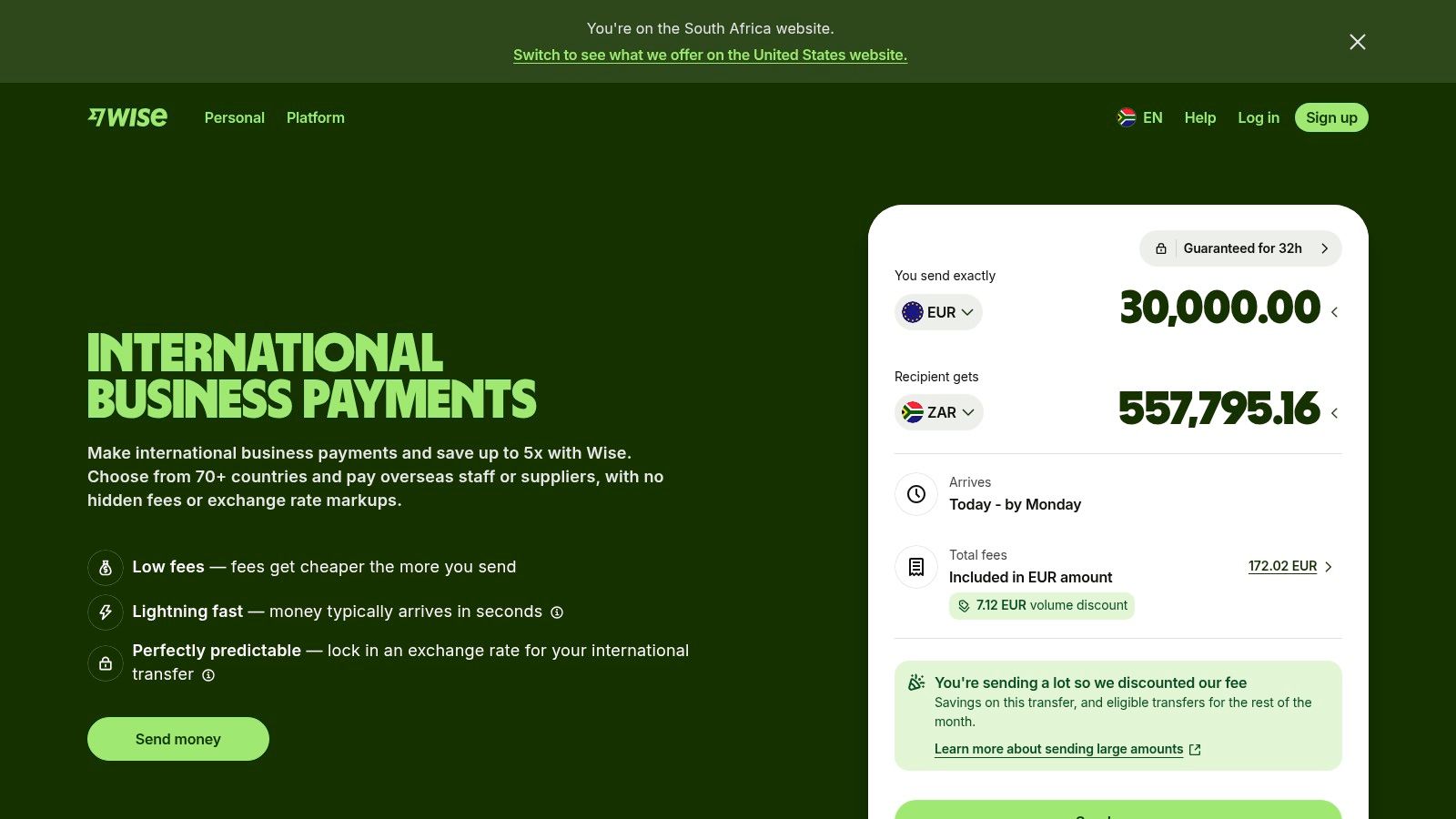
A South African business comparing transfer quotes on Wise may assume the hard part is picking the cheapest fee. It isn't. The harder question is whether the business can legitimately access the route at all. Wise is a transfer service rather than a South African bank, and its international business payments page describes pricing and business payment options that not every local company qualifies to use.
Wise states that South Africa doesn't currently have the full Wise Account and that customers there can't currently send from ZAR. Paying rand into a South African account is supported; funding an outbound transfer directly from a South African company's rand balance is a different matter. That makes Wise potentially useful on an eligible inbound route and unsuitable for the outbound workflow many local businesses need.
Confirm three things before treating any Wise quote as an available option: the registered business location, the funding currency, and the destination corridor.
Good price visibility, conditional route fit
- What works: Fees shown during transfer setup make an eligible route easier to compare against a bank quote.
- What doesn't: A competitive quote has no value if the business can't access the required account or funding method.
- Best-fit scenario: A supported business account and non-ZAR funding arrangement that legitimately matches the company's circumstances.
Eligibility rules deserve respect rather than workarounds. Requirements like the US address rules for non-resident PayPal exist because payment providers treat a registered address as proof of qualification, so don't try to solve a route restriction by substituting an address that doesn't represent the business.
I would consider Wise only after the route passes that check. Judge it by the rand landing in the business account, and establish who initiates the transfer and which party carries the funding and conversion costs.
How the Leading Options for South African Business Transfers Compare
A supplier invoice can look fine on the rate screen and still arrive short. The spread, a SWIFT charge and an intermediary deduction all come off before the rand hits the account. I rank these options by that net amount, and by whether a South African business can send or receive on the route.
| Item | Account Needed | Fee and Rate Transparency | Best For |
|---|---|---|---|
| Zaro | Verified South African business; KYB required | Transparent spread on the exchange rate and no SWIFT fees; pricing depends on volume and corridor, with a clear quote at sign-up or from the team, and fees shown before you confirm | South African businesses that want quoted cross-border payments rather than a bank markup |
| Capitec Business | Active Capitec Global Biz account | Fixed processing fees are published; exchange rates and possible intermediary charges also apply | Businesses needing forex payments, foreign-currency accounts, or hedging tools |
| FNB Business Forex | Qualifying FNB account | Exchange rates and possible third-party charges affect total cost | FNB businesses managing recurring payments or batches |
| Standard Bank Business International Payments | Business banking access; some services require Business Online registration | Rates and transaction costs can be viewed before payment; intermediary charges may apply | Businesses needing international payments alongside FX and foreign-currency accounts |
| Absa Business International Banking | Business platform access; confirm account requirements | Rates are available online during payment processing; confirm pricing for the account and route | Businesses with international trade, treasury, or cash-management needs |
| Access Bank South Africa | Business relationship-manager service; confirm the account type with the bank | No universal public transfer-fee figure; confirm pricing with the bank | Businesses with established trade and trade-finance needs |
| Wise | Eligibility depends on business location, account, and route; South African users lack the full Wise Account | Fees are shown during setup; qualifying transfers may receive volume discounts | Eligible businesses transferring on supported routes, generally with non-ZAR funding |
Public arrival times are not comparable across this set, so the table does not pretend they are. Zaro is the exception I can state plainly: funds from the US typically reach a South African account in a matter of minutes, with low FX spreads, no SWIFT fees and bank-grade security. For the banks, ask for the full rand debit on an outgoing payment, or the rand credit on the same foreign-currency receipt, and treat any intermediary cut as part of the price. A cheap headline rate that the business cannot fund from its own account is not a real option.
Match the Route to Your Payment Flow Before You Sign
Start by mapping how often you pay overseas, which currencies you use and whether you receive export revenue. Separate incoming receipts from outgoing obligations, then identify where the currencies overlap. A business paying suppliers from export proceeds has different requirements from a company converting every receipt into rand for payroll.
For incoming payments, request a written comparison showing the rand received for the same foreign-currency amount. For outgoing payments, reverse the calculation: compare the total rand debit required to deliver the same amount to the beneficiary. Use quotes obtained close together, because exchange-rate movements can otherwise distort the comparison.
Make the quote operationally complete
Your comparison should record more than the rate. Include the conversion spread, payment charges, known intermediary deductions, receiving fees, quote expiry and expected settlement date.
- Confirm eligibility: Record the contracting business entity, required account, supported funding currency and permitted destination.
- Prepare documentation: Keep invoices, payment-purpose information and source-of-funds evidence ready for review.
- Test the workflow: Run a representative transfer and reconcile the quote against the actual debit, credit and arrival time.
- Check controls: Assign responsibility for beneficiary changes, payment preparation, approval and exception handling.
Compliance is an ongoing payment workflow, not just an onboarding form. SARB's cross-border regulation material describes work on a coordinated framework for payment-facilitator activity covering payment-system and financial-surveillance requirements. Distinguish proposed frameworks from requirements already applicable to your transaction.
If your business is also evaluating stablecoin-based infrastructure, keep settlement separate from treasury investment. Discussion of putting customer USDC to work concerns a different decision from choosing how to collect an export invoice or pay a supplier.
The best bank to transfer money internationally is the eligible provider whose complete payment workflow fits your business at a defensible delivered cost. Choose on the evidence from your quote and test transfer, not a headline fee, a familiar logo or a speed claim without conditions.
We offer South African businesses transparent, quote-based FX pricing, no SWIFT fees and fast cross-border settlement through bank-funded ZAR and USD accounts. Visit Zaro to start KYB onboarding and get a corridor-specific quote you can compare against your bank's net rand outcome.