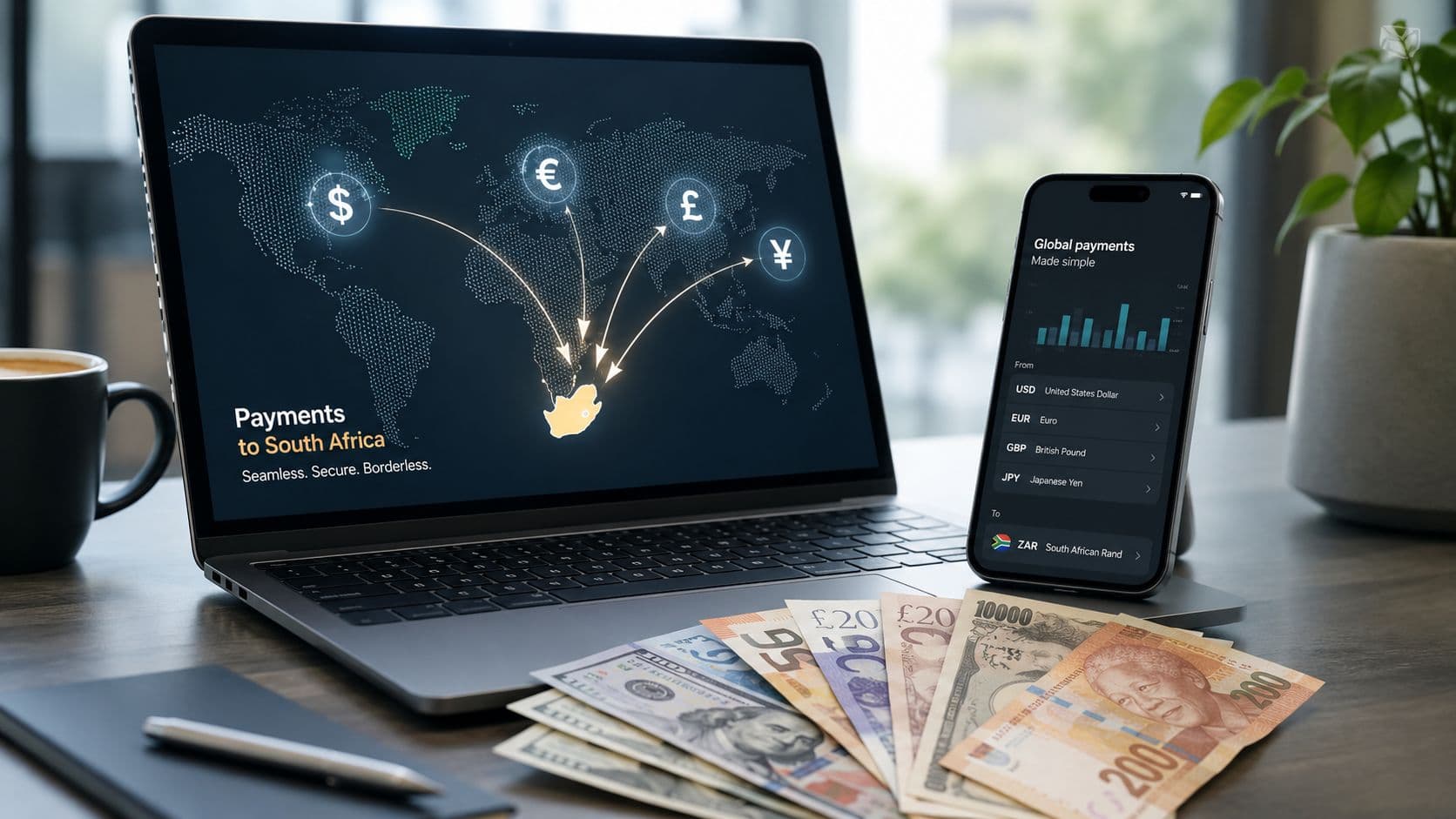
An overseas client pays your South African business on time, yet the amount that reaches your account is lower than the invoice. Your bank statement shows a receiving charge, the converted rand amount looks weaker than expected, and nobody can immediately explain what an intermediary bank deducted along the way. You're left reconciling a short payment instead of serving customers or managing cash flow.
That's why the best way to receive international payments isn't just the bank with the lowest advertised fee. You need to compare the all-in cost, including receiving charges, intermediary deductions, FX spreads, processing fees, settlement speed, and compliance work. The right choice also changes according to whether funds come from a SADC neighbour, the UK, Europe, the United States, or another market.
Why Receiving International Payments Costs More Than You Think
A South African exporter might invoice an overseas buyer in a foreign currency and expect the full amount to arrive in a local account. The buyer sends the correct sum, but the beneficiary receives less. The missing value can come from several points in the payment chain, not one obvious bank charge.
The first layer is the incoming payment fee. Capitec's 2026 fee schedule lists a charge of R50.00 to receive an international payment in rand or foreign currency, according to its 2026 personal banking fee schedule. Nedbank's 2026 pricing applies 0.63% to digital incoming payments above R2,000, with a R160 minimum and R747 maximum, as reflected in its published pricing information. Those charges can matter disproportionately when a business receives frequent smaller payments.
The visible fee is only the first deduction
A bank may also apply a conversion margin when it changes dollars, pounds, euros, or another currency into rand. The exchange rate shown on the statement may differ from the current market rate, even when the separate receiving fee appears reasonable.
Then there are intermediary costs. Standard Bank's international payment disclosure states that an international payment may attract charges from the sending bank, beneficiary bank, and an intermediary bank. It also explains that the beneficiary bank fee may not be known in advance. Independent South African banking coverage cited in the verified data describes commission ranges of roughly 0.43% to 0.63%, flat telecommunication charges, and correspondent fees that can reach R1,500 per transfer.
CFO rule: Never compare receiving fees without comparing the final rand value credited to the account.
FX spreads can be the largest part of the stack. African cross-border payments research cited in the verified data reports bank and intermediary FX spreads of 3% to 8%. The South African Reserve Bank paper on cross-border payments shows why this deserves attention. Remittance outflows from South Africa to the rest of SADC grew from R6 billion in 2016 to more than R19 billion in 2024, a rise of over threefold. As payment volumes expand, small pricing differences become a recurring margin expense.
The Main Methods for Receiving International Payments
South African businesses have six practical channels. Each uses a different combination of banking networks, account structures, payment gateways, and foreign exchange providers.

Bank SWIFT transfers
A traditional bank wire uses the banking system and, for many international routes, the SWIFT messaging network. The sender instructs its bank, one or more correspondent banks route the payment, and the South African beneficiary bank credits the business account after receiving and processing the funds.
This route works well for occasional, high-value invoices where both parties want a familiar bank-to-bank process. It's less attractive for regular smaller receipts because fixed fees, intermediary deductions, and bank FX margins can make reconciliation unpredictable.
Multi-currency accounts
A multi-currency account lets the business receive and hold selected foreign currencies before converting them into rand. That gives the finance team control over conversion timing and can reduce unnecessary conversions when the business also has foreign suppliers or expenses.
This structure is useful for exporters and firms selling through international marketplaces. The business can receive a foreign currency balance, match it against future expenses, and convert only the amount it needs.
Payment processors
Stripe, PayPal, and similar gateways sit between the overseas customer and the business. They handle card payments and other checkout methods, then release the balance to a linked bank or multi-currency account.
Processors are often the natural choice for e-commerce, software subscriptions, and online services. Their convenience comes with transaction pricing, possible conversion markups, withdrawal rules, refunds, and chargeback administration.
Local collection accounts
A local collection account gives the business account details in the payer's market or currency zone. The overseas customer pays locally, and the provider later transfers or converts the funds for the South African business.
This can remove some correspondent-bank friction. It's particularly useful when customers resist paying an international wire or when a business receives repeated payments from one region.
Forex brokers
A specialist foreign exchange provider can receive or help manage foreign currency and convert it into rand. Forex brokers make the most sense for businesses with recurring receipts, larger invoices, or a need to discuss pricing rather than accept a bank's standard margin.
The important question is whether the broker's quoted rate is transparent and whether the full transfer path is clear. A lower advertised spread doesn't help if the receiving bank or intermediary still deducts an unexplained charge.
Fintech platforms
Modern fintech platforms combine account management, payments, foreign exchange, user permissions, and reporting in one digital environment. Zaro, for example, provides ZAR and USD accounts, supports global payments, and uses a live exchange rate with zero spread for cross-border transactions, according to the publisher information supplied for this article.
Fintech onboarding usually involves KYB verification and documented controls. In return, businesses may gain clearer pricing, faster visibility, multi-user approvals, and easier reconciliation than they get from a basic bank account.
Comparing Costs Speed and Security Across Payment Methods
The cheapest-looking route can become expensive once the payment arrives. Evaluate every option against four questions: What will the business receive? How quickly will it be usable? Who controls the risk? How much compliance work is required?
| Method | Typical Cost | Settlement Speed | FX Transparency | Compliance Burden |
|---|---|---|---|---|
| Bank SWIFT transfer | Fixed receiving fee, percentage commission, intermediary charges, and possible FX margin | Can be slower and less predictable because several banks may process the payment | Often limited unless the bank gives a clear conversion quote | Higher documentation and payment-purpose checks |
| Multi-currency account | Account, transfer, conversion, or withdrawal charges depend on provider | Usually efficient once funds reach the account | Stronger when the business can hold currency and choose when to convert | Moderate, with account verification and transaction records |
| Payment processor | Transaction fee, possible withdrawal charge, and conversion cost | Fast customer authorisation, but payout access can depend on processor rules | Varies by processor and payout currency | Moderate, with merchant verification and chargeback controls |
| Local collection account | Provider fee and conversion charge, with fewer traditional correspondent deductions on suitable routes | Often quicker than a full international bank chain | Usually clearer if the provider shows the rate and fee separately | Moderate, with business verification and source-of-funds records |
| Forex broker | Negotiated spread or conversion fee, plus possible transfer charges | Suitable for planned transfers rather than instant checkout | Can be strong if the provider discloses the rate and spread | Moderate to high for larger or more complex transactions |
| Fintech platform | Transparent account or transaction pricing, depending on the provider | Often designed for digital visibility and faster execution | Strong when the platform uses a live rate and separates fees | Moderate, with KYB, user controls, and transaction monitoring |
Cost needs an all-in test
Published bank pricing demonstrates the fixed-cost floor. Capitec lists R50 for an incoming international payment, while South African fee schedules also show examples such as R250 for a foreign currency or ZAR incoming FX payment marked SHA/BEN and R350 for an OUR payment, according to the verified bank-fee data and Capitec's business banking pricing.
The payment instruction matters. Under SHA or BEN arrangements, costs can be shared or deducted from the beneficiary. Under OUR, the sender agrees to cover more of the charges, but the route still needs checking because banks and intermediaries apply their own rules.
Speed and control are connected
A bank transfer can be secure yet operationally awkward. The sender may have proof of payment while the recipient waits for intermediary processing, compliance review, or a query about the payment purpose. A fintech or local collection route can provide earlier tracking and a clearer status, but the provider still needs strong verification and transaction controls.
Security isn't just encryption. It also means authorised users, approval controls, reliable beneficiary verification, audit trails, and a clear process for disputed payments.
For occasional large receipts, a bank wire remains defensible. For frequent payments, compare the accumulated fixed charges and FX treatment. For online sales, a processor is usually necessary at checkout, but a multi-currency account or fintech account may improve the payout and conversion stage. For businesses with regular foreign-currency income, holding the currency before conversion often provides more control than accepting automatic conversion into rand.
How Corridor and Currency Choice Changes the Best Route
The payment corridor determines the sensible rail. A transfer from Lesotho, Namibia, or eSwatini isn't priced and routed in exactly the same way as a payment from the United States, the UK, Europe, or Asia.
The Common Monetary Area deserves separate treatment. Standard Bank's pricing distinguishes transactions outside the CMA from CMA-related payments in its 2025 non-resident pricing guide. The Reserve Bank's cross-border payments research also indicates that pricing and corridor mechanics vary significantly between providers and routes.

SADC and CMA receipts
For a recurring payment from a nearby SADC market, ask whether a regional or local rail can settle the transaction without a full SWIFT chain. A business shouldn't default to an international wire just because the sender is outside South Africa.
Check the currency, the payer's bank, the beneficiary account, and whether the provider treats the route as CMA-related. The correct regional option may reduce friction, but don't assume every provider applies the same price. Request a route-specific quote.
Rest-of-world payments
For receipts from the US, UK, Europe, or Asia, compare a standard bank wire with a local collection account or multi-currency account. A bank wire may suit a once-off export payment where the buyer insists on its existing bank process. A collection or fintech account is often more practical for recurring service fees, marketplace proceeds, and smaller invoices.
The currency decision is just as important. If the business receives USD and immediately converts to ZAR, it accepts the provider's rate at that moment. If it can hold USD, it may use those funds for foreign expenses or choose when to convert. That doesn't remove currency risk, but it gives the finance team more control over the timing and cost.
Recommended Payment Methods by Business Use Case
Start with the payment pattern, not the provider's marketing. A business that receives one large export payment has different needs from a BPO company receiving regular monthly invoices.

Exporters receiving overseas buyer payments
Use a bank SWIFT transfer when the buyer's procurement team requires bank details and the invoice value justifies the administrative process. Before issuing the invoice, confirm whether the buyer will send under OUR, SHA, or BEN instructions and ask the beneficiary bank for its receiving requirements.
For repeated export proceeds, add a multi-currency or fintech account to the structure. Receive the foreign currency into an account that shows the rate and charges clearly, then convert according to your cash-flow needs. Keep the bank route available for buyers who won't use an alternative.
BPO and professional services firms
A BPO business receiving regular service fees should avoid treating every invoice as a standalone wire. Use local collection details or a digital multi-currency route where available, then reconcile receipts against invoice references in one dashboard.
This arrangement supports cleaner monthly reporting. It also lets the finance team compare the actual received amount with the invoiced currency before deciding how much to convert.
E-commerce merchants
Use a recognised payment processor for card and wallet acceptance because the customer needs a familiar checkout. Don't stop the analysis there. Review the processor's payout currency, conversion treatment, refund process, chargeback exposure, and destination account.
A multi-currency account can make the payout stage more efficient when the processor supports it. The best structure is often a combination, processor for customer checkout and a transparent account for holding and converting proceeds.
SADC trading partners
Ask the payer whether a regional account-to-account option exists before requesting SWIFT details. Confirm the corridor classification, settlement currency, payment purpose, and all beneficiary charges.
A hybrid structure is usually more sensible than forcing every receipt through one channel. Use regional rails for suitable SADC transactions, bank wires for exceptional payments, and a digital account for regular cross-border operating flows.
Practical Strategies to Minimise Fees and FX Risk
Fee control starts before the customer presses “send”. Put the currency, payment instructions, fee allocation, beneficiary details, and payment reference directly on the invoice. Then ask your provider to model the amount that will be credited, not merely the fee charged at initiation.

Reduce fixed charges
Batch smaller receipts where commercial terms allow it. A fixed incoming fee has a greater effect on a small payment than on a large one, so fewer, better-planned transfers can simplify reconciliation and reduce repeated deductions. Don't delay a payment that creates a cash-flow problem merely to save a fee, though. Liquidity has a value.
Keep currency control
If your business has legitimate foreign expenses, hold foreign currency instead of converting every receipt into rand immediately. This can reduce unnecessary round trips between currencies and lets you align income with supplier, contractor, advertising, or software costs.
Negotiate the whole package
Ask your bank or FX provider to discuss the total rate, not just the commission. A low commission with a wide FX margin isn't a saving. For regular volume, request a written quote that separates receiving fees, conversion rates, intermediary costs, and payout charges.
Use the right sender instruction
OUR, SHA, and BEN instructions change who bears the payment costs. Make the agreed instruction part of the contract and invoice, especially where your margin depends on receiving the full amount. Confirm how the beneficiary bank treats the instruction before relying on it.
Practical test: Send a small controlled payment through each shortlisted route, then compare the sender's amount, the credited amount, the exchange rate, and the reconciliation effort.
For larger foreign-currency exposures, discuss hedging with a qualified adviser. A forward contract may help a business protect the rand value of a known future receipt, but it creates obligations and shouldn't be used casually. For routine transactions, a provider using a transparent spot rate can be simpler than accepting an opaque bank conversion margin.
Getting Started with Your Chosen Payment Solution
Build the receiving setup around your invoices and cash cycle. Don't open an account first and work out the payment flow later.
1. Map every corridor
List each payer location, currency, payment frequency, expected invoice pattern, and current receiving account. Mark which payments are SADC or CMA-related and which travel through rest-of-world routes. This reveals whether one method is enough or whether a hybrid structure is justified.
2. Gather KYB records
A modern fintech platform will normally verify the business, its directors or beneficial owners, operating activity, and source of funds. Prepare company registration records, ownership information, director identification, proof of address, bank details, invoices, contracts, and a concise explanation of the business model.
Traditional banks also conduct compliance reviews. Clear documentation helps either route and reduces delays when a payment is queried.
3. Set permissions before money moves
Create separate roles for payment preparation, approval, reconciliation, and administration. Use multi-factor authentication and require a second approver for material payments. The finance team should be able to see who created, changed, approved, and released each transaction.
4. Fund and test the account
For a platform supporting both rand and foreign-currency balances, fund the relevant account through a standard bank transfer, verify the beneficiary information, and complete a controlled test receipt. Match the sender's proof with the final credited amount and record every deduction.
5. Update customer instructions
Change invoice templates, contracts, website payment details, and supplier records only after the test succeeds. Tell overseas payers which currency to use, who bears charges, what reference to include, and where to send remittance advice.
Review the arrangement after the first reconciliation cycle. If the credited value, settlement visibility, or compliance workload doesn't meet expectations, change the route before payment volumes grow.
Zaro offers South African businesses ZAR and USD accounts, transparent spot-rate foreign exchange, cross-border payment functionality, and team controls for finance operations. Compare your current all-in receiving cost with a digital alternative, then visit Zaro to assess whether its account and payment setup fits your corridors.