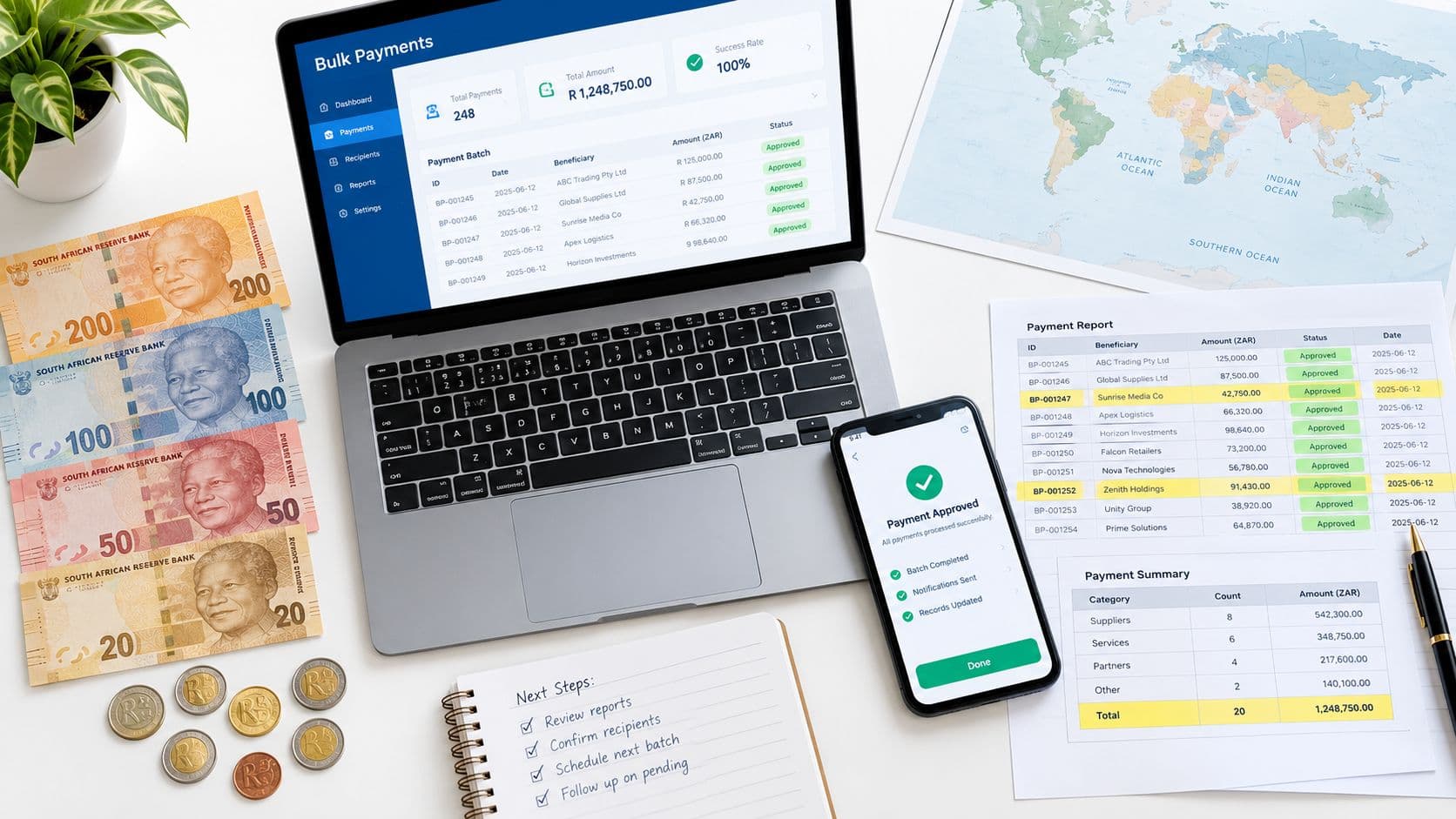
It's the 25th. Your supplier file is awaiting approval, payroll is due, and overseas contractors expect payment. One beneficiary's bank details changed by email, the cut-off is close, and expected export proceeds have not cleared. The amounts may look right, but releasing the batch without checking authority, funding, and evidence puts control at risk.
South Africa's payment infrastructure handles substantial corporate and interbank value. In 2022, SAMOS processed R129.2 trillion, and wholesale payments represented 89% of settlement value. The South African Reserve Bank's payments reporting provides context for the system businesses rely on. Efficient payment rails help move money; they do not verify your beneficiaries or approval trail.
Treat each payment line as a separate obligation, even when one file carries the whole batch. Each has its own beneficiary, purpose, currency, and approval history. Set a control that lets finance trace every line from its invoice or payroll record through authorisation to settlement. A single upload can simplify processing, but it cannot replace that audit trail.
Why Bulk Payments Break Down for Growing South African Teams
A Cape Town exporter's month-end run can put local suppliers, overseas contractors, and payroll on the same afternoon's agenda. Each payment carries its own deadline, authority, funding requirement, and supporting evidence. When the team relies on a shared spreadsheet, approval emails, and a bank portal with a fixed cut-off, the main bottleneck is proving that every line is valid before release.
Domestic and cross-border payments follow different rules. A ZAR supplier batch may depend on a scheduled processing window and sufficient prefunding. An overseas contractor payment can require extra beneficiary and bank details, currency conversion, purpose information, and supporting documents. Combining them in one file does not make their obligations the same.
A batch is not a control
A bank can check whether a file meets its technical requirements. It cannot confirm that a supplier invoice is genuine, that an amended account belongs to the supplier, or that the payment purpose is recorded accurately. Finance owns those checks, and should retain evidence against each payment line.
That responsibility matters when a bank statement records one debit for a file containing many recipients. Reconciling only the debit to the batch total can leave a rejected or misdirected payment hidden among successful ones. Match each line to its instruction, approval, and settlement outcome.
Operational rule: Treat the batch as a delivery format, not proof that every payment inside it is valid.
The rails are only part of the answer
The Reserve Bank's payments reporting cited earlier shows the scale of the payment infrastructure companies rely on. That scale makes the quality of a company's own payment controls more important, not less. Payment systems move value; they do not replace an approval matrix, commercial checks, or a line-level audit trail.
Map who creates each file, who approves it, who can change beneficiary details, and who investigates exceptions. Keep evidence of those actions against the affected payment line, including its purpose and supporting documents where required. If one person can edit a supplier's banking information and release that supplier's payment, the workflow has a material weakness, even if the bank accepts the file.
Teams assessing which repetitive finance checks can be systematised can review how AY Automate handles finance. Judge automation by whether it makes decisions, exceptions, and approvals easier to trace, not by whether it speeds up processing.
Building a Domestic Supplier and Payroll Batch You Can Trust
A domestic batch should follow a controlled path from the ERP or treasury system to the bank and back into the ledger. Don't let the urgency of payday or a supplier deadline turn file preparation into an informal exercise.
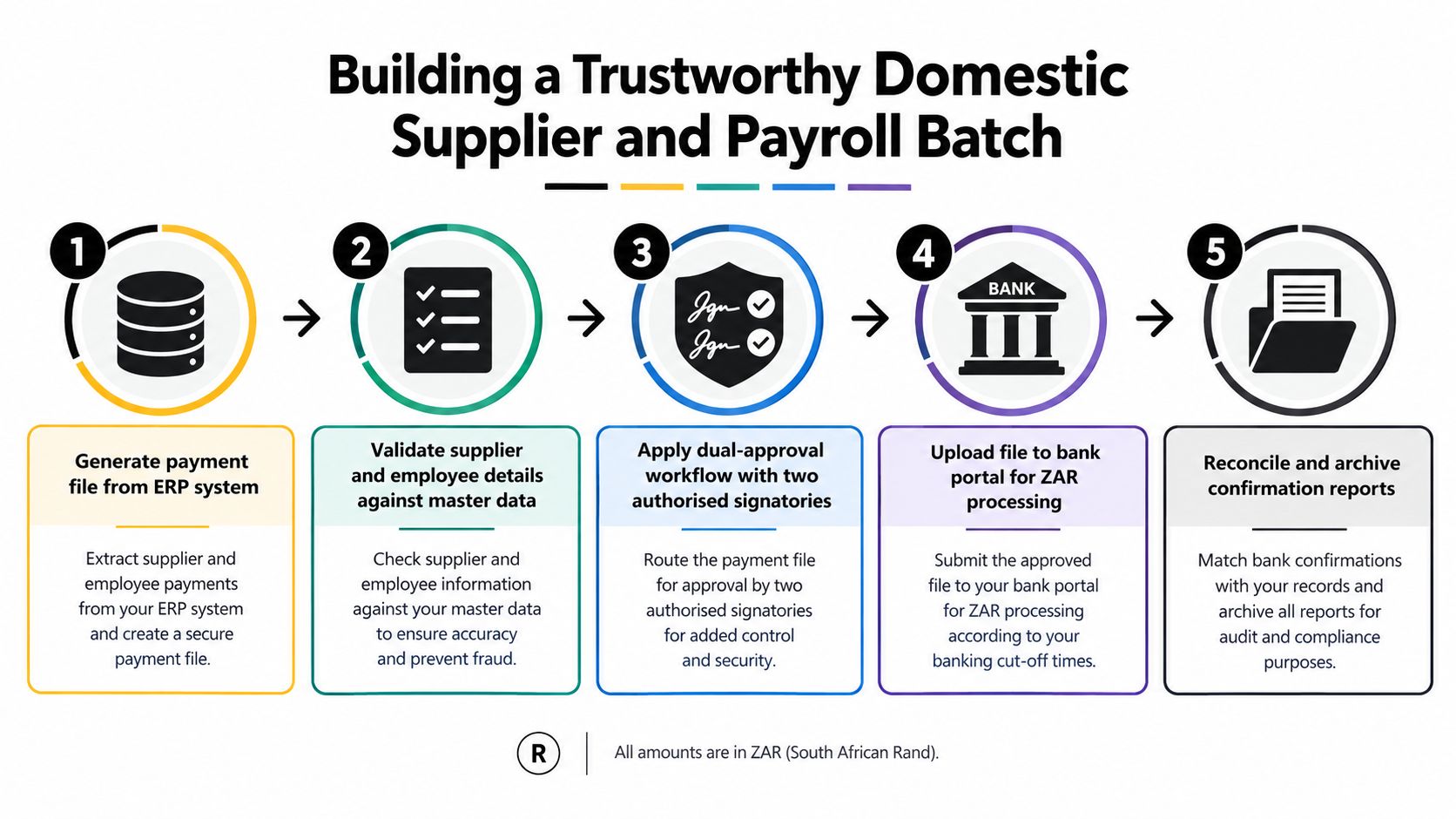
Use a repeatable release sequence
Generate the file from the system of record. Pull payment instructions from the ERP or treasury system rather than rebuilding the batch manually in a spreadsheet. Keep the original export and identify the run clearly.
Validate each line. Check beneficiary account fields, payment amounts, duplicate references, value dates, and approval limits. Compare changes against approved supplier or employee master data. A clean file structure is not proof that the underlying details are correct.
Apply independent approval. The preparer should confirm the file's content and produce an exception report. An independent approver should review the total value, beneficiary count, exceptions, and any material changes before release. This four-eyes model is a basic safeguard, not administrative theatre.
Transmit securely and meet the cut-off. Encrypt the file and send it over a secure host-to-host channel, such as SFTP, where available. Conventional batch processing uses scheduled clearing windows, so teams commonly need to plan submission on a T-1 or T-2 basis. Confirm your bank's actual cut-off instead of assuming that a payment uploaded on the due date will arrive on time.
Reconcile the response, not just the debit. Match the bank's acceptance report, rejects, returns, and final account statement to the original control total and then to each payment line. Archive the evidence with the batch record.
Catch the failures banks may not catch
The common failure points are predictable: late file submission, invalid beneficiary details, insufficient prefunding, duplicate uploads, and weak post-settlement reconciliation. A bank may reject a malformed instruction, but it won't necessarily tell you that a valid-looking payment was sent to the wrong account after a fraudulent master-data change.
The scale of automated processing makes careful validation essential. BankservAfrica processed 4,082,778,280 transactions worth R13,529,179,133,727 in 2020/21, as described in an Absa CIB report on African instant payments. That is a system-level illustration, not a forecast of your reject rate. Your operational lesson is simpler: validate before submission, and make exceptions visible after settlement.
For a practical view of how payment data connects to finance systems, review spend visibility across SAP and Microsoft. Whichever tools you use, retain the source file, approvals, bank response, and line-level reconciliation together so an auditor or colleague can retrace the run without relying on someone's memory.
Adapting the Same Workflow for Cross-Border Bulk Payments
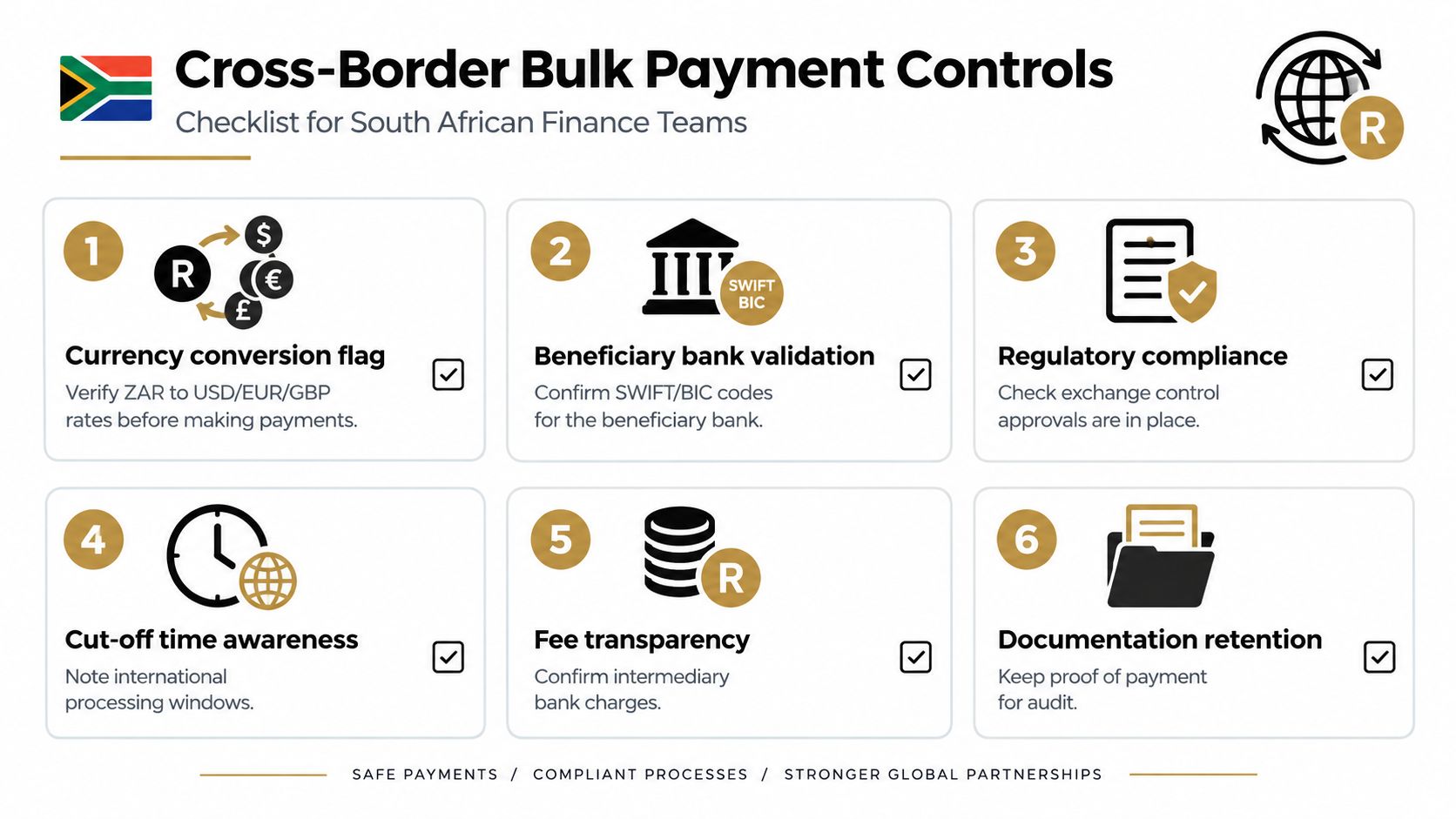
Cross-border bulk payments need the same discipline as domestic runs, with more information attached to each instruction. A batch containing contractor fees, a supplier invoice, and a royalty payment may be operationally convenient, but those are distinct transactions with distinct supporting records and purposes.
The 2023 South Africa Trade Barometer found that EFTs and international transfers together accounted for 66% of cross-border corporate payment methods. It also reported that 22% of businesses exported, and 45% of exporters shipped to at least one Southern African market. Those findings underline that overseas payment activity is part of ordinary business operations for many firms, not an exceptional task. The South Africa Trade Barometer provides the survey context.
Preserve an auditable record for every payment
For each line, assign a unique end-to-end ID and capture the beneficiary's legal name, bank identifiers, country, currency, and payment purpose. Attach the invoice, contract, or other commercial evidence that explains why the money is moving. Don't use a single vague purpose description to make unrelated payments easier to upload.
Before release, screen the originator, beneficiary, bank, and relevant jurisdiction. Apply sanctions, AML, transaction-limit, and dual-approval rules, then transmit structured payment messages through the chosen provider. Reconcile each response to both the instruction and its supporting document.
Keep batching separate from regulatory aggregation
Batching is an operational choice. It doesn't remove the need to identify the payer, beneficiary residency, purpose, currency, supporting evidence, or relevant reporting details for each payment. SARB's 2026 guidance says authorised dealers and authorised dealers with limited authority must report cross-border foreign-exchange transactions, while businesses must provide complete transaction details and complete an integrated form for inward and outward payments. See the SARB Currency and Exchanges Guidelines for Business Entities for the applicable guidance.
In practice, that means your payment file and supporting records need to preserve the purpose and evidence of each line. Don't bundle unrelated supplier invoices, service fees, royalties, dividends, or contractor payments under a catch-all description because they share a release date.
A banking-sector report also identifies bulk settlement visibility as a risk: when only the aggregate settlement can be seen, it becomes harder to establish who sent funds, whether the source of income is credible, and whether each payment relates to genuine goods or services. The report found that 60% of large banks surveyed had identified abuse of debit cards or EFTs in cross-border illicit-financial-flow activity, compared with 25% of small and medium banks. Those findings are in the banking-sector report on illicit financial flows and trade-based money laundering. Keep immutable approval logs, verify first-time beneficiaries independently, and hold any line with missing purpose or invoice information.
Where the Money Actually Leaks in Bulk FX Payments
A bank confirmation that shows a payment fee doesn't tell you the full cost of a cross-border batch. Finance teams should track three separate layers: the stated transaction charge, the exchange rate applied, and the effect of funding and settlement timing on working capital. If you compare providers using only the fee line, you're comparing only part of the transaction.
Separate the visible fee from the exchange rate
The explicit fee may appear as a transfer, correspondent, or service charge. Ask whether the quoted amount covers every intermediary or whether another institution can deduct a fee from the funds in transit. If the beneficiary receives less than the instructed amount, your team needs to know why before releasing the next batch.
The FX cost sits in the conversion rate. Compare the rate offered with the relevant market rate at the same time, and record the difference alongside the fee. A provider can advertise a low transfer charge while applying a less favourable exchange rate, leaving the total cost unclear unless finance checks both.
The funding and timing cost is less visible. Money held in a prefunded account is unavailable for other operating needs, while late settlement can delay a supplier payment or leave an exporter waiting to use revenue. These effects belong in the payment review even when they don't appear as a separate bank charge.
| Cost layer | Where it shows up | Typical signal |
|---|---|---|
| Transfer and intermediary fees | Provider quote, bank statement, or deductions in transit | The beneficiary receives less than the payment instruction |
| FX conversion | Applied rate and converted amount | The rate differs from a comparable market reference |
| Funding and settlement timing | Cash forecast and reconciliation record | Funds sit idle or arrive too late for the intended payment date |
Ask for a comparable quote
Compare providers using the same payment amount, source currency, destination currency, beneficiary route, and timing assumptions. Ask for the total amount debited and the expected amount received, with fees and FX conversion shown separately. If the provider can't explain how it calculates the rate or what the recipient will receive, you don't have enough information to approve the payment method.
An exporter repatriating foreign-currency revenue should apply the same discipline in reverse. Record the amount received, the rate used, any fees, and the resulting ZAR credit. That gives the finance team a usable view of cash conversion rather than a vague sense that the transfer was expensive.
Don't use a made-up worked example to compare providers. Pull a recent batch from your own ledger, remove sensitive beneficiary details, and request like-for-like pricing. That evidence will show whether the main leak is the transfer fee, the FX rate, delayed availability, or a combination of them.
Security and Governance When One Click Moves a Million Rand
Automation doesn't weaken controls by itself. Poorly designed permissions do. A system that moves a large batch quickly should make it easier to enforce approvals, identify changes, and prove who authorised each payment.
SABRIC-reported data cited by ITWeb says South Africans lost R2.4 billion to digital-banking crime across slightly more than 110,000 incidents in 2025. That figure is a warning about the consequences of weak digital-banking security, not a prediction that every batch will be targeted. ITWeb's report on business email fraud and digital-banking crime offers relevant context.
Split the powers that can move money
Don't give one user control over the entire payment chain. Separate file preparation, beneficiary-master-data changes, FX approval, and final release wherever your team structure allows. A preparer should not be able to change a beneficiary's bank details and approve the payment to those details without independent review.
Set dual approval for payments that exceed your risk thresholds or involve a new beneficiary, changed bank details, or unusual purpose. Independently verify any change to beneficiary banking information using a trusted contact channel, not the email or message that requested the change. Make approval evidence part of the transaction record.
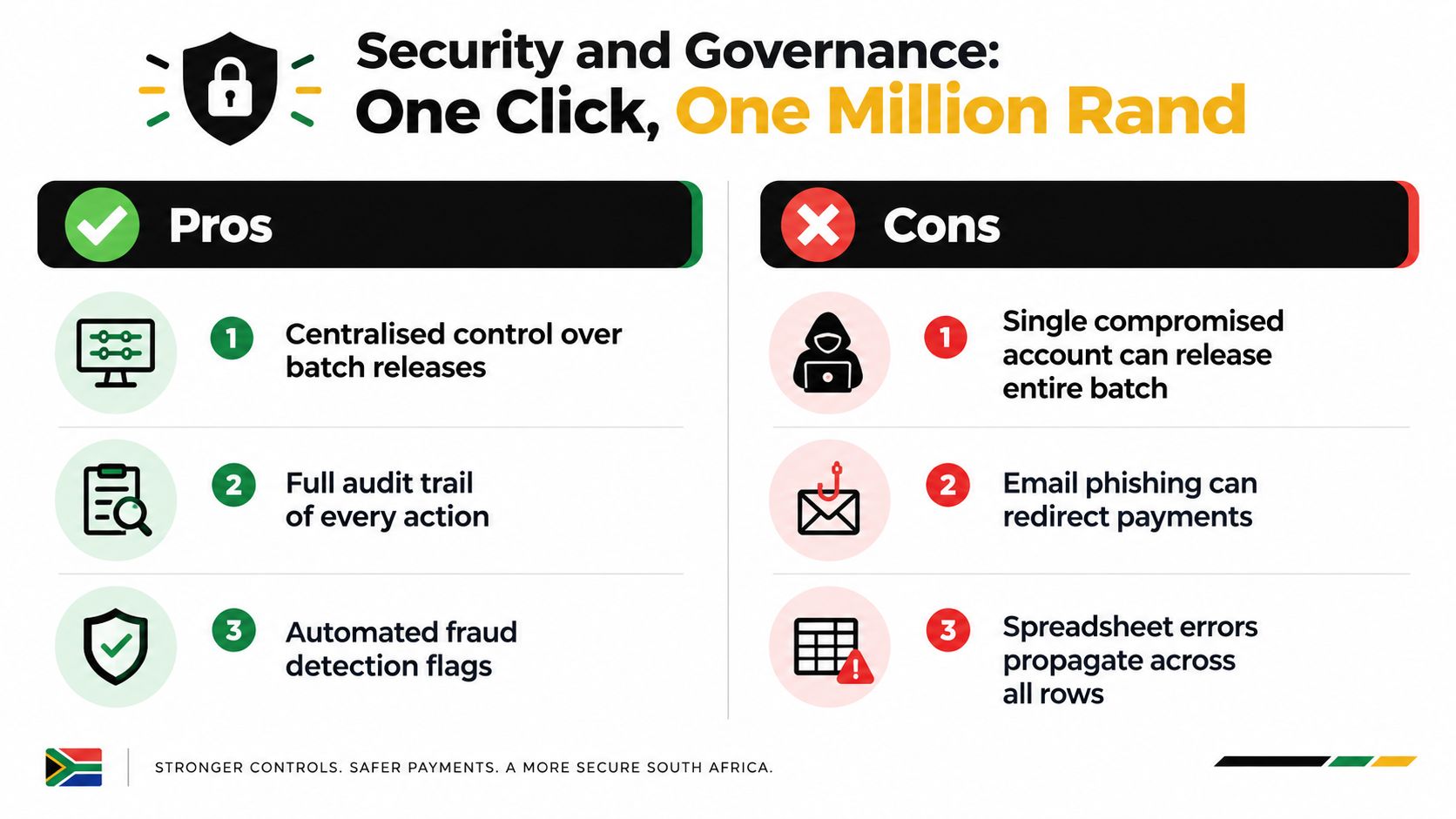
Control principle: Automation should make approvals programmable, visible, and proportionate to the payment risk.
Reconcile both sides of the release
After release, compare the submitted batch with the bank's response and reconcile each payment to the beneficiary outcome where that information is available. A matching batch total alone can hide a rejected payment, an altered instruction, or a short receipt after intermediary deductions. Record who reviewed each exception and how it was resolved.
The video on secure payment processes can support a team discussion about the risks around digital payment workflows. Use it to prompt practical questions: who can change a beneficiary, who can authorise a release, and what happens if the approver is unavailable on batch day?
A finance team doesn't need a complicated approval maze. It needs clear role separation, appropriate limits, independent checks on changes, and an audit trail that ties each payment to its evidence. When those controls are built into the workflow, automation can reduce manual handling without turning a single compromised account into the key to the entire batch.
Choosing Between Bank Files, ERP Integrations, and a Fintech Layer
The right setup depends on where your team spends its time and where payment risk sits. A domestic business paying local suppliers may be well served by a bank file. An exporter or BPO managing recurring international payments may need better visibility into currencies, beneficiary records, and line-level compliance data.
| Option | Cost transparency | Control granularity | Best fit |
|---|---|---|---|
| Bank batch file | Depends on the bank's fee and FX disclosures | Strong if your team adds independent approvals and line-level reconciliation | Regular domestic supplier and payroll runs |
| ERP integration | Depends on the connected bank or payment service | Can connect invoice, approval, and payment records if configured well | Teams seeking fewer manual hand-offs between finance systems |
| Fintech payment layer | Varies by provider; check fees and FX separately | Look for multi-user permissions, transaction-level records, and clear release controls | Exporters and BPOs with recurring cross-border payments |

Match the tool to the payment pattern
A bank file can be a sensible option when your runs are mostly domestic and the bank's file format, cut-offs, and reporting meet your needs. An ERP integration can reduce rekeying, but only if it preserves the evidence and approval trail rather than pushing data into a payment channel. For document-heavy finance workflows, ERP integration for document-heavy workflows is useful background when assessing how business records connect to payment operations.
A fintech layer deserves consideration when your team regularly handles different currencies or pays overseas suppliers and contractors. Assess the provider's pricing model, funding arrangements, cross-border coverage, user permissions, transaction reporting, and support for your compliance process. Ask for a test of the complete path, from source record to beneficiary receipt and final reconciliation.
Zaro is one option for South African businesses that need cross-border payments. It offers ZAR and USD accounts, file-based bulk freelancer payments, transfers at the actual spot exchange rate with no FX spread or SWIFT fees, and multi-user permissions. Verify how its workflow, supported payment routes, controls, and documentation fit your own bank, accounting, and regulatory requirements before selecting it.
Your 30-Day Bulk-Payment Improvement Plan
Use the next month to fix the process you have, not to buy a platform before you understand the gaps.
- Week one: Map how each batch moves from source system to beneficiary. Record fees, FX treatment, approvals, exceptions, and reconciliation steps.
- Week two: Tighten beneficiary-change verification, role separation, dual approval, secure transmission, and evidence retention.
- Weeks three and four: Test a small cross-border run with a bank or fintech. Review settlement timing, the applied FX rate, recipient outcomes, and the effort required to reconcile each line.
Treat these warning signs as prompts for a process review: month-end reconciliation regularly takes longer than two business days; the team needs manual overrides to complete routine batches; or nobody can quickly identify who approved a specific payment line. The objective isn't speed at any cost. It's a payment operation that can move funds efficiently and prove, line by line, why each payment was released.
If cross-border payouts are part of your regular workload, review how Zaro handles multi-currency accounts, file-based bulk freelancer payments, FX pricing, and team permissions. Compare the workflow with your current controls, then decide whether it gives your finance team the visibility and audit trail your batches require.