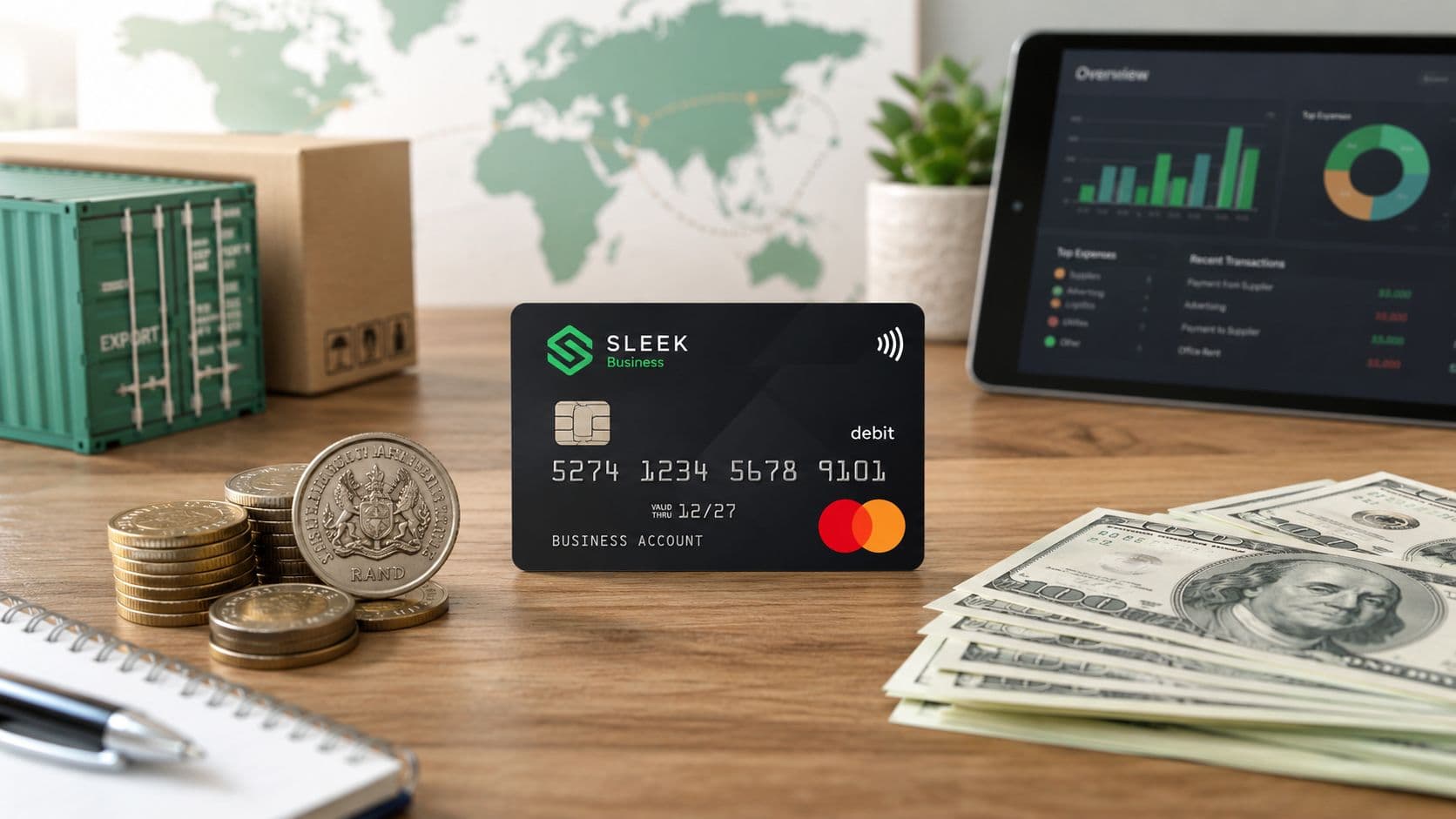
A Cape Town apparel exporter approves a USD invoice from a Shenzhen fabric supplier on Monday. By settlement, the rand has weakened, the bank has applied its foreign-exchange margin, and the first card attempt fails at the supplier's gateway. The finance manager then pays by wire, reconciles the card attempt manually, and discovers that the final rand cost bears little resemblance to the original quote.
That pattern is common among South African exporters. The card itself is only one part of the cost. Currency timing, conversion margins, international charges, declined-transaction fees, supplier acceptance, and month-end reconciliation all shape the true cost of cross-border spending. A business debit card can improve control, but a single-currency card attached to a traditional bank account won't solve the whole problem.
The Cross-Border Payment Problem for SA Exporters
The exporter in the opening example isn't dealing with one fee. They're dealing with a chain of decisions, each of which can add friction or cost. A USD invoice must be funded from rand, the payment must clear an overseas network, the supplier must accept the selected payment method, and the transaction must later be matched to the correct invoice and accounting record.
A weakening rand makes the first problem visible. The amount approved in ZAR can change before settlement, even when the supplier's USD invoice stays fixed. The bank's quoted rate may also include a margin that isn't displayed as a separate line item, making it difficult for a finance team to distinguish the market exchange rate from the provider's revenue.

Four friction points finance teams face
- ZAR/USD timing: A quote, approval, authorisation, and settlement can happen at different moments. The longer the process takes, the harder it is to forecast the rand cost.
- Hidden FX economics: A card can appear convenient while the issuer embeds its margin in the conversion rate. Finance teams should compare the actual debit against the observable market rate, not just the card's advertised fee.
- Manual reconciliation: A supplier invoice, card authorisation, final settlement, and bank statement entry may each show different references. Without currency-aware transaction records, staff spend time matching payments by hand.
- Weak spend governance: Overseas advertising, software subscriptions, freight platforms, and supplier portals can spread across several cards and accounts. A card without merchant, country, currency, and user controls creates leakage.
South Africa's payment environment makes this commercially important. The South African Reserve Bank Payments Study Report 2023 recorded debit card users at 91% of consumers in the DCPC segment and 75% in SCPC, with debit cards representing an estimated 34% of payment volume and 55% of payment value over the surveyed three-month period. The same report put the average debit card transaction at R768.20.
CFO view: Treat a business debit card as one component of a controlled multi-currency payment workflow. It isn't a substitute for currency planning, supplier controls, or disciplined reconciliation.
The scale is larger than everyday purchases. GlobalData's South Africa card-payments forecast reported that total card payment value rose 10.3% in 2024 to about ZAR2.7 trillion, with debit cards accounting for 74% of total card payment value. For exporters, that scale reinforces the point: small differences in the payment process can matter across repeated supplier, travel, software, and logistics transactions.
What Business Debit Cards Actually Are
A business debit card is a payment card connected directly to a company's current account or multi-currency wallet. When an employee pays, the provider deducts available funds rather than extending a revolving loan. The transaction normally carries useful bookkeeping signals, such as the merchant, merchant category, country, currency, cardholder, and reference.
That structure matters because the card becomes a spending-control instrument. A finance manager can allocate funds before the purchase, assign a card to a person or supplier, and review the transaction shortly after authorisation. The company doesn't need to wait for a monthly statement to discover that a budget has been exceeded.
Debit, credit, and corporate aren't interchangeable
A business credit card uses borrowed funds. The issuer settles the merchant and bills the company later, usually through a statement cycle. That can help a business manage a temporary cash-flow gap, but it introduces repayment obligations, possible interest, and a less immediate view of available cash.
A corporate card is usually built for a larger organisation with formal central billing, employee policies, travel administration, and more elaborate reporting. It may be credit-based, and the liability arrangement depends on the agreement. The word “corporate” describes the programme and governance model, not automatically a lower-cost way to pay overseas suppliers.
Business debit cards suit a different job. They let the company impose a hard ceiling based on the funded balance, while modern providers may add:
- Per-card limits: Allocate separate spending capacity to a buyer, traveller, or operations employee.
- Currency wallets: Keep ZAR and USD funds separate instead of converting every purchase through one nominated account.
- Virtual cards: Issue supplier-specific cards for online procurement, SaaS, or advertising.
- Instant controls: Freeze, replace, or restrict a card without waiting for a branch process.
- Transaction-level records: Export payment data for accounting and invoice matching.
Debit also avoids the need to manage a revolving credit facility and its utilisation behaviour. That doesn't make it universally superior. A buyer who needs supplier credit or rewards may prefer credit, while a larger company may need central corporate billing. For an exporter focused on real-time control, currency discipline, and no month-end card debt, debit is usually the cleaner starting point.
The Real Cost Stack Behind Business Debit Cards
The headline card fee is rarely the complete answer. A South African exporter should calculate the all-in cost per transaction, including the account currency, conversion method, international-use charge, decline handling, and fallback payment route.
The verified pricing examples show why. Standard Bank's commercial card pricing guide states an international transaction fee of 2.75% of the rand value for purchases and cash withdrawals outside South Africa. African Bank's business pricing lists international point-of-sale purchases at R3.95 plus 4% of the transaction amount, while Investec charges 2% for international currency conversion and cross-border card use.
Local transactions also have layers. Absa's 2025 business banking pricing guide shows a 2.25% merchant service fee per transaction and an out-of-bundle debit purchase charge of R5.00. The same source set records African Bank's R3.95 local point-of-sale fee and an additional R15.00 charge for declined international point-of-sale transactions.
Build the calculation from the payment outward
For each foreign transaction, check these layers:
- Account and card charges: Include card issuance, replacement, delivery, and account fees where they apply.
- Merchant acceptance costs: Separate the merchant service charge from the cardholder's own transaction charge.
- FX conversion: Identify whether the provider applies a spread, a fixed conversion fee, or both.
- International usage: Confirm whether cross-border purchases attract a separate percentage.
- Failure and fallback: Record decline fees, retry attempts, and the cost of switching to a wire or urgent payment.
- Reconciliation labour: Include the finance time needed to match authorisations, settlements, and invoices.
A USD1,000 supplier payment from a ZAR account can therefore have a materially different cost from a USD1,000 payment funded from a USD wallet. The comparison below intentionally leaves provider-specific amounts blank where the available verified data doesn't establish a universal price.
| Cost Layer | Bank-Issued Debit Card, ZAR Account | Multi-Currency Debit Card, USD Wallet |
|---|---|---|
| Funding currency | ZAR must be converted into USD at payment time | USD is funded before the purchase |
| FX exposure | Issuer conversion rate and any cross-border charge apply | No ZAR-to-USD conversion at the point of a USD purchase |
| International fee | May apply, depending on issuer and card programme | Must be checked against the provider's tariff |
| Decline handling | Can create retries, exception charges, or a wire fallback | Wallet balance and card controls can reduce avoidable declines |
| Reconciliation | Requires matching ZAR debit to USD invoice | USD transaction can map directly to the USD invoice |
| Cash-flow visibility | Rand balance falls when the payment settles | USD balance and ZAR balance remain separately visible |
For wider payment-process decisions, finance teams can also review capital cost savings by Capital Express when comparing merchant accounts and payment processors. The useful lesson is the same: compare the complete operating cost, not the attractive front-page rate.
Business Debit Cards vs Credit and Corporate Cards
The right card depends on what the company is trying to control. Exporters often choose credit because it feels flexible, or corporate cards because they sound more modern. Those are weak reasons. The decision should follow the payment pattern, funding position, and tolerance for FX uncertainty.
| Dimension | Business Debit Card | Business Credit Card | Corporate Card |
|---|---|---|---|
| Cash flow | Uses funded company cash immediately | Uses borrowed funds and settles later | May use credit or central company billing |
| Spending control | Balance, card limits, merchant rules, and wallet allocation | Limits exist, but the company also carries debt exposure | Formal policies, central limits, and employee controls |
| FX behaviour | Draws from the linked account or currency wallet | Usually converts through the issuer's rate | Often combines issuer conversion with travel and policy features |
| Reconciliation | Immediate transaction visibility | Statement-cycle settlement can delay coding | Strong reporting, but setup and administration can be heavier |
| Best fit | Exporters demanding hard cash and FX discipline | Buyers needing float, rewards, or repayment flexibility | Larger firms with central travel and employee-spend governance |
Choose based on the dominant payment
A business credit card is sensible when the company needs working-capital float and can manage the repayment cycle. It may also suit regular domestic spending where rewards matter more than currency control. It becomes less attractive when the business uses it for overseas supplier payments but can't clearly identify the issuer's conversion economics.
A corporate card makes sense for a business with many travellers, departments, or formal expense policies. Its reporting can be valuable, but the company should still inspect cross-border fees, currency conversion, cash withdrawal pricing, and the liability terms.
A business debit card is the practical choice when the priority is spending only what has been funded. It limits debt exposure and gives the finance team a faster view of supplier, travel, advertising, and software spend. The strongest version is a multi-currency setup, not a single ZAR card used for every foreign purchase.
Decision rule: If cross-border supplier payments dominate card spend, prioritise a funded USD wallet and a USD debit card. If temporary float dominates, assess credit. If central travel administration dominates, assess corporate cards.
The exporter should also ask whether the company can recover card costs by adding a surcharge to customers. The Payments Association of South Africa's 2025 clarification states that merchants aren't allowed to add extra charges for card purchases and that acquirers must enforce the no-surcharging rule. That makes internal cost control more important than assuming the customer can absorb acceptance costs.
Why a ZAR and USD Multi-Currency Card Setup Changes the Math
A ZAR and USD card structure changes the funding route, not merely the card label. The company receives or holds USD in a USD wallet, then pays a USD supplier from that wallet. Domestic costs remain in ZAR, and the business converts between currencies only when treasury chooses to do so.
That separation removes the most obvious avoidable error, paying a USD obligation from a ZAR balance and accepting whatever conversion rate the card issuer applies at authorisation or settlement. It also reduces the risk of a forced rand sale when export receipts are already available in USD.

Use each wallet for the job it was designed to do
A workable operating model looks like this:
- Receive USD export proceeds: Keep foreign-currency receipts in the USD wallet when they're earmarked for foreign suppliers, contractors, travel, or platforms.
- Issue the USD card: Use it for USD supplier payments and overseas expenses that should settle from the USD balance.
- Keep local spending in ZAR: Use the ZAR card for domestic suppliers, fuel, local services, and rand-denominated overheads.
- Convert deliberately: Move funds between wallets when the treasury decision makes sense, rather than allowing every card purchase to trigger an automatic conversion.
- Match currency to invoice: Code the USD card transaction against the USD invoice and retain the supporting documentation.
This doesn't make every fee disappear. A provider can still have card, wallet, replacement, ATM, or compliance charges, so the tariff must be read carefully. The advantage is structural: the company stops paying an FX conversion cost on transactions that can be funded in the transaction currency.
A wallet split also improves decline prevention. The card isn't relying on a single rand balance to support every currency, and finance staff can see whether a failed payment reflects insufficient USD funds, a merchant restriction, a country rule, or a fraud control. That distinction saves time during supplier deadlines.
For South African businesses, Zaro offers business accounts with ZAR and USD balances and issued debit cards for local and international spending. Its stated account model supports receiving and sending funds in those currencies, while card controls and user permissions can help finance teams separate operational spending from approval authority.
Here's the practical workflow for an exporter:
- Receive buyer funds in USD.
- Reserve the required amount for foreign supplier obligations.
- Pay those obligations with the USD card where card acceptance is appropriate.
- Use the ZAR card for South African operating costs.
- Review both currency ledgers before month-end close.
Selecting, Implementing, and Securing the Right Card
Start with the payment routes your business uses. Ask suppliers which network they accept, identify the countries and merchant categories involved, and test the payment flow before issuing cards to the whole team. Visa and Mastercard acceptance can vary by market, gateway, and merchant configuration, so a network logo alone isn't a sufficient test.

Selection criteria that affect the outcome
Review the tariff and controls together:
- Currency support: Confirm that the provider offers the currencies you receive and spend, not just a foreign-exchange calculator.
- FX method: Establish whether the rate includes a spread, a conversion fee, or a separate international-use charge.
- Decline economics: Check whether declined international transactions attract fees and whether the app explains the reason.
- Spend governance: Look for per-card limits, merchant-category restrictions, country controls, approval workflows, and instant freezing.
- Card formats: Use virtual cards for online supplier and SaaS spend, and physical cards for travel or places that don't accept virtual credentials.
- Accounting integration: Confirm whether transaction exports can feed Xero, Sage, or the company's chosen ledger with useful references and currency fields.
- Regulatory readiness: The provider should explain KYB or FICA onboarding, transaction monitoring, and how it supports South African exchange-control requirements.
Implement in a controlled sequence
Open the business account, complete the required verification, and fund the ZAR balance through the company's normal banking channel. Arrange for export receipts to reach the USD wallet, issue a limited virtual card for a controlled online use case, and test a real supplier workflow before expanding access.
Set limits by user and purpose. A procurement employee shouldn't have unrestricted advertising access, and a traveller shouldn't need a supplier-payment card. Use merchant-category and country restrictions where available, then connect transaction exports to the accounting system so the bookkeeper doesn't reconstruct the month from email receipts.
Security controls should be active from day one. Enable 3-D Secure, biometrics, one-time passwords, and transaction alerts where the provider supports them. Freeze a card immediately when supplier details change unexpectedly, and retain invoices, statements, approvals, and payment evidence for the company's audit file.
Implementation test: Before signing up, ask for the full fee schedule, a sample statement, the decline-handling process, the supported wallet currencies, the accounting export format, and the compliance documents required for cross-border use.
Real Use Cases and Practical Questions for SA Exporters
A card structure only earns its place if it changes daily work. Consider a Cape Town wine exporter paying a Hamburg distributor in USD. The finance team can reserve USD receipts for that obligation and use the USD card rather than routing the payment through a ZAR balance. The important outcome isn't a marketing reward. It's a clearer link between the export invoice, the wallet, the card transaction, and the settlement record.
A Durban logistics business has a different pattern. Fuel, local contractors, and South African operating expenses belong on the ZAR card, with separate limits for drivers or dispatch staff. A Johannesburg electronics re-exporter may need both: the ZAR card for domestic logistics and the USD card for overseas travel, supplier platforms, and foreign operating costs.
| Exporter scenario | Recommended Zaro setup | Outcome |
|---|---|---|
| Cape Town wine exporter paying a Hamburg distributor | USD wallet and USD business debit card for the foreign obligation | USD invoice and payment remain aligned |
| Durban logistics SME with local operating spend | ZAR wallet and controlled ZAR card for fuel and domestic costs | Local transactions are easier to review and code |
| Johannesburg electronics re-exporter | Separate ZAR and USD cards, with limits by employee and purpose | Travel, supplier, and local spend stay distinct |
Questions finance teams should settle
Do card payments change SARS customs declarations?
A card doesn't replace the underlying commercial and customs documentation. Keep the supplier invoice, payment record, shipping documents, and any declaration support together. Ask your customs broker or tax adviser how the transaction should be reflected for the specific goods and structure.
What if a merchant category is blocked?
A merchant-category restriction can reject a legitimate overseas supplier if the gateway classifies the merchant differently from the supplier's description. Add the relevant category only after approval, and avoid giving the employee a completely unrestricted card as a workaround.
What happens when the USD wallet is depleted mid-trip?
The card may decline, or the provider may apply its configured fallback behaviour. Set travel limits before departure, monitor the wallet balance, and keep an approved funding route available. Don't rely on an emergency conversion that nobody has priced.
How are cross-border disputes handled?
Start with the merchant, preserve the invoice and correspondence, and submit the dispute through the card provider's stated process. Record the disputed amount, currency, authorisation, and delivery evidence in the accounting file.
Can statements support an exporter tax pack?
They can form part of the evidence, but a statement alone may not explain the commercial purpose. Exporters should retain invoices, approvals, shipping records, and currency details, then confirm the required pack with their accountant.
For a CFO, the Monday-morning test is straightforward. Can you identify who spent the money, in which currency, with which supplier, against which invoice, and at what total cost? If the answer requires several spreadsheets and a bank-rate guess, the card setup needs redesigning.
Zaro offers South African businesses ZAR and USD business accounts with corresponding debit cards, helping separate local spending from foreign-currency supplier and travel payments. Review the workflow against your current FX, decline, and reconciliation costs, then visit Zaro to assess whether its multi-currency setup fits your export operation.