
A Johannesburg BPO signs a contract priced in dollars and pays an overseas software vendor from a rand account. The invoice looks familiar, the bank fee appears manageable, and the payment gets approved. Then the finance team compares the expected cost with the settled amount and finds that the true loss wasn't the visible transaction fee. It was the exchange-rate spread applied between the market rate and the rate used by the bank.
A Cape Town exporter faces the reverse problem. The business quotes a UK distributor in pounds, buys local inputs in rand, and waits for payment after shipment. A rand move between the contract date and settlement changes the value of the receivable, weakens the expected margin, and makes the next customer quote harder to price. Business foreign exchange is a margin decision, not an administrative afterthought.
Why Business Foreign Exchange Matters for South African SMEs
South African businesses operate in a market connected to international liquidity. The Bank for International Settlements' 2025 survey reported South African OTC foreign exchange turnover at about US$21 billion per day on a net-gross basis in April 2025, with South Africa representing roughly 0.2% of global OTC FX turnover. That scale matters to a local exporter because the price offered by a bank or platform reflects global currency conditions, not an isolated domestic rate.
For a small or mid-sized company, the practical exposure usually appears in ordinary decisions. An importer must decide what a shipment will cost in rand. An exporter must decide whether a quote remains profitable when the customer pays later. A BPO operator must budget for foreign software, contractors, cloud services, and other recurring costs. The company may not employ a treasury specialist, but it still carries treasury risk.
The four business outcomes at stake
Landed import cost: A supplier invoice in dollars, euros, or pounds can become more expensive in rand before settlement. That affects gross margin unless the business can reprice quickly.
Export competitiveness: A company that builds too much currency protection into its quotation may lose the contract. A company that ignores the exposure may win the contract and then discover that the margin has disappeared.
Cash-flow predictability: Directors and lenders need to know how much cash will be available after foreign receipts and payments settle. Unmanaged currency exposure makes that forecast less reliable.
Cross-border growth: Overseas customers and suppliers expect firms to pay accurately, on time, and in the required currency. Poor FX processes can turn a commercial opportunity into a finance headache.
South Africa's FX system also sits inside a regulated payments environment. The IMF's 2025 technical assistance report on South Africa describes authorised dealers as facilitating trade finance, cross-border payments, and foreign-currency accounts, particularly for high-value transactions. The report also discusses domestic reporting linked to payment-flow data covering 2004 to 2024.
That means a business should treat FX as part of its control environment. Start with the rate, but don't stop there. The rest of this guide focuses on pricing, exposure, hedging, provider choice, and governance.
How Business FX Pricing Actually Works
A finance manager doesn't need a dealing-room vocabulary to use FX properly. The manager needs to know when the rate is determined, what exposure is being protected, and what the provider has included in the price.
A spot transaction is the straightforward choice for a payment or conversion that settles shortly after the deal. In ordinary SME workflows, the business confirms the amount, receives a quoted rate, and sends or receives the funds within the provider's settlement window. Spot suits a supplier invoice that is due now or an export receipt that has already arrived.
A forward contract serves a different need. A Durban manufacturer expecting a euro receivable in roughly three months can agree a rate today for a future conversion, subject to the provider's terms, credit requirements, and settlement conditions. The business gives up some potential upside in exchange for knowing the rand value it will receive.
What shapes the forward price
A forward rate is not just the current spot rate copied into a future date. It reflects the interest-rate differential between the two currencies, along with the provider's pricing and risk terms. The forward points can therefore make the future rate look higher or lower than spot. For a rand-based company, the forward market may reflect the relative funding cost of rand and the foreign currency.
Use the product that matches the certainty of the exposure:
Market order: Convert at the available rate when the payment or receipt is ready. This is simple, but it leaves the business exposed to the rate at that moment.
Limit order: Set a preferred rate and allow the provider to execute if the market reaches it. This can help a company target a better level without watching the market continuously, but execution isn't guaranteed.
Stop-loss order: Set a protective level that limits further deterioration. It can help manage a defined risk boundary, but the executed rate may differ from the level in a fast-moving market.
Forward contract: Lock a future conversion rate for a sufficiently certain payment or receipt. It brings budgeting clarity, but the commitment must be managed carefully.
| Price Type | Settlement | Typical SME Use Case | When It Fits Best |
|---|---|---|---|
| Spot | Short-term settlement after the deal | Paying an invoice that is due or converting received funds | The amount and timing are known now |
| Forward | Agreed future settlement date or period | Protecting a confirmed supplier payment or export receipt | The exposure is material and reasonably certain |
| Limit order | Triggered if the chosen rate is reached | Seeking a target rate for a planned conversion | The business can wait and accepts that execution may not occur |
| Stop-loss order | Triggered at a protective threshold | Containing downside on an exposed conversion | The business has a clear risk boundary |
| Market order | Executed at the available rate | Routine payments where timing matters more than price targeting | Speed and certainty of execution matter most |
For most SMEs, the operating sequence is clear. Use spot for immediate needs, forwards for confirmed future exposure, and a foreign-currency account when receiving and paying in the same currency can reduce unnecessary conversions.
Where the Hidden Cost of a Cross-Border Payment Hides
A South African exporter can pay an overseas supplier, see a modest transfer charge on the bank statement, and still lose far more through the exchange rate. The same problem affects BPO operators paying international contractors or receiving foreign-currency revenue. Visible fees are easy to identify. The invisible spread cost is where competitors' guides often underweight the risk.
A bank statement may list a transaction fee, SWIFT charge, administration fee, or correspondent deduction. Review each item, but do not stop there. The larger cost often sits inside the exchange rate used for the conversion.
The FX spread is the difference between a reference or mid-market rate and the rate applied to the business's transaction. Providers may show only the final rand amount, leaving the benchmark rate, markup, and resulting cost separate from the payment record. Finance teams should request all three before approving a material conversion.
The spread scales with the payment
South African business reporting cited by Moneyweb's analysis of international transfers says banks may add a hidden 2% to 3% margin to the mid-market rate. The same reporting notes that SWIFT and administration fees can add roughly R500 to R1,000 per transaction.
The supplied example shows why the percentage deserves more attention than the line-item fee. On a R1 million cross-border payment, a 2.05% markup can remove more than R20,000 before settlement. On R5 million, the spread cost reaches about R100,000. For an exporter, that comes directly out of margin. For a BPO operator, it can reduce the rand value of receipts or increase the cost of paying overseas suppliers.
| Cost Component | R1 Million Payment | R5 Million Payment |
|---|---|---|
| FX spread at 2.05% | More than R20,000 | About R100,000 |
| SWIFT or administration fees | Roughly R500 to R1,000 per transaction | Roughly R500 to R1,000 per transaction |
| Correspondent deductions | Depends on the payment route | Depends on the payment route |
| Total cost implication | The spread dominates the fixed fee | The spread becomes substantially more material as the payment grows |
Practical rule: Before approving a large conversion, request the mid-market benchmark, the applied rate, and every fixed fee.
Measure the total cost of the cross-border payment, not the advertised transfer fee. Compare the beneficiary's received amount, the rand amount debited, the benchmark rate, and the time between funding and settlement. A provider with a low visible fee can still be expensive when it embeds a wide spread.
The fee is usually fixed or relatively small. The spread applies to the value converted, so a modest-looking percentage can consume a serious share of export margin as payment size increases.
Core Hedging Strategies Finance Teams Can Use
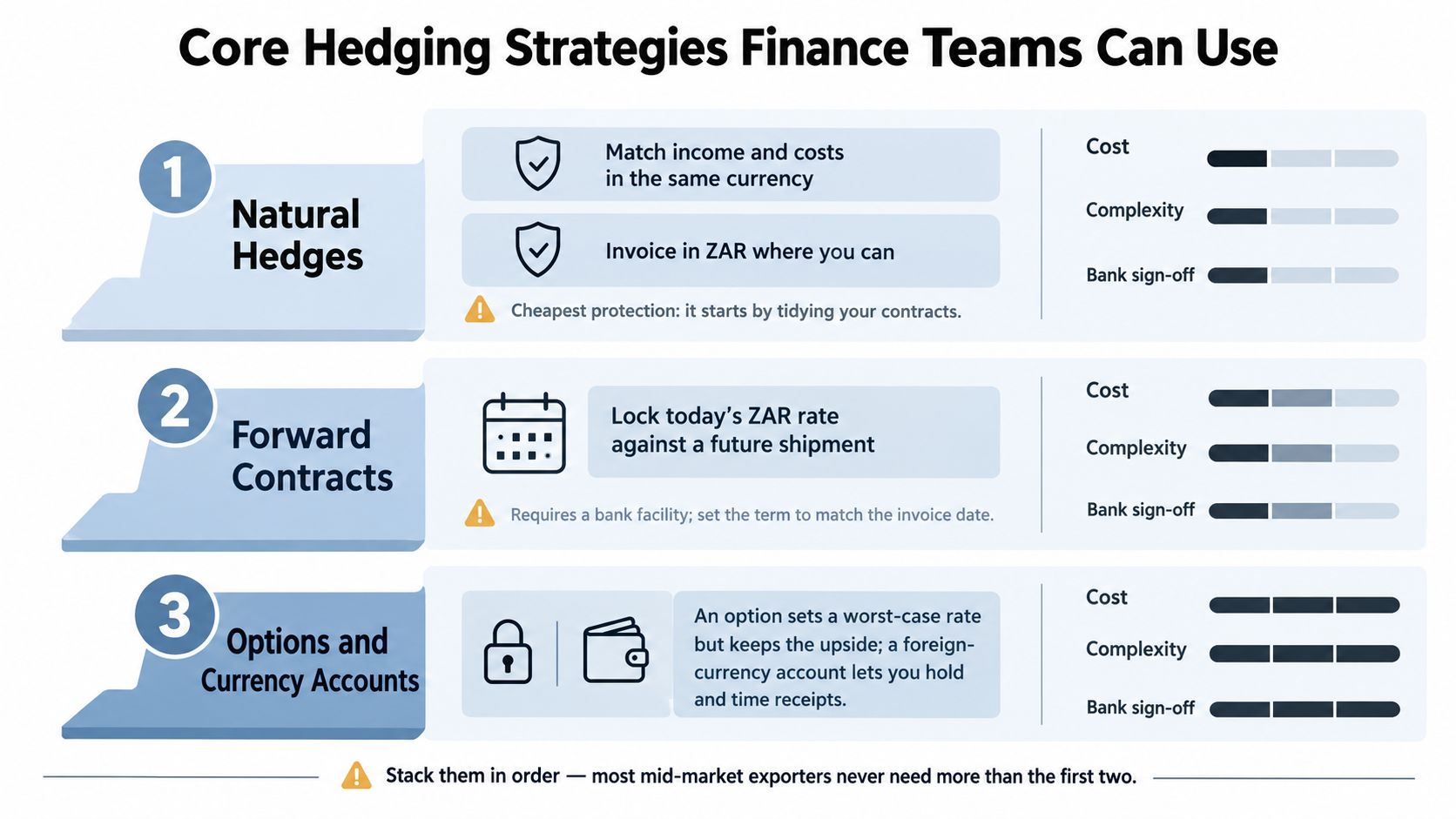
Hedging should start with business design, not derivatives. A company that earns dollars and pays a dollar supplier has a natural offset. It doesn't need to convert the full receipt into rand and later buy dollars again unless there is a clear reason to do so.
The next improvement is operational. Net foreign-currency receipts against payments, schedule settlements deliberately, and negotiate contract terms that reduce timing mismatches. If a customer will accept a rand quotation, use it where commercial bargaining power allows. If the customer requires a foreign-currency quote, build a clear validity period into the offer.
Match the instrument to the exposure
Natural hedges are the cheapest protection because they change the flow before the finance team buys a financial product. Match foreign revenue with foreign costs, use foreign-currency balances for upcoming payments, and avoid converting money twice.
Netting works when several entities or departments have offsetting payables and receivables. Rather than processing every gross movement separately, the finance team can calculate the net amount that needs conversion, subject to internal controls and the requirements of the payment structure.
Leading and lagging involve changing the timing of a payment or receipt. Pay earlier when the commercial and liquidity position supports it, or delay a settlement where the contract permits and the exposure is expected to improve. This isn't a trading strategy. It is a working-capital decision and mustn't breach supplier terms.
Forward contracts are the workhorse for a confirmed exposure. If a business knows it must make a sizeable dollar payment after a production cycle, a forward can turn an uncertain rand cost into a known budget input. The contract must match the expected amount and settlement date closely enough to avoid a new problem.
Options have a narrower role. They can protect a worst-case rate while preserving some upside, but their pricing and documentation make them harder to use well. Currency swaps are generally more appropriate for recurring or structured funding needs than for an occasional supplier invoice.
Decision rule: Use a natural hedge for a recurring offset, a forward for a committed exposure, and an option only when retaining upside justifies the added cost and complexity.
Over-hedging is the common failure. A company locks the full forecast, sales slip, and the business is left with a contract that no longer matches its underlying cash flow. Hedge what the business can reasonably evidence, document the assumptions, and review the position when orders change.
Rand Volatility and the Export P&L
Currency movement belongs in the P&L discussion, not only in the dealing chat. An exporter can sell more product and still experience weaker physical performance if pricing, volume, and exchange-rate effects move in opposite directions.
The South African Reserve Bank's September 2025 Quarterly Bulletin reported that merchandise exports fell 1.9% in the second quarter of 2025, while the rand price of merchandise exports rose 2.4% and export volumes fell 4.2%. The lesson for a CFO is straightforward. A higher rand value attached to exports doesn't automatically mean stronger underlying export activity.
The same source references an OECD-recorded ZAR/USD exchange rate of around 18.33 in the 2025 South Africa survey context. The specific level matters less than the management implication. CFOs need to know which rate sits in the budget, which rate sits in the quotation, and which rate will determine cash when the customer settles.
Translate the currency into operating decisions
A wine exporter, citrus producer, automotive-component manufacturer, or BPO provider should model at least three outcomes:
- Base case: The rate used when the customer quote or budget was approved.
- Adverse case: A rand move that reduces the rand value of foreign receipts or increases the rand cost of foreign payments.
- Favourable case: A move that improves the conversion result, without relying on that upside to justify an unprofitable contract.
| Rand Move Scenario on a R50 Million Export Book | ZAR Move vs Base | ZAR/USD Impact | ZAR/EUR Impact | Gross Margin Swing | Working Capital Days Affected |
|---|---|---|---|---|---|
| Base case | No change | No change | No change | No currency swing | No currency effect |
| Adverse move | Defined by the finance policy | Recalculate against the approved base rate | Recalculate against the approved base rate | Recalculate by currency and exposure | Recalculate from receipt and payment timing |
| Favourable move | Defined by the finance policy | Recalculate against the approved base rate | Recalculate against the approved base rate | Recalculate by currency and exposure | Recalculate from receipt and payment timing |
Do not use a single point estimate in the cash-flow forecast. Show the foreign-currency amount, the assumed rate, the expected settlement date, and the rand result under each scenario. When the actual rate breaches the internal tolerance, procurement and sales should re-quote affected orders rather than passively accepting a weaker margin.
A BPO should apply the same discipline to contractor and software costs. A business that invoices in dollars but pays a large portion of its operating costs in rand needs a rate policy, not a hope that the next month will be kinder.
Banks Versus Fintechs for Business Foreign Exchange
The right question isn't whether banks or fintechs are universally better. It is which provider is suitable for each transaction and which controls the business must retain.
A bank remains the natural home for firms that need lending, trade finance, structured hedging, large-ticket limits, or a relationship manager who can resolve an unusual payment. Banks also understand the broader credit picture and may provide facilities that a payment-focused platform won't.
A fintech platform often has a cleaner workflow for routine supplier payments and customer receipts. It may show the rate more transparently, support faster digital onboarding and execution, and reduce the operational friction around recurring cross-border flows. Those advantages matter when the business makes regular payments but doesn't need a complex treasury product for every transaction.
Compare the workflow, not the marketing
| Dimension | Traditional Bank FX | Fintech FX Platform |
|---|---|---|
| Total cost | Can include account, transfer, correspondent, and embedded spread costs | Often presents a simpler digital price, but the business must still check the applied rate and terms |
| Rate transparency | May require the client to request or calculate the benchmark and spread | Usually designed to display the conversion rate more directly |
| Settlement | Depends on payment route, cut-off times, and correspondent network | Often built around a streamlined digital payment flow |
| Regulatory standing | Operates within established banking and authorised-dealer arrangements | Must be assessed for its legal structure, permissions, safeguarding, and compliance process |
| Credit and hedging | Stronger fit for facilities, forwards, and complex treasury arrangements | Stronger fit for routine conversions and payments, depending on the platform |
| Accounting integration | May connect through existing bank and ERP processes | May offer API, export, or accounting workflow tools that need review |
| Relationship support | Personal support can help with exceptions and large transactions | Digital support may be faster for standard tasks but narrower for complex cases |
A hybrid model is usually more practical than a forced choice. Keep the bank for credit facilities, hedging, and transactions that require relationship-led judgement. Use a suitable fintech for transparent, repeatable day-to-day payments, with one FX policy covering both channels.
The control point is the reconciliation. Your finance team should compare the approved rate, applied rate, fees, beneficiary amount, and accounting entry regardless of provider. For teams that need to clean and review bank exports before reconciliation, this FNB to Excel with BankStatementWizard resource can help organise statement data into a workable spreadsheet process.
A Practical FX Governance Checklist for Growing Firms
Good FX governance is boring by design. The business should know who can approve a deal, which exposures qualify for a hedge, where the evidence is stored, and how the final payment is reconciled.
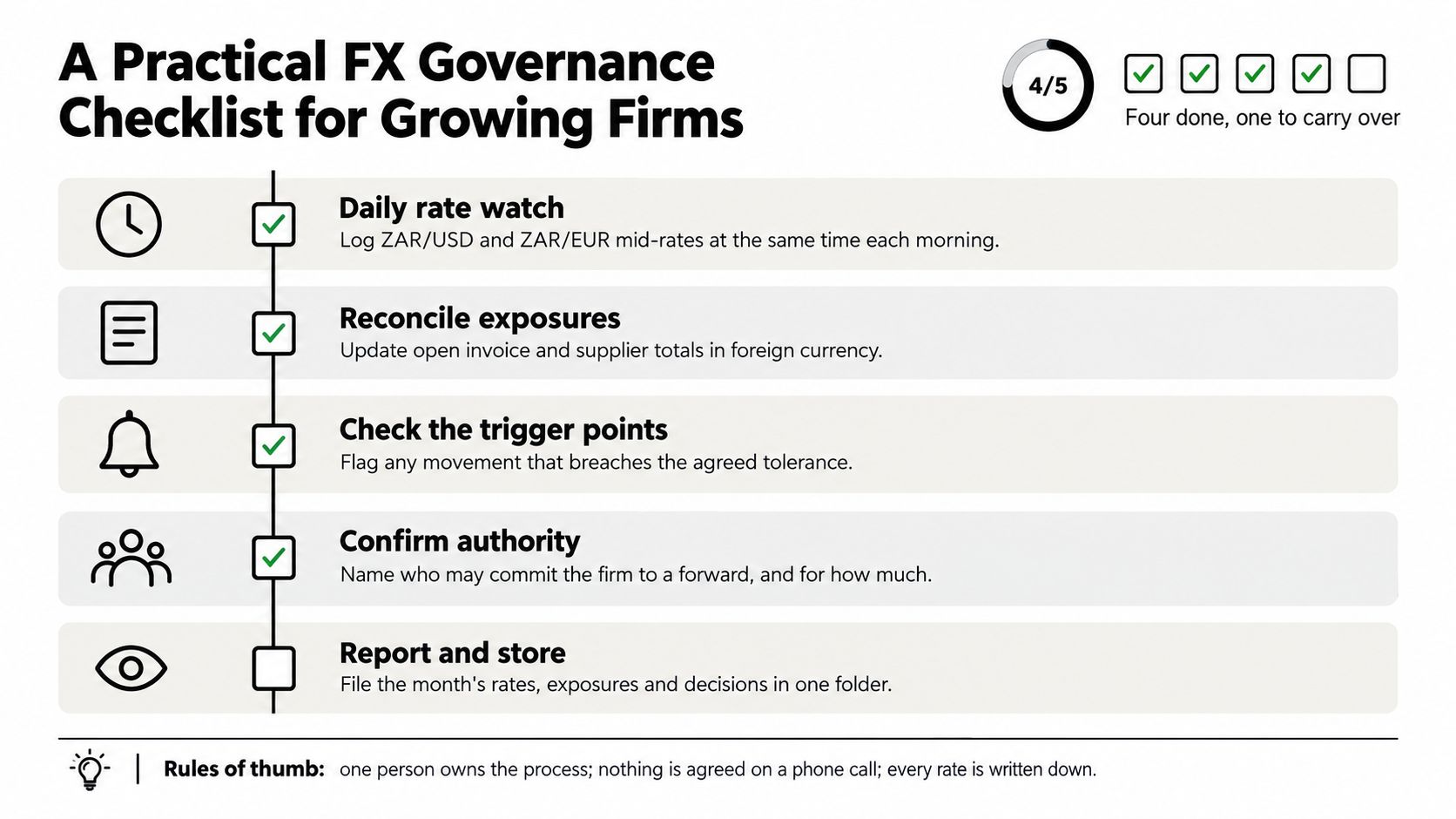
Start with a fixed daily rate-watch habit. Log the ZAR/USD and ZAR/EUR mid-rates at the same time, then record the rate your bank or platform booked. This exposes spread creep and gives the finance team a reliable history instead of a memory-based explanation after month-end.
Keep the policy short enough to use
Record exposures: Maintain one register of foreign invoices, supplier commitments, expected receipts, currency, amount, owner, and settlement date.
Set approval authority: State who may book spot conversions, forwards, or options, and which transactions need dual approval. The limit should be explicit, not implied by seniority.
Separate duties: The person who initiates a deal shouldn't be the only person who releases the payment and posts the accounting entry.
Reconcile monthly: Compare the expected rate and amount with the settled result. Investigate differences instead of allowing them to disappear into bank charges.
Review the forward book: Track open contracts, settlement dates, underlying invoices, and the current mark-to-market position. Cancel or restructure only through an approved process.
Stress the forecast: Test the cash plan against a severe rand move chosen by management. The point is to understand liquidity and covenant headroom, not to predict the market.
Document exceptions: Record why the team deviated from policy, who approved it, and what happened afterward.
A growing firm should refresh the policy whenever it adds a new currency, supplier corridor, customer market, or payment provider. For broader thinking on finance responsibilities and when outside support may help, this guide for small business owners offers useful context.
The strongest policy fits on a page, but the evidence behind it should be easy to retrieve. Store rates, quotes, approvals, contracts, payment confirmations, and reconciliations in one controlled location.
Pulling It Together and Your Next 30 Days
The next step isn't to become a currency trader. It is to make the exposure visible, price it accurately, and protect the part that can damage the business.
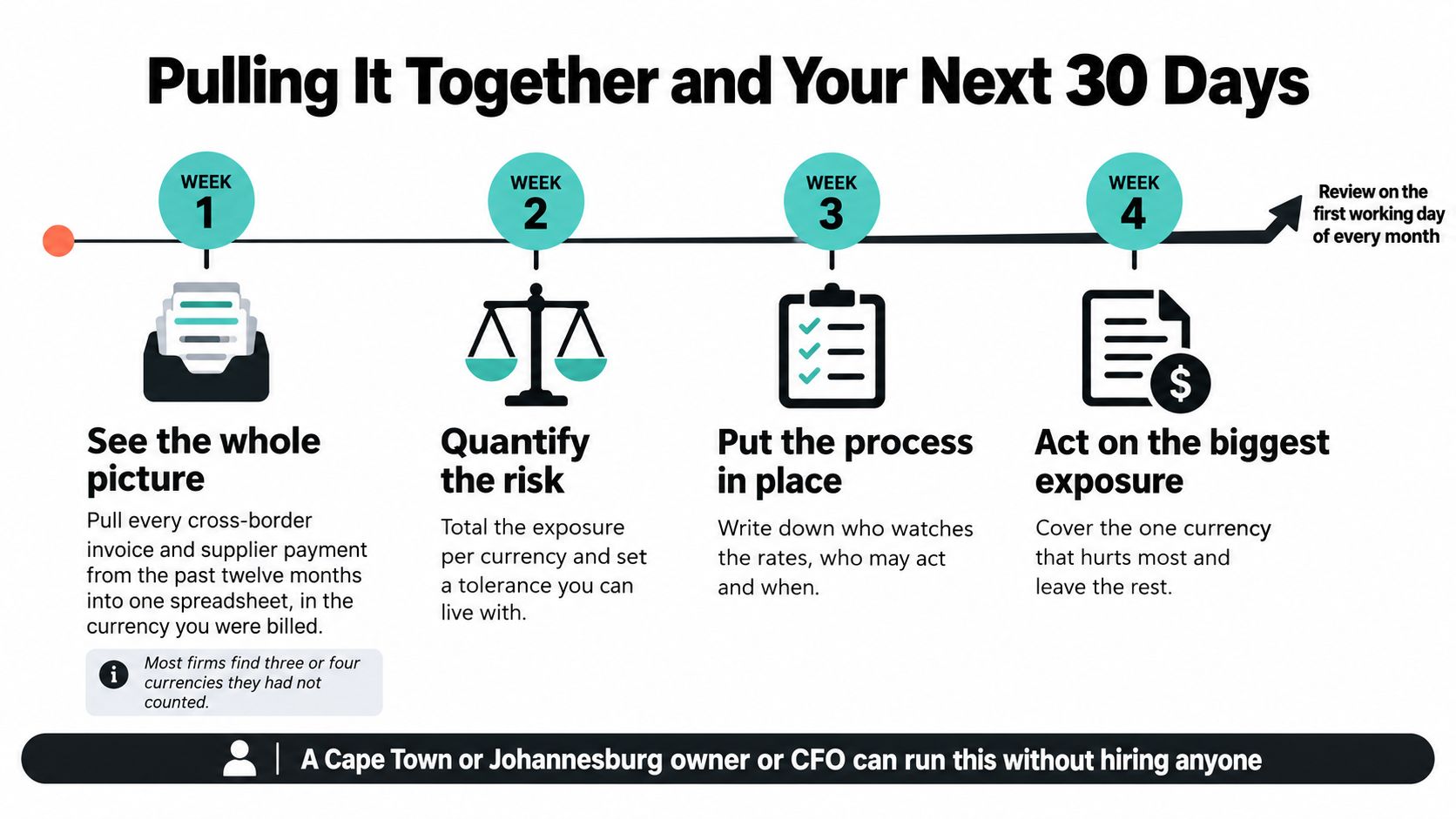
Week 1 is exposure discovery. Pull every cross-border invoice and supplier payment from the last twelve months into one spreadsheet. Tag the currency, amount, expected settlement date, commercial owner, and rand equivalent. Separate committed payments from forecasts so the team doesn't hedge uncertain revenue as if it were already contracted.
Turn the spreadsheet into a decision
Week 2 is provider comparison. Ask your current bank and at least one fintech provider for indicative spot pricing, forward pricing, settlement terms, and fee schedules. Compare the total rand cost and beneficiary outcome, not the headline transfer fee. Ask each provider to show how its quoted rate relates to the relevant benchmark.
Week 3 is policy. Write one page covering approval limits, dual authorisation, permitted instruments, hedge triggers, rate logging, reconciliation, and exception handling. Give the policy to the person who processes payments. A policy nobody can follow is decoration.
Week 4 is execution. If the exposure is material and sufficiently certain, book the first appropriately sized forward through an approved provider. Set up the rate-watch log, reconcile the first transaction, and brief sales, procurement, and operations on the commercial consequences of currency terms.
The objective isn't to predict the rand. It's to stop an unpriced currency movement from deciding your margin.
Review the process on the first working day of every month. Add new currencies and corridors to the register, close out settled exposures, and challenge any unexplained difference between the quoted and applied rate. FX is a recurring margin line, so it needs recurring ownership.
If your business is paying suppliers, receiving export revenue, or funding overseas contractors, Zaro provides ZAR and USD business accounts, real spot exchange rates with zero spread, and cross-border payment execution without SWIFT fees. Visit Zaro to assess whether its transparent payment workflow fits your FX policy and routine international payment needs.