
Business process outsourcing means paying an outside provider to run a defined business function, such as payroll, accounts payable or customer support, against agreed service levels.
Your invoice queue is growing, customers are waiting, and your managers are covering routine work instead of making decisions. An outsourcing quote looks cheaper than hiring, but you still need to establish what's included, who owns mistakes, and how much money will reach the provider after currency conversion and payment fees.
The useful comparison isn't an internal salary against an offshore salary. It's the total cost of getting the work completed correctly, including supervision, technology, rework and moving money across borders.
What Business Process Outsourcing Means in Practice
A restaurant doesn't need to wash its own tablecloths, calculate payroll and keep every accounting record internally. It can give those processes to specialists while its kitchen concentrates on cooking and its managers concentrate on customers.
Business process outsourcing applies the same logic to business functions. The important distinction is that you're buying an operated process, not just another pair of hands.
What the provider takes responsibility for
A genuine BPO arrangement usually has these features:
- Process ownership: The provider manages the agreed workflow and takes responsibility for its contracted outputs.
- Measurable service levels: The agreement specifies what acceptable delivery means, such as accurate payroll by the agreed deadline.
- Delivery management: The provider normally organises staff, systems, training and quality checks within the contracted scope.
The handover needs clear instructions and boundaries, not just access to a shared inbox.

For an introductory explanation to share with colleagues, Kushan Business Solutions explains BPO in a resource from Kushan Business Solutions LLC. Use it to establish a common vocabulary before discussing providers.
Buying a process rather than renting people
With staff augmentation, you bring in people but still assign and supervise their daily work. With consulting, you buy advice or a redesign, while your team usually continues operating the process.
BPO changes who runs the work. For example, a finance provider might receive invoices, validate them and prepare approved records for payment, charging per invoice. A payroll provider could collect approved employee changes and complete the monthly payroll run. A customer-service provider might operate after-hours chat for a fixed monthly fee.
You still decide policies, approve exceptions and retain business accountability. Outsourcing payroll administration doesn't mean an external team should decide your remuneration policy.
Practical rule: If you can describe the task as a repeatable process with a measurable output, it's a BPO candidate. Keep decisions requiring continuous senior leadership judgement in-house.
The Main Types of Business Process Outsourcing
BPO models by location, work type and trade-off
| Model | Where the work is done | Typical work | Main trade-off |
|---|---|---|---|
| Onshore | Buyer's own country | Payroll, HR administration, local customer support | Often highest cost, with simpler legal, language and time-zone coordination |
| Nearshore | Neighbouring or same-time-zone country | Shared services, IT helpdesk, finance operations | Often moderate cost, with closer working hours and easier supervision |
| Offshore | Distant lower-cost country, such as South Africa | Contact centre, accounts payable, data processing | Potentially lowest labour cost, but adds distance and currency exposure |
| Back-office BPO | Any location | Invoice processing, payroll, claims administration | Judged on accuracy and turnaround time |
| Front-office BPO | Any location | Customer calls, chat, sales support | Judged on response time and first-contact resolution |
| Knowledge process outsourcing (KPO) | Any location | Research, legal review, financial modelling | Needs scarcer skills, so prices are generally higher |
| Business process as a service (BPaaS) | Delivered through the provider's cloud platform | Automated workflows run on the provider's software | Subscription or usage pricing, with less staff-driven cost |
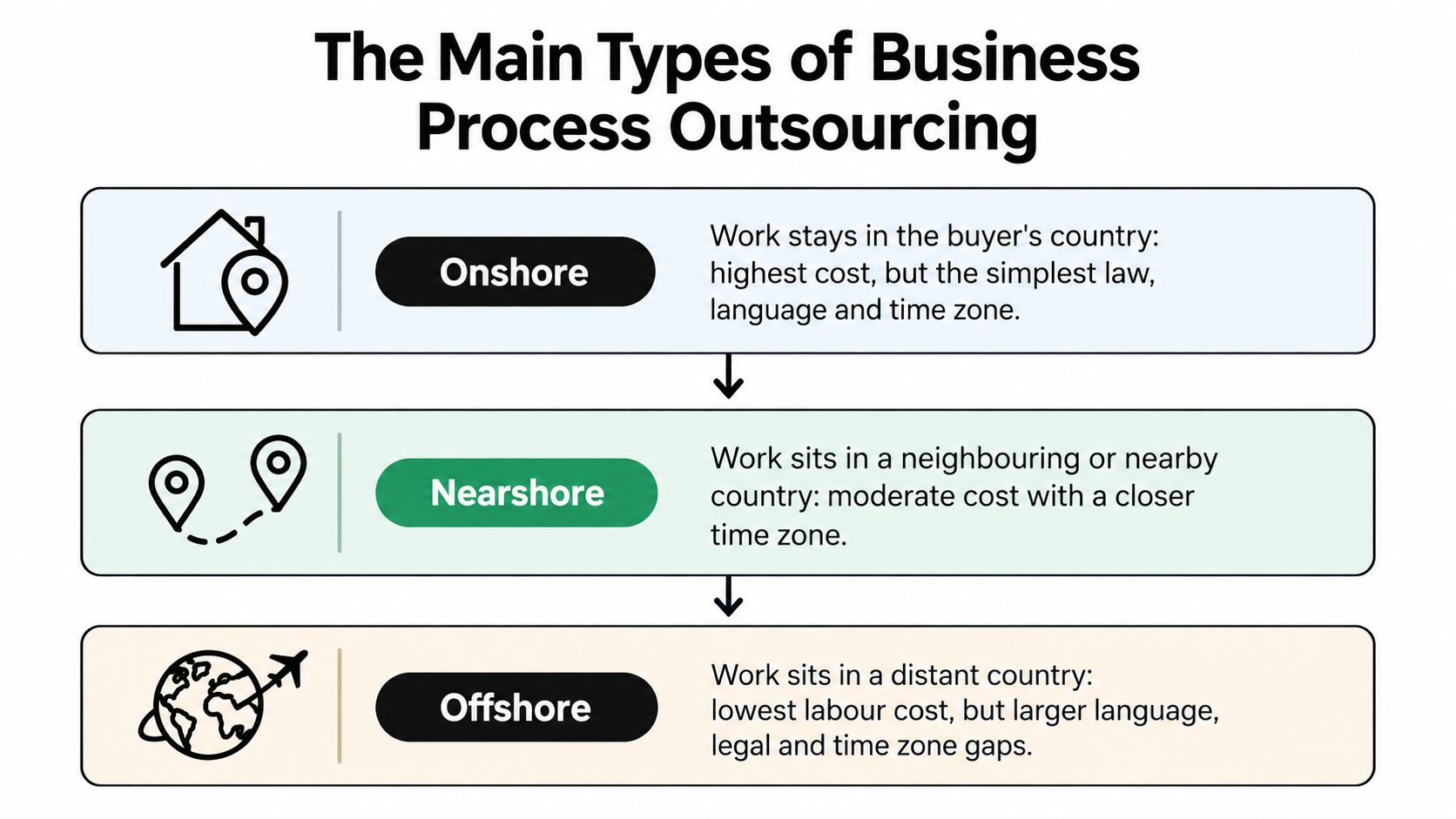
Location describes where, not what
Onshore outsourcing keeps delivery in your country. It can simplify local payroll rules, customer expectations and meetings, although a domestic address doesn't automatically guarantee better service.
Nearshore outsourcing places delivery nearby or within closely aligned working hours. It suits teams that need frequent collaboration without making every conversation an early-morning or late-evening appointment.
Offshore outsourcing places work farther away, often to access a lower-cost workforce. South Africa can be offshore for an overseas buyer while still offering workable overlap with that buyer's day. Geography is relative to the customer, not a permanent label attached to the provider.
These location categories are a starting point, not a price guarantee.
Function describes the work being bought
Back-office BPO supports internal administration. An invoice-processing team needs controls for duplicate documents, missing approvals and incorrect supplier details. Speed matters, but an incorrect record processed quickly is still an incorrect record.
Front-office BPO involves your customers directly. Calls, chat and sales support require clear brand guidance, escalation authority and quality monitoring. SnapDial's explanation of how businesses can reduce costs through support outsourcing is useful when evaluating customer-support delivery, but compare the complete service rather than the advertised staffing cost.
KPO covers work requiring specialist interpretation, such as research, legal review or financial modelling. Give these providers clear review standards and decision boundaries. A technically complete report isn't necessarily useful advice.
BPaaS combines a process with the provider's software. Instead of mainly buying a managed team, you buy access to an operated workflow, often through subscription or usage pricing. Check integration, exception handling and data export before choosing the platform.
The categories overlap: a service can be offshore, back-office and platform-delivered simultaneously. To choose, ask how much judgement the work needs and how much the proposed saving relies on moving it farther away.
Why Companies Send Work to South Africa
South African BPO at a glance
| Indicator | Figure | Period |
|---|---|---|
| Jobs created in the first nine months | More than 14,000, about 88% filled by young people | 2024, according to ITWeb's sector report |
| Export revenue in the first nine months | Almost R13.6 billion | 2024, in the same ITWeb report |
| National BPO employment | About 100,000, with about 60,000 in the Western Cape | Early 2024 Western Cape government figures reported by ITWeb |
| Foreign revenue per offshore BPO job | Approximately R350,000 | Early 2024 Western Cape government estimate reported by ITWeb |
| Total market value | Approximately US$461 million, comprising US$272 million traditional BPO and US$188 million BPaaS | September 2020 market snapshot reported by fDi Intelligence |
| Employment across six cities | More than 270,000, of whom about 65,000 served international clients | September 2020 snapshot, also discussed in McKinsey's BPO industry report |
| Compound annual growth | About 24% | 2014 to 2018, reported by fDi Intelligence |
| Government grants and bonuses | About R1.3 billion | 2007 to 2018, reported by fDi Intelligence |
An export industry, not just a call-centre market
The employment and export figures describe different aspects of the sector. New jobs show recruitment activity, while export revenue reflects services sold to overseas customers. Neither measure tells you whether a particular provider can run your process successfully.
The youth-employment share also matters. Providers recruiting people into early-career roles need structured training, supervision and progression. Buyers should examine how agents learn unfamiliar products and how supervisors identify errors before customers experience them.
The Western Cape concentration helps explain Cape Town's prominence as a delivery hub. The government's foreign-revenue estimate also shows why offshore services matter beyond individual employers: overseas clients pay for work delivered locally.
Historical growth and public support help explain how the delivery ecosystem developed. They aren't substitutes for current due diligence, and the older market-value figures shouldn't be treated as a current valuation.
What an overseas buyer should validate
English-language capability, working-hour overlap with European teams and access to an established recruitment market can make South Africa practical. Test those advantages against your actual needs rather than assuming every provider delivers them equally.
- Communication: Listen to sample interactions involving your customers' terminology and difficult queries.
- Continuity: Review backup connectivity, power arrangements and recovery procedures.
- Relevant experience: Request evidence of comparable international delivery, not just a long customer list.
- Technology: Check whether systems support your workflow, reporting and access controls.
Total employment is not the same as capacity available for international work.
The table combines different years and market definitions. The broader historical workforce includes domestic activity, while offshore delivery is a narrower measure. Judge a shortlisted provider on international seats available for your contract, trained supervisory capacity and experience serving your market, not total headcount alone.
Benefits and Risks Buyers Should Weigh
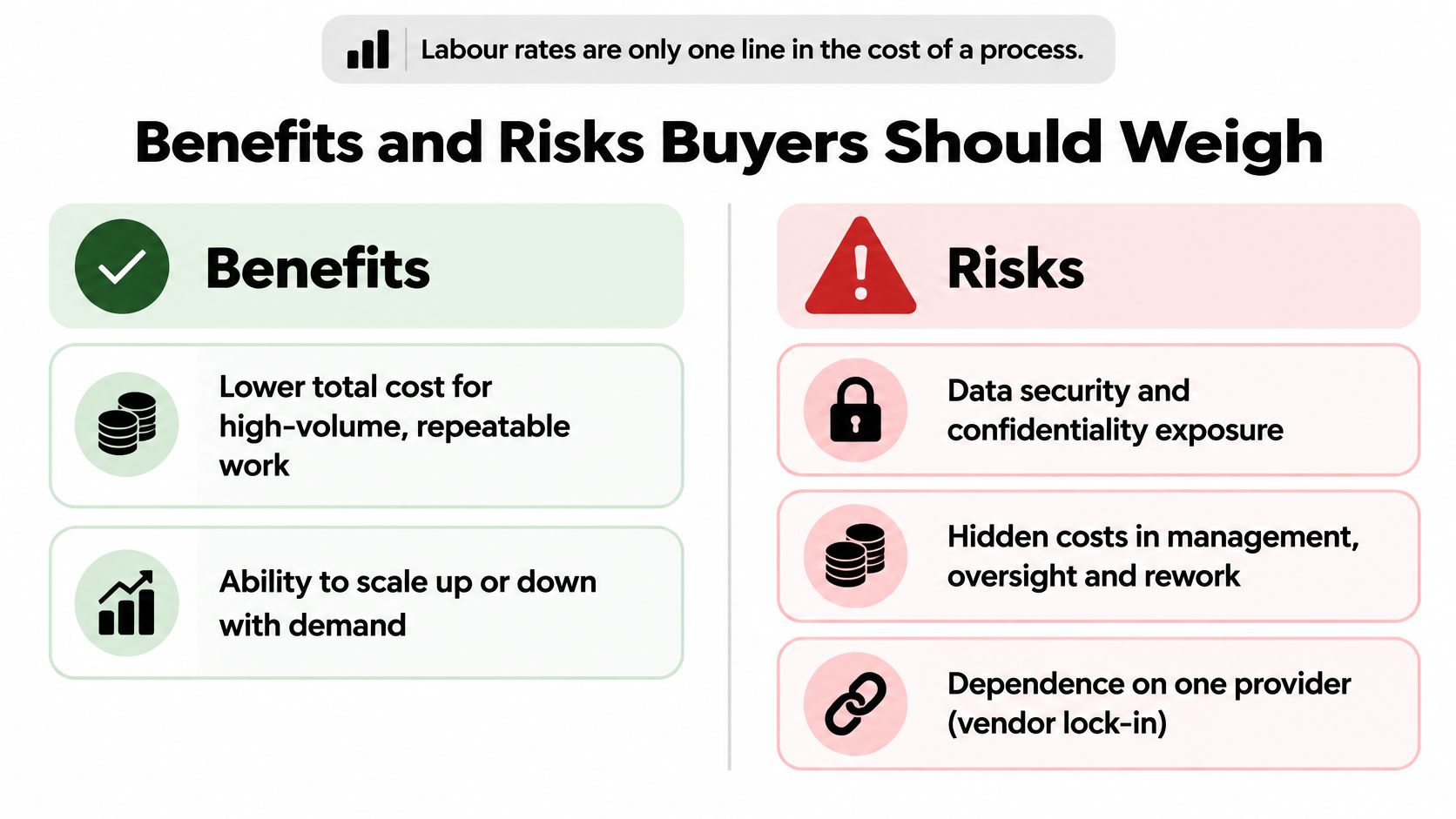
Labour rates are only one line in the cost of a process. A provider can quote cheaper staffing while leaving your managers with more coordination, exceptions and reconciliation.
The comparison below is a useful reminder to assess both sides of the decision.
Where outsourcing can help
- Lower operating cost: Repeatable, high-volume work can benefit from shared infrastructure and specialist delivery.
- Flexible capacity: Contracted staffing can expand for peaks and reduce afterwards, subject to notice periods and minimum commitments.
- Extended coverage: Multi-shift support avoids building every internal rota yourself.
- Specialist capability: Providers can supply tools and skills you wouldn't maintain internally.
- Management focus: Leaders can spend less time administering routine queues.
Where the savings can disappear
- Hidden expenditure: Transition work, oversight, currency conversion and rework can sit outside the headline quote.
- Misleading targets: Agents may close conversations quickly without resolving the underlying problem.
- Sensitive information: Wider access creates confidentiality and security exposure. Include a legal review of applicable South African privacy requirements, including the Protection of Personal Information Act.
- Provider dependence: Proprietary workflows and restrictive exit terms can make replacement difficult.
- Automation changes: The process you buy today may need fewer routine tasks but more exception handling later.
Automation needs a commercial answer
Job growth doesn't settle whether a provider's operating model is resilient: BPESA reports that 26,346 international-market jobs were created in 2025. Buyers still need to understand how providers will adapt when software handles routine enquiries, data entry or call routing.
Ask who benefits financially when automation reduces manual work. If the contract remains tied to staffing, the provider's technology savings might not reach you. If pricing is outcome-based, check that automated failures and repeat contacts aren't counted as successful delivery.
A useful introductory video can support the conversation about how outsourced operations work.
Say a buyer moves customer support offshore, then adds a backup provider and retains an internal manager to reconcile incompatible monthly reports. The staffing quote is lower, but duplicated supervision and reporting absorb the saving.
That doesn't mean outsourcing failed by definition. It means the business case omitted work the buyer still had to perform. Track rising rework, repeated escalations and disputed invoices as early warnings that the contracted process and the actual process no longer match.
How BPO Is Priced and Transitioned
The pricing unit determines which risks remain with you. Compare quotes using the same workload, quality standard and treatment of exceptions.
BPO pricing models and what the buyer carries
| Pricing model | How the buyer pays | Main trade-off |
|---|---|---|
| Per FTE | Monthly fee per full-time staff member | Predictable cost; buyer carries productivity risk |
| Per transaction | Fee per invoice, call or record | Scales with volume; suits back-office work |
| Per resolved case | Fee only when the issue is closed | Aligns price with outcome; needs a clear resolution definition |
| Subscription or usage (BPaaS) | Monthly platform fee or metered usage | Lower staff-driven cost; depends on software fit |
Establish the full contract price
An FTE, or full-time equivalent, is a staffing unit, not a guaranteed output. Transaction pricing shifts attention towards volume, while resolved-case pricing requires an agreed definition of closure and treatment of reopened cases.
Check minimum volumes, term length, implementation charges, FX pass-through and data-return obligations. Minimum commitments can create costs before useful production begins.
For automation-heavy proposals, Yellow.ai's three-year AI cost breakdown offers a useful framework for considering lifecycle expenditure. Include integration, maintenance and human review rather than treating software as a complete replacement for operations.
Transition through evidence, not optimism
- Map the current process. Document inputs, approvals, exceptions and baseline cost per completed transaction.
- Build the business case. Forecast normal and peak demand, including work your team will retain.
- Cap the pilot. Test a bounded batch and compare accuracy, turnaround and exception handling against the baseline.
- Cut over in waves. Expand only when the provider meets acceptance criteria.
- Review delivery. Hold monthly service reviews and quarterly business reviews covering cost, quality and changes.
For an invoice-processing pilot, select a manageable subset of documents before transferring the full monthly workload. Include awkward invoices, not just clean ones, because exceptions reveal whether the operating model works.
Following the Money and Keeping Payments Under Control
A South African BPO provider may invoice in USD or GBP while paying salaries, rent and local suppliers in ZAR. The contract can look profitable in its invoicing currency while leaving insufficient rand available when local payments fall due.
Client concentration makes this a practical concern: the United States and United Kingdom accounted for 76.5% of new jobs during April–June 2025, according to BPESA's global business services update. Providers serving those markets need deliberate decisions about receipt currencies, conversion and cash availability.
Separate currency movement from conversion charges
Exchange-rate movement changes the rand value of a foreign-currency invoice between issue and settlement. A conversion spread is the difference between the reference exchange rate and the rate applied to the transaction. They're separate costs and need separate controls.
For a hypothetical monthly invoice, calculate expected rand proceeds at the chosen reference rate. Then compare that amount with the rand credited after conversion and fees. Don't assess the transaction using a transfer fee alone.
A low transfer fee doesn't establish a low payment cost. Reconcile the amount sent, every deduction and the amount received.
This illustrative workflow shows why the finance team needs visibility beyond the invoice total.
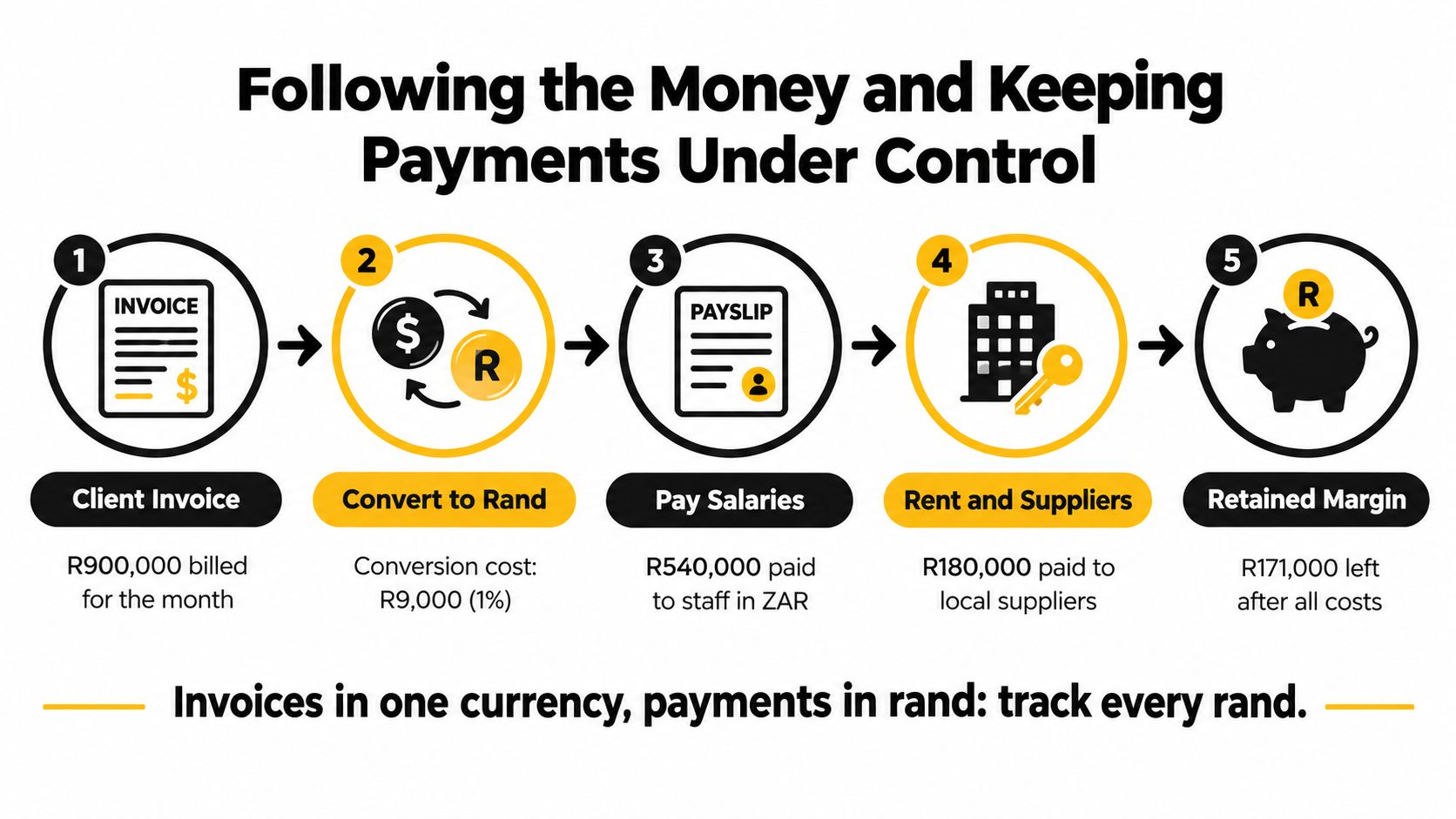
Where money moves and where it leaks in a BPO deal
| Payment stage | Who pays whom | Currency | Where cost leaks |
|---|---|---|---|
| Client pays invoice | Overseas buyer to South African provider | USD, GBP or EUR | Sender bank fees and intermediary charges |
| Conversion to rand | Provider converts through its bank or payment provider | Foreign currency to ZAR | Spread between reference and applied exchange rates |
| Payroll run | South African provider to staff | ZAR | Funding gap if foreign receipts arrive late |
| Vendor payments | South African provider to software and telecom suppliers | USD or ZAR | Card and FX markups on foreign-currency purchases |
| Profit repatriation | South African company to parent abroad | ZAR to foreign currency | Conversion fees and approval delays |
| Refund or credit note | Provider to overseas buyer | Original invoice currency | Rate movement between invoice and refund |
Match receipt timing to local obligations
A customer can pay within its contractual terms and still pay too late for your payroll calendar. Build the cash forecast around cleared funds, not the date the buyer initiates payment.
Holding foreign currency can help match foreign receipts with foreign supplier bills, avoiding unnecessary conversion in both directions. It doesn't remove the need to fund rand obligations. Decide which receipts cover local costs and which can remain in their original currency.
The contract should identify who carries FX risk. A foreign-currency price may leave the provider exposed to rand movements, while a rand-denominated invoice may shift conversion uncertainty to the buyer.
Set a treasury review threshold based on committed local costs and the amount of currency exposure the business can absorb. Where hedging is appropriate, review the instrument, cost and obligations with a qualified treasury adviser rather than trying to predict the market.
Refunds need attention too. Returning the original foreign-currency amount can require a different rand amount from the original receipt. Assign responsibility for that difference and for any return-payment charges.
Give the finance team repeatable controls
- Agree the currency and risk allocation. Put invoice currency, conversion arrangements and permitted price adjustments in writing.
- Fix the payment calendar. Include processing time and escalation before payroll funding becomes urgent.
- Require invoice references. Match receipts to customers, invoices and credit notes before allocating cash.
- Separate preparation from approval. Use dual approval above a documented internal limit and independently verify changed beneficiary details.
- Record the effective rate. Retain the reference rate, applied rate, charges and net proceeds for each conversion.
- Prepare receipt documentation. Keep invoices, contracts and supporting records accessible for Balance of Payments reporting.
- Reconcile monthly. Compare expected and actual proceeds, investigate exceptions and assign an owner to each unresolved item.
Connect payment costs to service economics
The Inner Circle Guide to South African Contact Centres reports benchmarks of 27 seconds average speed to answer, 4.2% call abandonment and 86% first-contact resolution. These are reference points, not promises for every process or provider.
A quick answer is useful only if the customer gets an effective response. Better first-contact resolution can reduce repeat work, while poor handling can make a cheap interaction expensive.
Build a monthly dashboard showing cost per resolved case, first-contact resolution, abandonment, response time, automation rate and payment costs separately. Give each measure a named owner on both sides. Keep a workable exit clause so unresolved delivery or financial problems don't leave either business trapped.
Choose Your Next Step Before You Sign
Confirm what you're buying before committing money. A clear process boundary and a reconciled cost model are more valuable than a persuasive presentation.
For an overseas buyer, the immediate decision is whether the provider has suitable international delivery capacity and can demonstrate the required outcomes. Request a sample service report and test how it counts completed work, reopened cases and exceptions.
For a South African provider, start with the cash forecast. Identify the payment stage most likely to interrupt delivery, then assign responsibility for fixing it before increasing foreign-client volume.
Put payment governance into practice
A small services exporter should distinguish money reserved for rand obligations from foreign currency available for overseas expenses. Separate ZAR and USD balances can support that discipline, provided the finance team maintains a clear conversion and funding policy.
At Zaro, we offer cross-border payments with real exchange rates, zero spread and no SWIFT fees, alongside multi-user access and customisable team permissions. Our free BoP code checker identifies the likely category for an export receipt or import payment, supplies bank-ready wording and shows which documents to prepare.
To get started, sign up and complete Know Your Business verification. Businesses must pass KYB and compliance checks, and the person onboarding must be authorised to bind the organisation. Fund ZAR and USD accounts by bank transfer, then make and receive cross-border payments; cards are coming soon.
Choose a single payment stage from the payment-flow table and fix it this month. Give the task an owner, define the evidence of improvement and review the result before changing anything else.
We help South African businesses manage cross-border receipts and payments with clearer costs and team controls. Visit Zaro to assess whether our payment workflow fits your BPO cash cycle, and start with the foreign receipt or supplier payment that's hardest to reconcile.