
South Africa's BPO sector contributed approximately R35 billion to the economy and supported about 100,000 jobs nationally, according to a Western Cape Government statement. That makes call centre outsourcing more than a search for cheaper agents. For South African exporters, it's a decision about foreign-currency commitments, workforce reliability and who takes responsibility when a customer's problem remains unresolved.
A low seat rate won't protect your margin if you're paying for replacement training, repeat contacts and dollar invoices against weakening rand receipts. Build the business case around cost per resolved case, then test whether the provider can deliver it without weakening customer relationships or data controls.
Which Work to Outsource and What Stays In-House
Outsourcing fit by type of customer work
| Work type | Outsource fit | Keep in-house | Reason |
|---|---|---|---|
| Order status and tracking | High | Nothing routine | Repetitive, low risk, easy to script |
| Tier-one billing questions | High | Disputes above a set value | Scripted answers, clear escalation rules |
| Password resets and account admin | High | Identity exceptions | Standard flows with defined checks |
| Refund requests above approval limit | Medium | Approval decisions | Needs your authority limits and audit trail |
| Regulated financial advice | Low | Everything | Licensing, liability and compliance exposure |
| Key-account and VIP clients | Low | Everything | Relationship risk outweighs cost savings |
| After-hours overflow | High | Escalations only | Covers peaks without idle staff |
Treat this table as a starting judgement, not permission to move an entire department. A provider can explain an invoice without having authority to reverse a charge, and it can collect refund evidence without approving the refund.
Test the scope against your contact logs
Export a representative period from Zendesk, Salesforce Service Cloud or your existing ticketing system. Include ordinary trading, billing runs and a busy period rather than selecting a quiet sample that makes staffing look easy.
Group contacts by reason, not just channel. For each group, calculate volume, average handling time and the share requiring supervisor intervention; then inspect the actual conversations behind unusually long or repeatedly reopened cases.
Keep the classification practical:
- Outsource work with stable answers, accessible records and clear completion criteria.
- Keep decisions requiring commercial authority, regulated judgement or relationship ownership.
- Split processes where a provider can prepare the case but your team must authorise the outcome.
South Africa's global business-services sector created more than 14,000 jobs between January and September 2024, according to Business Process Enabling South Africa. That demonstrates recruitment scale, not a guarantee that a particular vendor has trained agents available for your launch.
Once your scope is clear, use Voicedial.ai's resource to compare call center outsourcing options against the same queue requirements. Mark every work type outsource, keep or split, then total only the contacts that qualify for external handling.
Benchmarks and KPIs to Lock In Before You Sign
Service benchmarks to write into the SLA
| KPI | Reference point | How to measure |
|---|---|---|
| Speed to answer | 27 seconds, South African benchmark | Seconds from connection to agent answer |
| Abandonment rate | 4.2%, South African benchmark | Abandoned calls as a share of offered calls |
| First-contact resolution | 86%, South African benchmark | Issues closed without repeat contact during your agreed observation window |
| Average handle time | Set from your baseline by contact reason | Talk, hold and wrap-up time per contact |
| Customer satisfaction | Set from your existing survey baseline | Post-contact survey score, with response rate disclosed |
| Complaint rate | Establish a baseline and maximum acceptable rate | Complaints as a share of resolved contacts |
| Platform uptime | Negotiate an availability threshold | Telephony and CRM availability per month |
| Latency | Negotiate an end-to-end voice threshold | Voice-path delay under normal and peak loads |
| Cost per resolved contact | Set from your fully loaded baseline | Total monthly cost divided by resolved contacts |
The South African reference points of 27-second speed to answer, 4.2% abandonment and 86% first-contact resolution come from The Inner Circle Guide to South African Contact Centres. They're comparison points, not automatic contract targets, particularly when your queue includes difficult disputes or identity exceptions.
Put resolution ahead of speed
Say an agent finishes a billing call quickly but doesn't confirm when the revised invoice will arrive. The customer calls again, another agent reconstructs the history, and your finance team receives an escalation. The first call looked efficient; the complete case wasn't.
Set first-contact resolution and complaint rate before average handle time. Use handling time to diagnose long searches, awkward systems and missing knowledge, not to reward agents for ending conversations prematurely.
Practical rule: A closed ticket isn't proof of a resolved problem. Match repeat contacts across channels before paying an outcome bonus.
Define what counts as the same issue, how reopened cases are treated and which system supplies the authoritative record. Otherwise, a provider can appear to improve resolution by creating fresh tickets.
Make reporting usable
Measure your baseline before the contract begins, then require weekly results separated into voice, digital and priority customers. Include denominators and contact reasons so managers can distinguish a service failure from a change in case mix.
For sensitive queues, Recepta.ai's guide to managing patient calls with outsourced support is a useful prompt for defining boundaries between routine administration and specialist escalation. Don't assume appointment handling and clinical concerns belong in the same workflow.
Add a buyer-target column to the working SLA table before issuing your request for proposal. Define the pilot exit rule there too: expansion requires sustained attainment of each critical target, not a good overall average that conceals a failing priority queue.
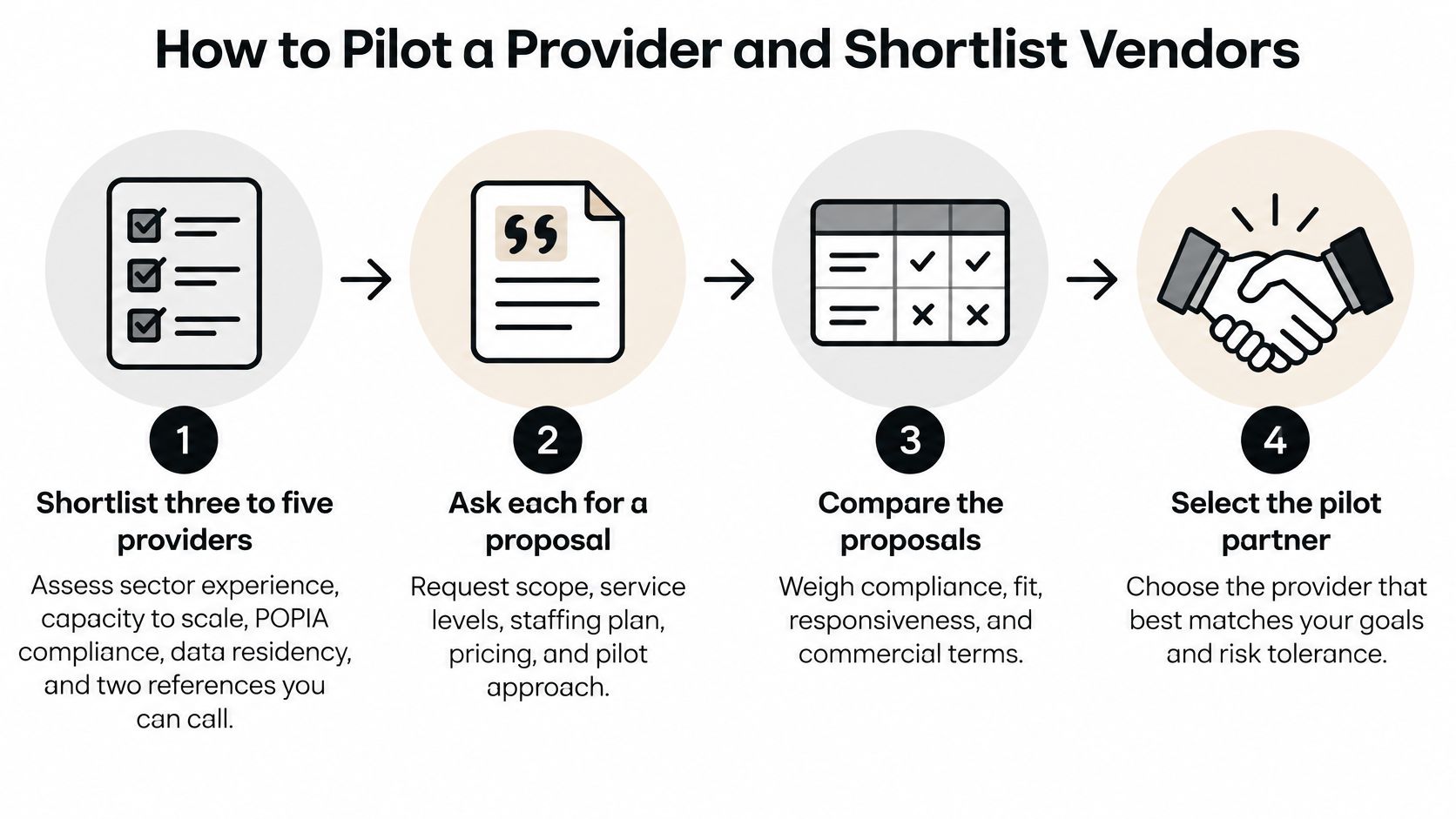
How to Pilot a Provider and Shortlist Vendors
Select a partner through a controlled operating test, not a polished demonstration. The procurement sequence should make it difficult for a vendor to substitute generic capability claims for evidence about your actual work.
Run a gated selection process
Build a manageable shortlist. Assess sector experience, language capability, scale-up capacity, POPIA controls and data residency, then speak directly to reference customers running comparable queues. Ask those customers how the provider handled missed service levels and difficult exits, not just whether the relationship is pleasant.
Request a pilot proposal using your contact reasons and scripts. Require named assumptions for staffing, system access, training, reporting and exclusions so you can compare proposals without accepting different scopes.
Build the knowledge base and escalation matrix together. Give every escalation tier a named owner, a response commitment and a fallback contact; an agent shouldn't have to search a group chat for someone willing to approve a refund.
Run a shadow operation before transferring ownership. Let the provider review or prepare responses alongside your live team in a controlled environment, without duplicate customer messages or uncontrolled changes to production records.
Launch a bounded queue. Choose a clearly identifiable product, region or contact reason, and retain a rollback route so your team can recover the work if service deteriorates.
Review the weekly KPI pack against the agreed exit criteria. Expand only after consecutive reporting periods meet the critical thresholds, with your operations owner approving the increase rather than procurement treating expansion as automatic.
Pause when the measures contradict each other. If handling time improves while resolution and complaints worsen, investigate scripts, agent permissions and incentives before adding volume; re-tender if the provider can't correct the underlying problem.
Score evidence rather than promises
Give resolution quality and data controls greater weight than price. Treat a material security weakness as a disqualifier rather than something a low rate can offset.
Ask for queue-level staffing information: agent tenure, recent departures, training completion, supervisor coverage and replacement readiness. A company-wide retention figure tells you little if your proposed team consists largely of new recruits.
Use a scorecard with an evidence field beside every rating. A failover test record is stronger than a resilience slide, while sample quality evaluations reveal more than a claim that supervisors monitor calls.
Don't outsource an unresolved internal process and expect a new employer for the agents to fix it.
Keep a retained operations owner throughout the pilot. That person must be able to change policy, release missing information and make decisions quickly; otherwise, you'll judge the provider for delays your own approval chain caused.
Cost and Rand Exposure in Your Business Case
Industry reporting places fully loaded South African BPO cost at approximately US$13,900 per full-time equivalent annually, while workforce figures cited for South Africa include approximately 25% annual attrition and 10.2% absence, as summarised in McKinsey's report on South Africa's BPO industry. Use those figures as business-case reference points, not a current supplier quotation or a prediction of your team's performance.
Build capacity before comparing rates
Start with forecast contacts by interval and contact reason. Convert those contacts into workload using handling time, including after-contact work, then use a workforce-management tool or queueing model to test the staffing required to meet service levels.
Your model needs explicit allowances:
- Shrinkage: Deduct leave, training, coaching and absence from scheduled availability.
- Occupancy: Preserve breathing room between interactions rather than assuming agents can handle customers continuously.
- Management coverage: Include team leaders, quality assurance and escalation support.
- Resilience: Allow for disruption, replacement training and unexpected demand.
Don't add absence twice if it's already included in shrinkage. Equally, don't assume a provider's replacement promise means a departing experienced agent can be replaced immediately by someone equally productive.
Run a base case, a peak-demand case and a downside case. Compare contracted savings with recruitment charges, training time, overtime, rework, quality failures and compliance remediation during a quarterly total-cost review.
Separate operating savings from currency movements
A dollar-billed contract costs more in rand when the rand weakens, even if the provider never changes its rate. Calculate the invoice in its billing currency first, then translate it using both your planning rate and a stressed rate approved by finance.
For an exporter earning dollars, matching dollar fees to dollar receipts can reduce conversion needs. It won't remove timing risk if customer receipts arrive after the provider's invoice falls due.
Keep the FX movement separate from operational performance in management reporting. Otherwise, procurement may claim a saving caused by a stronger rand, or blame the supplier for a cost increase caused by exchange rates.
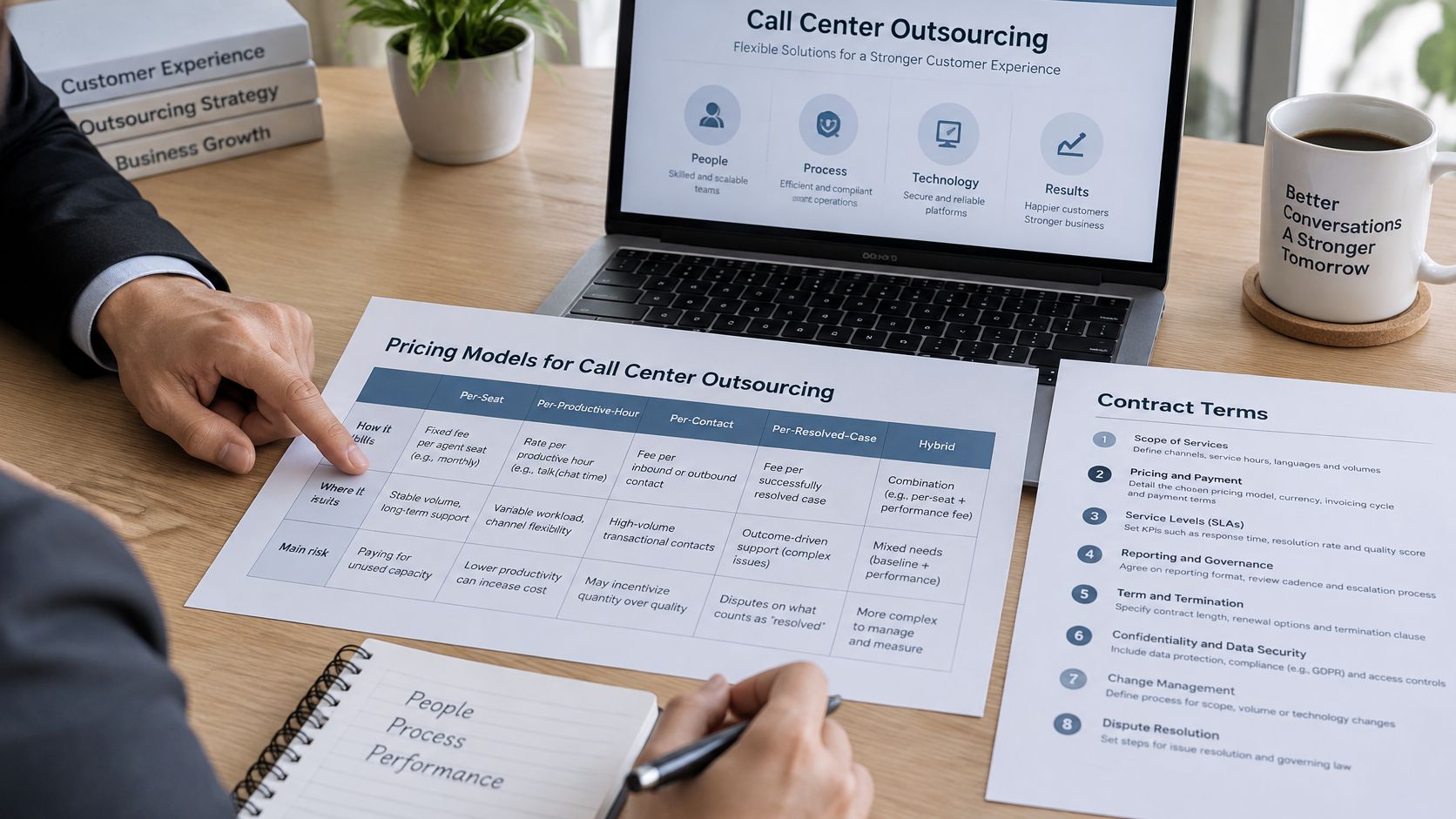
Contract Terms and Pricing Models Compared
Pricing models and their trade-offs
| Pricing model | How the provider bills | Best fit | Main risk |
|---|---|---|---|
| Per seat | Monthly fee per dedicated agent | Steady, forecastable volume | You pay for idle seats during low periods |
| Per productive hour | Contract-defined logged-in or productive hours | Variable volume you can plan | Broad definitions can make idle time billable |
| Per contact or minute | Fee per interaction or per minute | Spiky volume with simple contacts | Speed incentives and separately billed repeat contacts |
| Per resolved case | Fee when the case meets closure criteria | Outcome-led work | Disputes over what counts as resolved |
| Hybrid base plus outcome | Fixed capacity fee plus performance bonus | Buyers needing stable coverage and outcome incentives | More complex reconciliation and overlapping rules |
The model's label matters less than its billing definition. Logged-in time isn't necessarily productive time, and a case marked closed isn't necessarily eligible for payment.
Protect service and customer information
Tie service credits and bonuses to first-contact resolution, complaint-free resolution and data accuracy, rather than calls handled alone. Specify evidence, exclusions, remediation deadlines and the right to challenge the calculation.
Have counsel document the POPIA operator arrangement and allocate responsibilities for access, incidents, subcontractors and cross-border processing. Set role-based permissions, recording-retention periods and audit trails for customer-record changes; don't accept shared agent credentials.
Require demonstrated CRM and telephony failover, including recovery of open cases. A spare internet connection isn't enough if authentication, recordings or the customer database still depend on the failed service.
Close the commercial gaps
The currency clause should identify the invoice currency, conversion mechanism and agreed rate-review band. State what happens inside the band and what renegotiation process applies outside it, so every exchange-rate movement doesn't become a pricing dispute.
Specify volume bands, minimum commitments and the notice needed to increase or reduce capacity. Separate a temporary demand spike from a permanent scope change, and require approval before the provider adds chargeable seats.
Contract check: Ask finance to reconcile a sample invoice against the proposed wording before signing. Ambiguous billing definitions become expensive after launch.
Define ownership and export formats for the knowledge base, case histories, recordings and agent-level quality records. Include transition assistance, access revocation and deletion confirmation so you can move to another provider or return the work in-house without losing operational history.
Automation Risk and Your Next Step
Assess automation by workflow and consequence of error, not by whether a vendor describes itself as AI-enabled. Keep complex, regulated, multilingual and emotionally sensitive interactions human-led until the specific workflow has passed your quality and risk checks.
Use a practical risk split:
- Routine retrieval: Automate order-status checks where the answer comes directly from an authoritative system.
- Controlled account actions: Allow password resets only through approved identity checks, with human handling for exceptions.
- Judgement and vulnerability: Route advice, contested transactions and distressed customers to authorised people.
South African contact-centre operations reportedly had 66% AI adoption, while 70% of managers in a cited study expected AI to produce more human agents rather than fewer, according to Weconnect's sector assessment. Neither measure proves a saving on your queue.
Govern the hybrid model
Before go-live, settle customer consent, data residency, access to interaction records and liability when automation mishandles a transaction. Price the complete journey so you don't pay an automation success fee and a human resolution fee for the same unresolved issue.
Use customer support automation strategies from Applied to frame workflow questions, then judge proposals on resolution, escalation rates, quality scores, workforce stability and total cost per resolved case.
Take these actions this quarter:
- Count contacts by reason from a representative contact-log export and identify the highest-volume eligible queue.
- Populate your working SLA's buyer-target column using your baseline and customer-risk requirements.
- Shortlist suitable providers and agree a paid, bounded pilot with explicit acceptance and rollback criteria.
For the cross-border receipts and payments alongside your outsourcing operation, we offer a free BoP code checker that finds the likely category, copies bank-ready wording and shows which documents to have ready. Visit Zaro to prepare the payment paperwork alongside your staffing, service and currency business case.