
A contractor payment schedule can look perfectly reasonable on paper and still leave a South African business financing its clients. In the 2023/24 financial year, 362,068 invoices were paid after 30 days, with a combined value of R35.1 billion, while another 114,908 invoices older than 30 days remained unpaid at year-end, worth R10.7 billion, according to South African government reporting on supplier payment failures. That's why Net 30 should be treated as a control point, not a promise that cash will arrive on time.
The schedule that survives in practice connects four things: the work completed, the evidence accepted, the person who approves it, and the date money is released. It also accounts for certification delays, month-end bottlenecks, cross-border documentation, and the contractor's need to fund labour and materials before payment arrives.
Why the 30-Day Rule Is the Floor, Not the Ceiling
South Africa's 30-day payment standard provides an important reference point. It tells businesses when an invoice should ordinarily be settled unless the contract provides another arrangement. It doesn't guarantee that every contractor will receive cash on that date, particularly where invoices still need validation, certification, budget approval, or release through a payment batch.
The practical gap is substantial. Research by the Department of Planning, Monitoring and Evaluation found that 56% of surveyed SMMEs experienced delayed payments at provincial level, while 18% experienced delays at national level. Among firms that experienced delays, 54% waited between 31 and 90 days for invoices to be settled, as reported in the DPME research on late payment of SMMEs.
That evidence changes how a CFO should build a schedule. The question isn't only, “When is the invoice due?” It's also, “What happens if certification takes longer than expected, the approver is unavailable, or the client's own customer hasn't paid?”
Statutory versus actual payment behaviour
| Framework | Statutory deadline | Reported payment position | Practical variance |
|---|---|---|---|
| South African Treasury payment standard | 30 days unless the contract says otherwise | Invoices are regularly paid after 30 days | Cash may arrive after the contractual expectation |
| Provincial public-sector environment | 30-day benchmark | 140,364 invoices older than 30 days remained unpaid at the end of 2024/25, valued at R17.8 billion | The delay can extend well beyond the benchmark |
| National public-sector environment | 30-day benchmark | 2,437 invoices older than 30 days remained unpaid at the end of 2024/25, valued at R381 million | A compliant invoice can still face operational delay |
The provincial and national figures are documented in the DPME research and related public finance reporting cited above. They don't mean every private client will behave the same way. They do show why businesses shouldn't build payroll, supplier commitments, or project purchasing around the assumption that every 30-day invoice converts to cash exactly on day 30.
Practical rule: Build the schedule around the earliest defensible payment date, then test whether the business can survive a delayed certification or release.
A contractor payment schedule should therefore specify the invoice submission date, the review period, the acceptance owner, the payment due date, and the escalation trigger. If those stages aren't written down, “30 days” often starts only after an internal team decides that an invoice is complete, which may be weeks after the contractor submitted it.
Choosing the Right Payment Frequency for Each Contractor
Payment frequency should follow the contractor's work pattern and cash exposure. A casual worker completing short assignments shouldn't be paid under the same arrangement as a consultant delivering a long-running advisory programme. The wrong cadence either creates unnecessary administration or forces the contractor to finance work for too long.
Weekly payments for short assignments
Weekly runs suit short-duration work, casual labour, and assignments where the contractor's costs arise almost immediately. Use a simple timesheet or completion record, with a clear cap on approved hours or output. The purpose isn't to create a miniature payroll department. It's to stop small, frequent obligations accumulating into a larger dispute.
Bi-weekly payments for continuing services
Bi-weekly payment works well for maintenance, field services, and retainers where the contractor remains active but produces work continuously. A fixed-fee invoice can be supported by a service log, job card, or manager approval. This cadence gives the contractor more predictable cash flow without forcing the finance team to process every small task separately.
Monthly payments for professional assignments
Monthly terms remain practical for consultants, agencies, developers, and other professionals working against a defined scope. The invoice should identify the billing period, work completed, approved expenses, and any changes to the agreed rate card. Net 30 can work here, but only when the business has a disciplined approval workflow and the contractor understands when the payment clock begins.
For businesses that manage trades, field work, or multiple service providers, selecting the right invoice software for home services can help keep job records, approvals, and billing information together.
Milestone payments for project work
Milestone billing is usually the stronger option where the contractor carries material or labour costs before completion. Each release should follow a measurable output, not a vague phrase such as “work substantially complete”. Link the payment to a signed deliverable, tested installation, approved design pack, or other evidence that an accounts-payable team can verify.
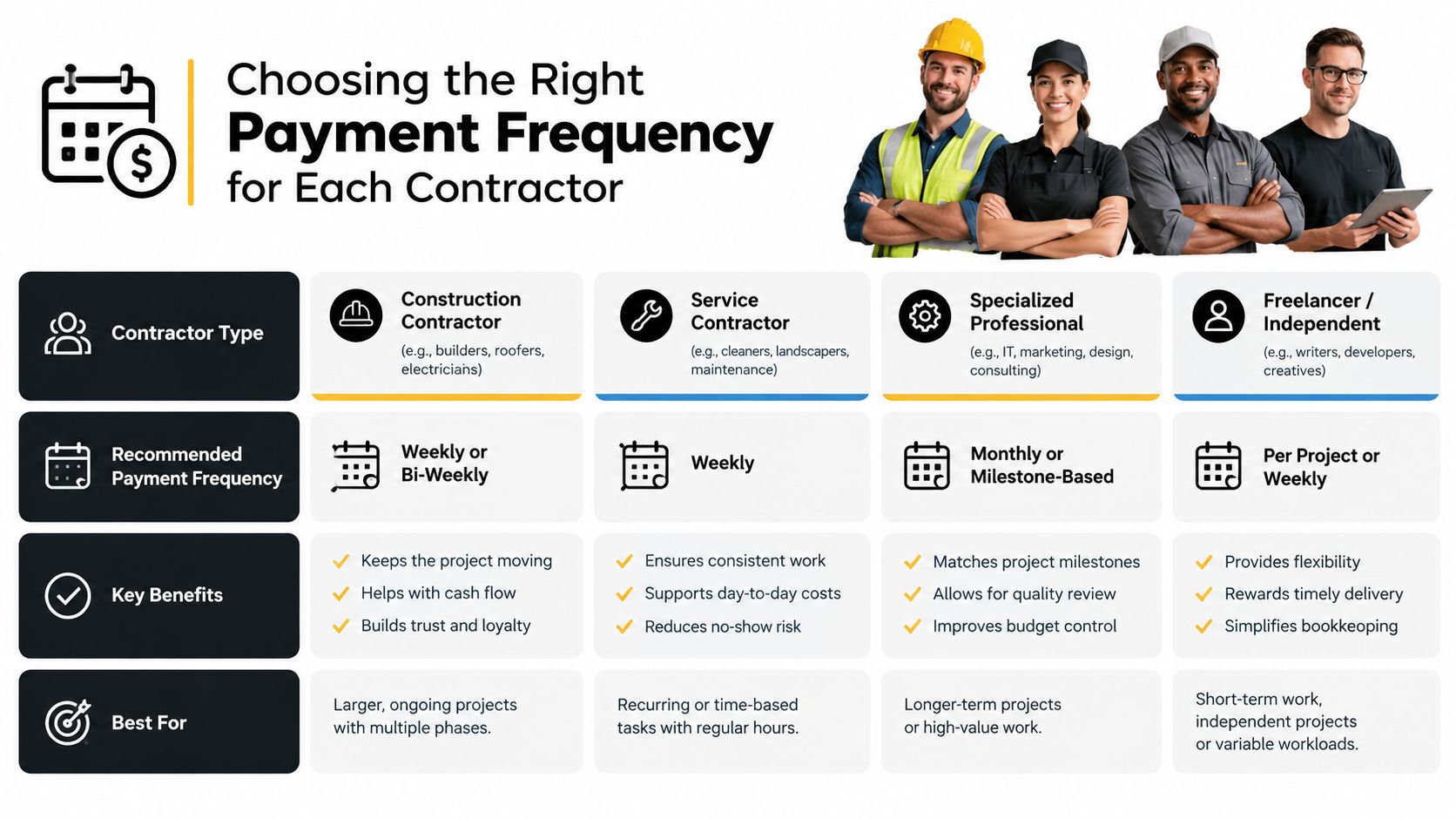
More frequent payments generally improve contractor cash flow, but they also increase invoice handling, review effort, and banking activity. They may reduce the client's bargaining power to retain cash between deliverables. The right answer depends on how quickly the contractor incurs costs, how easy the output is to verify, and whether the business can process the payment without creating a new administrative bottleneck.
Structuring Milestones That Actually Get Paid on Time
A milestone should be written so that someone outside the project team can decide whether it has been achieved. “Phase one complete” invites argument. “Approved drawings issued, client comments incorporated, and final design pack signed by the appointed project owner” gives accounts payable something that can be checked.
Give every release five control points
Each milestone needs five fields:
- A measurable deliverable, such as a report, installation, tested system, design pack, or accepted batch of work.
- An acceptance criterion, which explains what “complete” means and what evidence proves it.
- A named sign-off owner, not a department or informal group.
- A payment value, linked to the work and cost exposure represented by that stage.
- A certification trigger, stating when the payment period begins.
The certification trigger matters because completion and acceptance aren't always the same event. A contractor may finish work on a Friday, but the payment clock shouldn't depend on an unavailable manager noticing it several days later. Require the sign-off owner to accept, reject, or comment within a defined review window.
Break large releases into reviewable outputs
Three large payments often create unnecessary pressure at month-end. A client may challenge one part of a broad milestone and then hold the entire release. Smaller, well-evidenced stages narrow the subject of any disagreement and give both parties a clearer record of what has already been paid.
This doesn't mean creating a separate invoice for every minor task. Group related work into stages that have a coherent definition of done, such as procurement and mobilisation, installation, testing, handover documentation, and practical completion. The schedule of values should mirror the project plan so that finance can see which future costs each release is meant to fund.
A milestone is a payment control, not just a project-management label.
Retainage can protect the client against defects, but it also transfers funding pressure to the contractor. If retainage is used, state the percentage, the exact release event, the inspection process, and the deadline for returning it. Don't leave “final completion” undefined. Practical completion, defect correction, handover, and close-out may be separate events, and each can create a new delay if the contract doesn't distinguish them.
VAT needs its own treatment in the paperwork. The commercial milestone certificate and the VAT invoice should be clearly connected, while the schedule states which document triggers review and which document supports tax processing. This prevents an accounts-payable team from rejecting a valid claim because the project evidence and tax invoice arrived in different formats.
Finally, review the schedule against the project cash-flow forecast before signing. If the contractor must purchase materials well before the first release, the schedule is underfunded even if the total contract price is correct. A payment schedule works when it pays for the costs it creates.
Cross-Border Contractor Schedules and FX Timing
A Cape Town digital studio may agree to pay a Polish developer in EUR every month while receiving client revenue in USD. The contract can state a clean monthly payment date, yet the studio still carries several timing risks: the USD receipt may arrive late, the ZAR value of the EUR invoice may change, and bank or compliance checks may delay release.
The first decision is the rate-fixing point. If the contract leaves the exchange rate open until the day payment is made, the contractor knows the EUR amount but the South African business doesn't know the final ZAR cost. If the rate is fixed at invoice acceptance, both sides gain clarity, but the client carries the risk of a currency movement between acceptance and settlement.
Map the payment path before signing
A cross-border schedule should state:
- The invoice currency, and whether the payer funds the transfer in ZAR, USD, EUR, or another currency.
- The rate source, such as the agreed bank rate or another documented reference.
- The fixing date, which should be tied to an identifiable event rather than an informal promise.
- The fee allocation, including who bears bank, correspondent, and receiving-bank charges.
- The required documents, including the signed contract, approved invoice, and any compliance information requested by the paying institution.
- The settlement convention, meaning when the payment is considered made, sent, or received.
A transfer instruction sent on the due date isn't necessarily cash received by the contractor. Banks can apply cut-off times, screening, beneficiary checks, or requests for supporting documents. Build those controls into the schedule instead of pretending they don't exist.
Cross-border payment cost and timing benchmarks
| Corridor | Typical FX spread | SWIFT and correspondent fee | Settlement days |
|---|---|---|---|
| South Africa to Europe | Varies by bank, currency, and account arrangement | Varies by sending and intermediary banks | Depends on cut-off times and compliance review |
| South Africa to Latin America | Varies by currency pair and payment route | May include intermediary and receiving-bank charges | Depends on the corridor and beneficiary bank |
| South Africa to other international markets | Must be confirmed before approval | Must be allocated expressly in the contract | Confirm the expected settlement window in writing |
For businesses assessing a new delivery team, resources such as hire developers from Brazil can help frame the commercial and operational questions before the contractor agreement is signed. The payment schedule still needs to deal with the specific bank route, currency, documentation, and tax treatment selected by the parties.
The safest approach is to pre-clear the documentation, nominate the paying account, and make the rate-fixing rule part of invoice acceptance. That turns FX from an unpleasant surprise into a visible line in the project forecast.
Building a Four-Step Approval Workflow That Releases Before Day 30
Late payment often begins before the invoice reaches the person who can approve it. A contractor sends the invoice to an employee's inbox, the employee goes on leave, the project manager disputes a line item, and finance only sees the document after the internal review has already consumed the available payment window.
Step one is receipt and timestamping
Use a shared finance mailbox or an automated intake rule. Record the date and time the invoice arrives, the contractor, the contract reference, the project, and the person responsible for validation. Don't allow the payment clock to depend on whether an employee remembers to forward an email.
The intake process should reject obvious gaps quickly. Missing purchase-order references, absent milestone certificates, and unreadable bank details should return to the contractor with a specific reason, not sit in an unresolved queue.
Step two is a three-way validation
Match the invoice against:
- The purchase order or approved instruction, to confirm the business authorised the work.
- The delivery note, timesheet, or milestone sign-off, to confirm the contractor completed it.
- The contract and rate card, to confirm the amount, currency, expenses, and tax treatment.
Give one accountable owner a short, defined review window. A shared checklist is more reliable than a chain of informal emails because it creates an audit trail and shows exactly what was checked.
Step three is budget-holder approval
Set approval limits that reflect the organisation's risk appetite. The CEO shouldn't approve every contractor invoice, yet no invoice should bypass budget ownership just because the amount is inconvenient. Route exceptions, scope changes, and unbudgeted work separately from routine invoices.
Xero and QuickBooks can support structured invoice handling for smaller teams. An Excel register can also work if it sits behind a controlled inbox, uses locked fields, records timestamps, and has one owner responsible for overdue items. The software matters less than the discipline.
Step four is release authorisation
After approval, finance should confirm the beneficiary details, payment currency, bank instruction, and scheduled release batch. Run payment batches frequently enough to avoid missing bank cut-offs. A payment that is approved but waits for the next internal run is still late from the contractor's perspective.
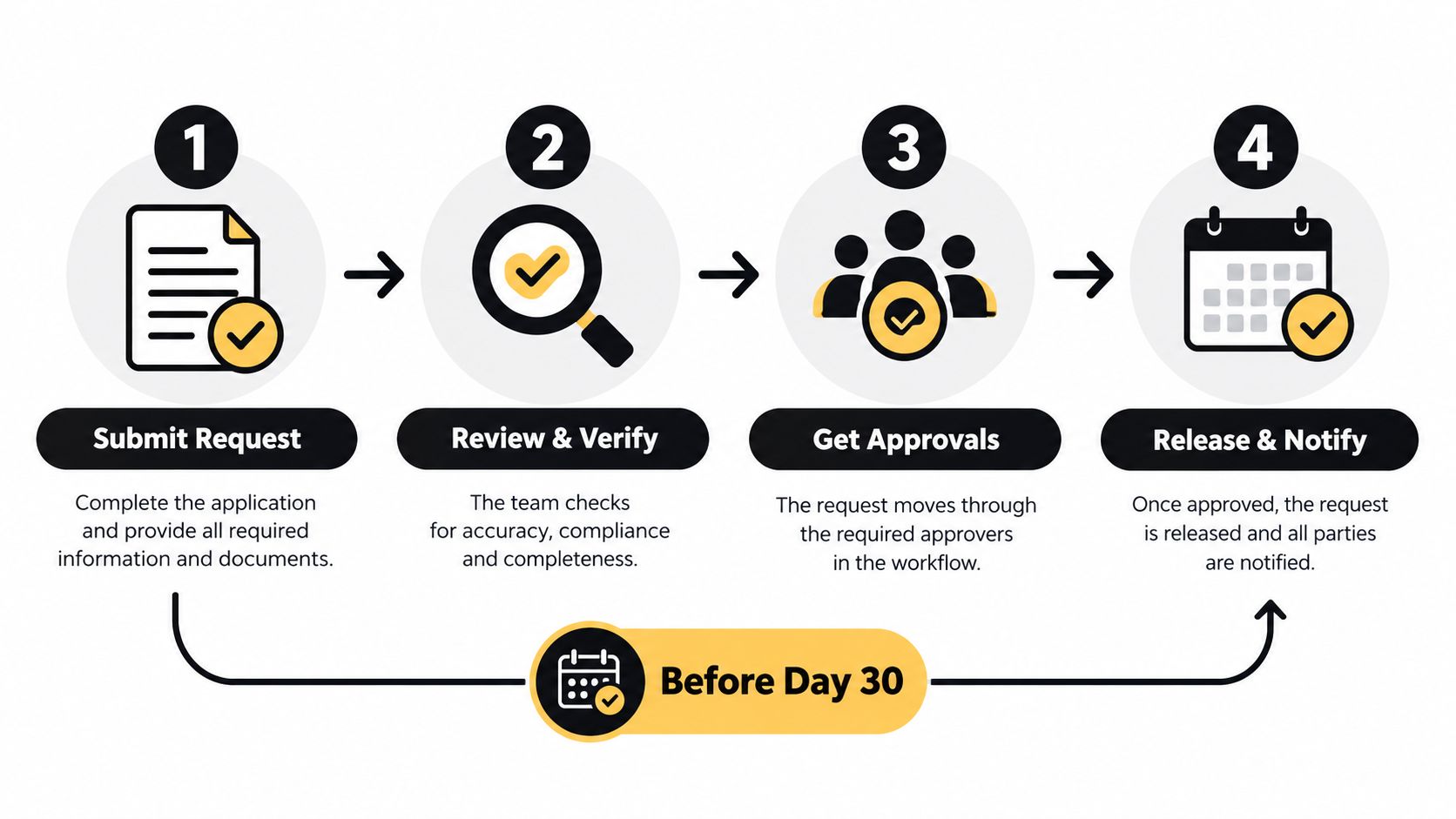
Treasury reported that, in Q1 2025/26, 172,387 invoices were paid late and 81,736 remained unpaid beyond 30 days, worth R11.7 billion, as shown in the National Treasury report on supplier invoice non-compliance. A four-step workflow doesn't eliminate every dispute, but it makes preventable delay visible and gives the business evidence of what happened.
Interest Clauses and Escalation When the Schedule Breaks
Late payment shouldn't be treated as an unavoidable feature of doing business. A contractor that has delivered accepted work has provided value, and a business that repeatedly pays late is using that contractor as an involuntary source of working capital.
The contract should state what happens after the due date. That may include interest on overdue amounts, recovery of reasonable enforcement costs, a right to suspend further work after notice, or termination if the breach isn't cured. The wording needs to distinguish a genuine dispute about defective or incomplete work from an undisputed invoice that just hasn't been paid.
Separate a dispute from a delay
A useful agreement requires the client to notify the contractor promptly when it disputes an invoice. The notice should identify the disputed line, the contractual basis for the objection, and the amount being withheld. The undisputed portion should remain payable according to the schedule.
Without that separation, a small disagreement can freeze the whole invoice. The contractor then carries labour, materials, and tax obligations while both parties argue about an issue that may represent only part of the claim.
Use a measured escalation ladder
| Step | Action | Notice period | Typical cost to enforce |
|---|---|---|---|
| 1 | Send a formal overdue notice identifying the invoice and amount | As stated in the contract | Internal administration and professional review |
| 2 | Issue a letter of demand and reserve contractual rights | The cure period in the agreement | Legal drafting and delivery costs |
| 3 | Suspend affected work if the agreement permits it | After the required notice and cure period | Delay, demobilisation, and relationship cost |
| 4 | Pursue formal recovery | Subject to the contract and applicable law | Legal fees, court costs, and management time |
The contractor should keep proof of delivery, acceptance records, invoice correspondence, and every reminder. The business owner should do the same. A well-organised file can resolve a payment dispute before litigation becomes necessary.
Put protection in the master agreement
Interest and escalation provisions are most useful when they're agreed before the first invoice. The agreement can also address ownership of unpaid deliverables, access to project materials, personal suretyship where appropriate, and the notice required before suspension or termination.
Don't insert harsh remedies after a payment has already been missed. That creates a negotiation at the worst possible time. The stronger approach is to make the payment schedule and its consequences part of the commercial deal from the beginning, then apply them consistently.
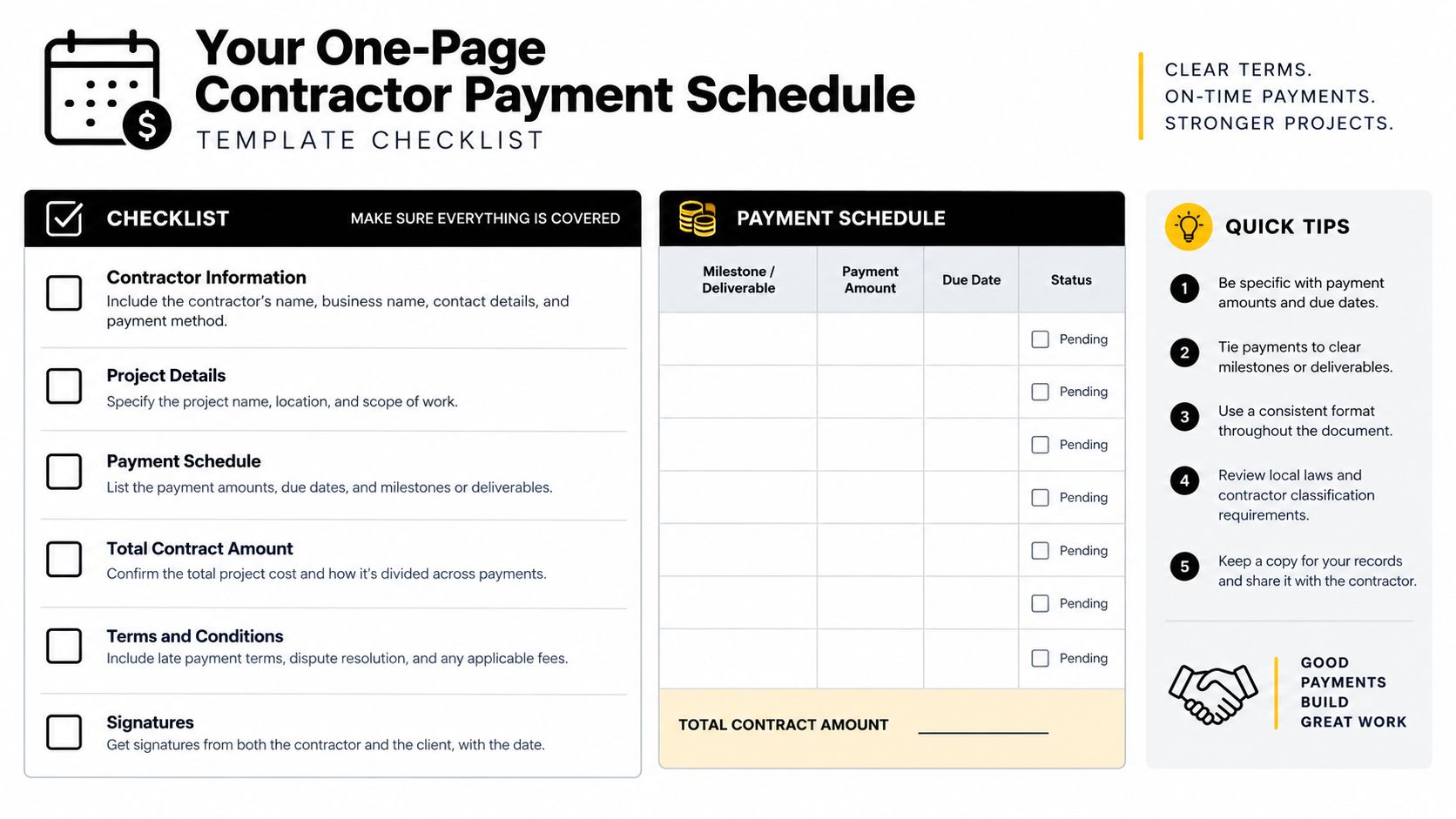
Your One-Page Contractor Payment Schedule Template
A useful contractor payment schedule should be short enough for a project manager to use and complete enough for finance to defend. Put the commercial terms, evidence requirements, approval path, and escalation triggers on one page. The document can then sit behind the contractor SLA and the purchase order.
Header block
Start with the contractor's legal name, registration details, VAT number where applicable, tax compliance information, and bank details. For local suppliers, include any procurement information the business requires. For international contractors, add the agreed payment currency, beneficiary bank information, and the documents needed for compliance review.
Frequency and trigger
Select one payment rhythm: weekly, bi-weekly, monthly, or milestone-based. Write the trigger in active language:
- “The contractor submits an approved service log.”
- “The project owner signs the deliverable.”
- “Finance receives a valid invoice and supporting certificate.”
- “The client accepts the tested installation.”
Avoid phrases such as “upon completion” unless the agreement defines who confirms completion and how quickly that confirmation must occur.
Milestone matrix
Use five columns:
| Milestone | Deliverable | Acceptance criteria | Due date | Payment value and retainage |
|---|---|---|---|---|
| 1 | Defined output | Named approver confirms the stated test or review | Agreed date | Amount and agreed holdback |
| 2 | Defined output | Evidence attached to the certificate | Agreed date | Amount and agreed holdback |
| 3 | Defined output | Acceptance recorded in writing | Agreed date | Amount and agreed holdback |
For non-ZAR engagements, state the exchange-rate source, fixing event, fee allocation, and treatment of any difference between the invoice currency and the funding currency. Add the review window, the due date, and the interest or escalation provision in plain language.
Leave three fields customisable
The retainage percentage, payment terms, and dispute window should remain editable for each engagement. Those fields carry the greatest commercial trade-off and shouldn't be copied blindly from one project to another.
The completed schedule should be stored as a single PDF and attached to the contractor agreement, purchase order, and project record. It's a practical control for smaller engagements, but it shouldn't replace legal review where the scope, liability, cross-border exposure, or dispute risk is material.
For South African businesses paying local and international contractors, Zaro provides scheduled and recurring payment workflows, approval controls, status visibility, and reconciliation support for contractor payouts. Use Zaro to make the payment date, currency, and approval path part of the operating schedule rather than an afterthought.