
South African commercial businesses now operate at an average DSO of 63 days, more than double the standard 30-day payment term. Net 30 is therefore not a cash-flow plan, it's only a starting clause.
A contractor can submit a correct invoice on time, meet every deliverable, and still wait well beyond the agreed date for cash. That delay funds payroll, materials, VAT obligations, subcontractors, imported inputs, and the client's internal approval process. If your agreement doesn't control those risks, your margin implicitly becomes working-capital finance for someone else.
Why Contractor Payment Terms Matter More Than Ever in South Africa
A contractor paid on net 30 can still carry the receivable for another month, and that gap is priced into the day rate before the contract is signed. In Johannesburg, the contractor must fund salaries, suppliers, VAT obligations, subcontractors, and imported inputs while the client's approval process runs. A weak payment clause therefore raises the true cost of the engagement, even when the quoted rate looks competitive.
The 63-day national average DSO for South African commercial businesses shows why net 30 is only a starting point. The benchmark covers businesses across all nine provinces and ten industries, making it a useful operating reference rather than a narrow construction estimate. South Africa's commercial debt benchmark supports a practical collection rhythm: monitor the invoice at day 30, escalate at day 45, and treat 60-plus days as a high-risk recovery point.
That delay changes contractor behaviour. A business carrying unpaid work may demand a deposit, shorten the credit period, increase its rate, reduce its willingness to prioritise the project, or decline the engagement. Export-oriented SMEs face another exposure. If payment arrives in a different currency, the clause should identify who carries foreign-exchange movement, when conversion occurs, and whether bank charges reduce the contractor's receipt.
The statutory baseline does not solve the operating problem. Public-sector procurement is formally anchored to payment within 30 days of receiving an invoice or claim, yet construction payment performance has been uneven. One South African survey found that only 54% of projects were paid within 30 days, while 26% were paid within 31 to 60 days, 13% within 61 to 90 days, 3% within 91 to 120 days, and 4% after 120 days. The South African construction payment research also found that private-sector clients were particularly weak early payers, with only 35% of projects paid within 30 days.
Finance rule: Treat the agreed due date as the point when collection action starts, not the point when your team first asks whether the invoice has been approved.
Smaller businesses have less room to absorb the delay. Recent local reporting recorded 95,399 government invoices older than 30 days, worth R12.4 billion, at the end of Q2 2025/26. The same reporting cited 91% of SMEs experiencing late payment, average overdue invoices being paid 18 days after terms, and some businesses receiving cash only 60 to 90 days after invoicing. The South African late-payment analysis also describes contractor and supplier cycles that can exceed 150 days where clients demand 60, 90, or 120-day terms while suppliers require payment before delivery.
Pay-when-paid wording creates a separate risk. For a contractor, payment should not depend indefinitely on a client's receipt from its own customer. Set a time limit, require prompt notice of non-payment, and preserve the right to suspend work after a defined default.
Negotiate more than “net 30” or “net 60”. Set when the payment clock starts, what makes an invoice valid, how quickly disputes must be raised, what happens after default, and whether you can stop work without creating a new dispute.
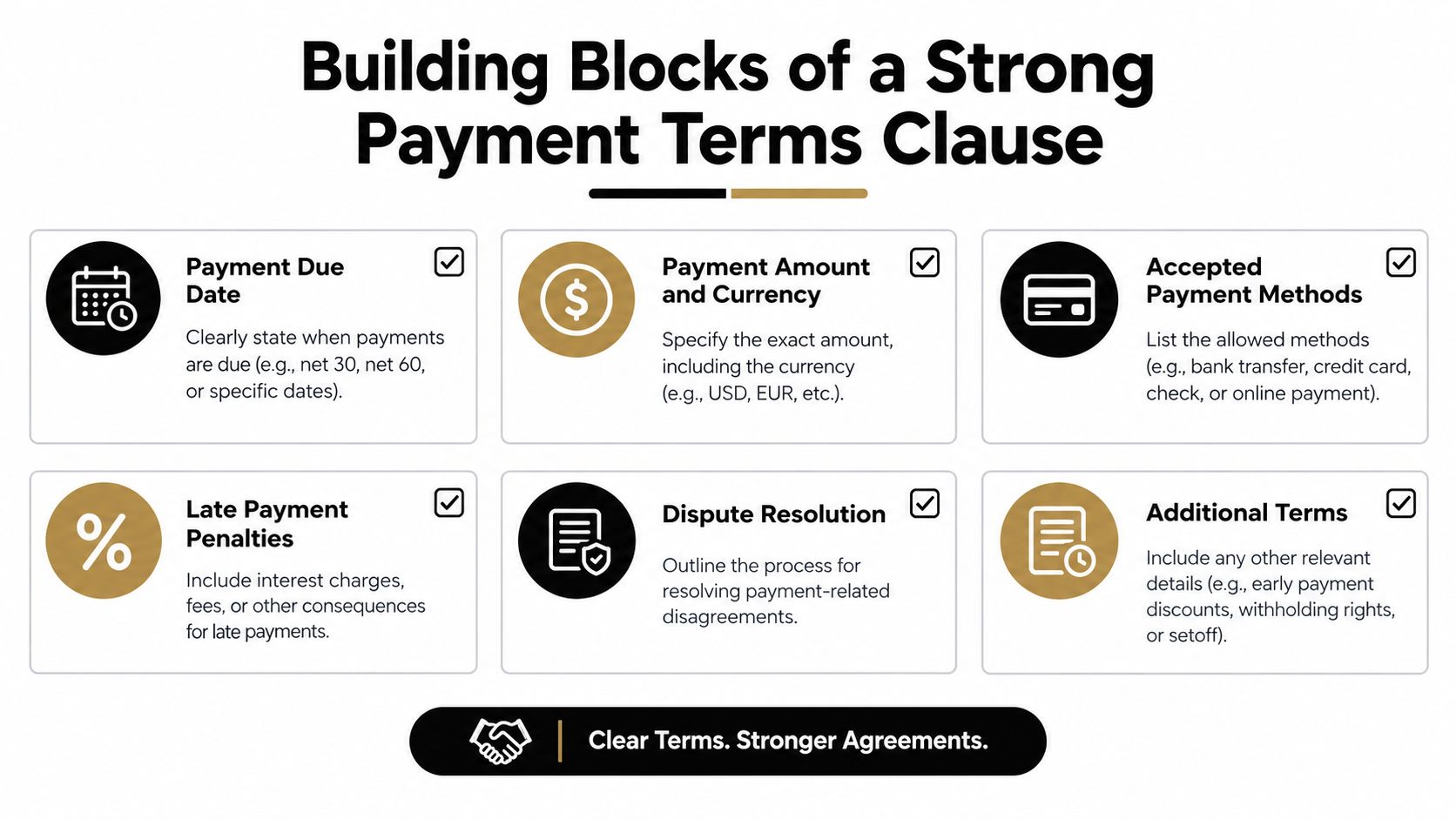
Building Blocks of a Strong Payment Terms Clause
A strong clause removes arguments before the invoice reaches accounts payable. It should define the due date, the documents that start the clock, the treatment of disputed amounts, interest, retention, and any incentive for early settlement.
Define the clock precisely
Avoid wording such as “payment within 30 days of approval”. Approval can sit with a project manager, procurement team, quantity surveyor, or finance department, and the contract may never identify which event controls.
Use language like:
“The client shall pay each undisputed invoice within 30 calendar days after receipt of a valid invoice and all documents listed in this agreement. Receipt occurs when the invoice reaches the client's designated accounts-payable address or electronic invoicing portal.”
Then define “valid invoice” in the same agreement. State the required purchase-order reference, service period, description of work, banking details, VAT information where applicable, and supporting delivery records. A client shouldn't be able to restart the payment clock because its internal team missed a document that the contract never required.
Control submissions, disputes, and retention
Add an acceptance rule with a short, workable query period:
“The client shall notify the contractor in writing of any specific invoice dispute within seven calendar days of receipt. The notice must identify the disputed line item, the reason for dispute, and the supporting information required. Any amount not disputed within that period is deemed accepted and remains payable by the original due date.”
This doesn't prevent a genuine fraud or error claim. It prevents a vague “invoice under review” message from holding the entire invoice hostage.
Retention requires equal precision. Don't write “retention will apply as agreed” and leave the amount, release trigger, and account treatment elsewhere. Instead, specify the agreed retention amount, the work or certificate to which it applies, the release event, and whether the client may withhold retention while other undisputed sums remain payable.
Add interest and incentives
A late-payment provision should identify the interest rate or the agreed reference rate, when interest begins, and whether the contractor may recover reasonable collection costs where legally permitted.
“Any undisputed amount not paid by the due date shall accrue interest from the day after the due date at the rate stated in this agreement, without limiting the contractor's other contractual remedies.”
Early-payment discounts should also be explicit. State the discount amount, the exact payment date that qualifies, and whether the client may deduct it without written confirmation. A discount that has no clear expiry date becomes an accounting dispute rather than a cash-flow tool.
For a broader framework on making obligations, definitions, remedies, and approval mechanics clear, use this practical contract drafting guide. It's particularly useful when legal, procurement, and finance teams are editing the same agreement.
Choosing Between Milestone, Hourly, and Fixed-Fee Structures
Payment structure decides who carries scope risk. Choose the structure before you negotiate the due date, because net 30 on an unsuitable pricing model still leaves the wrong party financing the work.
| Structure | Best For | Risk Allocation | Cash-Flow Profile |
|---|---|---|---|
| Milestone | Defined projects with verifiable deliverables | Client pays as agreed outputs are accepted, while the contractor carries delivery risk between milestones | Predictable if acceptance criteria are objective and milestones are frequent enough |
| Hourly | Long-running collaborative engagements with changing requirements | Client carries utilisation and scope risk, contractor carries time-recording and approval risk | Regular billing works well, but disputed timesheets can delay payment |
| Fixed-fee | Specialist tasks with a tightly defined scope | Contractor carries most cost-overrun and rework risk | Strong predictability for the client, but potentially poor liquidity for the contractor unless deposits or staged billing apply |
Use milestones for measurable delivery
A milestone model suits construction packages, implementation work, design phases, and other projects where a client can verify a discrete result. Define the deliverable, evidence of completion, reviewer, response period, and consequences if the client doesn't respond.
Don't tie payment to “satisfaction” or “final approval” without an objective standard. Those phrases let a client reject a completed stage because its internal preference changed. Link each invoice to a document, test, certificate, acceptance record, or other evidence that both parties can identify.
Use hourly billing for moving targets
Hourly billing is the right choice for retained advisers, technical specialists, maintenance teams, and collaborative work where the client will change priorities. Require weekly or monthly time records, identify the person authorised to approve them, and state that silence within the agreed review period doesn't invalidate properly recorded time.
Fixed fees work when the contractor can price the scope confidently. They don't work as a default for exploratory work, vague strategy assignments, or projects where the client controls the inputs. If the client wants a fixed price, insist on a change-control clause that converts additional work into a separate fee rather than an argument at the end.
The blunt recommendation is simple. Use milestones for defined outputs, hourly billing for evolving work, and fixed fees only where scope boundaries are defensible. Deposits, staged invoices, or shorter billing cycles should fund the contractor through the work instead of leaving the full recovery risk until completion.
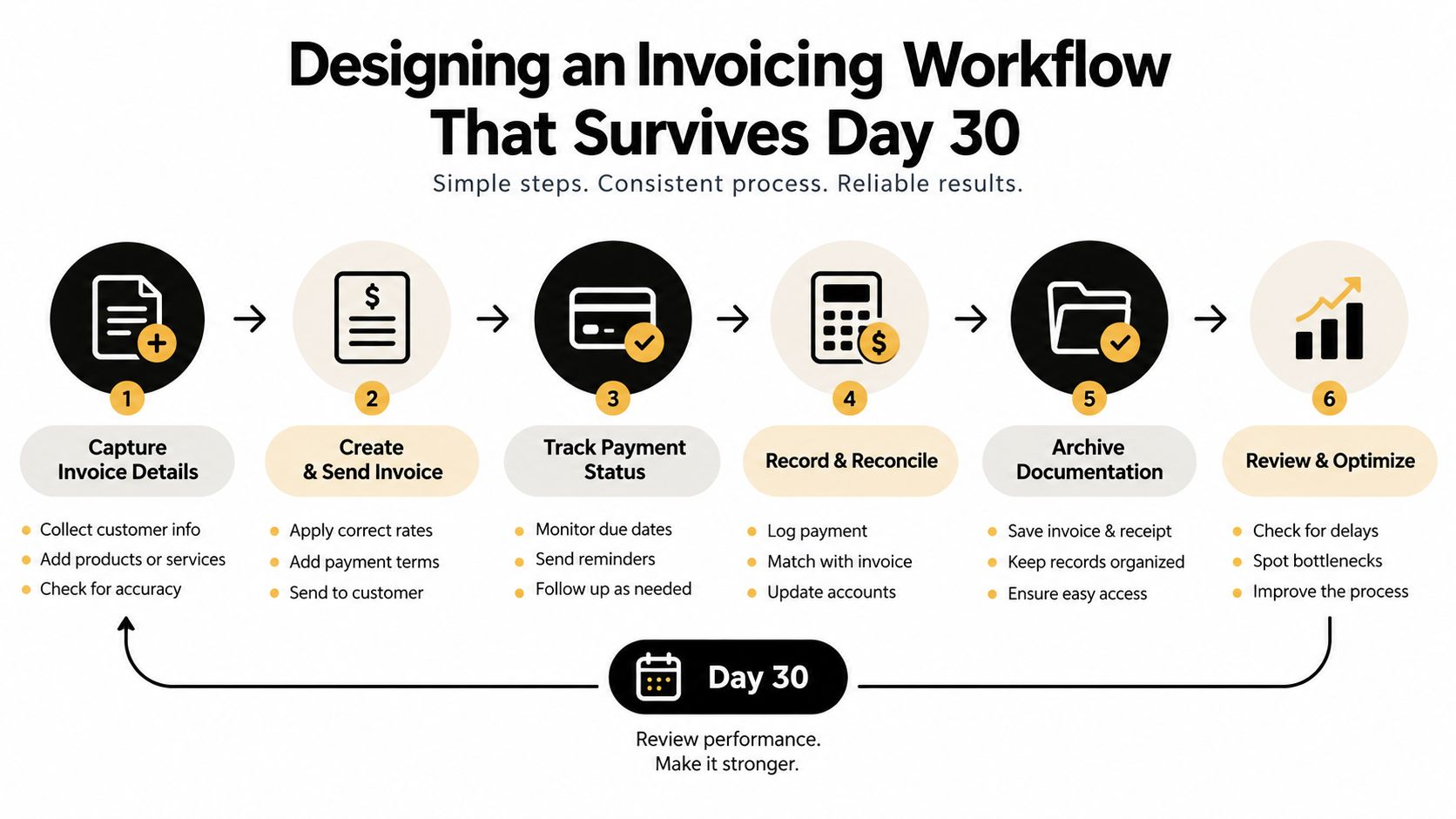
Designing an Invoicing Workflow That Survives Day 30
A payment clause fails if nobody can prove when the invoice arrived or whether the client had a valid reason to withhold it. Your invoicing workflow should create an evidence trail from submission to settlement.
Step one, standardise the invoice
Use one template for every contractor engagement. Include the legal entity names, purchase-order or contract reference, service period, line-item description, banking details, VAT information where applicable, and any agreed B-BBEE or SARS-related fields. Match the client's portal and file-format requirements before the first invoice, not after accounts payable rejects it.
The invoice should also state the due date and the person responsible for queries. Don't rely on a PDF sent to a project manager's personal email. Send it to the contractually designated address or portal and retain the submission confirmation.
Step two, attach proof
Add signed timesheets, delivery notes, completion certificates, inspection records, purchase-order references, or other proof required by the agreement. Name each file consistently and link it to the invoice line item. A finance team should be able to understand the claim without asking the contractor to reconstruct the project history.
Step three, watch the ageing
Review every open invoice at day 7, day 14, and day 28. These checkpoints are operating recommendations, not waiting periods. At each review, confirm receipt, acceptance, missing documents, dispute status, and the employee who owns the next action.
Government departments remain subject to a 30-day invoice settlement requirement, yet 112,442 invoices worth R10 billion were paid late in Q2 2025/26, while 95,399 invoices worth R12.4 billion remained unpaid by the end of September 2025. The Treasury-focused payment analysis shows why contractors need an active workflow even where the legal term looks clear.
Step four, escalate without improvising
Use a written ladder:
- Send a receipt and acceptance check before the due date.
- Request a payment-status confirmation at day 28.
- Call the finance director or contract owner on day 30 if payment hasn't arrived.
- Issue a formal default notice at day 45.
- Suspend further work only under a contract right, after checking the effect on safety, handover, and other obligations.
Use this invoice acceptance wording:
“An invoice is accepted when the client confirms receipt electronically or fails to issue a specific written dispute within seven calendar days. A dispute concerning part of an invoice does not suspend payment of the undisputed balance.”
The cash-flow guide from Nexist is a useful companion for aligning invoice timing with working-capital decisions. The key principle is the same: collection is a process with owners and deadlines, not an email sent after the due date.
Handling Pay-When-Paid and Dispute Resolution Clauses
Pay-when-paid clauses aren't automatically safe or automatically abusive. The wording determines whether the clause changes timing or transfers the risk of non-payment to the contractor.
A pay-when-paid clause generally says the contractor will be paid after the client receives payment from an upstream payer. In that form, it may operate as a timing mechanism. A pay-if-paid clause goes further by making upstream payment a condition of the client's obligation. That can leave the contractor carrying the insolvency, delay, and administrative failures of parties it doesn't control.
South African construction commentary notes that there is no dedicated prompt-payment law covering the market generally, so contract wording and case law matter heavily. It also notes that an explicit and unambiguous pay-when-paid clause may be enforceable. The South African analysis of pay-when-paid clauses discusses the importance of clear wording, interest rights, notice procedures, and payment mechanics in standard construction forms such as JBCC.
| Factor | Pay-When-Paid | Pay-If-Paid |
|---|---|---|
| Core effect | Delays payment until an upstream event occurs | Makes upstream payment a condition of payment |
| Contractor exposure | Timing risk and collection delay | Potential loss of the receivable |
| Drafting concern | The clause must define the trigger and required efforts | The clause must be reviewed for risk transfer and enforceability |
| Better protection | A long-stop date, interest, and regular status reporting | Direct payment rights, security, or removal of the condition |
| Finance response | Monitor the upstream claim and preserve notices | Price the risk as if the client may never pay |
Don't accept “subject to payment by the employer” as a complete clause. It doesn't say whether the client must pursue the employer, share correspondence, challenge a wrongful withholding, or pay after a defined period.
A more balanced provision would say:
“Where payment depends on an identified upstream payer, the client shall use reasonable contractual steps to pursue that payment and shall provide status information on request. The contractor's payment shall not be deferred beyond the agreed long-stop period solely because the upstream payer has not paid. If the upstream payer defaults, the client shall assign or otherwise transfer to the contractor any recoverable receivable or claim relating to the contractor's work, to the extent legally permitted.”
A long-stop period of 60 days is a practical negotiation position because the South African commercial benchmark treats 60-plus days as a high-risk recovery point. Don't copy it blindly into every agreement. Use it to force a conversation about security, assignment, suspension rights, and who owns the upstream dispute.
Build disputes in tiers. Start with the project manager and contract owner, require senior finance escalation, move to mediation within 14 days where the dispute remains unresolved, and specify arbitration seated in Johannesburg if the contract requires private determination. The agreement should preserve the right to claim undisputed amounts while the disputed line is being resolved.
Setting Cross-Border Contractor Payment Terms Without Losing Margin
Cross-border contractor payment terms fail when the parties agree a fee in one currency and discover later that the payer, contractor, and bank each understood the exchange-rate risk differently. A South African export business should decide the currency of account, conversion point, fees, tax responsibility, and evidence requirements before work begins.
Choose the currency deliberately
Invoice in ZAR when the South African business can protect its margin in rand and the contractor is comfortable receiving rand. Invoice in USD or EUR when the contractor's costs, salary expectations, or supplier commitments are linked to that currency. Don't quote a foreign-currency fee merely because it looks simpler. If the business earns in rand, a foreign-currency obligation can reduce margin when the rand weakens.
Use a currency-of-account clause such as:
“The fee is denominated in USD. Payment shall be made in USD to the contractor's nominated account. Any conversion, intermediary-bank charge, or receiving-bank fee is for the account of the party identified in this agreement. If payment is made in ZAR by agreement, the conversion shall use the published spot rate of the nominated payment provider at the time the payment instruction is executed.”
If the contractor must receive a fixed rand amount, reverse the risk allocation:
“The contractor must receive the agreed ZAR amount net of payment-provider and receiving-bank charges. The client shall calculate the required foreign-currency amount using the agreed reference rate on the payment date.”
Compare the payment rails
| Method | Settlement Time | Typical FX Margin | Best Use |
|---|---|---|---|
| SWIFT wire | Varies by correspondent banks and compliance checks | Varies by bank, corridor, and account arrangement | Large or infrequent payments where bank documentation is already established |
| Wise | Varies by corridor, verification, and funding method | Transparent pricing depends on the currency pair and transaction | Regular payments where the recipient can use supported local details |
| Ripple-based rails | Depends on the provider, corridor, and compliance process | Provider and conversion pricing varies | Businesses with an approved provider and a suitable supported corridor |
| Onafriq | Depends on corridor and local payout route | Provider and corridor pricing varies | Regional African payouts where local collection or disbursement matters |
Don't put an unverified settlement time or “zero-cost” promise into the agreement. Payment providers can pause a transaction for compliance review, beneficiary checks, incorrect account details, or source-of-funds questions. State who bears a failed-payment fee and what evidence proves that the payer initiated the transfer.
A forward contract can make sense for a cross-border engagement lasting more than three months, particularly where the business has committed foreign-currency costs against a known customer receipt. Split invoices into scheduled drawdowns rather than allowing the entire foreign-currency exposure to accumulate until completion. The hedge, invoice schedule, and customer collection plan must match. A hedge doesn't repair a late-paying customer.
Tax requires specialist review. Services performed partly inside South Africa can raise withholding-tax and source-of-income questions, including the interaction of section 6quat where relevant. Put the contractor's tax-residency certificate, beneficial-owner information, invoice tax treatment, and responsibility for filings into the onboarding checklist. Don't treat a payment rail as tax advice.
For businesses comparing staffing models and overseas support, examples such as LatHire virtual assistants can help clarify whether the commercial arrangement is an independent contractor engagement, a managed service, or another structure. That classification should match the agreement, invoice, and payment workflow.
Your 2026 Contractor Payment Terms Checklist
Give legal and procurement a checklist that finance can use before signing. Every item should answer one practical question: what protects cash, prevents a dispute, or shortens recovery time?
Domestic cash flow
- Set the due date: Choose the payment term with the 63-day DSO environment in mind, not an assumption that net 30 equals cash in the bank. The regional DSO benchmark supports active collection rather than passive waiting.
- Require a funding mechanism: Use a deposit, staged billing, or agreed retention release so the contractor does not finance the full project from its own cash.
- Define invoice validity: List the purchase order, VAT details, banking information, service period, and delivery evidence required before the payment clock starts.
- Set the dispute window: Require a specific written query within seven calendar days. Keep the undisputed balance payable by the original due date.
- Price scope changes: Require written acknowledgement of verbal instructions before additional work is performed. This gives finance evidence for the extra invoice.
- Protect late payment: State the interest rate, start date, collection rights, and the contractor's right to suspend work where the agreement permits suspension.
- Add a payment force-majeure carve-out: A force-majeure event may affect performance, but it should not erase payment for work already accepted or goods already delivered.
Cross-border payments
- Name the currency: State whether the obligation is in ZAR, USD, EUR, or another currency. Include the conversion rule when the payer settles in a different currency.
- Allocate fees and FX risk: Specify responsibility for bank charges, intermediary fees, conversion costs, and losses caused by incorrect beneficiary information.
- Plan the hedge: For engagements longer than three months, assess a forward contract or another approved hedge against the expected payment schedule. Match the hedge to the invoice and collection plan.
- Use controlled execution: Require authorised payment instructions, beneficiary verification, and settlement evidence before finance marks the invoice paid.
- Check tax treatment: Have a South African tax adviser review residency, services performed in South Africa, withholding obligations, and section 6quat implications.
Dispute readiness
- Create a recovery ladder: Assign an owner and a review date to every open invoice, then confirm that the day-30 and day-45 actions from the invoicing workflow are documented in the contract.
- Separate disputes from valid claims: Require the client to identify each disputed line. The undisputed amount should continue through payment.
- Control pay-when-paid exposure: Identify the upstream payer, require reasonable pursuit of that payer, and set a long-stop period. Never accept an open-ended condition that leaves the contractor waiting indefinitely.
- Choose the forum: Use project escalation first, mediation within 14 days where appropriate, and a clearly identified arbitration seat or court jurisdiction.
- Make electronic records contractual: Align electronic invoicing and submission evidence with the client's SARS and internal compliance requirements. Preserve delivery confirmations and approval records.
- Review quarterly: Compare contracted terms with actual DSO, ageing, disputes, and recovery outcomes. Change the template when the data exposes a recurring failure.
Before signing, make the due date measurable, disputes specific, currency risk visible, and ownership clear. A contractor agreement protects cash only when finance can operate the process without interpretation.
Zaro gives South African businesses ZAR and USD business accounts for managing global contractor and supplier payments, with team permissions and approval controls for finance workflows. If cross-border FX costs and payment visibility are weakening contractor margins, visit Zaro to review the platform.