A staff member is booking an overseas hotel, a software subscription is due, and a supplier invoice has landed in the finance inbox. Each payment could be made in a different way, but the immediate question is bigger than which card to use: how will the company know who spent the money, whether the purchase was allowed, and what it ultimately cost?
A well-run corporate card programme answers those questions before the transaction becomes a month-end puzzle. Think of the card as a controlled route for spending, with a person responsible for each purchase and a record that finance can reconcile. It's useful, but it isn't automatically the cheapest or safest way to pay.
What a Corporate Card Is and Who Does What
A corporate card is less like a personal wallet and more like a petty-cash tin with a lock, a labelled key for each person, and a receipt written for every coin. It's a card issued in the company's name to named employees, where the company carries liability for what's charged and the finance team sets the limits. Unlike a personal card, where the bill follows the individual, a corporate card connects approved business purchases to a company account and creates a record for review.
That record-keeping function matters as much as payment. A traveller can use a card for an approved hotel booking, while finance can review the transaction against the employee, business purpose and supporting receipt. The card becomes a governance tool when the company sets rules for who can use it, what they can buy and who reviews exceptions.
Absa describes its corporate card as serving medium and large enterprises, multinational organisations, government institutions and agencies. Its listed uses include business travel, accommodation, stationery and office equipment. Consolidated statements for airline, car-rental and accommodation expenses, along with electronic statements and SMS notifications, support monitoring and reconciliation (Absa's corporate card information). Absa states that its payment cycle allows up to 55 days of interest-free credit, with payment due 25 days after the billing cycle. Those are Absa's stated terms, not a standard that applies to every corporate card.
The people below each control a different part of the programme. In a smaller business, one person may hold more than one operational role, but spending and approval should still be separated wherever possible.
| Party | What it does | Typical holder in an SME |
|---|---|---|
| Company | Owns the account and is liable for the balance | Business owner or board |
| Programme administrator | Adds cardholders, sets limits and roles | Finance manager or CFO |
| Cardholder | Spends within limits for approved purposes | Traveller, buyer or contractor manager |
| Approver | Signs off exceptions and monthly statements | Department head or second finance user |
| Issuing bank or provider | Approves the account, issues cards and bills the company | Bank or licensed fintech provider |
| Card network | Routes authorisation requests between issuer and merchant | Visa or Mastercard |
Benefits for SME Owners and South African CFOs
Separating business spending from personal spending is the clearest reason to issue a corporate card. When an employee pays a business expense with a personal card, the company has to identify the transaction, collect proof and reimburse the employee. A dedicated business card places the purchase in the company's records from the start.
A Mastercard survey found that 85% of surveyed South African SMEs used a business debit or credit card to manage expenses rather than a personal card, and 80% accepted online payments. The survey isn't a census of every business in the country, but it offers a useful regional benchmark: dedicated business payment tools were already mainstream among the SMEs surveyed (Mastercard's South African SME survey).
What owners gain
- Personal and business funds stay apart. Business transactions don't need to be untangled from an owner's personal statement.
- Staff can make routine purchases without cash advances. A card can cover an approved travel or operational expense directly.
- Reimbursement chasing falls. Employees aren't routinely paying company costs out of pocket and waiting to be repaid.
- Spending sits in one place. The company can review card activity through a central account and supporting records.
What CFOs gain
- A traceable transaction record. Each purchase can be reviewed against its cardholder, merchant and date.
- More useful foreign-spend information. The statement or platform may show the currency, exchange rate and fee, making it easier to review the cost.
- A clearer payment cycle. A defined billing and settlement schedule helps finance plan cash requirements.
The credit period can help with cash timing, but it doesn't create cash. The company should plan repayment before spending, rather than relying on an interest-free window to cover a shortfall.
The card's real value is the record it creates, not only the credit it extends.
Card Controls and Fraud Defences
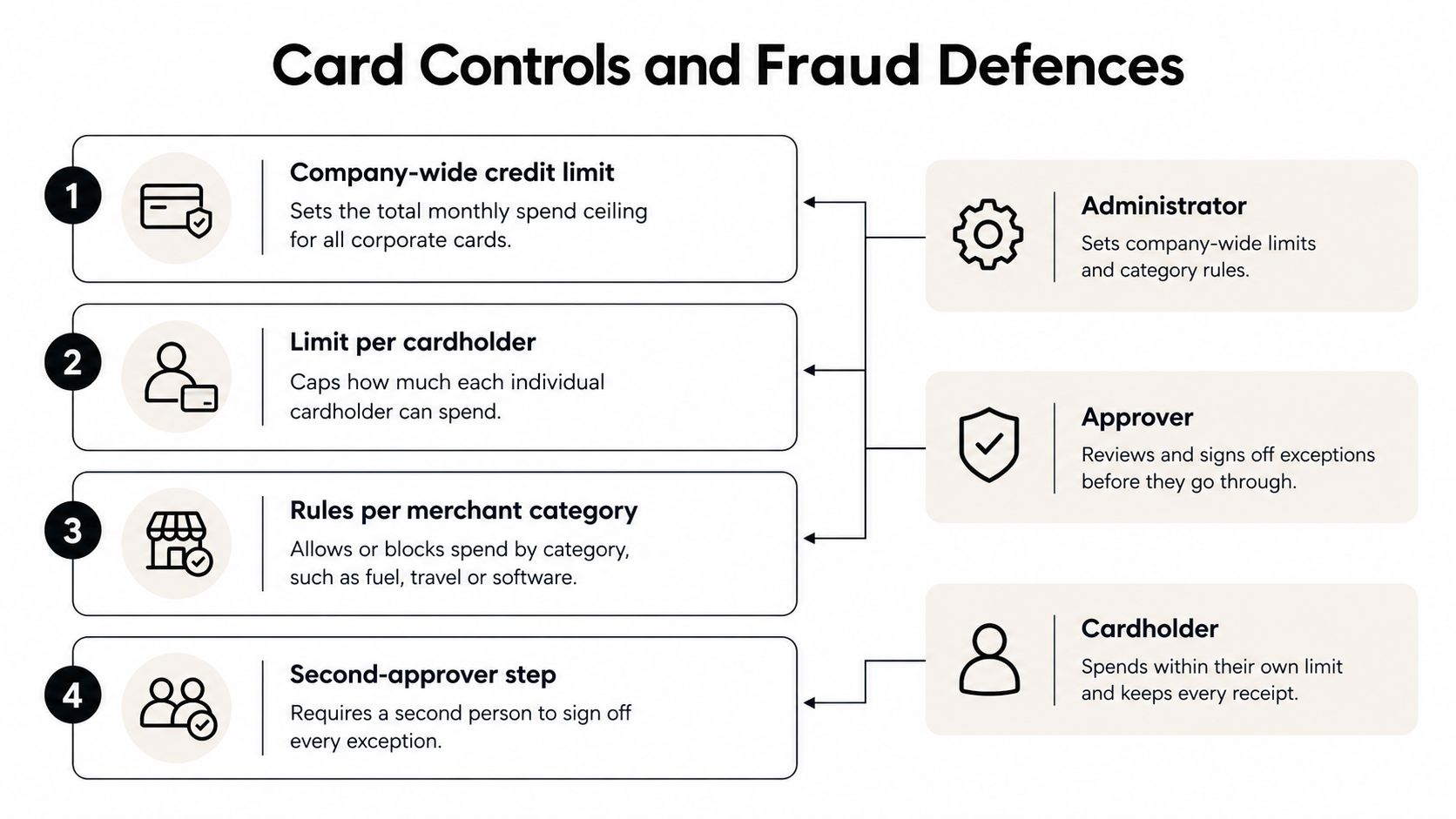
Start with four layers of control: a company-wide credit limit, a limit for each cardholder, rules for merchant categories, and a second approver for exceptions. Together, these translate the company's spending policy into settings that can prevent or flag transactions before they become difficult to investigate.
Give people only the permissions they need. An administrator can manage cards and settings, an approver can review exceptions, a cardholder can make approved purchases, and a read-only viewer can monitor activity without changing it. Don't allow someone to issue their own card and approve their own spending.
The table gives sample settings, not provider rules. Set each limit to fit normal business purchases and your own risk tolerance.
| Control | What it limits | Example SME setting | Fraud route it addresses |
|---|---|---|---|
| Per-transaction limit | Value of a single purchase | R5,000, set near the largest routine purchase | Insider misuse |
| Monthly spend limit | Total spend in one billing cycle | Approved budget per cardholder | Insider misuse |
| Merchant category block | Merchant types that accept the card | Block ATMs, gambling and cash-equivalent categories | Card-not-present theft |
| Channel control | Online, in-store or contactless use | Keep online use off unless the role requires software or travel purchases | Card-not-present theft |
| Foreign-currency control | Cross-border and USD spend | Allow USD spend only for approved travellers | Card-not-present theft |
| Single-use virtual card | One supplier, one amount and one period | Use one card for an annual software renewal | Phishing and merchant data breach |
| Approval threshold | Spend that needs another approver | Require second approval above a set threshold, such as R10,000 | Insider misuse |
| Step-up authentication | High-risk online transactions | Require it above the approval threshold | Compromised cardholder account |
| Freeze and unfreeze | Immediate block on a card | Freeze the same day an employee leaves or an alert fires | Compromised cardholder account |
Online controls deserve particular attention. The South African Reserve Bank reported that card-not-present fraud represented 79.5% of all credit-card fraud losses on South African-issued credit cards in its cyber-resilience consultation paper. The paper also identifies phishing, hacking and card-information theft as routes to fraudulent online transactions (South African Reserve Bank cyber-resilience consultation paper).
Use merchant restrictions and per-transaction limits to contain exposure. Where a card platform supports them, virtual cards restricted to a specific supplier can narrow how stolen details might be reused. Send instant alerts so a cardholder or administrator can question an unexpected purchase quickly.
Track card-not-present approval rates, blocked-transaction rates, unauthorised-loss value and the time between an alert and a card freeze, grouped by cardholder type. Review settings when an employee changes roles, a new supplier is added or overseas online spending expands. Keep business verification documents current, and record who approved each limit change.
A card limit is policy written in software. If the policy isn't written into the card, it isn't enforced.
How to Reconcile Card Spend Every Month
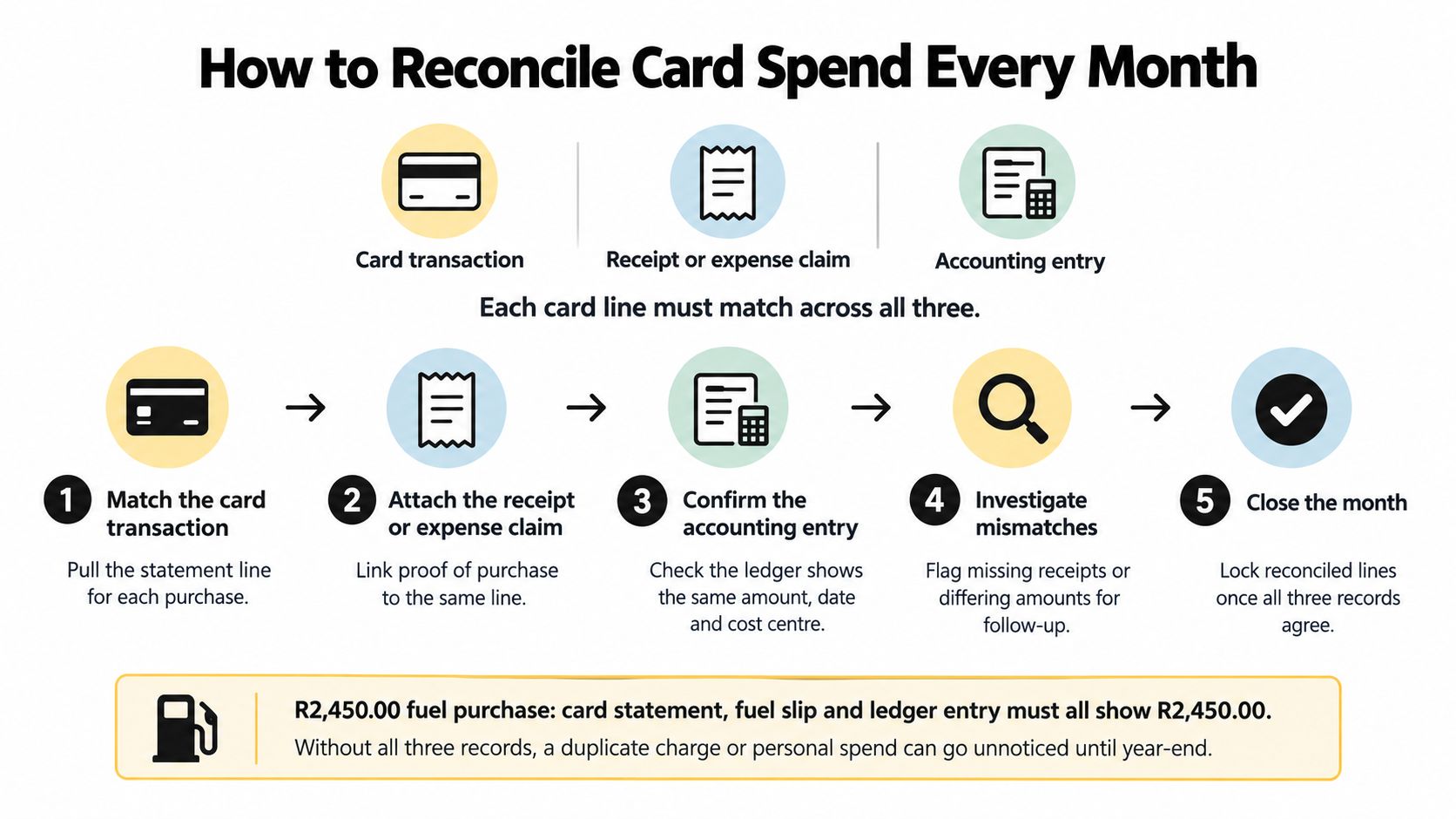
Every card line should match across three records: the card transaction, the receipt or expense claim, and the accounting entry. If one is missing, finance may be left guessing whether a charge was valid, duplicated or coded to the right part of the business.
Good transaction data makes that check easier. A card platform that provides authorisation status, merchant category, currency, exchange rate, fees, settlement date and dispute status can give finance a fuller record to compare with receipts and accounting entries. The South African Reserve Bank describes a card-payment environment with issuers, acquirers, a shared network and merchants handling authorisation, clearing, settlement, disputes and fraud monitoring. For a business, the practical takeaway is to choose records that can be exported and reviewed, rather than relying on a statement that shows only a merchant name and total (South African Reserve Bank payments report).
A repeatable month-end routine
- Export the full statement. Include the merchant name, category code, currency, exchange rate, fees and settlement date so the team can see more than the amount charged.
- Match each purchase to proof. Attach a receipt, invoice or pre-approved claim to the corresponding card transaction.
- Code each line. Assign the ledger account, department and project before posting, so the expense lands in the right place.
- Flag exceptions. Send missing receipts, possible duplicates and personal spend to the cardholder for explanation.
- Check foreign-currency charges. Compare the exchange rate and fees with the quote provided when the transaction was confirmed.
- Route exceptions to another approver. The person who made the purchase shouldn't approve their own exception.
- Post and reconcile. Record the journal, then match the card balance to the payment made on the due date.
For example, a Durban exporter reviewing its monthly statement could discover that a cardholder hasn't submitted a receipt, a software charge appears twice, or a foreign-currency fee needs checking. The finance team should assign each issue to a named person, investigate it, and record how it was resolved. That's more useful than leaving a vague query on a reconciliation worksheet.
The standard is straightforward: every line has a code, a receipt and an approver, and every exception has a named owner.
When a Corporate Card Is the Wrong Payment Method
A Cape Town business books an overseas hotel on a corporate card, then finds a booking surcharge and foreign-exchange costs on the statement. The card made payment easy, but ease is only one part of the decision. Treat the card first as a governance and reconciliation tool, then test whether it is also the right way to pay.
Mastercard reports that 90% of surveyed South African SMEs had adopted digital payments (Mastercard's SME digital-payments findings). Digital payment adoption does not mean every supplier accepts cards, or that a card is the lowest-cost option.
Compare the total landed cost before choosing a route. Add the purchase price, any merchant or booking surcharge, the foreign-exchange markup against the quoted rate, and any cash-advance fees or interest. Include settlement timing too: a card may help with purchase tracking, while a bank transfer may suit a supplier who requires direct payment.
| Scenario | Usually best fit | Watch for |
|---|---|---|
| Staff flights and hotels abroad | Corporate card | Booking surcharges and foreign transaction costs |
| Overseas contractor paid monthly | Direct cross-border transfer | Confirm card acceptance and compare the full cost |
| Local supplier that accepts only EFT | Bank transfer | The supplier may not accept cards |
| Cash needed abroad | Avoid cash advances | Fees and interest may apply immediately |
These are examples, not provider rules. A card can work well for travel bookings or recurring online purchases when the recipient accepts it and the full cost is clear. For a contractor needing a direct payment, or a supplier accepting only EFT, a transfer is often the practical choice.
Ask for the applicable fees and exchange-rate quote before confirming a transaction. If the recipient cannot accept a card, or the card's total cost is higher, use a transfer. The payment method should fit the supplier and the cost, while the card programme's controls keep eligible spending visible and accountable.
Setting Up Your Card Programme Step by Step
Set the rules before issuing cards. A small pilot can reveal where the policy, transaction settings and month-end process don't line up.
- Write a one-page card policy. Define eligible spending, limits by role, receipt deadlines and the rule on personal use. Later settings and approvals should follow this document.
- Confirm the business can apply. Complete the provider's KYB and compliance checks, and make sure the applicant is authorised to bind the organisation. Zaro's services are available to businesses that pass KYB and compliance checks, and users must have that authority.
- Map the roles. Name an administrator and at least one approver, then group cardholders by department or job need. Keep card issuance and approval with different people wherever possible.
- Set limits and merchant rules. Begin with settings that cover routine purchases without giving cardholders more authority than their role requires.
- Pilot with a small group. Start with two or three cardholders for one full billing cycle. This gives the team a manageable way to test both transactions and reporting.
- Reconcile the pilot. Use the month-end routine to identify missing data, slow approvals or unclear responsibilities, then fix the process before adding more users.
- Train every cardholder. Explain what receipts to keep, how to freeze a card and what to do if a transaction looks suspicious.
- Review the settings. Revisit limits each quarter and whenever a role, supplier or market changes.
A pilot is ready to scale when cardholders submit receipts on time, unexplained exceptions are resolved, and staff know how to freeze a card. If those habits aren't in place, adding more cards will increase the amount of work finance has to chase.
Choose a Provider and Start a Controlled Pilot
Check these points before choosing a provider:
- Confirm licensing on the FSCA register.
- Check FIC registration and FICA controls.
- Look for role-based access for administrators, approvers and cardholders.
- Confirm that the provider supports per-cardholder limits and merchant blocks.
- Review how foreign-exchange spreads and fees are disclosed before confirming a transaction.
- Check that reconciliation exports include merchant, currency, rate and fee.
- Confirm that cards are available in the currencies your business needs.
Zaro is an authorised Financial Services Provider registered with the FSCA under FSP number 55133 and is operated by PivotalCapital (Pty) Ltd t/a Zaro. It offers multi-user access, team permissions and bank-grade security. Its ZAR and USD cards are listed as coming soon, so a pilot today should use funded ZAR and USD accounts for transfers while card availability is rolled out.
The onboarding route is to sign up, complete KYB verification, fund ZAR and USD accounts by bank transfer, then make and receive cross-border payments. Start with the policy from the setup steps, request a written quote, and compare the landed cost of your largest recurring international payments before choosing a route.
If your team is weighing card controls against direct international payments, Zaro offers business cross-border payments with transparent quoted fees and multi-user controls, while its ZAR and USD cards are coming soon. Write your spending policy, compare the full cost of your regular payments, and visit Zaro to explore the account and onboarding process.