
You've just approved a supplier invoice, or maybe you're waiting for a buyer's payment to clear so you can release stock, pay wages, or settle the next shipment. The screen says "sent", but the money hasn't really taken a straight line anywhere. For a South African SME, that gap between clicking send and seeing funds land is where correspondent banking, fees, compliance checks, and delays shape cash flow.
What Happens When You Press Send on an International Payment
A Durban fruit exporter pays a Dutch buyer's euro invoice from a local bank account. On paper, it looks simple. In practice, the payment has to leave South Africa, find its way into the right currency system, pass through one or more banks that do not know your business personally, and then land in an account held somewhere else.
That is why a transfer can arrive short, slow, or rejected. The screen shows a single instruction, but the payment is really a chain of conversations between banks, each one checking the message, the currency, and the compliance data before it agrees to move the next step. For the exporter, the problem is never just “did I press send?”, it's “which route did this payment take?”
Why the route matters for an SME
If you run finance for an SME, you feel the route in practical ways. A payment can be deducted for intermediary handling, hit a conversion rate you didn't expect, or pause while a bank asks for more invoice detail. None of that is obvious in the first click.
Practical rule: if a cross-border payment feels unpredictable, the route is probably doing more than one job, it is moving funds, proving purpose, and satisfying controls.
The central question is not academic. It is whether your payment needs the correspondent chain at all, and if it does, where the friction is likely to appear. That is the routing decision hidden inside every international transfer.
The Core Mechanics of Correspondent Banking
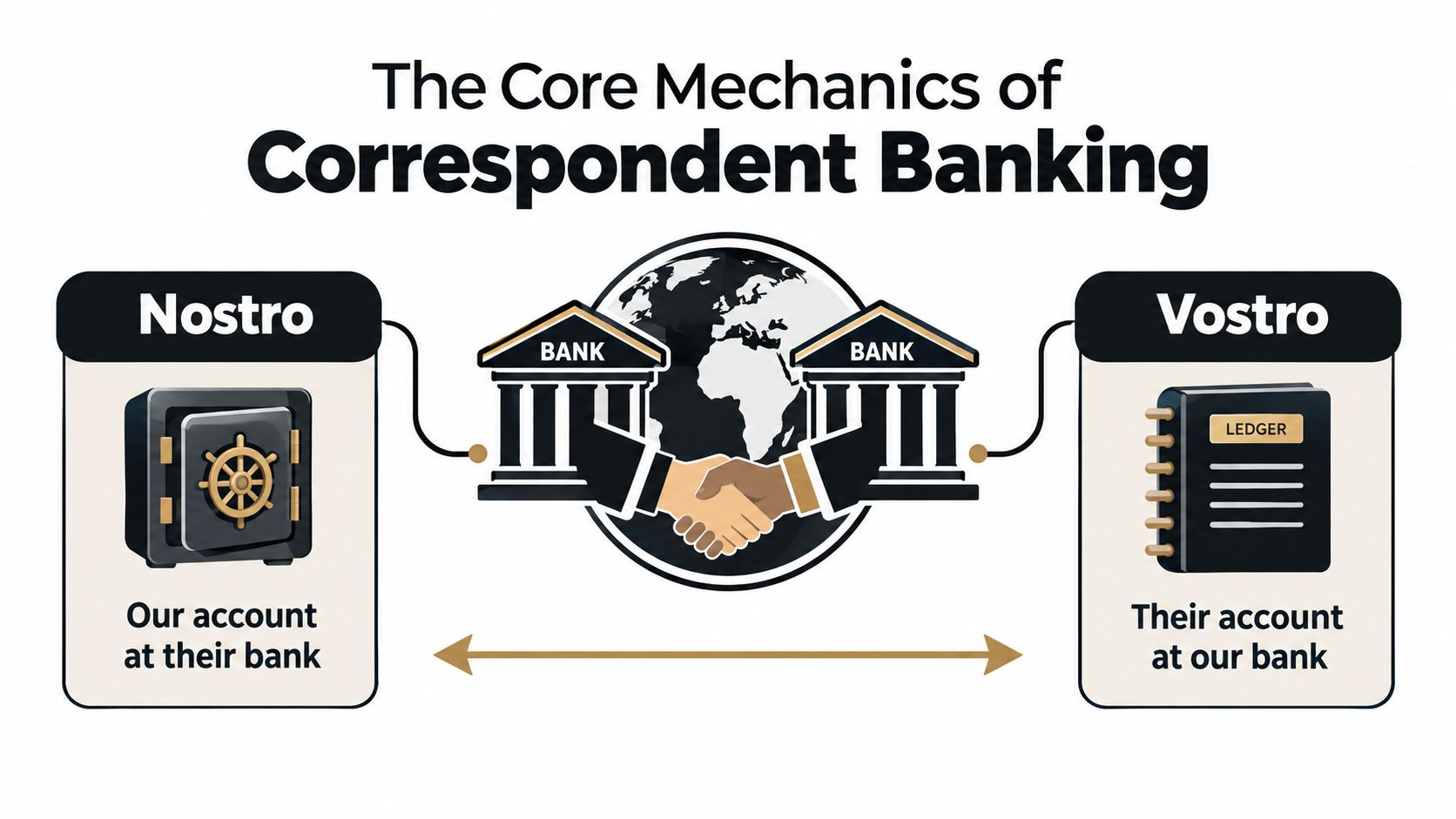
A South African SME sending money into another currency system is often relying on correspondent banking without seeing it on screen. The South African Reserve Bank describes it as an arrangement where banks in different territories hold accounts with one another in the currencies needed to settle transactions, so a bank can make and receive payments where it has no physical presence or direct account relationship in the destination country (SARB correspondent banking overview). In practice, one bank keeps money, or access to money, on behalf of another bank so a cross-border payment has a place to land.
Nostro and vostro in plain English
Nostro and vostro are just two sides of the same relationship. A nostro account is “our account at their bank”. A vostro account is “their account at our bank”. The simplest image is a wallet held by someone else for safekeeping. The money still belongs to you, but it sits in their possession until you need it.
For a South African bank, those foreign accounts are the entry points into other currency systems. SARB reported that, as of December 2024, 18 institutions in the South African banking sector held correspondent banking accounts at foreign banks, and across the sector they held 2,439 correspondent accounts (SARB prudential public awareness note). For an exporter paying an overseas supplier, that is the plumbing behind the payment rail, not a side feature.
Why US dollars are a special case
US dollars usually need access to a major USD clearing centre, or a partner bank that has it. A regional pricing study covering South Africa and the SADC region explains that correspondent relationships support cross-border payments, foreign exchange, and trade, and that dollar settlement generally depends on access to a jurisdiction hosting a major USD clearing house (SARB regional pricing study). That concentration explains why fees appear and why delays happen. Each extra bank in the chain adds another check, another handoff, and another point where repairs may be needed.
Every nostro account opens a door into a different currency's clearing system. If you know which door your payment needs, you can judge whether the correspondent chain is the right route, or whether a regional rail can carry it instead.
How a SWIFT Message Travels From Your Bank to the Beneficiary
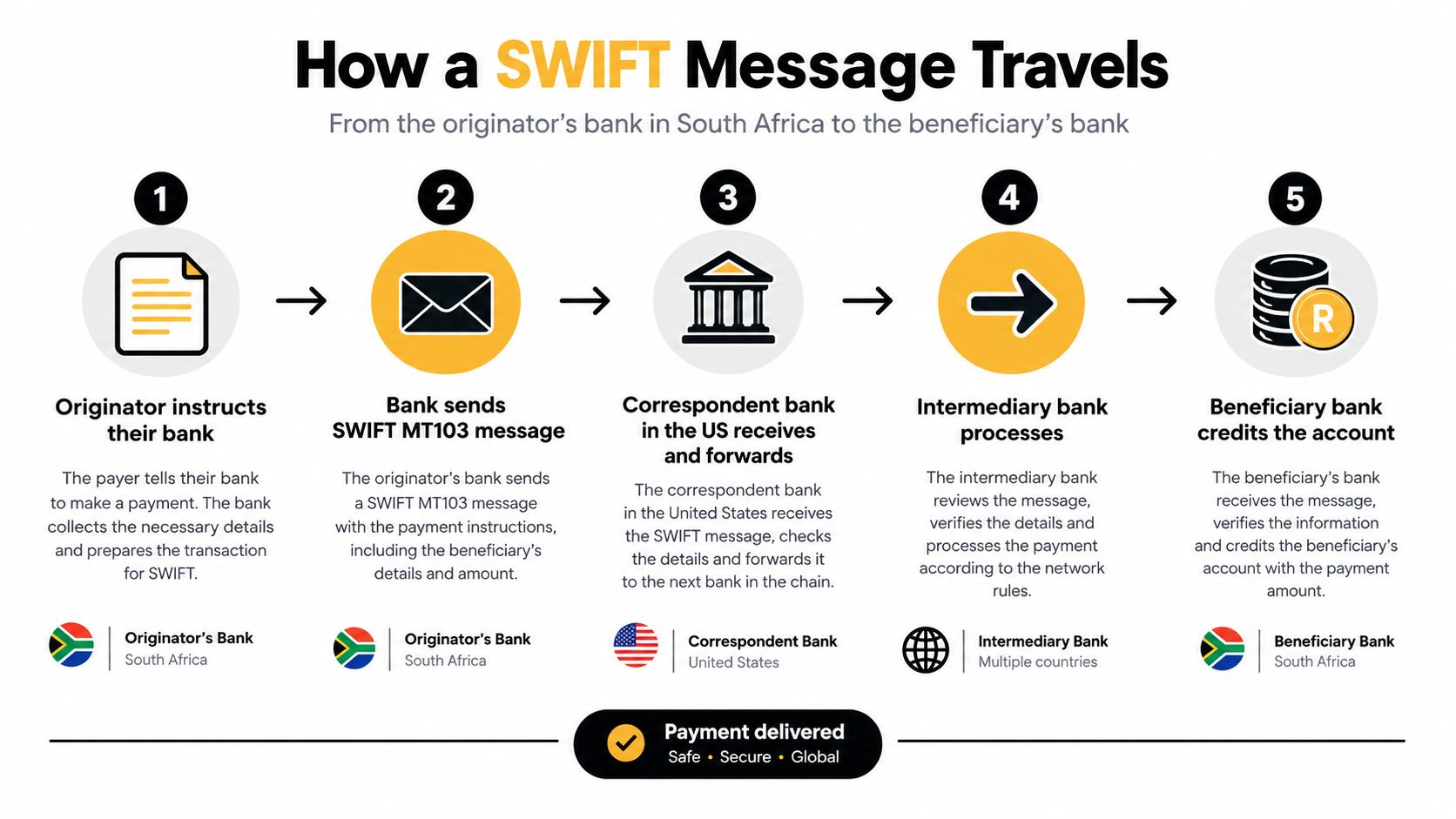
A Randburg manufacturer sends payment to a component supplier in China. The finance team sees a single instruction, but the route behind it is a message chain, often carried in a SWIFT MT103, that tells each bank what to do and who to credit. The local bank does not always send funds straight to the supplier's bank. It may first route the payment through one or more correspondent banks, and that routing choice is made every time the transfer leaves the account.
The hand-offs in the middle
The first bank receives the instruction from the originator. It checks the beneficiary details, the payment purpose, and whether the transaction fits exchange-control and compliance rules. Then it sends the instruction through SWIFT to the next institution in the chain.
The correspondent bank receives the message and applies its own checks. If it cannot settle the currency directly, it forwards the payment to another correspondent or intermediary bank. A nested correspondent can sit in the middle when the payment needs a bridge through a bank that already has the right clearing access. Only when the chain reaches the beneficiary bank does the final credit happen.
For a South African SME, this is the difference between choosing a direct road and taking a connection through a hub airport. The payment may still arrive, but each hand-off adds another checkpoint.
Where payments get stuck
Any node can pause the transfer. One bank may ask for missing invoice support. Another may flag beneficiary ownership data. A third may hold the instruction because the payment purpose is unclear or the sanctions screening result needs review. For an SME waiting on cash flow, “stuck in compliance” often looks like a silent delay, then an email asking for documents that should have been captured before the payment left the originator's bank.
The IMF assessment links higher remittance costs from South Africa to the complexity of meeting AML/CFT, exchange-control, data-protection, and foreign-correspondent requirements, and notes that those obligations raise operational cost for users (IMF assessment). That is why a payment that looks instant on screen can still move through several hand-offs before it reaches the beneficiary.
Where the Hidden Costs Sit
The fee you see on an international transfer is usually the smallest part of the bill. The larger cost often sits in the exchange-rate spread, then in intermediary charges, then in the time your team spends fixing a payment that has gone off course.
| Cost Layer | What It Covers | Typical Impact |
|---|---|---|
| Transfer fee | The fee charged by the sending bank or payment provider | Visible upfront, but rarely the full cost |
| Correspondent processing | Charges from intermediary banks in the chain | Can reduce the amount received |
| FX spread | The markup embedded in the exchange rate | Often the biggest hidden cost |
| Compliance review | Screening, documentation checks, exception handling | Causes delay and internal admin |
| Payment repair | Fixing beneficiary data, invoices, or routing errors | Adds time and can trigger extra fees |
A cross-border payment is a routing choice your SME makes every time it sends money. If the route runs through correspondent banks, each hand-off can add cost or delay. If the payment can use a regional rail instead, part of that chain may be bypassed.
The IMF reported that sending remittances from South Africa to Zimbabwe averaged 12.7% of the transferred amount in Q1 2024, well above the G20's 3% target for 2030 (World Bank Remittance Prices Worldwide database). That corridor shows how quickly friction builds when several layers stack on top of one another.
A simple worked example
If an SME sends R1 million and the quoted exchange rate is weaker than the mid-market rate, the spread can remove a meaningful chunk of value before any transfer fee is added. The exact amount depends on the rate offered at the moment of conversion.
The practical test is straightforward. Compare the rate you receive with the market rate and treat the gap as a real cost, not an abstract one.
What to watch first
- FX rate transparency: Ask what rate is being used, not only what the fee is.
- Intermediary charges: Check whether the beneficiary will receive less because another bank took a cut.
- Repair risk: Clean beneficiary data reduces follow-up work and delays.
- Purpose evidence: Invoice or contract support can prevent compliance holds.
For a South African exporter, the visible fee is often the easiest number to spot and the least useful one to judge. The exchange rate is usually where the largest hidden cost sits.
When Correspondent Banking Is Not the Only Route
A South African exporter does not have to assume every regional payment follows a correspondent chain. In some corridors, the payment can move through a regional rail instead, which changes the routing choice from the start.
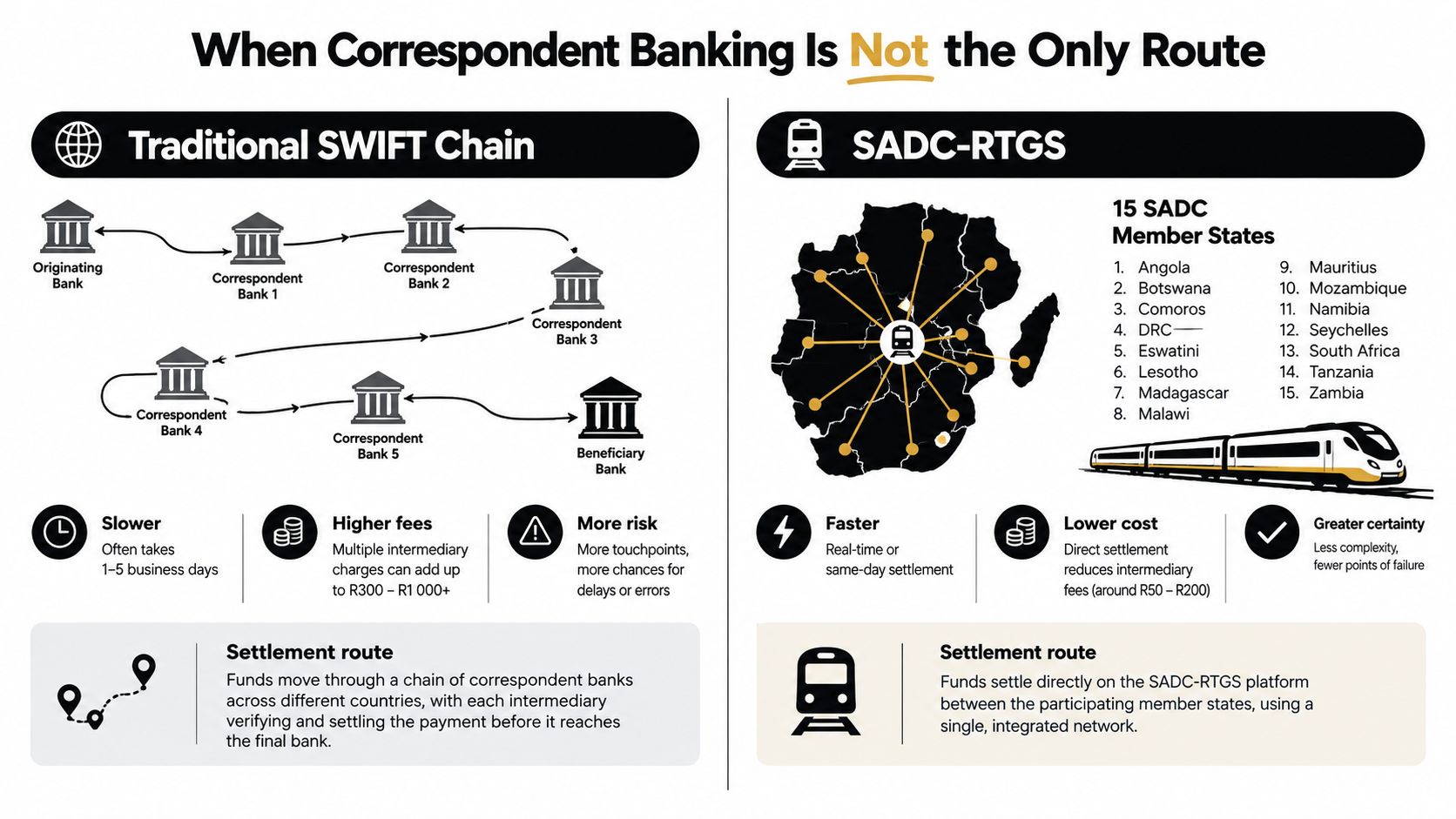
Regional rails can bypass part of the chain
SADC-RTGS, operated by SARB for participating central banks, connects 15 SADC member states and 89 banks. In 2025 it processed approximately US$3.77 billion in trade and interbank transactions across nine currencies, and South Africa represented nearly US$2.99 billion, or 79% of total value (regional payments report). For an SME, that means a payment inside the right corridor may clear through a regional settlement rail rather than a full correspondent chain.
Eligibility still matters. The currency, the corridor, and the participating banks all need to line up. A transfer between eligible regional banks can bypass part of the chain, but that does not make every regional payment eligible.
TCIB changes the low-value CMA picture
SARB's Directive No. 1 of 2025 requires low-value cross-border electronic funds transfers within the Common Monetary Area, South Africa, Lesotho, Eswatini and Namibia, to migrate to the TCIB regional retail-payment scheme (SARB Directive No. 1 of 2025). A small payment to a supplier in one of those CMA countries may therefore use a different rail from a dollar payment to Europe or Asia.
For a finance team, the routing question is simple. If the payment is regional, low-value, and the receiving bank participates, check whether a regional rail is available before defaulting to correspondent banking.
A corridor-by-corridor lens
Use three checks. Is the currency supported? Is the beneficiary bank participating? Is the corridor covered by a regional rail or by a CMA rule change? If all three answers are yes, part of the correspondent chain may be bypassed. If not, the older route may still be necessary.
Comparing the Correspondent Route With a Transparent Fintech Rail
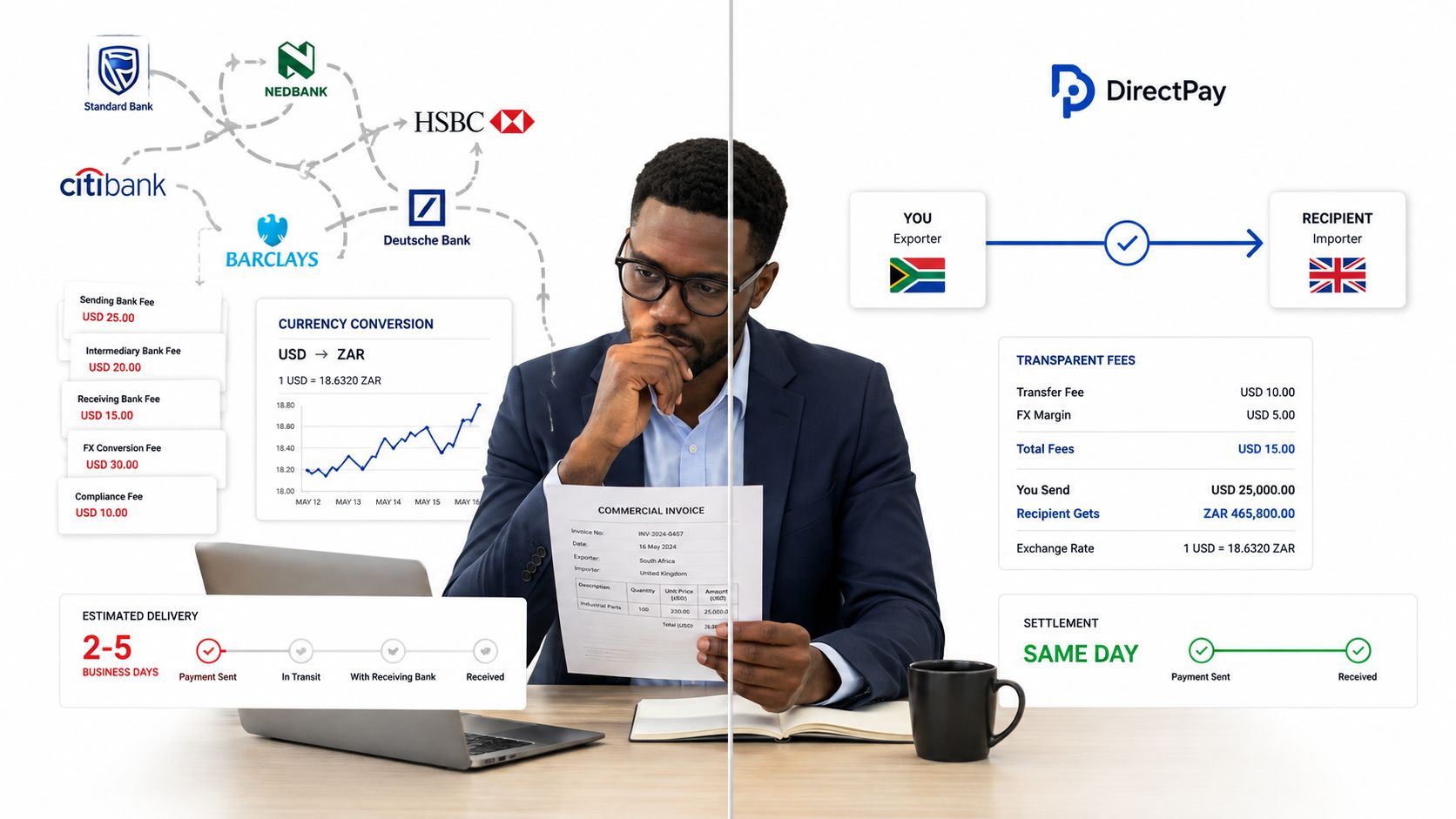
A South African exporter paying a US dollar invoice is making a routing choice every time money leaves the account. The traditional correspondent route can move the funds, but the payment may pass through several intermediaries, each adding FX spread, compliance checks, or a fee that was not obvious at the start. A transparent rail takes a different approach. It shows the exchange rate and fee structure up front, so finance teams can compare the full cost before they send.
A product such as Zaro follows that model. It funds ZAR and USD accounts through standard bank transfers, uses the actual spot rate, and avoids SWIFT fees. That does not make it the right answer for every corridor. It does show how a direct rail can simplify the payment path when the corridor and beneficiary setup fit.
The choice is structural, not emotional
An exporter does not need to settle on one rail for every payment. The better approach is to match the rail to the corridor and the payment purpose. A time-sensitive supplier payment may justify one path, while a recurring regional transfer may fit another. A regulated regional payment can also follow a different route from a hard-currency invoice going outside the region.
Payment timing is only half of the working-capital picture. The other half is how you plan cash flow around those payments.
A quick comparison checklist
- Currency: Is the payment in ZAR, USD, or another currency?
- Urgency: Does the beneficiary need certainty more than flexibility?
- Beneficiary bank: Can the receiving bank take a direct regional or direct-rail payment?
- Regulatory environment: Does the corridor trigger exchange-control or CMA rules?
- Relationship value: Is this a one-off transfer or a recurring supplier flow?
If those answers point to a simpler rail, use it. If they do not, correspondent banking still has a place.
Practical Steps for South African Exporters to Reclaim Control
A supplier in Johannesburg sends a payment to a partner in Kenya, and the question is not just “What is the fee?” It is “Which rail should this transfer use?” Start by mapping every cross-border payment by currency, corridor, and beneficiary bank. That shows which flows still need correspondent banking and which can move through a regional rail or another direct route.
Then compare the full cost, not only the transfer fee. Include the spread, intermediary charges, compliance delays, and the time your team spends fixing exceptions. Clean onboarding data helps too, because structured beneficiary, invoice, and ownership details lower the chance of manual review.
For regional payments, route CMA transfers through TCIB where eligible, and use SADC-RTGS for participating regional corridors where the currency and bank setup fit. Keep correspondent banking for the flows that still need it, especially when the beneficiary bank or currency makes that route unavoidable.
A good operating habit is to record the purpose of payment before funds leave your account. Finance teams that keep that record usually spend less time on follow-up and reconcile faster when a payment is queried.
Payment timing also affects working capital. If you want a practical cash-flow reference, see how AmbitionCFO helps.
A direct-rail option like Zaro can fit South African business payments where the corridor and compliance setup line up. Use that kind of route for the flows that suit it, and keep correspondent banking for the transfers that still need the older path.