
Your supplier in Rotterdam has sent the same invoice three times this quarter. The amount is $10,000, the due date is Friday week, and your bank's quote sits on screen beside a quote from a specialist platform that looks cheaper on the rate and vaguer on everything else. The invoice says $10,000. What leaves your account is a rand figure nobody printed on the document, and the gap between those two numbers is the subject of cross border transactions banking.
That gap isn't one fee. It's a chain of small decisions taken by four or five institutions in sequence, each taking a slice, most of which never appear as a line on your statement. Once you can see the chain, the rand figure stops surprising you, and you can rank two quotes on the same invoice without guessing.
How a Cross Border Payment Travels Between Banks
Follow the invoice. Your bank debits your rand account, but it can't push rand into a Dutch bank account and leave it there. For any rand-to-foreign-currency conversion, a South African bank works through an Authorised Dealer or an Authorised Dealer with limited authority, an ADLA. That dealer is the party permitted to buy or sell foreign currency against rand, and it's where your rand becomes dollars, at a rate the bank quotes rather than a rate the market sets.
The relay has five moving parts, and each one is a place where cost can enter.
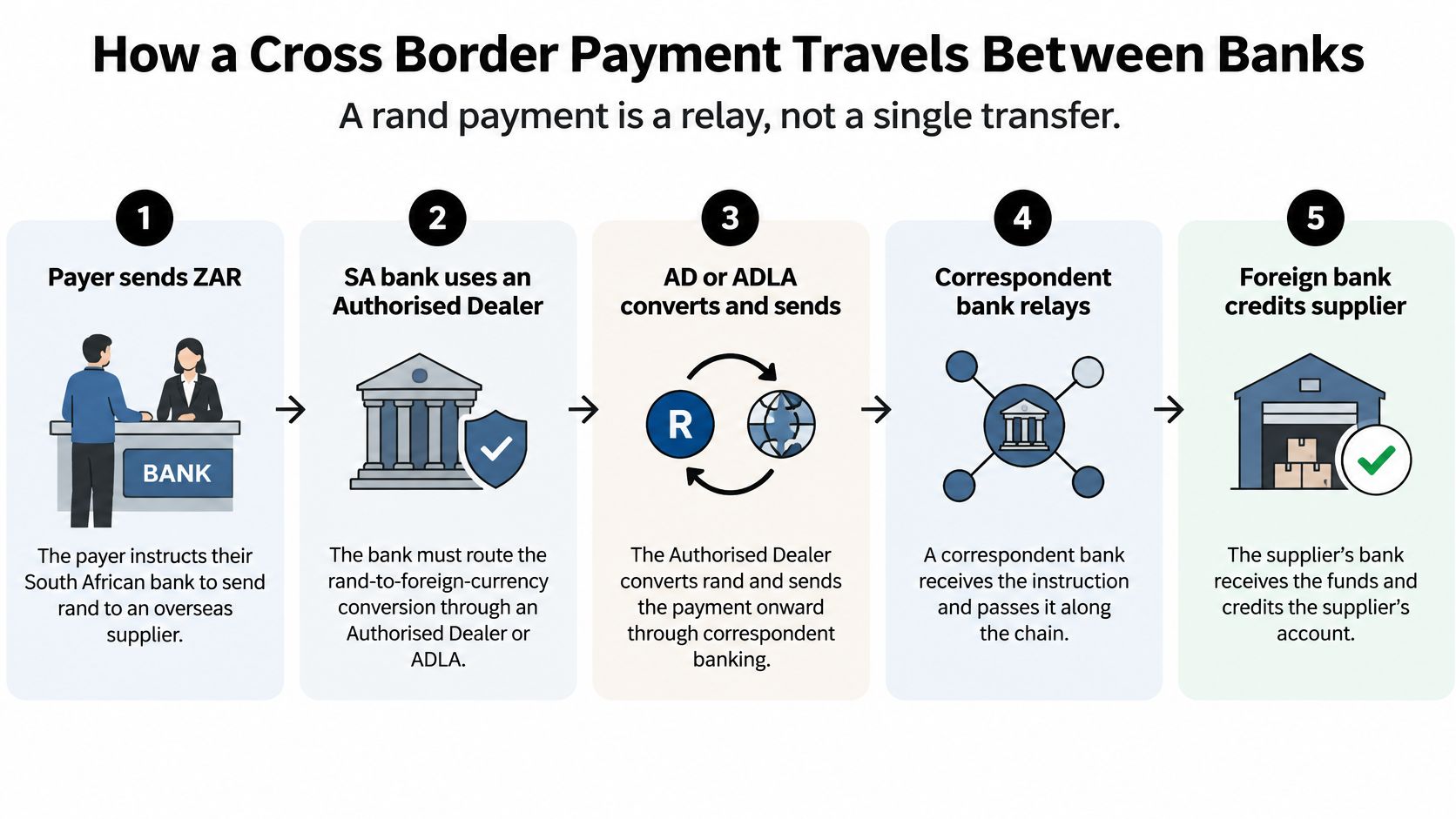
The payment instruction travels separately from the money. Your bank packages the beneficiary details, purpose and amount into a message and sends it over the SWIFT network, the messaging system banks use to tell each other what to pay and to whom. Where your bank and the beneficiary's bank hold no direct relationship, a correspondent bank sits between them, keeping accounts in both currencies, receiving the instruction and passing the funds along. The beneficiary's bank then credits your supplier, usually minus whatever the intermediaries deducted on the way.
Think of it as a letter rather than a wire transfer. The letter is your instruction. Every sorting office it passes through stamps the envelope, and every handler takes a small cut before passing it on. The letter still arrives. It just arrives lighter.
Volume shows how ordinary this has become. South African Reserve Bank analysis based on its FinSurv Cross-border Reporting System shows formal remittance outflows to the rest of SADC rising from just under R6 billion across about 4.8 million transactions in 2016 to more than R19 billion across about 15.7 million transactions in 2024 (SARB analysis of South Africa and SADC cross-border payments). That's more than a threefold increase in both count and value across eight years.
Those figures cover formal, reported transactions passing through the regulated banking system, so they don't count every transfer in the region. They do show that this isn't corporate-only plumbing. A high-volume stream of smaller payments now runs the same rails your supplier payment uses, which is why pricing discipline and clean processing matter more than they did a decade ago.
Three Questions to Ask About Any Transfer
- Who converts the money? Usually the Authorised Dealer, at its own quoted rate. The rate is the largest cost component on most payments and the one most often left unexamined.
- Who forwards it? Your bank, possibly a correspondent, then the beneficiary's bank. Each hop is a chance for a deduction.
- Who charges at each step? Commission, the message fee and intermediary charges are three separate charges, and they're rarely quoted together.
Ask those three before you approve anything, and the quote starts to make sense.
Payment Routes and Timelines Compared
Cross Border Payment Routes Compared
| Route | How the money moves | Typical timing | Main cost drivers |
|---|---|---|---|
| Bank SWIFT transfer | Authorised Dealer converts rand and sends through correspondent banks | 1-3 business days, longer if queried | FX spread, SWIFT fee, correspondent charges |
| Bank USD account funded in rand | Bank converts rand to dollars at its quoted rate when funds are debited | Same day to 2 business days | Quoted-rate margin, conversion commission |
| Regional settlement via participating bank | Real-time gross settlement between banks in the SADC-RTGS network | Real time to same day, only where both banks participate | Bank fees, FX margin, participation check needed |
| Specialist FX platform | Funds converted on the platform and paid out over local or SWIFT rails | Platform-specific, confirm before committing | Spread, platform fee, funding method |
| Card spend abroad | Card transaction converted at the card network rate | Immediate at point of sale | Card FX margin, foreign transaction fee |
Read that timing column as a planning range, not a commitment. Transit time varies by bank, corridor and currency, and the only answer you can safely build a promise on comes from your own bank in writing.
What the Regional Rails Actually Carry
SADC-RTGS, the regional real-time gross settlement system used by participating central and commercial banks, processed 142,413 transactions worth about R210.02 billion in September 2024 alone, averaging 7,121 transactions a day. The network reported 88 participating institutions, and the September country summary records 53,430 South African transactions worth about R93.98 billion (SARB's SADC-RTGS settlement statistics for September 2024). Regional settlement isn't a niche add-on. It's shared infrastructure carrying serious volume, which is why it relies on shared rails rather than a patchwork of bilateral deals.
That matters because a route is only as fast as its weakest link. If your bank participates but your supplier's bank doesn't, the payment drops out of the regional system and finishes over correspondent rails, which puts the business days straight back. Before you promise same-day value, confirm the beneficiary's bank is a participant, and confirm it by name rather than by assumption.
Three Decision Rules
- One-off payment to a bank outside the regional system: use SWIFT through your Authorised Dealer. It has the widest reach, and reach is what you're buying.
- Both banks participate in the regional system: settle regionally. Fewer intermediaries means fewer deductions, and same-day value is possible where both sides are ready.
- Choosing between two viable routes: compare total cost, not speed. A faster route that costs more only pays off if the delay would cost you a penalty, a production stoppage or a customer.
Reading Timing Against a Due Date
Work backwards from the date on the invoice. If the supplier needs funds in their account by the 28th and the route takes three business days plus one day for a query you can't rule out, your latest release date is the 24th, not the 27th. Public holidays in the receiving country count too, and they aren't in your calendar by default. Put the release date in the payment run rather than the due date, and late payment conversations largely disappear.
The Real Landed Cost Behind Every Transfer
Write down two numbers before you approve anything: the rand that leaves your account, and the foreign currency your supplier confirms receiving. Convert the second back at the mid-market rate and subtract it from the first. What's left is the true cost of the payment, and it's usually bigger than the fee line on the quote.
Components of the All-in Landed Cost
| Cost component | What it is | Where it shows up | How to check it |
|---|---|---|---|
| Quoted rate versus mid-market rate | Margin the bank adds to the live rate | Built into the rand per dollar figure | Compare with the live mid-market rate on the same day |
| Commission | Flat or percentage fee on the transfer | Separate line on the rand debit | Ask for it in writing before confirming |
| SWIFT fee | Charge for sending the payment message | Sender or beneficiary debit, depending on OUR, SHA or BEN | Confirm which option applies to the payment |
| Correspondent bank charges | Deductions by intermediary banks along the route | Reduces the amount the beneficiary receives | Ask for the amount expected at the beneficiary |
| Timing risk | Rate moves between quote and settlement | Rand cost changes after the quote | Use a quote with a stated validity window |
| Pre-funding | Cash held in the foreign account before sending | Working capital tied up before payment | Count the days of cash held and price them |
Where the Cost Hides
The quoted rate is the biggest line and the quietest. A bank that charges nothing in commission but quotes a rate well off mid-market can cost you more than a provider charging an explicit fee at the actual rate. The only way to know is to put both numbers side by side on the same day.
Then come the deductions you don't see. A message fee is charged once, but who absorbs it depends on whether the payment is sent as OUR (sender pays all charges), SHA (shared, sender pays their own bank's charge) or BEN (beneficiary pays all charges). Under BEN, and often under SHA, an intermediary bank subtracts its own charge before funds reach the supplier, so the invoice arrives short by an amount nobody quoted you.
The IMF 2025 South Africa technical assistance report identifies pre-funding across currencies and limited access to efficient foreign-exchange markets as drivers of higher end-user costs. A 2025 G20 cross-border-payments scorecard estimate cited in that analysis puts hidden FX fees paid by South African consumers and SMEs at a combined $757 million for the year.
Pre-funding is the cost finance teams forget, because it never appears on a statement. If you must hold dollars for three days before the payment leaves, that cash isn't available for payroll, and the cost of carrying it belongs in the comparison.
The contrarian point: removing a visible transfer fee doesn't make a payment cheap. If the spread and the funding requirement stay opaque, you've moved the cost, not deleted it.
The Formula That Ranks Two Quotes
All-in cost = rand debited minus the mid-market rand value of the invoice, plus the mid-market rand value of anything the beneficiary never receives.
That last term is the correspondent shortfall, and leaving it out flatters every quote carrying heavy intermediary charges. At R18.00 to the dollar, a $25 deduction along the route adds R450 to the true cost of the payment.
Ask every provider three questions before you commit: what is the total rand debit, what amount will the beneficiary receive, and how many days is my cash held before the payment leaves?
Approvals, Evidence and Payment Controls
When a Payment Becomes an Approval Question
Money crossing a border doesn't by itself trigger exchange-control review. The outcome depends on the transaction's purpose, the documents behind it, the counterparty, the currency and whether the Authorised Dealer holds delegated authority to approve that category of payment. Exchange-control matters run through an Authorised Dealer or an ADLA, and SARB publishes separate business-entity guidance alongside its financial surveillance guidance for the general public. The U.S. Department of State's 2025 South Africa investment-climate report notes that authorised foreign-exchange dealers must handle international commercial transactions and report every foreign-exchange purchase, and that transactions above certain thresholds can require SARB approval. Separately, SARB's 2025 Exchange Control Circular allowed authorised dealers to permit eligible agricultural commodity producers to hedge foreign exposures, subject to firm commitments, documentary evidence and reporting.
Read that last item carefully. Liberalisation for one group of exporters doesn't loosen the evidence standard for anyone else. It moves the decision closer to the bank and makes accurate purpose codes and audit-ready records more important, not less.
Evidence and Approval by Payment Case
| Payment case | Evidence to keep | Approval route | Escalate to SARB when |
|---|---|---|---|
| Supplier invoice in foreign currency | Signed invoice, purchase order, import documents | Authorised Dealer processes under current rules | Amount above the threshold that requires approval |
| Export proceeds received | Export invoice and shipping or customs evidence | Authorised Dealer, with proceeds handled under the export rules | Proceeds aren't repatriated or the shipment evidence doesn't support the inflow |
| Contractor or service payment abroad | Contract, service invoice, tax documents where required | Authorised Dealer | Purpose or beneficiary falls outside the dealer's delegated authority |
| Intercompany loan | Loan agreement, interest terms, board approval | Authorised Dealer, may need SARB approval | Above the threshold or a new structure |
| Hedging foreign exposure | Firm commitment and underlying documents | Authorised Dealer; agricultural producers have expanded flexibility under the 2025 circular | Outside the scope of the circular |
The reporting duty is transaction-level. Every cross-border foreign-exchange transaction must be reported to SARB's Financial Surveillance Department, and businesses must complete an integrated form for each one (SARB's Currency and Exchanges Guidelines for Business Entities). SARB defines such a transaction as the purchase or sale of foreign currency with or for rand, which puts your ZAR-to-USD conversion and your international supplier payments squarely in scope. Your payment system therefore needs payer, beneficiary, purpose, currency, value and documents captured per transaction, not a daily settlement total.
Five Fields to Make Mandatory Before Release
- Purpose code. A wrong code sends the payment to manual review. The common slip is reusing last month's code because the invoice looked similar.
- Beneficiary screening. Sanctions and watchlist screening is a pre-release check, not a tidy-up afterwards. The common slip is screening the parent company but paying the subsidiary.
- Invoice evidence. A missing or mismatched invoice creates an exception the dealer must resolve before release. The common slip is a purchase order whose reference doesn't match the invoice.
- Approval history. Who approved this, when, and against which limit. The common slip is an approval given by email that never reaches the payment system.
- Reconciliation status. Whether the payment ties back to the vendor ledger and the bank statement. The common slip is a payment booked in the wrong period, which makes the trail harder to rebuild. If that tie-back is where your process frays, month-end payment reconciliation for controllers walks through the closing routine.
The six-month audit test: could someone rebuild this payment from the record alone, six months from now, without asking you a single question? If the answer is no, the record isn't finished.
Paying a Foreign Supplier in USD
Every figure below is illustrative, not a live rate. The method is the point, and you should replace these numbers with quotes you've received before deciding anything.
Your supplier invoices $10,000. The mid-market rate on the day is R18.00 to the dollar, so the invoice is worth R180,000 in rand at the rate you can see on any currency site. Your bank quotes R18.40, charges R500 commission and a R650 SWIFT fee, and a correspondent bank deducts $25 on the way through.
That's the whole scenario, and it's the one most finance teams meet with a mixture of habit and hope.

The Visible Cost First
Convert the invoice at the quoted rate and add the fees. $10,000 at R18.40 is R184,000. Add R500 and R650 and the rand debit comes to R185,150. Against the mid-market value of R180,000, the visible cost is R5,150, about 2.9 per cent of the invoice.
Now price the second quote. A platform offers R18.10 with the same R500 commission and R650 SWIFT fee. The converted value is R181,000, the rand debit is R182,150, and the visible cost is R2,150, about 1.2 per cent.
| Quote | Rate | Converted value | Commission and SWIFT | Rand debited | All-in cost at mid-market |
|---|---|---|---|---|---|
| Quote A | R18.40 per dollar | R184,000 | R1,150 | R185,150 | R5,600 (about 3.1 per cent) |
| Quote B | R18.10 per dollar | R181,000 | R1,150 | R182,150 | R2,600 (about 1.4 per cent) |
The gap between the two quotes is R3,000. That number is larger than the R500 commission most buyers fixate on, and it came entirely from the rate.
Then Add the Shortfall
Your supplier receives $9,975, not $10,000, because the correspondent bank took $25. At the mid-market rate of R18.00, that missing $25 is R450 of value the beneficiary never got, and it belongs in the cost whether or not your bank mentions it.
So Quote A costs R5,600, about 3.1 per cent of the invoice, and Quote B costs R2,600, about 1.4 per cent. The R3,000 gap doesn't change, but the actual cost of paying is higher than either quote suggests on its own.
One thing both calculations leave out: if you pre-funded roughly R185,000 for three days before the payment left, that cash was tied up and unavailable for payroll. Price those days at your own cost of capital and add them.
Check Your All-In Cost Before Your Next Transfer
Before the next payment run, do four things in order.
- Get the live mid-market rate for the currency pair on the day you're approving, not the day the invoice arrived.
- Get the quoted rate and every fee in writing, including whether the payment goes OUR, SHA or BEN, so you know who absorbs intermediary charges.
- Calculate the all-in cost as the rand debited minus the mid-market rand value of the invoice, then add the mid-market value of any shortfall the beneficiary will experience.
- Confirm the amount the beneficiary will receive, in their currency, before you release the funds. That number belongs on the quote you approved, not in a notification two days later.
Two quotes, one invoice, one formula. That's the whole comparison, and it's the only version a CFO can act on, because it puts every route on the same footing: the same $10,000 invoice, converted back to a single rand number.
Zaro runs a free USD to ZAR converter that checks the live mid-market rate and compares what a bank may take in FX spread and SWIFT fees, which delivers steps one and three in a couple of minutes. We're FIC registered and meet FICA requirements for anti-money laundering and know-your-customer compliance, so onboarding means signing up, completing Know Your Business verification, funding your ZAR and USD accounts by bank transfer, then sending and receiving cross-border payments. Our services are available to businesses that pass KYB and compliance checks, and the person signing up must be authorised to bind the organisation.
Run the converter on the invoice sitting on your desk right now, before you approve the payment.
Cross-border payments shouldn't cost a day of guesswork every time an invoice lands, and they don't have to. Zaro gives South African businesses ZAR and USD accounts, conversion at the mid-market rate with no SWIFT fees, and a free converter that prices a bank's spread against the live rate before you commit a cent. Visit Zaro and put your next supplier invoice through it first.