
A Johannesburg manufacturer approves a EUR payment to a German machinery supplier on Friday afternoon. A Durban exporter is watching a USD receipt that has to land in a rand account, matched to an invoice and a customs declaration, before month end. Both transfers cross a border. They fail in completely different ways, and the fix that works for one is usually wasted on the other.
That's the trouble with most cross border transactions examples. They treat a payment as one event, when it's a chain: beneficiary checks, exchange control, correspondent banks, conversion, reconciliation. Break the chain anywhere and you end up with a payment that's technically made but commercially late.
Below are eight flows that cover most of what a South African finance team handles in a month: supplier wires, export receipts, hedged receivables, import letters of credit, contractor payouts, USD service billing, card spend and marketplace payouts. Each one gets the same treatment: how the money really moves, where the hidden cost sits, and a short list of what to verify before anyone approves the transfer. Rates and rules shift constantly. The shape of the cost rarely does.
1. SWIFT International Wire Transfer
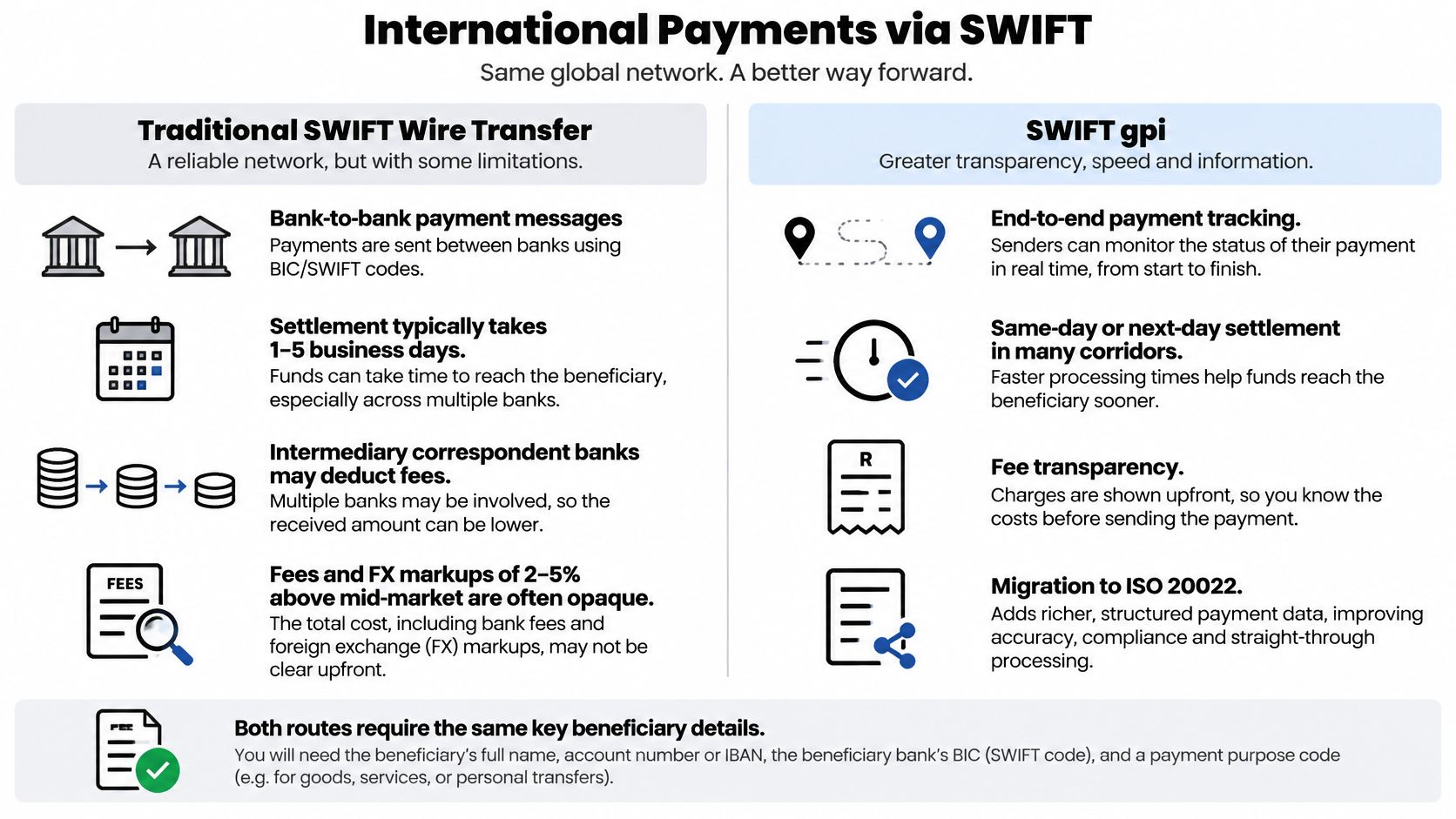
A South African importer paying a machinery supplier in euros may send the instruction through SWIFT, but the payment can pass through correspondent banks before the supplier's account is credited. Each bank in the chain may charge a fee, and processing time depends on the route and the payment details.
For corporate payments in USD, EUR and GBP, bank wires are a common route. The transfer fee is only one part of the cost: the exchange-rate spread and any correspondent-bank deductions also affect how much the beneficiary receives.
Where a wire quietly gets expensive
Ask the bank for the total rand debit and the exchange rate it will apply. Compare that rate with the mid-market rate at the same time, and confirm whether the sender or recipient bears intermediary charges. On a EUR 40,000 machinery invoice, even a small difference in the exchange rate can outweigh the stated transfer fee.
Ask for the debit, not just the fee: get the total rand amount before approval, along with the rate and the expected beneficiary amount. Check the quote for all applicable charges.
Before you approve the transfer
- Confirm beneficiary details in writing, including the IBAN and exact legal name. Verify any account change through a trusted channel, not email alone.
- Include the invoice number in the payment reference so the supplier can match the funds to the correct invoice.
- Check the purpose code and supporting documents with your bank before sending. Keep the invoice and payment confirmation together for reconciliation.
- Check the expected value date and tracking options. If the payment is delayed, use the bank's tracker where available and follow up with the payment reference.
2. Export Proceeds Repatriation
A South African exporter has shipped the goods, but the foreign-currency receipt still needs to be matched to the export before it can be handled through an authorised dealer. The payment itself may be straightforward. Missing or inconsistent documents can delay the bank's review.
Statistics SA recorded exports of about R179.6 billion in October 2024 against imports of R165.0 billion, a monthly surplus of R14.6 billion, with the cumulative surplus at R145.5 billion for the year to that point (Statistics SA trade statistics). For an individual business, the practical task is to make its invoice, shipment records and incoming payment easy to match.
Exchange control is the real gatekeeper
South African residents and companies operate within an exchange control framework. Transactions outside authorised-dealer parameters can be referred to SARB's Financial Surveillance Department (Wesgro and Dentons exchange control guide). Incomplete payment data can trigger questions, manual review and delays, so align the remittance details with the invoice and supporting export documents.
Keep the shipment and receipt dates consistent in your records. A clear trail linking the invoice, customs declaration and bank credit makes the transaction easier to reconcile.
Before the money lands
- Include the export invoice number and customs reference in the remitter's payment instructions so the receipt can be matched.
- Ask your authorised dealer about the applicable repatriation timing before shipping, then track the expected receipt against each shipment.
- Compare the bank's conversion rate with the mid-market rate on the day of credit and record the difference as a cost of sale.
- Before choosing a route, check the all-in cost: include the FX spread and any payment fees, not just the stated transfer charge.

3. Forward Exchange Contracts for Hedging Export Receivables
Hedging with forwards is a decision about certainty, not about beating the market. A forward fixes a rate today for a conversion that happens later: you agree with your bank to sell USD or EUR at a set rate on a set date, and when the customer pays you deliver the currency into that contract instead of taking the spot rate of the day.
Say a KwaZulu-Natal engineering firm invoices a US customer for a machine that ships in 60 days and pays 30 days after that. Between quote and cash, the rand can move enough to erase the margin on the job. The forward turns that unknown into a known rand number. The trade-off is real: you give up the upside if the rand weakens before the customer pays.
Price the forward, not just the rate
Banks quote forwards as spot plus or minus forward points, and the points reflect the interest rate difference between the two currencies. That's why a forward rate is never the same as spot. Ask for both numbers separately. A single all-in quote with no breakdown tells you nothing about whether you're paying for the hedge or for the spread on top of it.
A forward is a binding commitment. If the shipment slips or the customer cancels, you still have to settle the contract, and closing it early costs you the gap between the contracted rate and the market.
Before you sign the contract
- Match maturity to the expected payment date, with a small buffer, and check the date still sits inside the repatriation window your dealer confirmed.
- Hedge a portion of the exposure, somewhere between half and three quarters of a predictable receivable, and leave the rest open so a late shipment doesn't leave you over-hedged.
- Approve a written policy covering instruments, limits, who may deal and how hedges are reviewed monthly against actual receipts.

4. Letters of Credit for Import Payments
A letter of credit moves risk from the trading partners to the banks. Your bank undertakes to pay the supplier once the supplier presents documents that match the credit exactly: bill of lading, invoice, packing list, inspection certificate where the deal needs one. The supplier gets certainty of payment. You get certainty that payment only happens against proof of shipment.
The rules sit in the ICC's Uniform Customs and Practice for Documentary Credits, commonly called UCP 600, and they are unforgiving about wording. A supplier name spelled differently on the bill of lading than on the credit is a discrepancy, and a discrepancy lets the bank refuse to pay until you waive it.
Sight, usance and confirmed
A sight credit pays on presentation of compliant documents. A usance credit pays at a stated future date, which buys the importer working capital against a supplier that wants certainty. A confirmed credit adds a second bank's undertaking, useful when you don't want to carry the issuing bank's country risk. Each step up costs fees, and on a small trade those fees take a meaningful share of the value.
Say a Port Elizabeth parts importer buys components from a Chinese manufacturer it has never traded with. A sight credit is cheap insurance for the first two orders. Once there's a track record, open account terms with a payment window beat both the bank fees and the document chasing.
Before the credit is issued
- Draft the documentary requirements with your bank and send them to the supplier for comment before issuance, because amendments after the fact cost money and time.
- Check every required document can be produced in the exact form demanded, especially where a third party issues it.
- Budget the fees as a percentage of the trade, not a flat cost, and weigh that against paying in advance for a settlement discount.
5. Paying International Contractors and Freelancers
Contractor payments are the mirror image of a supplier wire. The amounts are small, the frequency is high, and each one carries the same compliance overhead as a large payment. That mismatch is where budgets leak.
A Cape Town fintech paying Eastern European developers monthly stacks four charges on every invoice: platform fee, FX spread, withdrawal fee and the contractor's own bank charge. FinMark Trust's work on low-value cross-border trade describes the same pattern on the region's busiest corridors, with delays, high fees, safety risks and complex KYC, and remittance costs on the South Africa to Zimbabwe corridor reaching as high as 12.7%; the same summary notes Africa had 31 live fast-payment systems while interoperability and ISO 20022 adoption remained limited (FinMark Trust webinar summary). Piecemeal infrastructure explains why a payout that runs smoothly in one corridor stalls in the next.
Judge the payout by what lands
Compare providers on the amount the contractor receives, not the headline fee. Pay in the contractor's local currency where the platform supports it. A USD payout into a Polish account often converts twice, and the second conversion is the one nobody quotes you.
Batching is the cheapest control you have. Twelve invoices paid in one monthly run cost less, reconcile faster and give you a single date to defend if a contractor queries a shortfall.
Before the payout runs
- Collect the tax paperwork first. For US contractors that means a W-8BEN on file before the first payment, not after the first query.
- Write the currency and the cut-off date into the contract so nobody assumes a mid-month ad hoc run is free.
- Check the all-in cost per payout every quarter, because platform pricing changes and the contractor's bank is not on your side of the table.
6. USD Client Billing for BPO and Remote Services
A South African BPO invoices a US client in USD, then pays staff in rand. The amount credited locally depends on the exchange rate and deductions along the payment route, so billing terms affect the margin from the start.
A firm-level study of South African exporters from 2010 to 2019 examined the staggered rollout of the SADC Real-Time Gross Settlement system across 14 countries. It found bilateral trade between participating countries rose by about 34% after payment integration, an effect the authors compared to cutting tariffs by 8.3 to 12.1 percentage points (SADC RTGS settlement study). For a BPO, the practical point is that payment friction can affect the economics of winning and servicing international work.
Price the receipt, not the invoice
The client's bank may charge before sending funds, intermediary banks may deduct fees, and the receiving bank applies its exchange rate. Track the invoice amount against the rand credited for each client. That makes it easier to see which contracts absorb the costs and which remain profitable.
Contract clause worth the argument: specify the invoice currency, whether the client bears its bank charges, and who absorbs intermediary deductions. If those terms are unclear, deductions become a recurring reduction in revenue.
Before the invoice goes out
- Give every invoice a unique reference and ask the client to include it with the payment, so the receipt can be matched without guesswork.
- Set the conversion rule in advance. Decide whether to convert on receipt or hold foreign currency for a defined period, then record the policy.
- Benchmark payment delivery costs before you bid. Compare expected FX deductions and settlement timing across routes. If near-shore staffing is part of the cost comparison, review the best place to hire latin american virtual assistants.
7. Cross-Border Card Payments and Foreign Currency Debit Cards
Cards are how a great deal of cross-border spend happens: software subscriptions, advertising budgets, the supplier who only takes card, travel. The money leaves without a finance approval meeting, which is exactly why the cost goes unnoticed until year end.
A USD-denominated card changes the maths. You hold a USD balance, spend it with a merchant billing in USD, and skip a conversion. The network still applies a rate whenever it has to convert, and that rate is where cards are won or lost against a bank transfer.
Pay in the merchant's currency, always
At a terminal or an online checkout you'll be offered the choice to pay in rand instead of the merchant's currency. Accept the rand option and the merchant's bank sets the rate, usually well away from mid-market. Pay in the merchant's currency and let your own provider convert, because you can at least see that rate and challenge it.
Say a Cape Town digital agency runs international ad campaigns. One virtual card per platform, each with a set monthly limit, makes spend visible per channel and lets you kill a card the moment a subscription renews at the wrong price or a card number is compromised.
Before the card is used
- Issue one virtual card per recurring supplier instead of pooling spend on a single corporate card.
- Set limits and approval workflows that match your finance policy rather than the provider's defaults.
- Reconcile statements to invoices monthly, and escalate any merchant that bills in a currency it never quoted.
8. Cross-Border E-commerce Marketplace Payouts
Selling through a global marketplace means the platform collects from buyers, deducts its fees, converts the currency and pays you the net. You never see the buyer's money, only the remainder. That makes payout structure a pricing decision, not a back-office detail.
Say a Stellenbosch leather goods maker sells on Etsy to US buyers and receives USD payouts. The platform fee comes off the top, conversion happens at a rate the platform sets, and a bank charge may sit at the end of the chain. Set international prices from the net number, not the gross, or you'll find the margin problem a quarter after the sales landed.
Choose the payout currency once
Every conversion is both a cost and a decision. Receiving in USD and converting once into rand usually beats letting a platform convert to rand and a bank convert again. Check the payout currency options before you list a single product, because changing them later means reworking every price on the store.
Before the payout cycle closes
- Reconcile the payout to the sales report line by line and investigate any deduction you can't name.
- Check VAT and sales tax registration thresholds in your main buyer markets before volume makes the decision for you.
- Automate the month-end check rather than rebuilding it by hand; a set of AI prompts for seller payouts is a sensible starting point for structuring that reconciliation.
- Run more than one channel so a single fee change on one platform doesn't reset your entire margin.
How the eight cross border transaction types compare on speed, cost, and compliance effort
| Item | Typical settlement | Main cost driver | Compliance effort | Best for |
|---|---|---|---|---|
| SWIFT International Wire Transfer | 1–5 business days; often same or next day with gpi | Bank and intermediary fees, plus FX markup | Moderate; beneficiary and payment details, purpose code, and possible supporting documents | Large, high-value, or one-off international transfers |
| Export Proceeds Repatriation | Generally within 30 days of goods shipment; services follow separate timelines | Bank FX margin and conversion costs | High; SARB rules, deadlines, and export-document matching | South African exporters bringing overseas earnings into the country |
| Forward Exchange Contracts for Hedging Export Receivables | Future date, typically 1–12 months | Forward points and the agreed exchange rate | Moderate to high; bank approval, credit or margin requirements, and hedge documentation | Exporters seeking certainty over the rand value of expected receipts |
| Letters of Credit for Import Payments | On document presentation or a future date, depending on LC terms | Issuance, amendment, and presentation fees | High; strict documentary requirements under UCP 600 | New or higher-risk supplier relationships and high-value imports |
| Paying International Contractors and Freelancers | Provider- and payout-method-dependent; often faster than bank wires | Platform fees, FX spreads, and withdrawal fees | Moderate; contractor onboarding, contracts, and tax documentation | Businesses paying overseas contractors regularly or in batches |
| USD Client Billing for BPO and Remote Services | Depends on payment method and client terms; often monthly or quarterly billing | Transfer fees, intermediary deductions, and FX margins | Moderate; contracts, invoices, and receipt reconciliation | South African service providers billing overseas clients |
| Cross-Border Card Payments and Foreign Currency Debit Cards | Typically near real time | FX markup, foreign transaction fees, and dynamic currency conversion | Low to moderate; spend controls and expense records | Travel, subscriptions, advertising, and small international purchases |
| Cross-Border E-commerce Marketplace Payouts | Daily, weekly, or monthly, depending on platform | Marketplace fees, FX conversion margins, and bank charges | Moderate; payout reconciliation and possible overseas tax obligations | Sellers reaching international customers through marketplaces |
Turning Cross Border Payments Into a Repeatable Process
A EUR 40,000 machinery payment and a batch of small contractor invoices need different payment routes. Choose based on the payment's purpose, timing, and total cost, then check what the recipient will receive.
Match the route to the flow
- Large one-off supplier payments: Use a wire, include the invoice reference, and confirm the total rand debit before approval.
- Predictable export receipts: Consider a forward for the portion you can forecast, with maturity aligned to the expected receipt date. Check the applicable SARB repatriation timing as well as the contract terms.
- New or high-value imports: A letter of credit can set documentary conditions for payment. Account for issuance, amendment, and presentation requirements before choosing it over open account terms.
- Frequent contractor or marketplace payouts: Compare batch options by the net amount each recipient receives, including platform charges and FX costs.
- Card spend: Set card limits and reconcile transactions against invoices and receipts.
Calculate the all-in cost before selecting a route. Compare the quoted exchange rate with the mid-market rate, then add transfer charges, intermediary deductions, provider fees, and any recipient-side costs you can identify. For repeat payments, multiply that cost by the expected transaction count.
Keep the payment purpose consistent with the invoice and retain supporting documents. For goods, keep the relevant customs records with the payment file. Track export receipts against invoices as they are issued, and check the applicable repatriation timing so funds are not left unmatched or unaccounted for.
Zaro makes cross-border transactions as easy as local EFTs for South African businesses. Companies that pass KYB and compliance checks can fund ZAR and USD accounts by bank transfer, then send and receive cross-border payments. Zaro uses blockchain-based stablecoins to process payments quickly and at low cost, with low FX spreads, no SWIFT fees, and bank-grade security. Fees and spreads are disclosed before a transaction is confirmed. Match each settlement to its invoice in your accounting system; Xero bookkeeping services are one option for keeping those records organised.
Visit Zaro to sign up, complete KYB verification, and get a clear quote based on your volume and corridor before you make a payment.