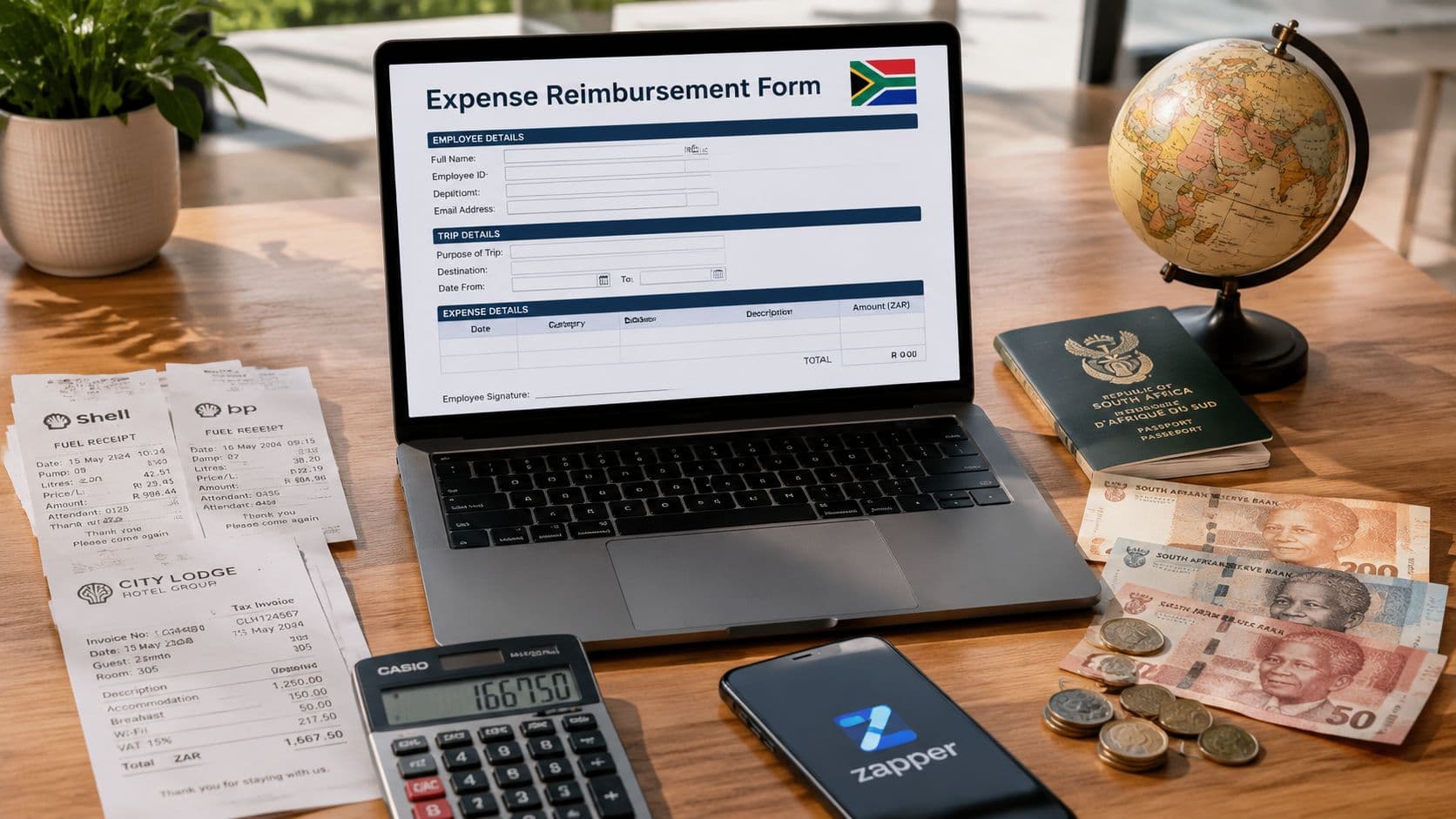
You're already dealing with the worst version of expense reimbursement: a stack of local fuel slips, a hotel bill that needs approval, and at least one foreign payment that's sitting in limbo because the amount changed between submission and settlement. In South African finance, that mix isn't a side task, it's where tax risk, cash flow friction, and employee trust all meet.
A good reimbursement system doesn't just pay people back. It decides what is tax-free, what must go through payroll, what evidence will survive a SARS review, and how much time your team loses every month chasing missing documents. When the business also pays across borders, the same workflow has to handle FX, bank fees, and timing gaps without turning every claim into a manual investigation.
The Hidden Costs of Inefficient Expense Reimbursement
A finance manager at a growing South African company usually sees the problem first in the inbox. One claim is a local mileage log from a field sales rep. The next is a hotel stay with breakfast included. Then comes an overseas contractor invoice that needs to be settled in foreign currency, and suddenly the “simple” repayment process has become a compliance and treasury issue.
That's where expense reimbursement starts costing more than the amount on the claim. Every weak control creates follow-up work, and every unclear policy creates a tax question that someone in finance has to answer twice. If the payment crosses a border, the same claim can also pick up FX spread, transfer friction, and settlement delays before it ever reaches the employee or supplier.
Practical rule: if a reimbursement needs a long email chain to justify it, the policy is too vague or the supporting documents are incomplete.
Inefficient reimbursement systems often conceal their costs in subtle ways. A claim gets reworked because the receipt isn't complete. A payout gets delayed because the approver is travelling. A payroll team has to correct a taxable item that should have been split out earlier. None of those issues look dramatic on their own, but together they drain time and create avoidable risk.
For teams that want a cleaner operational base, the right starting point is a disciplined claims process. A practical guide to doing accurate expense reports helps employees understand the basics before finance ever sees the file.
Understanding Expense Reimbursement Fundamentals
A controller's first problem with expense reimbursement is rarely the payment itself. It is deciding whether the claim is a straight repayment of business spend, a fixed allowance, or an advance that still needs to be settled. That classification drives the tax treatment, the supporting documents, and the payroll entry, and if the label is wrong the accounting can still be wrong even when the money reaches the right person.

Direct reimbursement
Direct reimbursement is the cleanest structure. The employee or contractor pays an approved business cost, keeps the proof, and the business repays the exact amount. For SARS purposes, that sits in a different bucket from an allowance because the payment is tied to actual, substantiated business expenditure, which is why receipts, invoices, and matching dates matter in the file.
The practical benefit is clear. A hotel bill, a courier charge, or a client meal with a valid receipt can be repaid as actual spend if the policy allows it and the documentation is complete. A fixed amount loaded into payroll is a different transaction, even if it is meant to cover the same kind of cost. Finance teams that blur those two often create avoidable tax questions later.
Allowances and per diems
Allowances are fixed amounts paid in advance or alongside salary. They are useful where the business wants predictability, but they also carry tax risk if payroll treats them as automatically exempt. Per diems are a specific form of fixed daily payment for subsistence, and SARS deals with them through prescribed daily limits rather than by assuming every claim is tax-free.
The operational issue is classification. If the company pays for expected travel costs without tying the payment to actual receipts, that is an allowance. If it pays a daily amount for meals or incidental costs, that is a per diem. If it repays a verified bill line by line, that is direct reimbursement. Each route needs a different control in payroll, and each one produces a different audit trail.
Advances
Advances work differently again. The business gives cash or funds up front, then requires the claimant to account for the spend afterwards. That can reduce out-of-pocket pressure for travelling staff and suppliers, but only if the reconciliation process is tight.
If the receipts do not come back, or if the advance is higher than the final business cost, the excess has to be handled properly. Otherwise, finance ends up carrying an open item that should have been cleared, and the tax treatment can become messy as well.
For employees, the easiest way to avoid rework is to submit clean supporting documents from the start. A practical guide to doing accurate expense reports helps set that standard before the claim reaches finance.
Navigating SARS Rules for Tax Compliance in 2026
A South African reimbursement policy has to follow SARS thresholds, not internal convenience. For the 2026/2027 tax year, the prescribed tax-free mileage rate is 495 cents per kilometre, and the domestic tax-free subsistence rate for overnight meals and incidental costs is R595 per day. If a reimbursement goes beyond those government-set limits, the excess can become subject to PAYE withholding (SARS and compliance guidance summary).
That is why reimbursement design has to be threshold-driven. Finance teams cannot just approve a claim and hope payroll sorts it out later. They need to split claims into the part that sits within the SARS limit and the part that becomes taxable remuneration before the payment is posted. If they do not, the company risks payroll misclassification and the kind of downstream IRP5 clean-up nobody wants in year-end processing.
SARS tax-free reimbursement rates 2026/2027
| Expense Type | SARS Prescribed Rate | Notes |
|---|---|---|
| Mileage | 495 cents per kilometre | Tax-free up to the prescribed business-travel rate, excess may be taxable |
| Domestic subsistence, meals and incidental costs | R595 per day | Relevant for overnight domestic travel, excess may be taxable |
The broader compliance lesson is that SARS sees reimbursement as a control mechanism, not just a repayment. When an employee is repaid for exact expenditure with proof, the amount can be excluded from taxable income, but if support is weak or the payment exceeds the prescribed business-travel rate, the excess is taxable and must be reported as remuneration (SARS guidance).
A practical policy has to answer three questions every time. Is the amount a tax-free reimbursement, taxable remuneration, or an allowance category? Is the spend backed by the right support before payroll releases the payment? And if the claim includes foreign travel or cross-border costs, is the business converting and classifying it correctly before exchange-rate movement creates a mismatch? That is the level of detail that protects the payroll team and reduces avoidable SARS exposure.
Building a Fraud-Proof Reimbursement Workflow
A compliant process starts before approval. It starts when the employee submits the claim with the right proof, because SARS-aligned guidance expects original receipts for most claims, a detailed logbook for travel, proof of overnight stays for subsistence, and secure retention of records for five years (SARS-aligned documentation guidance). If the paperwork is missing, the claim can be reclassified as taxable income.
The controls that matter
A finance team doesn't need a complicated workflow, it needs a disciplined one. The strongest setups make the employee do most of the data capture at the point of spend, not after the fact when memory is vague and receipts are missing.
- Capture at source: require receipts to be uploaded when the claim is created, not days later.
- Force business purpose fields: every claim should show why the expense was necessary.
- Separate travel details: personal-vehicle claims need route, distance, and logbook support.
- Require proof for subsistence: overnight stays need evidence, not just a note in the comments box.
- Preserve the audit trail: approvals, edits, and rejections should stay traceable.
Those controls also help with fraud prevention. Duplicate submissions, inflated mileage, and mixed personal spending are easier to spot when the system refuses incomplete claims. Manual review still matters, but it works better when the system has already blocked the obvious exceptions.
How the workflow should move
A clean sequence is simple. The employee submits, the manager checks the policy fit, finance verifies tax treatment and support, then payroll or AP releases payment. The point is to make each review step distinct, so nobody assumes the previous person already handled tax classification.
Keep the audit trail boring. If your process is easy to explain to an auditor, it's usually easier to run for employees too.
A process built this way protects more than tax compliance. It also reduces back-and-forth, which is where reimbursement teams burn time. A system that stores the receipt, logbook, and approval path from the start is far harder to game than one that reconstructs the story after payment.
Solving Cross-Border and Multi-Currency Reimbursements
The hardest claims are the ones that look ordinary on the front end but settle in another currency on the back end. A local employee might submit a legitimate business expense, yet the reimbursement still has to move through a bank that adds spread, routing cost, and timing uncertainty. That's the point where expense reimbursement stops being only a finance workflow and starts becoming an FX workflow too.
For South African businesses, the practical issue is not just whether the claim is valid. It's whether the final amount paid will still match the approved amount once conversion, banking delays, and settlement fees are layered in. That's especially awkward when a payment is meant to be cleanly recorded in one currency but is funded from another.
A separate guide to cross-border payment solutions for SaaS teams is useful here because the same payment frictions show up in employee reimbursements and contractor payouts. The structure differs, but the pain points are the same, cost opacity, delayed settlement, and poor visibility.
What works better
Transparent FX helps because finance can forecast the actual outflow before payment starts. Traditional bank flows often hide the true cost in the spread between quoted and delivered amounts, which makes reconciliation harder later. When the payment platform shows the actual conversion and settlement path, treasury can match the reimbursement to the approved liability with less noise.
A modern payments platform can sit alongside a reimbursement process. Zaro, for example, is designed to move international business payments at real exchange rates with efficient settlement. Used well, that kind of tool helps a finance team separate employee claims from cross-border disbursements instead of forcing both through the same opaque banking route.
Cross-border reimbursement works best when the claim, the currency, and the payment rail are all visible before approval.
The operational win is predictability. Finance can approve the expense for what it is, not for what a bank might later adjust it to be. That matters in South Africa, where a small amount of uncertainty in FX can turn into a large reconciliation headache when claims are frequent.
Crafting Your Company Expense Reimbursement Policy
A strong policy removes guesswork. If your employees need to ask whether a taxi, a meal, a client gift, or a hybrid work cost qualifies, the policy is too loose. If your approvers interpret the same rule differently every month, the policy is too vague for real use.

The clauses that belong in the document
A useful policy should start with the purpose, then define reimbursable categories, non-reimbursable items, and the evidence required for each claim. That sounds basic, but most reimbursement disputes come from policy silence, not policy complexity.
- Eligible expenses: name the categories the company will pay back.
- Submission deadlines: state when claims must be lodged.
- Approval hierarchy: define who signs off at each threshold.
- Documentation requirements: specify receipts, logbooks, and other proof.
- Fraud prevention measures: explain what happens when a claim is out of policy.
Hybrid and remote-work claims need special care
Hybrid reimbursements are where many policies fail. Business expenses, allowances, and remote-work costs can all appear in the same workflow, but SARS treatment differs for each, so a one-size-fits-all policy creates risk (Praxima's treatment of employee expense reimbursements in South Africa). That is especially true when a business tries to simplify claims too aggressively.
The safest policy is not the shortest one. A flat rule can be easy to administer, but if it pushes actual business spending into the wrong tax bucket, it becomes expensive fast. On the other hand, forcing every employee to chase item-by-item substantiation for every minor cost can choke the workflow and create resistance.
The middle ground is clear definitions plus narrow exceptions. State what must be receipt-backed, what can be paid as a fixed allowance, and what needs finance review before it hits payroll. That gives managers something they can enforce without turning every submission into a debate.
Simplify Your Global Reimbursements with Zaro
South African expense reimbursement works only when three things line up. The claim has to be tax-correct under SARS rules, the documents have to survive review, and the payment rail has to settle cleanly without FX surprises. When any one of those breaks, finance spends time fixing avoidable errors instead of controlling cash.
That's why cross-border reimbursements deserve separate treatment from local claims. A platform like Zaro can sit on the international payment side of the process, where real exchange rates and simpler settlement reduce the friction that traditional banking often adds. For a growing business, that means fewer moving parts, clearer cash flow, and less manual reconciliation.
The strongest reimbursement systems are not the most complicated ones. They are the ones that classify correctly, demand the right evidence, and move money through the most transparent rail available.
If your team is still managing local claims, foreign payouts, and payroll exceptions in separate spreadsheets, it's time to tighten the process. Review your reimbursement policy, fix the SARS classification gaps, and test a more transparent cross-border payment workflow with Zaro.