
South Africa exported R170.7 billion in September 2024, recording a preliminary trade surplus of R12.8 billion, according to SARS's trade release. Yet a business contributing to that surplus could still struggle to pay its next wage bill. A profitable export isn't the same thing as cash in a South African bank account.
Export finance is a cash-flow design problem before it's a borrowing decision. You need funding that arrives when costs fall due, lasts until the buyer pays, and works with exchange-control requirements. A fast advance at an attractive rate can still be the wrong structure if it creates premature conversion, mismatched repayment dates or an unclear reporting trail.
Why Export Receipts Arrive After the Bills
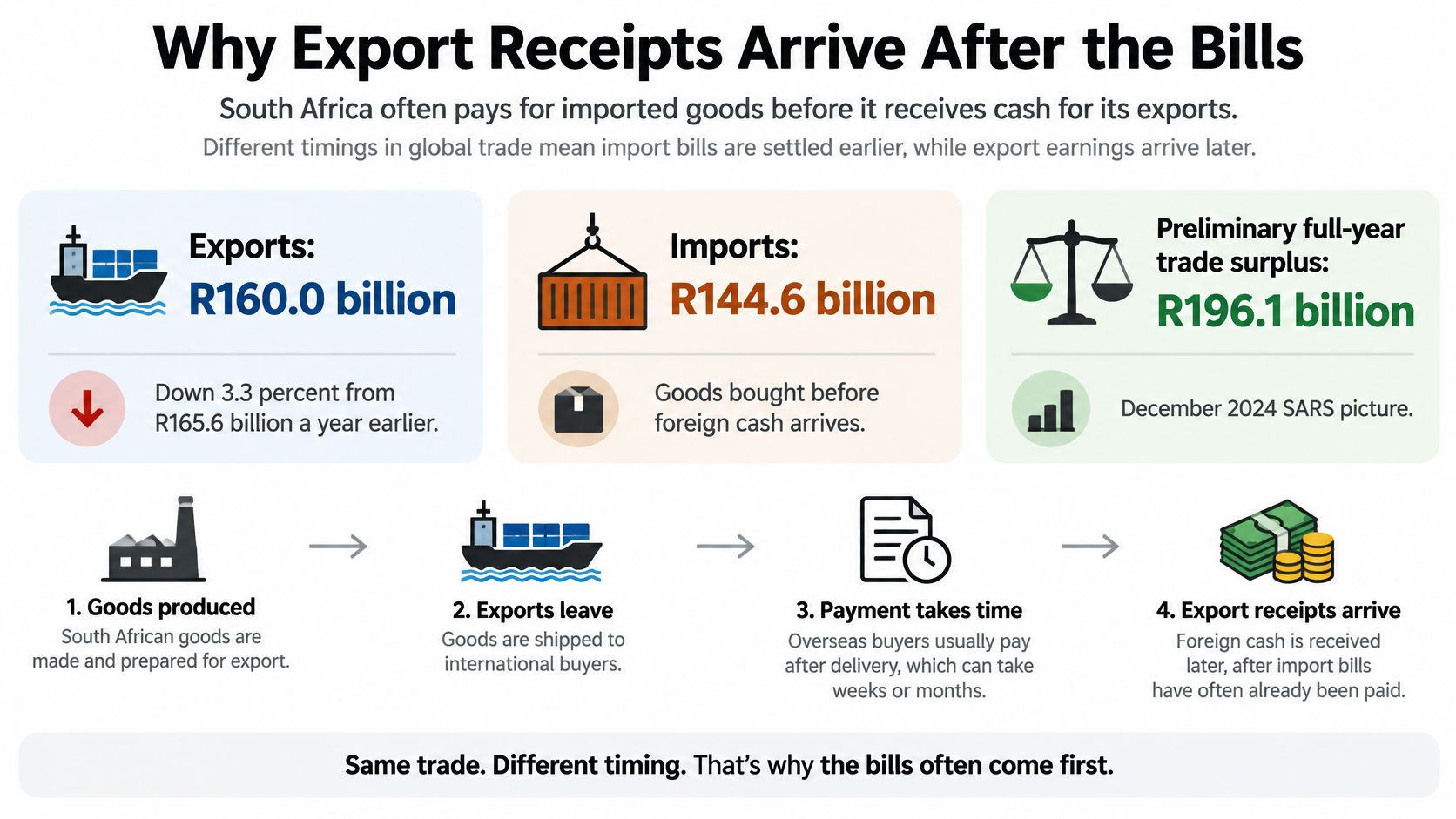
SARS's December 2024 trade statement recorded exports of R160.0 billion, down 3.3% from R165.6 billion a year earlier, imports of R144.6 billion, and a preliminary full-year trade surplus of R196.1 billion. Those national totals describe trade, not the cash available to an individual exporter.
Think of a shop that stocks its shelves for a customer who pays only after the goods have crossed a border. The shopkeeper must pay suppliers and staff while the customer's payment is still somewhere in the future. Exporters face the same gap, with freight, customs documentation and foreign-currency settlement added to the sequence.
The difference between selling goods and collecting money is the central funding problem.
Separate profit from available cash
Export finance covers the wait between paying costs and collecting an overseas invoice. Say a South African manufacturer accepts an order for fabricated components. Its quoted margin looks healthy, but steel, wages and packaging must be paid before the overseas customer accepts delivery.
The owner shouldn't treat the invoice value as money available for the next production run. Until collection, the business must fund its commitments from cash reserves, supplier terms or an appropriate facility.
Divide that requirement into distinct stages:
- Purchase-order funding: Cash needed to begin fulfilling a confirmed order.
- Pre-shipment working capital: Materials, labour and production costs before dispatch.
- Goods in transit: Exposure while freight, insurance and delivery obligations are being completed.
- Post-shipment receivables: The wait between invoicing and buyer payment.
Keep a buffer for an imperfect collection
A dollar or euro invoice introduces another uncertainty when operating costs are in rand. The foreign amount may remain unchanged while its rand value changes, leaving less cash available for domestic commitments.
Build a rolling cash-flow forecast around actual payment dates, not just monthly sales totals. Stress-test a weaker receipt and a late-paying buyer separately, then combine them to see whether payroll and supplier payments remain covered.
The liquidity buffer should protect essential payments, not disguise an unprofitable order. If an order only works when the buyer pays early and the exchange rate moves favourably, revisit the commercial terms before borrowing. Match the uncovered stage to a facility rather than financing the entire transaction indiscriminately.
Funding Options and When the Cash Arrives
Two facilities with similar interest costs can create very different cash-flow outcomes. Compare them by when the money arrives, what triggers repayment and who bears the loss if the buyer does not pay.
Export finance facilities by cash timing
| Facility | When cash arrives | What it funds | Who carries buyer risk | Best fit |
|---|---|---|---|---|
| Pre-shipment working capital | Before shipment | Materials, wages and production | Exporter still owes the lender | Confirmed orders with a production gap |
| Post-shipment invoice finance | After the invoice, before the buyer pays | A share of foreign receivables | Often the exporter if the advance is with recourse | Repeat sales on agreed credit terms |
| Letter of credit | On complying documents, per the credit | Shipment against a bank undertaking | Issuing bank if documents match, subject to bank and country risk | New buyers or weaker payment histories |
| Export credit insurance | No cash by itself; it can support a loan or longer terms | Risk cover that helps a bank fund the sale | Insurer for covered political and commercial risks | Capital goods and markets banks won't take alone |
| Buyer or supplier credit | Seller receives funding under the structure; buyer pays over time | An export contract on extended terms | Lender and insurer according to the agreement | Machinery, projects and extended payment schedules |
| Forfaiting | When the bill or note is sold | A trade receivable sold at a discount | Forfaiter, usually without recourse for obligor non-payment | Larger one-off receivables with a strong obligor |
Distinguish funding from payment protection
Pre-shipment finance covers the production gap. A lender advances money before dispatch, and the exporter expects to repay from the export receipt. Check which evidence triggers a drawdown, such as a purchase order, supplier invoices or progress in production.
Post-shipment invoice finance addresses the wait for collection. The funder advances an agreed portion of an eligible invoice. With recourse, the exporter may still have to repay if the buyer does not. Insurance can cover specified losses, subject to its exclusions and documentary requirements.
A letter of credit is a bank undertaking to pay against complying documents. It does not guarantee payment for any shipment: discrepancies between the credit and transport documents can delay payment, even when the goods are satisfactory.
Practical rule: Ask who must repay the lender if the buyer disputes the invoice. That answer may matter more than the advertised advance rate.
Match longer terms to the right instrument
Export credit insurance does not put cash in the exporter's account. It can support risk-sharing that helps a lender finance a transaction. ECIC cover is relevant to qualifying capital goods and related services.
Buyer and supplier credit let an overseas customer pay over an extended schedule. Forfaiting instead converts an eligible bill or promissory note into proceeds through a discounted sale, usually without recourse for the obligor's failure to pay. Check what warranties and other obligations remain; the sale does not automatically end every exporter responsibility.
For context on financing international business growth, the facility still needs to fit South African export-proceeds rules. Confirm how an advance will be classified before signing. An earlier drawdown can affect the compliance treatment as well as the interest bill. A facility that releases cash sooner may still be the wrong structure if its repayment timing conflicts with the proceeds rules.
From Purchase Order to Foreign Payment
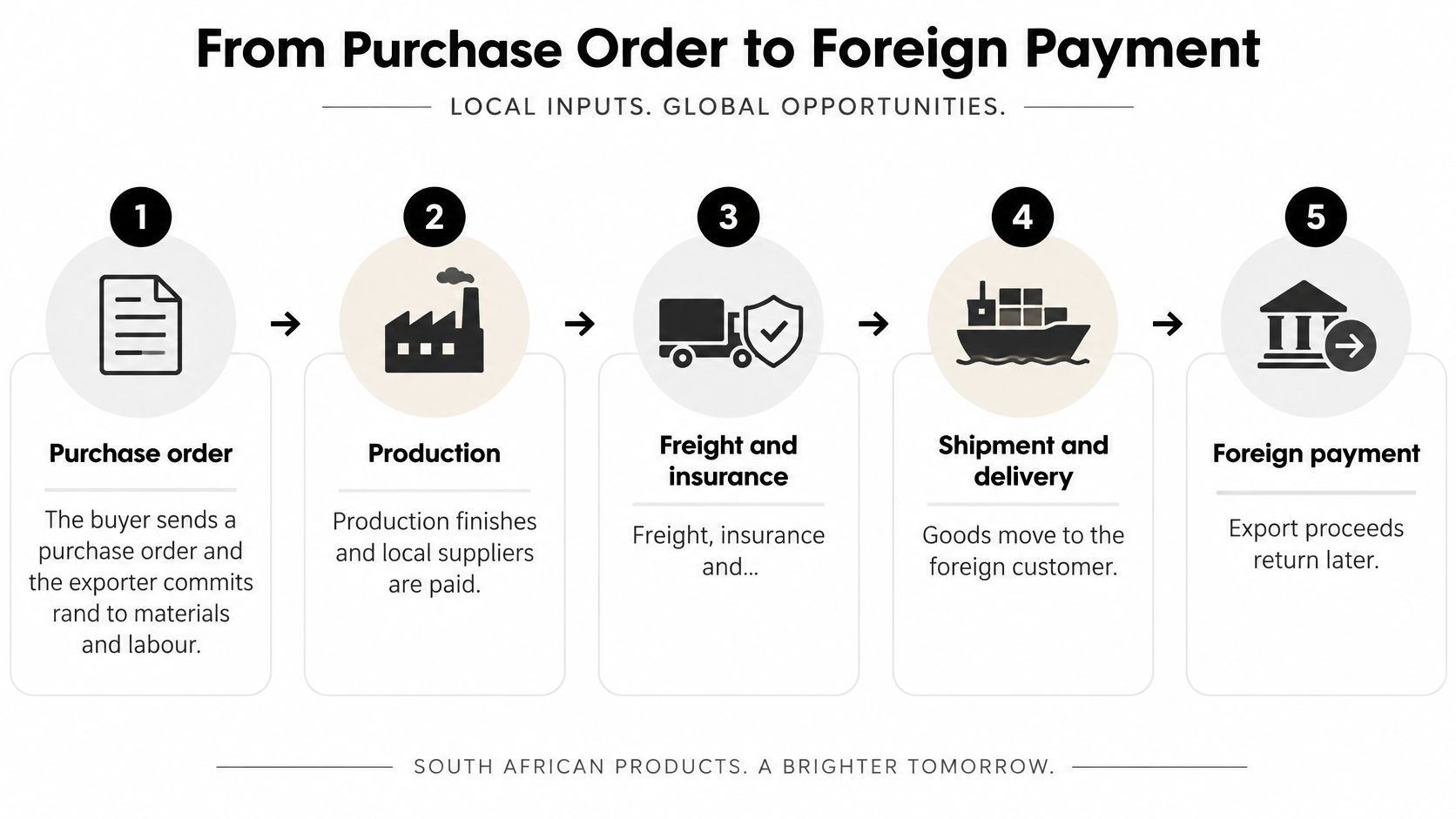
A profitable export order can still leave a cash gap: supplier bills may fall due well before the buyer pays. Build a schedule for one order, assigning each event a date, an owner and a supporting document.
The process graphic shows the broad commercial journey.
Build an event-based funding schedule
Accept the purchase order. Check the buyer's identity, specifications, destination and payment terms before committing rand to materials and labour. A forecast enquiry is not a binding order.
Complete production and pay suppliers. Compare actual costs with the quotation. Record deposits received so you do not borrow for costs the buyer has already funded.
Arrange freight, insurance and customs. Allocate these costs according to the contract. Check who bears loss or damage at each transport stage and whether insurance matches that responsibility.
Issue the commercial invoice. Follow the agreed invoicing milestone and payment tenor. Incoterms allocate specified delivery responsibilities, costs and risks. They do not, by themselves, set when the buyer must pay.
Collect the foreign-currency payment. Track the contractual due date, not just the date your sales team expects payment. Follow up promptly on deductions, short payments and unclear remittance references.
Reconcile the receipt. Match the bank credit to the invoice and shipment, complete required reporting, and arrange conversion or permitted retention with the appropriate banking counterpart.
Borrow against milestones, not optimism
The monthly export series published by CEIC using SARS figures ranges from R42,137.1 million in January 2010 to R192,275.2 million in September 2022. That national range illustrates why a fixed borrowing assumption deserves regular review. It does not predict an individual firm's collections.
Draw funds when a production or shipment obligation arises. An approved facility left fully drawn before the cash is needed incurs interest without helping meet an immediate bill. Set repayment against a credible collection date, and agree how the business will respond if the buyer pays late. If the debt is in foreign currency but repayment depends on rand income, an adverse exchange-rate move can raise its rand cost.
The difference between a quoted exchange rate and the amount received matters when forecasting proceeds. This guide to currency conversion for small businesses explains the topic. In your cash-flow schedule, estimate the net rand receipt after conversion and settlement charges, rather than multiplying the invoice by a headline rate.
Use the accompanying video as a supplementary explainer while mapping your own transaction.
Repatriation Deadlines That Reshape the Loan
Under the South African Reserve Bank's Currency and Exchanges Guidelines for Business Entities, full foreign-currency export proceeds are generally required within six months of shipment, proceeds generally must be offered to an Authorised Dealer within 30 days after entitlement, and transactions require Financial Surveillance reporting. Confirm how the current provisions and any applicable exceptions apply to your transaction before drawing funds.
Faster access to funding doesn't improve liquidity if the structure forces premature rand conversion or creates reporting obligations the business hasn't prepared to meet.
The clocks don't necessarily begin on the same event. Shipment, contractual entitlement, receipt of an advance and buyer settlement must be distinguished rather than collapsed into a single payment date.
The early-advance trap
Consider a hypothetical sale on extended credit terms. The exporter needs money for local production, while the buyer won't pay until after delivery and acceptance.
A finance advance appears to solve the gap. However, an early advance can itself be treated as an accrual of export proceeds under the relevant exchange-control rules. Treasury therefore needs confirmation of the advance's treatment before assuming the only relevant receipt is the buyer's eventual payment.
Offering proceeds to an Authorised Dealer isn't automatically the same as converting every receipt immediately into rand. Ask the dealer to confirm permitted retention, conversion and repayment arrangements for the actual structure. Don't make that decision from the loan's marketing description.
Repatriation clocks and what evidences them
| Event | Trigger | Deadline | Evidence |
|---|---|---|---|
| Shipment | Goods leave South Africa | Full proceeds within the shipment-linked period stated above | Shipment record and bank advice of receipt |
| Entitlement to proceeds | Exporter becomes entitled to the money | Offer within the entitlement-linked period stated above | Dated offer and Authorised Dealer record |
| Payment extension | Buyer requests later payment | Obtain the required approval or confirmation before the applicable deadline | Signed amendment and Authorised Dealer response |
| Early finance advance | Facility drawn before buyer pays | Apply the confirmed accrual treatment when administering the advance | Authorised Dealer confirmation |
| Reporting | Reportable transaction occurs | Applicable Financial Surveillance reporting timetable, confirmed with the Authorised Dealer | Reconciled transaction record |
Keep one consistent account of the receipt
For each proposed repayment, reconcile the loan schedule with the shipment record, entitlement date and expected buyer collection. Check whether the lender collects directly from the foreign receipt or expects a separate repayment from the exporter's rand account.
Document exceptions in a dated exception log. Keep the buyer's request, amended contract, Authorised Dealer answer and revised collection date together.
A buyer's promise to pay later isn't regulatory approval. Nor does a contract amendment automatically authorise an extension.
The exporter, funder and Authorised Dealer should describe the same transaction consistently. Resolve differences before drawing, especially where a facility permits automatic advances against newly issued invoices.
Capital Goods Projects and Smaller African Orders
A machinery project and a repeat order for spare parts may both be exports, but they shouldn't automatically use the same financing structure. The decisive differences are the payment schedule, the risks a lender must accept and the evidence supporting collection.
A project needs risk-sharing, not just a bigger overdraft
Across the ten financial years covered by the dtic's ECIC export-promotion material, ECIC supported 46 transactions involving approximately US$2.5 billion in financing, equivalent to about R32.8 billion at the source's conversion. The transactions covered Africa and other emerging markets.
Consider a South African equipment supplier bidding for an overseas industrial project. The buyer needs extended payment terms, while the supplier must pay manufacturers and deliver equipment before collecting the full contract value.
The bank's concern isn't merely whether the exporter can produce the equipment. It must also consider commercial non-payment and political risks affecting collection.
ECIC's export-credit insurance helps share covered risks, making bank-supported financing possible for qualifying capital goods and related services. The exporter still needs a workable contract, credible delivery obligations and compliance with the cover's conditions.
A longer repayment schedule becomes financeable when the relevant parties can allocate and manage its risks, not simply when the exporter requests more credit.
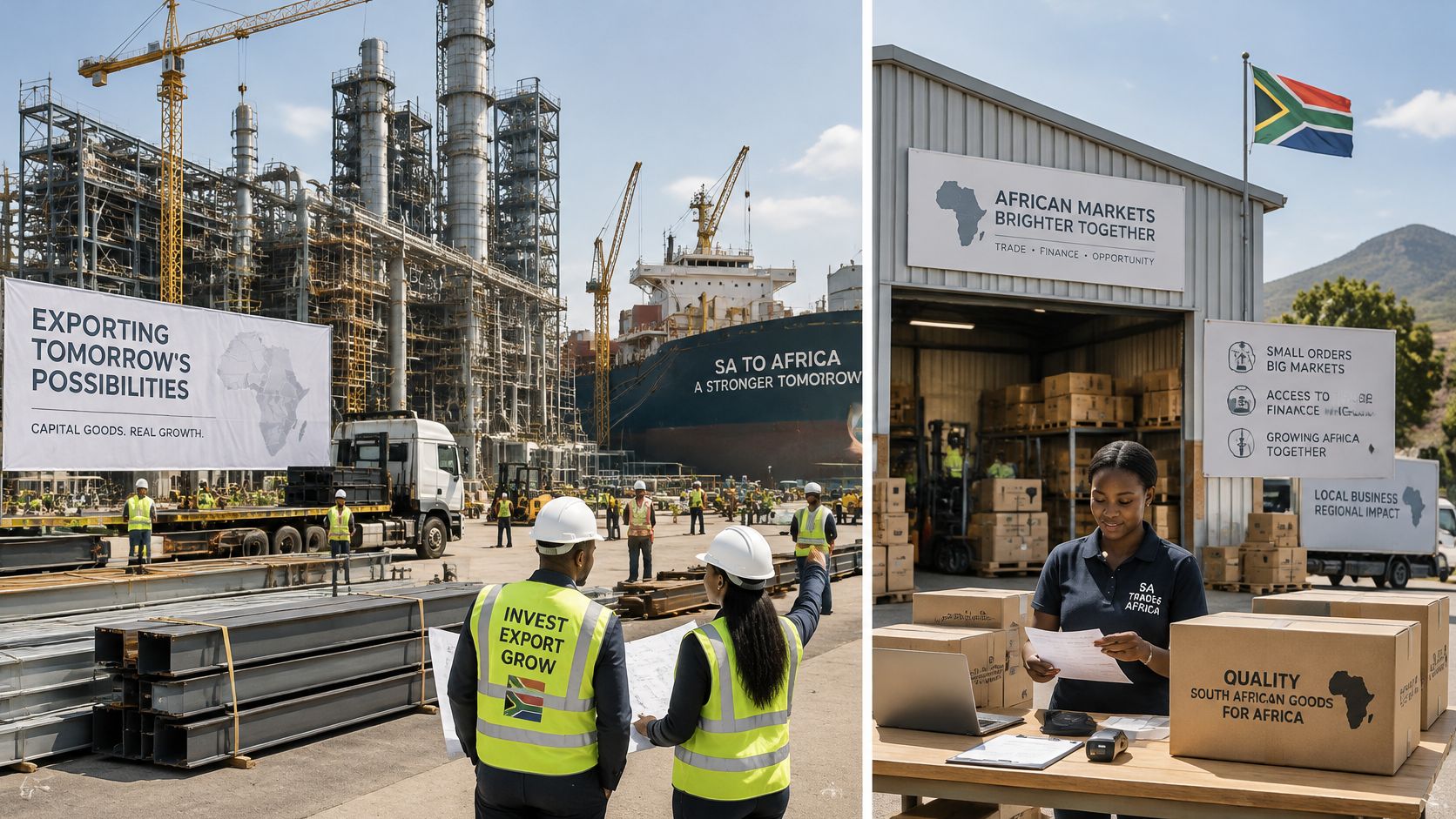
The contrast between industrial delivery and documentary preparation matters at every scale.
A smaller African order needs a defensible landed cost
For the smaller exporter, regional preferences can influence whether an order is commercially viable. The dtic's fourth-quarter report records approximately R820 million in exports under AfCFTA preferences between January 2024 and March 2025, including mining equipment, appliances, food, apparel, plastics and electrical machinery.
Say a spare-parts supplier quotes an African customer on a repeat account. Its immediate need may be short receivables funding rather than a project-style buyer-credit arrangement.
Before financing production, the supplier should establish the shipment's HS classification, applicable origin requirements and supporting evidence. A preferential tariff isn't available just because the goods leave South Africa.
Calculate gross margin with and without the preference. Also check who bears any additional duty under the contract if customs rejects the claim.
If the buyer faces an unexpected landed cost, it may dispute the invoice or struggle to pay on schedule. Contracts, origin evidence and payment history therefore belong in the financing decision, not just the customs file.
Records That Make an Application Fundable
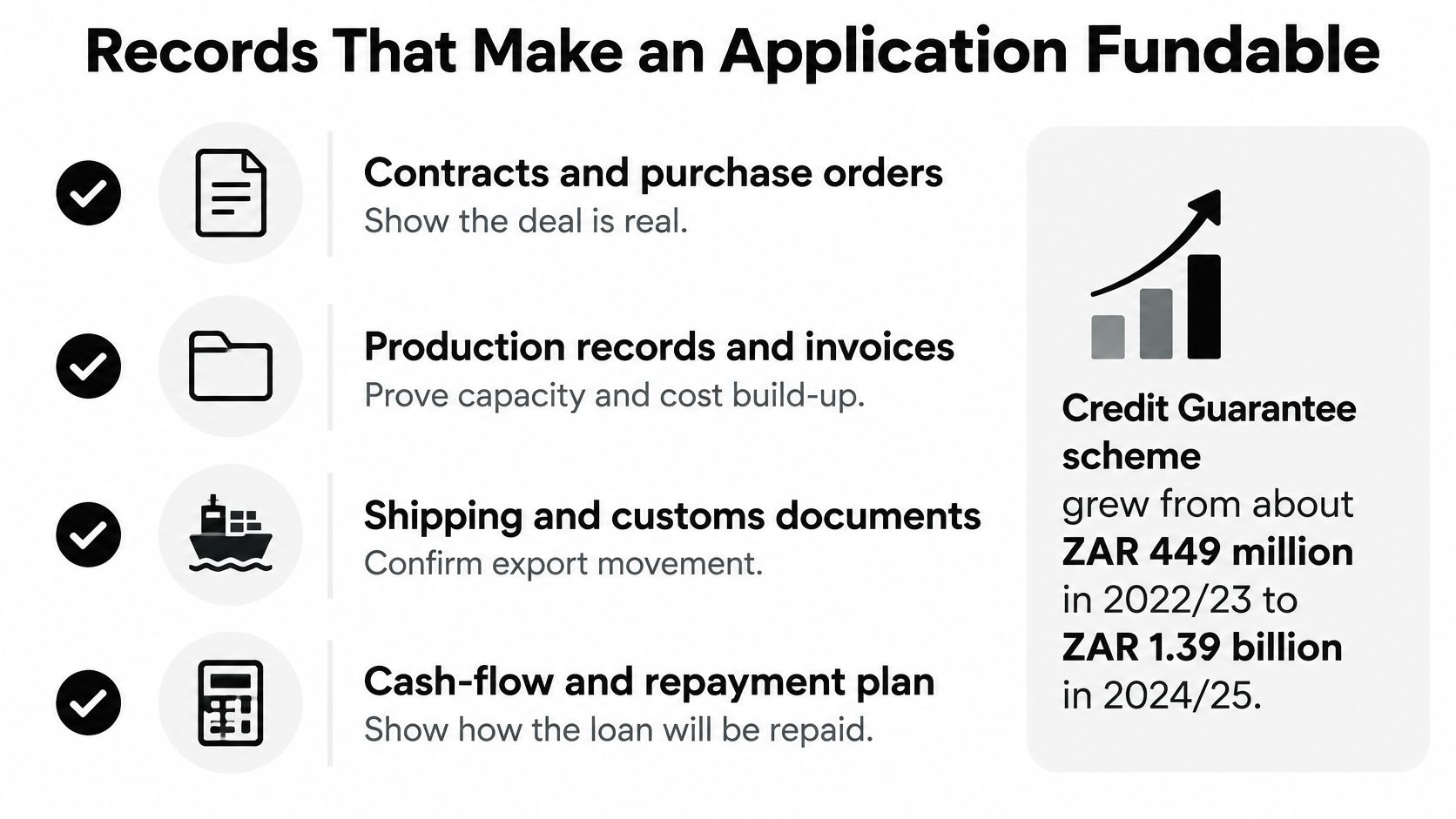
The OECD's South Africa SME-finance profile reports that the Credit Guarantee scheme expanded from approximately ZAR 449 million in 2022/23 to ZAR 1.39 billion in 2024/25, supporting finance to more than 2,900 MSMEs. Greater funding capacity doesn't mean every exporter can demonstrate a financeable transaction.
A lender needs evidence of the foreign receivable, buyer quality, shipment performance and currency exposure. A polished sales forecast can't substitute for those records.
The checklist groups the documents that connect the sale to repayment.
Assemble a transaction-level evidence pack
- Commercial commitment: Include the signed contract, purchase order, buyer's legal identity, destination, agreed Incoterms and payment tenor. Flag cancellation and acceptance conditions.
- Product and origin evidence: Provide the HS classification and origin documentation where a preference is claimed. Ensure descriptions agree across the contract, invoice and customs records.
- Production and shipment proof: Attach the cost build-up, production records, commercial invoice and relevant transport document. Explain late shipments rather than leaving unexplained discrepancies.
- Buyer performance: Supply payment history, current disputes and an ageing schedule of foreign receivables. Separate overdue invoices from amounts that aren't yet due.
- Currency and repayment plan: Show invoice currency against cost currency, the proposed borrowing currency, collection account and expected net cash available for repayment.
- Account reconciliation: Match receipts to invoices, identify deductions and explain unmatched credits. Include the records needed to connect financing repayments to the underlying exports.
Make the file easy to verify
Use consistent filenames built around the buyer and invoice reference. Add an index identifying the latest signed documents, and remove superseded versions from the lender-facing folder.
If email attachment limits become a problem, PDFWix explains how to create ZIP files for email. Follow the lender's security instructions and use its secure portal where required, especially for bank statements and identity documents.
Good records can reduce uncertainty when property collateral is limited, although they don't guarantee approval. The lender can assess an identifiable payment obligation more confidently than a forecast that never names the buyer, destination or payment terms.
Finish with a concise request stating the facility, eligible transaction, intended drawdown and repayment source. Hold the pack against that chosen structure, rather than sending the same generic application to every funding provider.
Choose the Facility Before You Compare Price
Choose the structure that funds the uncovered stage of the order, then compare its total cost. Start with the buyer, destination, payment terms and repayment source. If those aren't clear, a rate comparison is premature.
Apply the checks in order
Confirm the compliance treatment. Give your Authorised Dealer the proposed facility agreement and transaction schedule before drawing. Resolve entitlement, permitted retention, reporting and repayment arrangements in writing.
Separate funding from settlement. The lender finances the cash gap; insurance or a bank undertaking addresses specified risks. Conversion and settlement determine how much usable rand reaches the operating account. Price these functions separately so a cheap payment service isn't mistaken for credit protection.
Compare like with like. Request quotes for the selected facility and the conversion of its expected receipt. Include interest, arrangement charges, discounting costs, insurance premiums where applicable, currency charges and the consequences of a late payment.
Verify the settlement arrangement
For the payment leg, obtain a written rate, all applicable charges and an expected settlement time. At Zaro, we provide a clear quote based on volume and corridor, disclose applicable fees before confirmation, and charge a transparent FX spread with no SWIFT fees.
We're an authorised Financial Services Provider registered with the FSCA, FSP number 55133. Independently verify the regulatory registration and confirm that the service fits your business's transaction and compliance requirements.
A settlement service doesn't replace ECIC cover, a letter of credit or working-capital finance where those instruments are appropriate. Send the lender a transaction-specific evidence pack and a clear repayment proposal, not just a request for the lowest rate.
We offer cross-border payments with low FX spreads, fast settlement, no SWIFT fees and bank-grade security, helping you manage the collection and conversion leg of an export sale. Visit Zaro to discuss your payment corridor and request a clear quote for bringing your export receipts into South Africa.