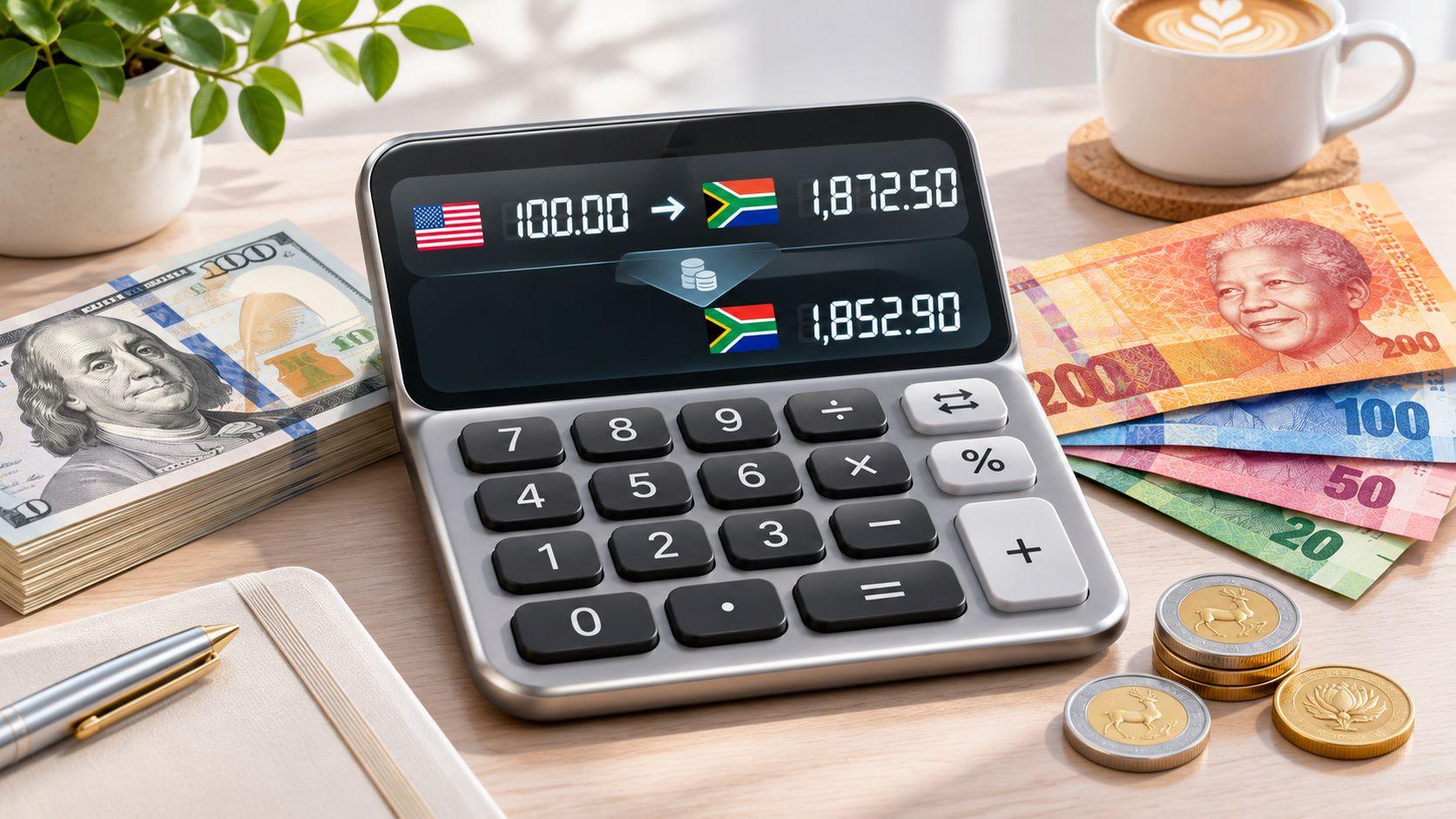
Your American supplier invoices you USD 10,000, due in 30 days. You open a converter, it returns a rate, you multiply, and the number looks workable. Then the payment clears and the rand that left your account doesn't match the figure you scribbled on the quote.
Nobody stole anything. The difference is the spread, the fixed fee and the rate type, none of which appear in the headline number you multiplied.
That gap is where cross-border budgets break. It's rarely one large error. It's a percentage point here, a flat charge there, a settlement that lands two days later than promised at a rate that has already moved. Exporters earning dollars and importers paying them both feel it, in opposite directions.
The habit worth building is simple. Judge every quote by the rand that lands, and treat the displayed rate as the opening line of the calculation rather than the answer.
What a USD to ZAR Conversion Really Pays
Take a USD 10,000 payment and a mid-market rate of R18.00 per dollar. That's the rate on most converter screens, and it's where some tools stop. A bank or provider rarely applies it. It applies the mid-market rate minus its margin, then adds a flat charge, and what reaches the account is smaller again.
Here is the worked version, with every value illustrative so you can rebuild the sum using your own numbers.
| Line item | Illustrative value | What it means for the payment |
|---|---|---|
| Mid-market rate (USD/ZAR) | R18.00 per USD | Headline rate a calculator usually shows |
| Gross rand at mid-market rate | R180,000 | Value before any cost is applied |
| Bank rate after a 2.5% spread | R17.55 per USD | The rate actually applied to your payment |
| Gross rand at bank rate | R175,500 | Value after the spread |
| Fixed transfer fee | R350 | Flat charge deducted from the rand amount |
| Net rand received | R175,150 | Amount that reaches the account |
| Effective rate | R17.52 per USD | Rate the payment really achieved |
| Total cost of conversion | R4,850, or 2.7% of the mid-market value | Gap between mid-market value and rand received |
The gap is R4,850. On this payment, the rate you were shown and the rate you got were the same rate in name only.
Turning any quote into an effective rate
- Multiply the amount by the bank rate. USD 10,000 × R17.55 = R175,500. This is gross rand, before charges.
- Subtract the fixed charges in rand. R175,500 − R350 = R175,150. Intermediary bank charges, where they apply, come off at this point too.
- Divide the net rand by the original amount. R175,150 ÷ USD 10,000 = R17.52. That's your effective rate.
Two providers can quote rates a few cents apart and still deliver different outcomes, because one charges a clean spread while the other adds fees after conversion. The effective rate flattens both into a single number you can put side by side.
Compare like with like: a quote only becomes comparable once you've expressed it as an effective rate on the same amount, settled on the same day.
None of this is specific to the dollar. Run a EUR 20,000 or GBP 15,000 invoice through the same three steps: substitute that currency's mid-market rate, apply the spread, deduct the fixed fee in rand, then divide back. The arithmetic doesn't change, only the quote you start from.
Making that gap visible before you commit is exactly what our free USD to ZAR converter is designed to do. It checks the live mid-market rate and sets it against what a bank may take in FX spread and SWIFT fees.
Reading Rate, Date and Direction in a Quote
A rate is a price per unit, quoted the way a petrol station quotes rand per litre. R18.00 per US dollar means one dollar costs eighteen rand. Simple, until the direction flips.
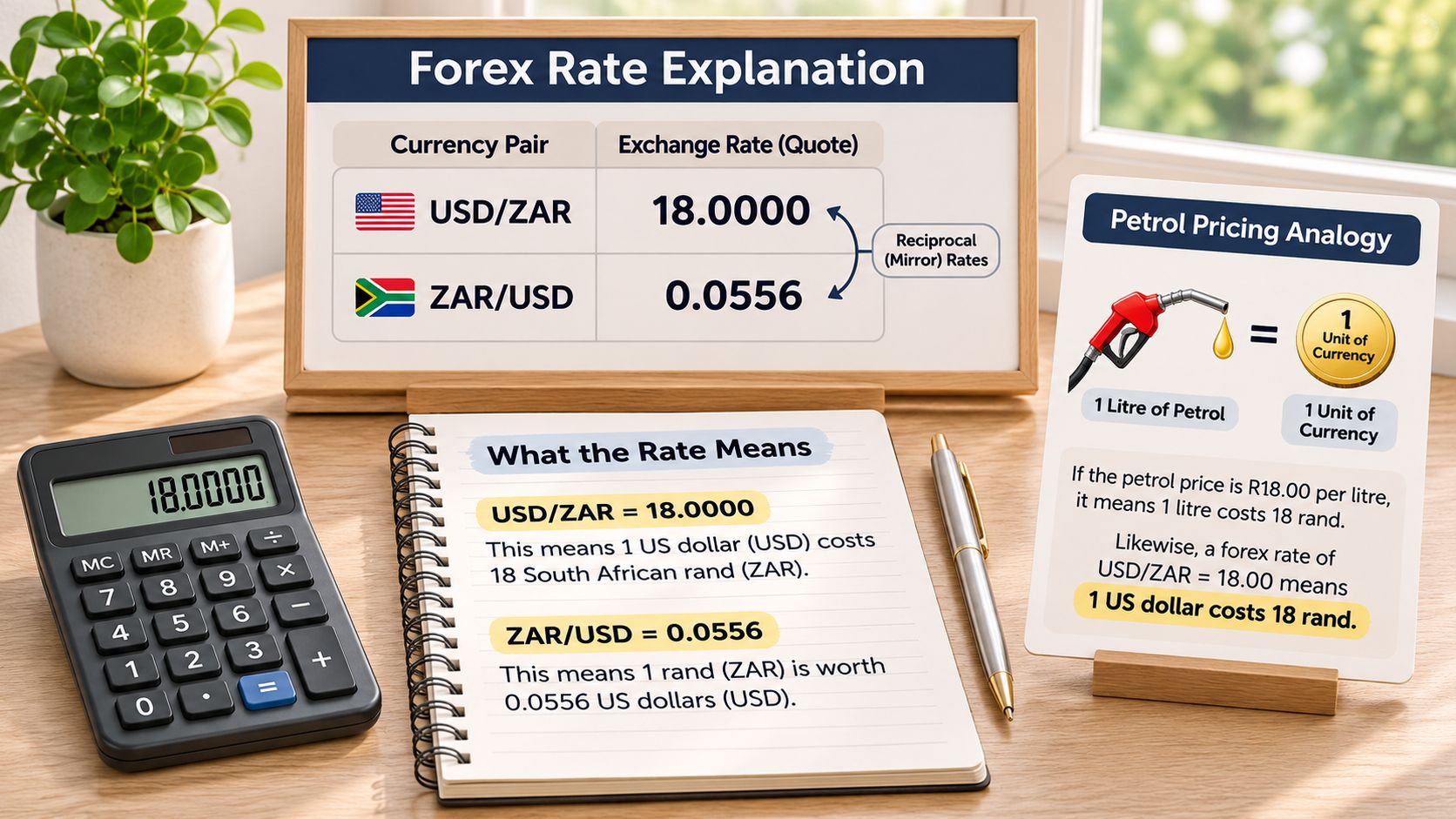
USD/ZAR and ZAR/USD are reciprocals, not two labels for the same thing. Divide 1 by 18.00 and you get about 0.0556, which is what one rand buys in dollars. Feed a rand amount into a field expecting dollars and your invoice changes by a factor of roughly 324. Most converter errors aren't mathematical. They're directional.
Rates also move during a trading day. A quote pulled at 09:00 and a payment settled at 15:00 are different transactions, so the timestamp on the rate has to match either the invoice date or the settlement date. Know which one your accountant will ask for before you need to produce it.
The South African Reserve Bank's selected historical rates earn their place here. The Reserve Bank publishes series for the US dollar, British pound, euro and Japanese yen, allowing you to compare a rate across months and years rather than relying on a number you recall. When you look up a past date, take the figure from the published table for that exact day and check it before it goes into a document or a tax file.
Direction and date compound. Say a USD 100,000 receipt converts at R18.50 rather than R18.00 per dollar. Before a single fee, the gross rand differs by R50,000. Same dollars, same bank, different day.
The walkthrough below shows the same pair on screen, with the base currency and the counter currency labelled.
Three checks catch almost every bad quote:
- Direction: which currency is the base, and is that the one you're converting from?
- Date: what timestamp sits on the rate, and does it match the document you're preparing?
- Source: is the number from an official table or a provider's quoted rate, and does it say which?
Spot, Executed and Average Rates Compared
Two calculators can disagree by a full percentage point and both be honest. They're showing different rate types, and a rate without a label is only half a number.
| Rate type | Source or method | Use it for |
|---|---|---|
| Live spot rate | Market rate at a given moment | Quoting and budgeting before payment |
| Executed bank rate | Rate the bank applies to the transaction | Reconciling what reached the account |
| Transaction-date spot rate | Spot rate on the invoice or payment date | Recording the rand cost of a USD supplier invoice |
| SARS annual average | Average of closing spot rates across the year of assessment | Tax calculations that call for a SARS-consistent annual average |
| SARB weighted average | Based on commercial-bank FX transactions, published quarterly by SARS | Tax-related averaging where SARS specifies it |
| SARB historical series | Published selected historical rates | Checking past settlements against a neutral reference |
The averages are the trap. SARS defines an average exchange rate using closing spot rates observed at daily or monthly intervals throughout the year of assessment, and the SARB-derived weighted average is based on commercial-bank foreign-exchange transactions, published quarterly by SARS. Neither is a spot rate, and treating one as though it were is the most common reason a payment record and a general ledger entry stop agreeing.
The second mistake runs the other way. Someone uses today's live rate to restate a figure that a tax calculation wants at a statutory average. The arithmetic is fine and the return is wrong.
Operationally, an exporter costing a USD supplier invoice wants the transaction-date spot rate. Tax reporting may want the annual average. Reconciliation wants the executed rate the bank applied. Three questions, three different numbers, one invoice.
Labelling rule: every result should name the rate type, carry the timestamp of the observation, state the currency direction, and say whether the figure is indicative spot, executed or a statutory average.
How to Calculate and Confirm Landed Cost
A converter answers what USD 10,000 is worth. A finance team needs three further answers: what the payment will cost, when it will settle, and what could change before it does. The gap between the displayed rate and the rand that lands is where surprises live.
South Africa adds a step that most online tools skip. The 2025 investment climate statement for South Africa notes that international commercial FX transactions are handled through authorised dealers, that every purchase of foreign exchange is reported, and that transactions outside prescribed parameters can require referral to SARB. A calculator cannot see that layer, which is why its output is a starting point rather than an answer.
Seven steps from quote to confirmed cost
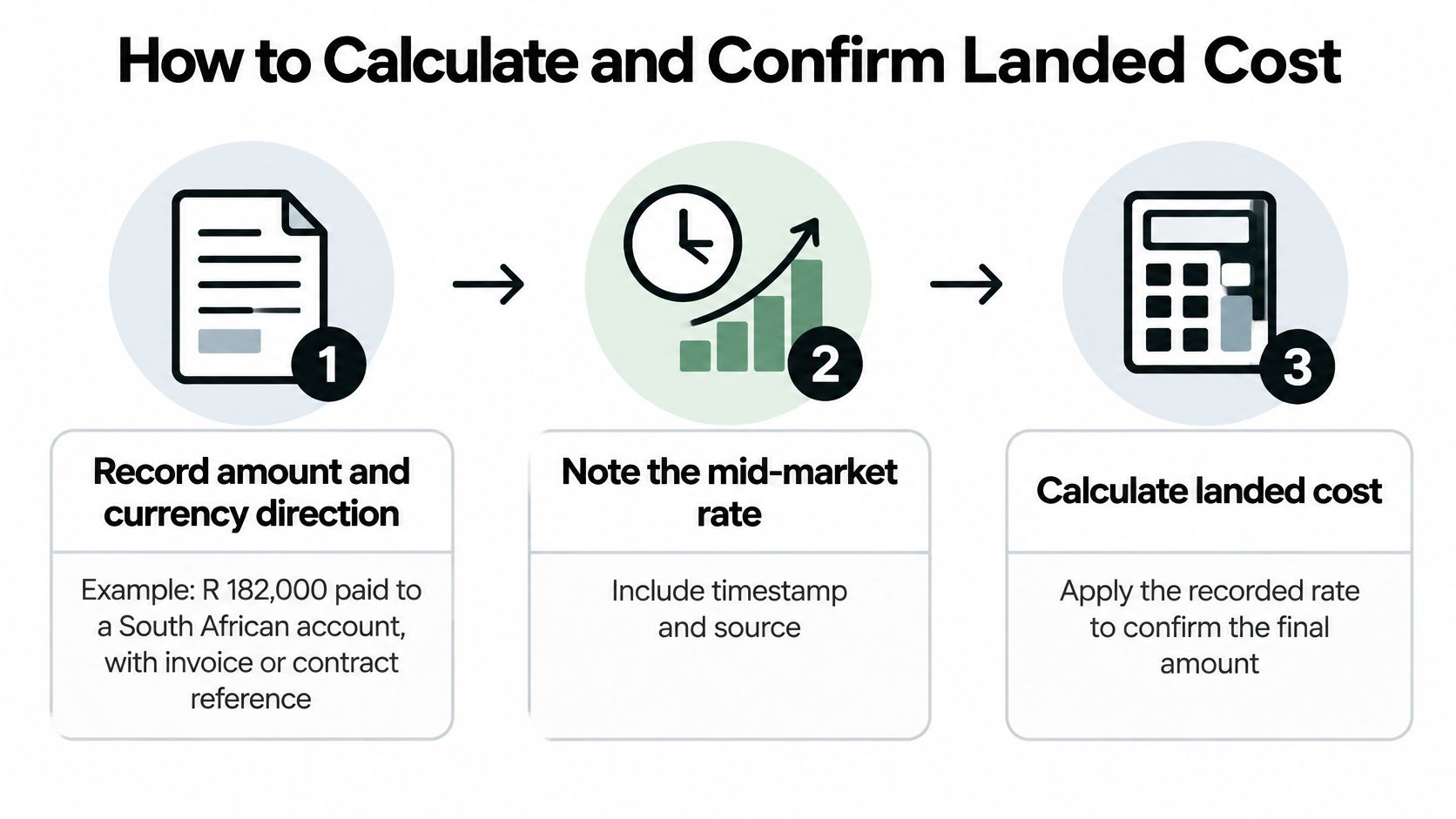
- Record the amount and the direction. USD 10,000 into a South African account, with the invoice or contract reference beside it. Without the reference, this is a currency exercise. With it, it's an audit trail.
- Note the mid-market rate with its timestamp and source. You'll need to reproduce the starting point weeks later, when someone asks why the ledger shows what it shows.
- Work out the bank rate. Multiply the mid-market rate by one minus the spread. A 2.5% spread on the R18.00 illustration leaves R17.55 per dollar. If the spread isn't quoted as a percentage, ask for it in cents.
- Multiply the amount by the bank rate. That gives gross rand, the figure before fixed charges.
- Deduct every fixed fee and intermediary charge. These should be disclosed in full before the transaction is confirmed, and you want them in writing rather than inferred from a statement later.
- Write down the settlement window. A conversion that lands in two days and one that lands in five carry different exposure, because the rate can move while the payment is in transit.
- Divide the net rand by the original amount. The result is your effective rate, and it's the only figure worth comparing across providers. On a USD 10,000 payment, a provider quoting R17.55 with no further charges delivers an effective rate of R17.55, while one quoting R17.60 but deducting R1,200 in fees delivers R174,800, an effective rate of R17.48. The better headline rate is the worse deal.
Why the cheapest quote can cost the most
That arithmetic is why the best exchange rate and the lowest total cost are different questions. A rate two cents worse with predictable fees, faster settlement and documentation that clears first time can leave more rand in the account than a headline-beating quote that stalls at the bank for a week.
A slightly worse rate with a known fee and a two-day settlement beats a perfect rate that arrives next Thursday, if the invoice is due on Wednesday.
The output a CFO wants is a range rather than a point: quoted rate, estimated spread, explicit fees, expected recipient amount, settlement window, and the effect of a 1% or 3% rand move before the payment clears.
The rate is also only one input into landed cost. Duty and VAT assessed at the border sit on top of the goods value, so a supplier quote plus freight understates the full cost. The mechanics of how customs declarations work in 2026 decide which charges get added before a shipment clears.
Confirming before you pay
Before you release the payment, state three things in writing: the mid-market rate with its timestamp, the gap between mid-market value and the rand you'll receive, and the rate type behind the quote. File that note against the invoice reference. When a reconciliation question arrives six months later, the note answers it faster than any bank statement.
Current-account activity and capital-type transactions aren't treated alike, and the second can need approvals the first doesn't. Establish which one your payment is before you promise a supplier a date.
The decision rests on the total amount received. Everything else is a number on the way there.
Rand Moves and Sensitivity Scenarios
Direction matters more than expected. For an exporter receiving dollars, a weaker rand means more rand per dollar and a better outcome. For an importer paying dollars, the same move costs more. The rate moves either way; who it helps depends on which side of the invoice you sit.
Start from the R17.55 bank rate and shift it.
| Scenario | Rate (ZAR per USD) | Gross ZAR on USD 10,000 |
|---|---|---|
| Base bank rate | R17.55 | R175,500 |
| Rand weaker by 1% | R17.73 | R177,300 |
| Rand stronger by 1% | R17.37 | R173,700 |
| Rand weaker by 3% | R18.08 | R180,800 |
| Rand stronger by 3% | R17.02 | R170,200 |
Read the table by the gap, not by the rate. The difference between the base case and a rand 1% weaker is R1,800 on a ten-thousand dollar receipt. At 3% it's R5,300. That's the size of the buffer a cash-flow forecast needs, and it's precisely what a single point estimate hides.
One pair never tells the whole story. The South African Reserve Bank's current market rates separate bilateral rates from broader effective measures, and its weighted average rand exchange rate is based on trade with the country's 23 most important trading partners. A USD/ZAR conversion explains a payment to a US supplier. It says nothing about how the rand is faring against the basket that shapes a South African exporter's competitiveness.
A company billing in euros carries different exposure from one paying a dollar software invoice, even when both report in rand. Same currency of account, different currency of risk.
Running a few of these by hand is instructive. Running them systematically is better, and how to run what-if analysis shows how to structure the same thinking across a spreadsheet model instead of a single calculator screen.
A calculator that returns one number is answering a question nobody asked. What you want is a range, and a clear sense of which end of it you can survive.
What a Reliable Calculator Must Show
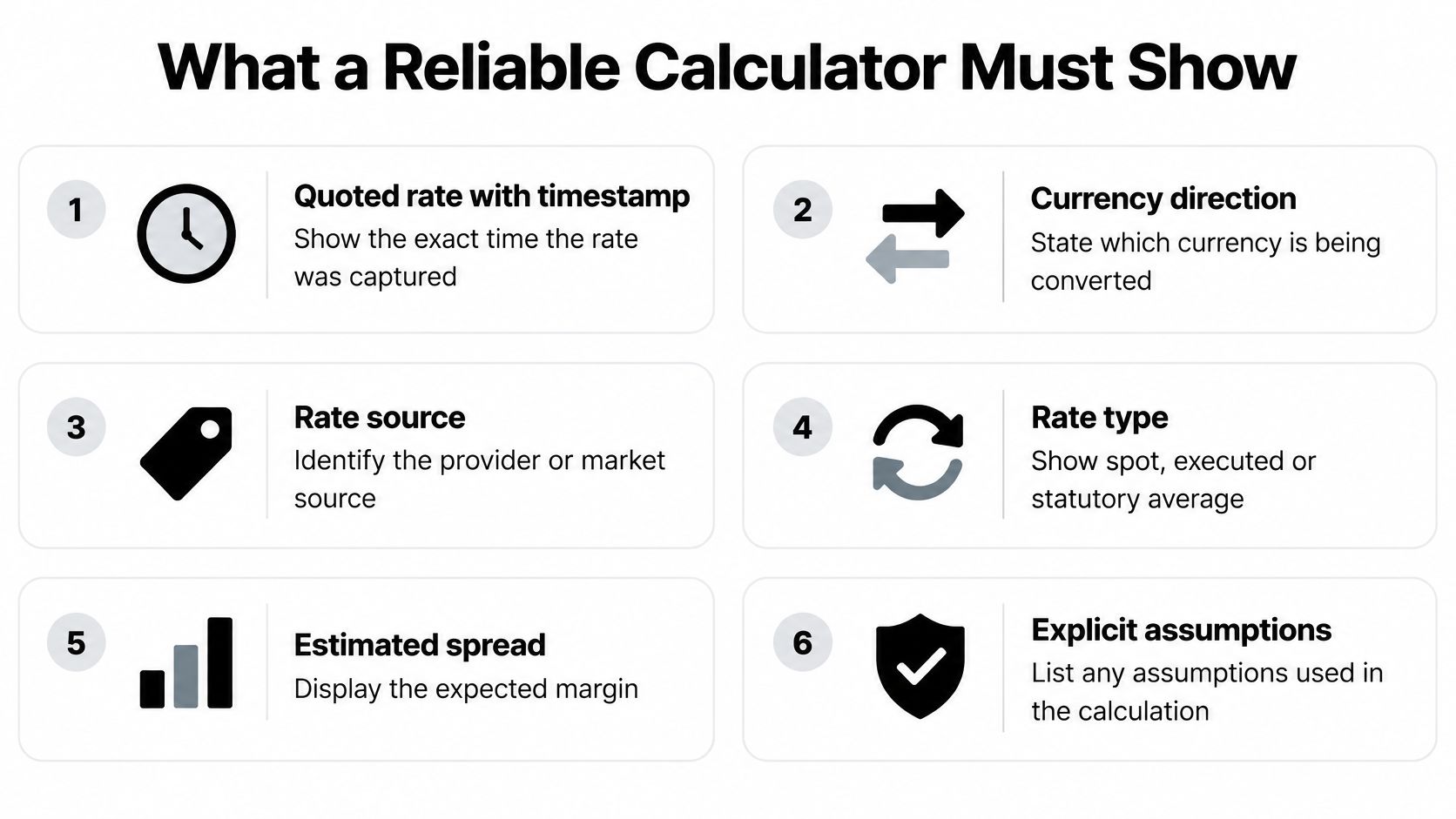
Compare any tool against this list. If half the fields are missing, the number it produces is a starting point at best.
- Quoted rate with a timestamp. The exact moment the rate was captured, because 09:00 and 15:00 are different markets.
- Currency direction. Which currency is being converted, stated rather than implied.
- Rate source. The provider, the market feed or an official series.
- Rate type. Spot, executed or statutory average.
- Estimated spread. The margin, shown rather than buried in the outcome.
- Explicit fixed fees. In rand, not "may apply".
- Expected recipient amount. The rand that lands, not the rand equivalent of the headline.
- Settlement window. When the money arrives.
- Sensitivity. What a 1% or 3% rand move does to the result.
- Transaction purpose, counterparty, invoice reference and settlement date. The fields that turn a conversion into a record.
Those last four fields aren't housekeeping. The Reserve Bank's Currency and Exchanges Guidelines for Business Entities state that qualifying cross-border foreign-exchange transactions for resident business entities must be handled through an Authorised Dealer or an authorised dealer with limited authority, and that cross-border FX transactions are subject to compulsory reporting to the Financial Surveillance Department. The same guidance indicates that spot foreign currency generally can't be bought to cover an uncertain future commitment, with an exception for a firm, ascertainable underlying commitment where the currency is transferred abroad within the permitted period.
Capturing purpose, counterparty, invoice or contract reference, currency, amount, rate timestamp and settlement date keeps a genuine payable separate from a speculative position. It also connects the conversion you see on screen to the documents settlement and reporting will require.
A foreign exchange rates calculator supports the decision. It doesn't replace the view of your bank or an authorised dealer on approvals, and it shouldn't be treated as though it does.
If you run several entities or hold balances in more than one currency, the same discipline belongs in the ledger, not only in the payment. Multi-entity currency consolidation is the accounting version of the labelling rule: every balance carries its rate, its date and its direction, or it doesn't reconcile.
Zaro's free USD to ZAR converter checks the live mid-market rate and shows what a bank may take in FX spread and SWIFT fees, so you can see the gap between the headline and the rand that lands before you send anything. We charge a transparent spread with no SWIFT fees, and you get a clear quote before a transaction is confirmed. Visit Zaro to run your next supplier payment or export receipt through it.