
Say you run a Cape Town export business. A Kenyan buyer pays your dollar invoice, but the rand credit in your account is lower than the amount you budgeted. The buyer sends proof of payment for the full invoice, while your bank statement shows only the final credit.
Before chasing the buyer for a short payment, reconcile the transfer. You need to separate the exchange-rate difference from the charges taken along the way, then establish who agreed to pay each one.
What Foreign Transaction Fees Are and Why They Add Up
For a business reconciling a payment, foreign transaction fees include the charges and embedded exchange-rate differences that reduce value between the amount sent and the amount received. Your bank might use the term more narrowly on its statement, so searching for a line labelled foreign transaction fee won't reveal the whole cost.
Think of an international payment as a parcel passing through sorting depots. The sending institution processes it, a correspondent may route it, and the receiving institution delivers it. Each institution can charge for its part, while whoever converts the currency can also earn a margin through the exchange rate.
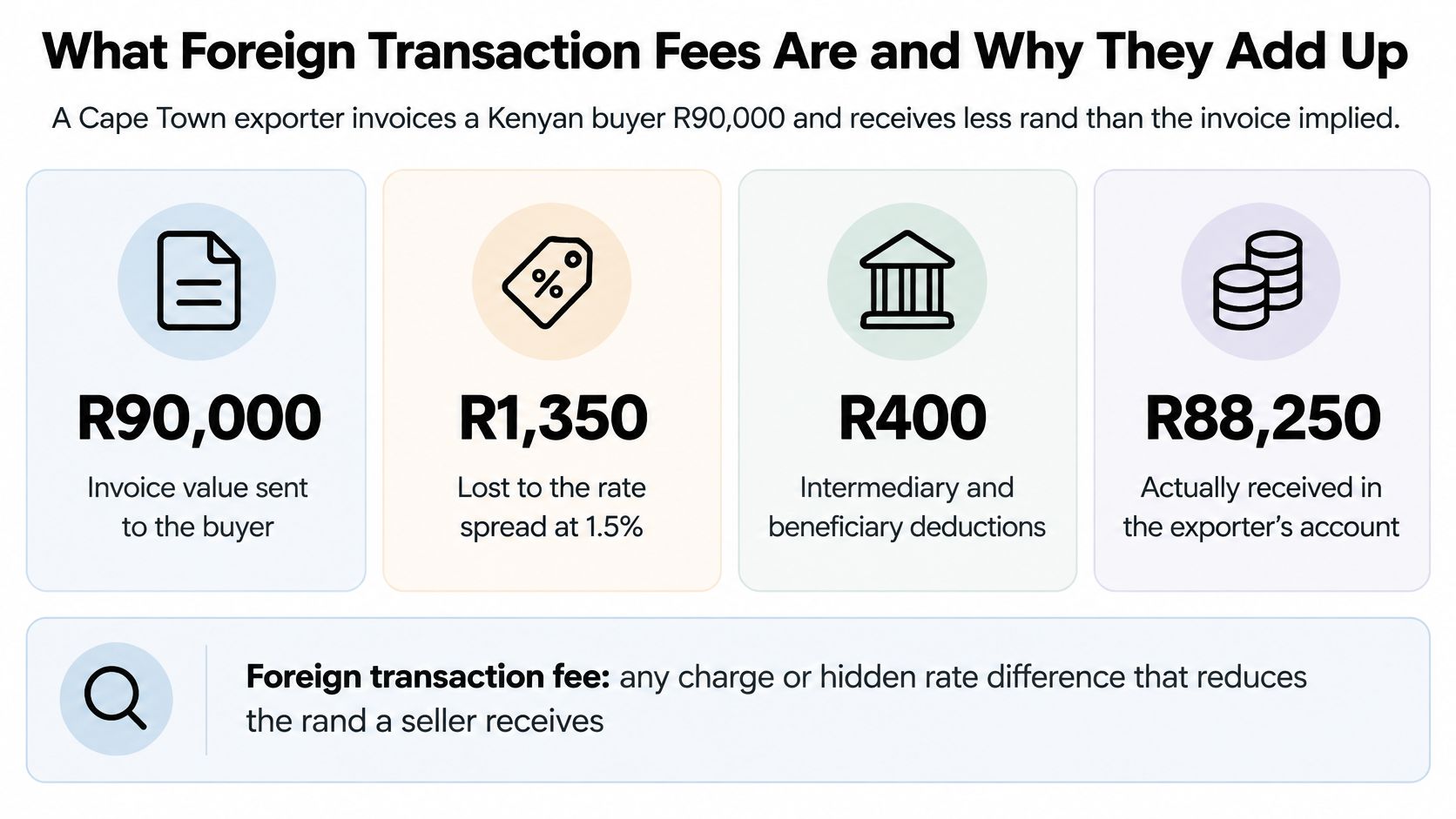
The diagram illustrates the difference between invoice value and cash received. Its amounts are hypothetical, not a bank quotation.
Route choice matters
World Bank remittance data reproduced in the G20 South Africa report put the average cost of sending money from South Africa at 13.12% in the second quarter of 2024, making it the costliest G20 origin country. This is consumer remittance data, not a business-payment tariff, but it shows why route selection deserves scrutiny.
For your finance team, the useful question isn't whether that average applies to your invoices. It's whether another supported route can deliver the required amount with fewer deductions and clearer pricing.
Fixed charges also weigh more heavily on smaller supplier and contractor payments. A recurring transfer can look inexpensive in rand while taking a substantial share of the invoice.
Reconciliation rule: Compare the sender's total debit with the beneficiary's actual credit, using a consistent exchange-rate benchmark.
A useful payment comparison therefore records the fee layers, net receipt, payment size, route and operational requirements together. The advertised transfer fee alone can't tell you which option costs less.
Every Fee Layer on an International Payment
An international payment rarely has a single cost. Some charges appear in the quote, others on the sender's statement, and others only become visible when the supplier confirms what arrived.
Start by separating cash deductions from internal processing costs. Both affect profitability, but only the former should reduce the amount recorded as received by the beneficiary.
Fee layers on an international business payment
| Fee layer | Where it shows up | How it is charged | South African reference |
|---|---|---|---|
| FX markup or spread | Built into the exchange rate | Margin against the comparable mid-market rate | Compare the executable quote with a timestamped benchmark |
| Conversion fee | Quote, conversion advice or account statement | Flat amount or percentage per conversion | Check the tariff for the specific account-to-account conversion |
| Outgoing SWIFT fee | Sending bank's account | Charge per payment | The bank's business tariff and selected charge instruction govern |
| Intermediary or correspondent deduction | Payment advice or a short beneficiary credit | Deduction or separately recovered correspondent charge | Request a payment trace and the correspondent charge details |
| Beneficiary bank charge | Receiving bank's incoming-payment advice | Incoming-payment charge, potentially deducted before credit | The beneficiary's account tariff governs |
| Compliance and documentation cost | Staff time, adviser invoices and approval records | Work needed to establish purpose, approvals and tax treatment | Exchange-control and tax requirements follow the transaction and recipient |
For a dollar receipt converted into rand, a less favourable rand-per-dollar rate means fewer rand arrive. For an outbound dollar purchase, the direction reverses: a less favourable rate means the sender spends more rand. Compare the same currency direction, amount and timestamp, rather than treating every rate difference as a percentage below the benchmark.
A separate conversion fee isn't necessarily the spread under another name. A bank can charge for moving money between accounts and also apply a margin to the exchange rate. Capture both, but don't count the embedded margin twice.
For deductions en route, obtain the payment confirmation, transaction reference and beneficiary's credit advice. A debit on your statement proves what left your account; it doesn't establish what the supplier received.
Compliance is an operating cost too
The Forvis Mazars exchange-control and transfer-pricing briefing states that South African residents must comply with SARB exchange-control rules before externalising payments to non-residents, related-party cross-border transactions must use arm's-length pricing, and transactions exceeding R100 million can trigger Local File and Master File obligations.
That isn't a universal checklist for every overseas invoice. Requirements change with the transaction type, relationship between the parties and applicable reporting obligations. Have the invoice, contract, beneficiary details and payment-purpose explanation ready before authorising the transfer.
Keep professional fees and staff time in a separate worksheet column. Otherwise, your finance team may mistakenly attribute an internal documentation problem to the bank's payment charge.
Merchant acquiring needs a separate comparison too. Sambapay's guide to typical MDR ranges for SMEs is useful context when reviewing card acceptance, but merchant discount rates aren't interchangeable with the costs of a supplier wire.
The cheapest visible transfer can still require the most manual work. Compare approval handling, document requirements and reconciliation records alongside the cash price.
How to Calculate the Rand a Supplier Receives
Net receipt equals the converted payment amount minus deductions borne by the beneficiary. Sender-side charges belong in the sender's total outlay, unless the payment instruction permits them to be deducted from the principal.
The currency distinction matters. If a supplier invoices in dollars and receives dollars, measure invoice settlement in dollars. A rand equivalent helps treasury compare costs, but it doesn't determine whether the dollar invoice has been paid.
Build the worksheet from the payment instruction
Use this clearly hypothetical scenario: a USD 5,000 payment has a mid-market rand equivalent calculated at R18.00 per dollar. Assume an illustrative spread of 2%, an intermediary deduction of R300 under SHA, and no separate beneficiary-bank charge.
Record the invoice amount. Start with USD 5,000 and identify the required settlement currency. This prevents a rand valuation from being mistaken for the contractual amount due.
Establish the benchmark. At the assumed R18.00 rate, the payment's benchmark value is R90,000. Save the rate and timestamp with the quote.
Calculate the rate difference. The illustrative 2% spread reduces that benchmark receipt by R1,800. Use the actual executable rate in a live reconciliation.
Allocate deductions. Under the SHA assumption, subtract the illustrative R300 intermediary charge from the beneficiary's proceeds. Don't assume a beneficiary charge is absent merely because it isn't on the sender's quote.
Record sender-side charges separately. Use the tariff for the charge instruction selected, rather than subtracting every charge from the supplier's receipt.
Compare the credit with the amount due. Ask the supplier for the incoming-payment advice and resolve any difference before closing the invoice.
For historical tariff context, Capitec's 2025 business pricing guide lists outgoing foreign-currency payments at R250 under SHA/BEN and R500 under OUR, and incoming FX/ZAR payments at R350 under SHA/BEN and R250 under OUR. These are specific account charges, not a universal all-in price, and a live payment needs the applicable current quotation.
Worked example of a supplier payment
The table uses the hypothetical exchange-rate and deduction assumptions above, with those historical outgoing tariff inputs. It assumes OUR protects the beneficiary from the modelled intermediary deduction and that no additional sender charge applies.
| Line item | SHA (supplier bears deductions) | OUR (sender pays all) |
|---|---|---|
| Benchmark rand equivalent | R90,000 | R90,000 |
| Bank FX spread at an illustrative 2% | R1,800 | R1,800 |
| Sender SWIFT fee, historical tariff input | R250 | R500 |
| Intermediary deduction, illustrative | R300 | R0 |
| Supplier receives, rand equivalent | R87,900 | R88,200 |
SHA means shared charges: the sender generally pays its own bank's charges while the beneficiary bears other applicable charges. OUR instructs that charges be borne by the sender; BEN allocates charges to the beneficiary. Confirm how the bank implements these instructions on the chosen route, because OUR isn't an unconditional guarantee against every receiving-account charge.
A higher sender fee can improve invoice certainty without improving the exchange rate.
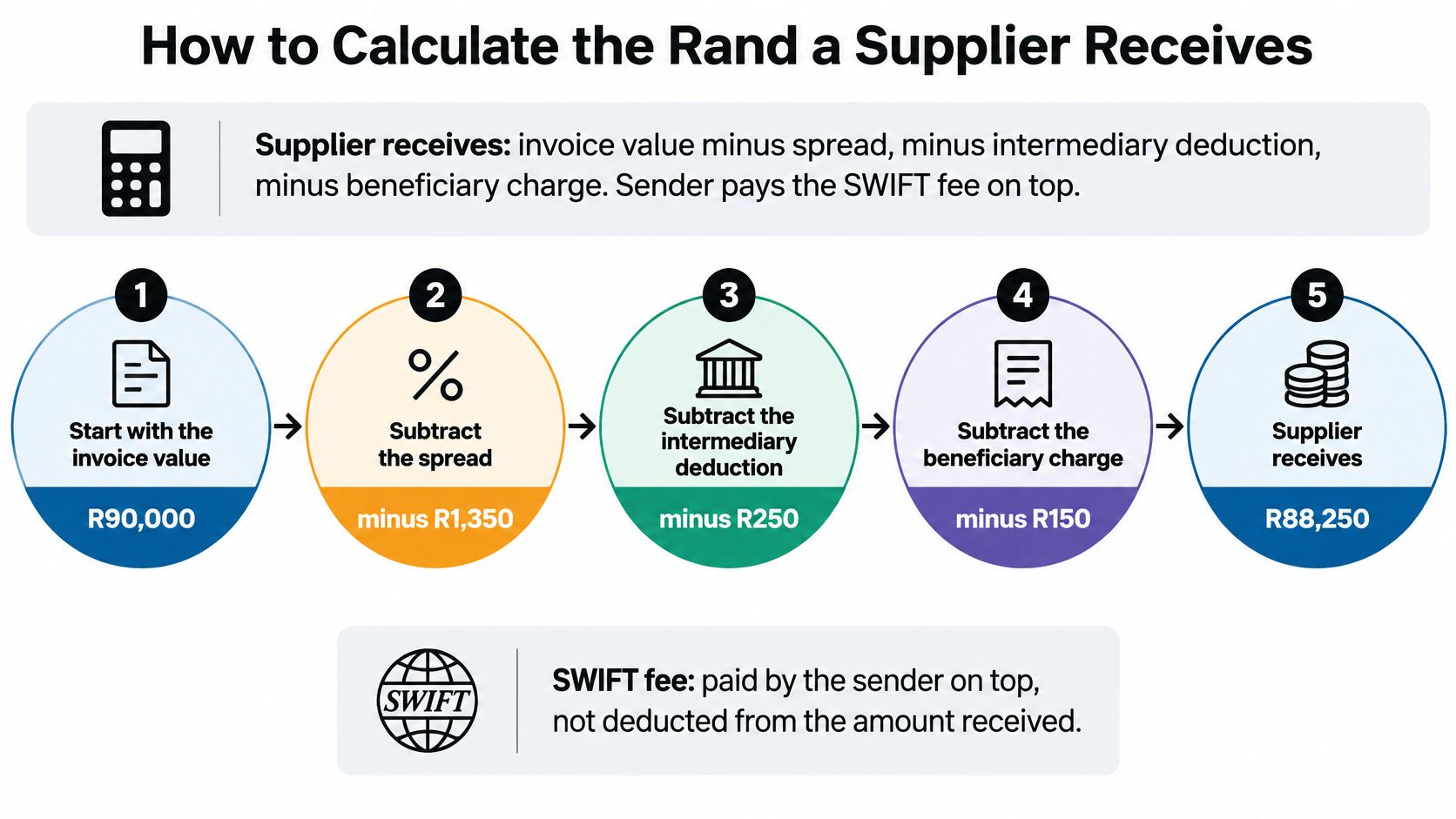
The following illustration uses a separate hypothetical set of deductions. It's a calculation template, not a continuation of the table.
At Zaro, our applicable fees and spreads follow the agreement or transaction quote, and we disclose applicable fees before confirmation. Keep that quote with the settlement record so the finance team can compare the expected result with the actual credit.
Why Small Payments Cost a Larger Share
In a hypothetical payment model, a R5,000 transfer with a R250 fixed fee and a 2% spread costs R350 before any other deductions. That's 7% of the payment amount, even though the spread itself hasn't changed.
The fixed charge explains the difference. As payment size rises, the fixed fee becomes a smaller share, but the percentage-based spread continues to scale with the amount converted.
Share of a payment taken by a fixed fee and spread
These are calculated examples, not quoted bank prices. The model assumes the same R250 fixed charge and 2% spread at every payment size and excludes receiving-bank charges, intermediary deductions and internal administration.
| Payment size | Fixed R250 fee as share | 2% spread in rand | Total modelled cost | Cost as share |
|---|---|---|---|---|
| R5,000 | 5.00% | R100 | R350 | 7.00% |
| R50,000 | 0.50% | R1,000 | R1,250 | 2.50% |
| R500,000 | 0.05% | R10,000 | R10,250 | 2.05% |
| R2,000,000 | 0.0125% | R40,000 | R40,250 | 2.0125% |
A business paying freelancers separately can therefore spend a substantial share on fixed processing charges. A larger importer may have the opposite priority: negotiating the exchange rate can matter more than reducing the flat transfer fee.
Actual spreads and fixed charges follow the bank, corridor, account and negotiated pricing. Don't extrapolate a small-payment quote to a large settlement without obtaining an executable quote for the larger amount.
Batching caution: Combining invoices reduces fixed-fee exposure only if you actually reduce the number of chargeable payments.
Paying several invoices to the same supplier in a consolidated transfer may work. Funding a payout account once doesn't necessarily help if the provider still charges separately for every beneficiary payment.
Timing also has a cost. Don't delay contractor wages or breach supplier terms merely to make the fee percentage look better. Agree a payment calendar with the recipient, attach remittance allocations, and compare any saving with the cash-flow or relationship consequences.
Real-Rate Platforms and USD Cards Compared
Test a payment quote by asking whether you can reproduce the final debit and expected credit from the disclosed rate and charges. A live mid-market display is a benchmark, not proof that the executable transaction carries no spread.
Keep the invoice, quote and card schedule together when comparing routes.

Routes for paying or receiving foreign currency compared
| Route | Rate basis | Fees to watch | Best fit |
|---|---|---|---|
| Bank transfer under SHA | Bank's executable rate, potentially including spread | Sending fee and beneficiary-side deductions | Payments where the recipient accepts the agreed charge allocation |
| Bank transfer under OUR | Bank's executable rate, potentially including spread | Higher sender charge and route-specific exceptions | Invoices requiring greater certainty over the amount delivered |
| Bank card used abroad | Network or issuer conversion rate, potentially with markup | Foreign purchase fee, merchant conversion and cash-withdrawal charges | Purchases and travel expenses |
| FX platform quoting against the mid-market rate, including Zaro | Executable quote compared with the benchmark | Disclosed spread and applicable service charges; our pricing has a transparent spread and no SWIFT fees | Recurring supplier, contractor and export payments |
| USD/ZAR business card | Issuer's rules for the card and funding currency | Foreign purchase charges, conversion and withdrawal fees | Online purchases and business travel |
Don't assume a platform removes the spread because it describes its rate as real. Check the transaction quote. Equally, a USD card doesn't eliminate conversion costs if you must first buy dollars to fund it.
Choose the route for the obligation
Cards work well when the merchant accepts them and you need purchase-level records. Read the issuer's schedule and compare merchant-offered rand conversion with paying in the purchase currency; accepting the rand option can introduce a separate conversion margin.
For invoice settlement, prioritise supported beneficiaries, payment references and clear confirmation of receipt. A platform can suit recurring flows, while cards often fit occasional purchases rather than contractual bank-payment obligations.
Use this video alongside the written quote comparison.
Cut the Fees and Confirm the Rand Received
Start with a recent period of international payments rather than your bank's headline tariff. Export the account debits, conversion records and payment confirmations into a spreadsheet, then match them to invoices and beneficiary credits.
Create columns for invoice currency, invoice amount, benchmark rate and timestamp, executable rate, sender charges, beneficiary deductions and settlement date. Keep internal processing time separate. Where a supplier can't confirm the credit, mark the receipt as unverified rather than assuming the payment arrived intact.
Change the payment instruction deliberately
Choose charge allocation around the contract. Use OUR where the invoice requires the supplier to receive the stipulated amount, subject to the route's actual terms. SHA can be appropriate where the recipient has agreed to bear its charges, but it isn't a saving if you later have to send a top-up.
Match receipts with expenses in the same currency. If your business earns dollars and pays dollar suppliers, consider using those receipts for those obligations where your account arrangements and exchange-control requirements permit it. Avoid converting into rand and then buying the same currency back unnecessarily.
Consolidate payments that can genuinely travel together. Combine invoices for the same beneficiary when the supplier accepts the timing and allocation. Send a remittance advice identifying every invoice, credit note and agreed deduction so the accounts team can allocate the receipt correctly.
These decisions need an owner. Treasury should set the route and charge instruction, accounts payable should confirm invoice terms, and the approver should check that the beneficiary and supporting documents match.
A cheaper route isn't useful if staff can't establish which invoices it settled. Retain the transaction reference in the accounting system, not just in an email inbox.
Balance savings against timing and risk
Holding foreign currency can help match future obligations, but it also leaves the business exposed to exchange-rate movements. Hold against a documented cash-flow requirement rather than treating an operational account as a speculative position.
Request the executable rate, complete charge schedule, quote expiry and expected delivery method in writing. Negotiate using actual payment volumes, currencies and beneficiary locations, rather than asking vaguely for a better rate.
Before changing routes, check:
- Delivery certainty. Can the provider state the expected beneficiary amount, or only the amount it will send?
- Operational fit. Can your team retrieve payment confirmations and reconcile receipts without manual reconstruction?
- Risk introduced. Does the saving require earlier funding, delayed supplier payment or a larger foreign-currency balance?
- Approval readiness. Are the contract, invoice and payment-purpose documents available before release?
For businesses onboarding with us, the process is to sign up, complete KYB verification, fund the ZAR and USD accounts by bank transfer, and then make and receive cross-border payments. Cards are coming soon, so don't build an immediate purchasing workflow around their availability.
We are FIC registered and meet FICA requirements for anti-money laundering and know-your-customer compliance. Funds from the US typically reach a South African account in a matter of minutes; treat that as a typical outcome, not a guaranteed deadline for every payment.
Close each transaction only when the beneficiary credit, sender debit and agreed invoice treatment reconcile. Judge the route by the cash delivered and the total cost of delivering it, not by whichever fee is easiest to see.
Zaro offers cross-border business payments with a transparent exchange-rate spread, no SWIFT fees and applicable fees disclosed before confirmation. Visit Zaro to compare a quote for your payment corridor against your current bank's total debit and expected beneficiary receipt.