You're looking at two numbers that should match and don't. The rate your banking app showed this morning, and the rate printed next to the coffee you bought in Amsterdam on your forex card statement.
That gap isn't a rounding error. It's the product. A forex card bundles a payment mechanism, an exchange rate and a set of legal classifications, and the advertised fee only describes the smallest of the three. Most South Africans compare the wrong thing, pick the card with the cleanest-looking fee schedule, and pay for it in the rate.
This guide works through it in the order that makes sense. What the card is, what it costs in rand once the spread is included, how to load and track it without losing money to small errors, the exchange-control rules that decide what you may do with the balance, and which payments belong on a card at all.
What a Forex Card Is and How It Works
Six weeks before a trade fair in Frankfurt, you need euros for meals, transport and hotel expenses. Carrying a large amount of cash feels risky, while using your everyday debit card may make it harder to separate travel spending. A forex card offers another way to pay.
A forex card is a prepaid card loaded with money that an issuer converts into one or more foreign currencies. It works like separate currency pockets on one card: euros, dollars or pounds, for example. The rand cost is set when you load each pocket, using the exchange rate and fees that apply at that time.
At a merchant, the card is charged in the local currency and draws from the matching pocket. If you have not loaded that currency, the transaction may be converted at the point of sale, where an additional conversion charge can apply. The amount deducted can therefore depend on both the exchange rate and the card's fee rules.

Three functions South Africans have always wanted from these cards
- Several currencies on one card. A multi-country trip can use one card instead of separate cards or cash for each currency. Spending is grouped on the card statement.
- A rate set when you load. The conversion happens when you fund the card, fixing the rand cost of that balance at the rate available then. Later changes in the exchange rate do not change the amount already loaded.
- Payments without carrying cash. The card can be used at merchants that accept it, so you may be able to pay for many trip expenses without visiting an ATM.
The format has a history in South Africa. When Absa launched its multi-currency prepaid travel card in May 2013, it sold 12,000 cards and processed more than R250 million in transactions within roughly six months, as Payments Afrika reported on the Absa multi-currency card. The product made up 77% of the bank's travel-card sales from a standing start, and the US dollar was the most used of its four supported currencies.
Absa also reported no transaction fee on point-of-sale purchases, with a conversion fee applying when the purchase currency differed from the loaded balance. A low or absent purchase fee does not necessarily mean the transaction is free: the exchange rate can include a spread, the difference between the rate used for the conversion and the mid-market rate.
A forex card is not an offshore account. Its balance is foreign exchange, and regulations set limits on how it may be used. Before applying, organize your travel documents in one place, including your passport details and proof of travel, which may be needed for an application or later query.
What a Forex Card Really Costs Compared With Other Options
A R50,000 overseas software bill can cost more than the advertised card fee suggests. To compare payment methods fairly, look at the total rand amount paid, including any fee and the spread built into the exchange rate.
Forex card costs compared with other ways to pay abroad
| Payment method | Conversion or FX cost | Fixed fees | What to check |
|---|---|---|---|
| Bank forex card, consumer | Up to 2.75% on transactions outside South Africa, including online purchases | Issuer's published fees may also apply | Whether the rate includes a spread on top of the conversion fee |
| Business forex card, Standard Bank | Conversion at the card's own rate; published pricing does not quantify the rate | R600 annual fee; R320 initiation fee | How much spending would offset the fixed fees |
| Debit card used abroad | Set by the issuing bank as a percentage of the rand value | Issuer's published fees may also apply | Foreign transaction and conversion charges on the statement |
| SWIFT transfer to a foreign account | Conversion at the bank's rate | Bank SWIFT fees apply per transfer | The SWIFT fee and the spread on the conversion |
The fee you see and the spread you don't
Nedbank states that an international currency-conversion fee of up to 2.75% can apply to transactions outside South Africa, including online purchases. Standard Bank's business forex card pricing lists a R600 annual fee and a R320 initiation fee. The first charge rises with spending; the second is a fixed cost.
There may also be a cost hidden in the exchange rate. A card issuer's rate can differ from the mid-market rate shown on a currency site, and the gap is a spread. So a card with no visible conversion fee can still cost more if its rate is less favourable. A card with a stated fee may be cheaper overall if its rate is closer to the mid-market rate.
The test that settles it: get the rand total for the same foreign payment from each method on the same day. Divide that total by the foreign amount, then compare the implied rate with the mid-market rate. The gap gives you a clearer picture of the cost than the advertised fee alone.
For a clearer picture of how charges fit together, start with this guide to understanding bank fees.
What it costs on a real invoice
Suppose an exporter pays R50,000 a month for overseas software, advertising and logistics. A 2.75% conversion fee would add R1,375 a month, or R16,500 a year, before any exchange-rate spread. The percentage fee can outweigh the R600 annual charge, but the full comparison depends on both costs.
Cash withdrawals add another layer. An ATM operator may charge for each withdrawal, while the card may also apply conversion charges. Frequent withdrawals can therefore make the total cost higher than the card's headline fee suggests.
How to Load, Spend and Track a Forex Card
Loading takes minutes. The discipline is in what you load, when, and what you write down afterwards.
The cycle below is the whole product in four moves.
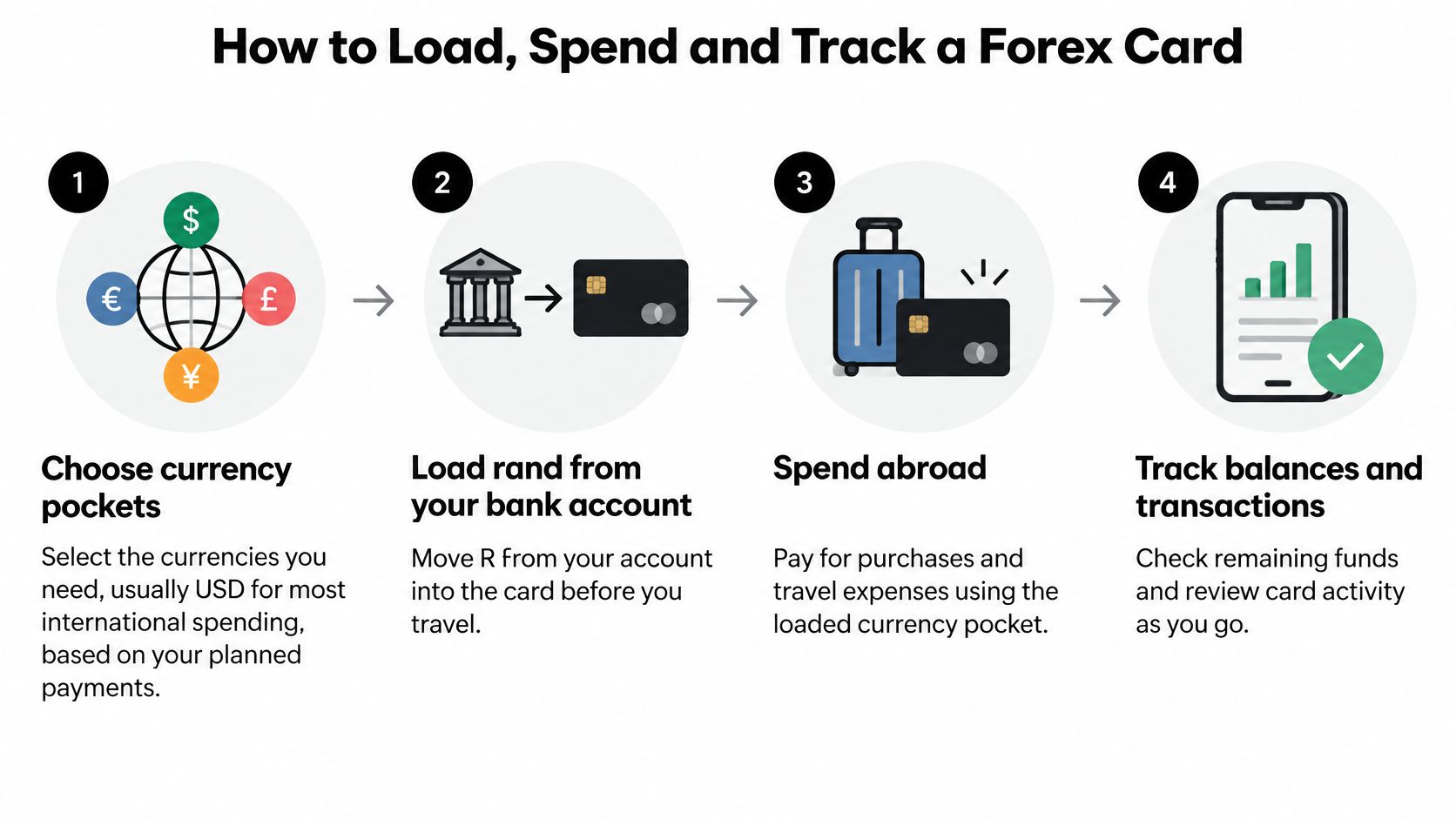
Each step below has a reason behind it and a slip that catches people. Work through them in order the first time; after that you'll only revisit the ones that cost you money.
- Choose your currency pockets. Match the pockets to the invoices and destinations you expect, with US dollars first for most international spending. The slip: loading a currency because it was on the list, then converting again at the till when you never needed it.
- Load rand and write down the rate and the date. The rate on the day you load fixes the rand value of that balance, which is the whole reason to preload. The slip: funding weeks ahead of a trip whose purpose you haven't documented, which creates a timing problem later.
- Confirm the balance in the app before you travel. You want to know exactly what's available before a hotel puts a hold on the card. The slip: assuming a reload cleared when it's still pending.
- Spend in the merchant's currency. Where the merchant's currency matches your loaded pocket, no conversion happens at the point of sale. The slip: accepting the terminal's offer to charge you in rand, which hands the conversion to the merchant at the merchant's rate.
- Record the purpose of every transaction. Travel, subscription, supplier payment and contractor fee are treated differently, and purpose is what you'll be asked about. The slip: lumping a business payment in with holiday spending and losing the trail.
- Reconcile monthly against the rand debited. Compare the rand that left your account, the foreign amount loaded, and the statement. The slip: checking only the foreign balance, which hides the rate paid.
- Reload or convert back. Any unused balance has to go back through an authorised channel within the window the rules allow. The slip: leaving a few hundred dollars sitting on the card for months because the amount felt too small to bother with.
If you'd rather see the mechanics demonstrated before you start, this walkthrough covers the loading and spending sequence.
The habit that matters most is step six. Most disputes and surprises on a forex card come down to a rand amount that doesn't reconcile to a rate the cardholder can't reconstruct, usually because nobody wrote the rate down on the day it was locked.
Exchange-Control Rules That Apply to Card Spending
A designer in Cape Town loads dollars onto a forex card in March for a client trip in April, then uses the same balance in May to pay a logo studio in London. The card accepts both payments. The exchange-control label on that currency does not.
A forex card is a payments product with a regulatory classification attached. For a South African resident, that classification decides how much foreign currency you can hold, when you can buy it, and what you may spend it on. The fee printed on the card never overrides those rules. It works like a tagged envelope: the cash inside spends easily, but the tag says whose trip it was for and which allowance it came from.
The South African Reserve Bank permits adults a single discretionary allowance of up to R1 million per calendar year, and foreign exchange under it can be supplied in an authorised form that includes a travel card, as set out in the SARB financial surveillance guidance.
Travel money comes with conditions. The foreign currency must match the travel purpose you declared. Spend it on something else and the payment sits outside the allowance it was drawn under. You also cannot buy it whenever it is convenient. Currency for a trip has to be purchased close to departure, so loading in January for a June trip is a timing problem. After you are home, unused balances have to be converted back to rand through an authorised channel within the period the rules allow.
That return leg is where the advertised card fee stops being the whole cost. Money that left rand, sat in dollars, and comes home again passes through two exchange rates. Each rate can hide a spread. A small leftover, converted late, can cost more in rate difference than the load fee you were shown at the start.
Keep the declaration and the statement together. If a query arrives months later, the purpose-of-payment record is what resolves it, and a card statement on its own rarely tells the full story.
The logo payment is the same problem in a business setting. The terminal will not object and the card will not decline. The purpose is an import of services, not travel, so it does not match the allowance the currency was drawn against. That mismatch shows up later, in reconciliation or reporting, and it is harder to fix then than to send the payment on the right channel before you confirm it.
Before each foreign card payment, be able to say what the purpose is, whether it counts against the allowance, whether the timing fits the rules, and whether you could produce a record in six months. If any answer is unclear, use a different channel.
Which Fits Each Payment
Short answer: a forex card suits approved, small, purpose-clear spending. It usually isn't a replacement for a business international-payment account.
South African regulatory guidance makes the boundary fairly clear. Foreign card payments and withdrawals count toward the single discretionary allowance, online payments for imports, subscriptions or services that aren't travel-related may be capped per transaction, and foreign-currency accounts can't be funded by card payment at all. They must be funded by SWIFT or a permitted cross-border transfer, as Nedbank's forex savings and investments guidance sets out.
The per-transaction cap needs care, because the published figures don't agree. The SARB exchange-control update raised the miscellaneous-imports, services and subscription-payment limit from R50,000 to R100,000 per transaction, while other guidance still states R50,000. It also states that splitting one larger payment into several smaller card transactions to stay under the limit isn't permitted. Confirm the figure that applies on the date you pay rather than relying on either number.
Which payment types suit a forex card
| Transaction type | Card suitable? | Key condition | Better route when not |
|---|---|---|---|
| Travel spending abroad | Yes | Must match the declared travel purpose and sit inside the annual discretionary allowance | Not needed for this use |
| Online imports, services or subscriptions | Sometimes | Capped per transaction, and the published cap is in transition between R50,000 and R100,000 | Business account for larger or recurring payments |
| Funding a foreign-currency account | No | Card payments cannot fund foreign-currency accounts | SWIFT or permitted cross-border transfer |
| Supplier settlement against invoices | Rarely | Needs documentary support and reconciliation to each invoice | Business account or bank transfer with documents |
| Holding unused foreign currency | No | Unused balances are dealt with under exchange-control rules | Convert back through the authorised channel |
The pattern behind the table is that cards buy convenience on small, well-evidenced payments, while supplier settlement needs a trail. A R180,000 invoice paid across a card in three tranches is exactly the pattern the rules prohibit, and it strips out the invoice-level documentation a bank transfer produces automatically.
If you're also weighing a consumer card for personal travel, these travel credit card rankings give a view of how the retail market compares on perks, though the fee logic is the same one that applies to business cards.
Before choosing a tool for any payment, map it on five attributes: transaction type, allowance treatment, documentation required, per-transaction limit, and how it reconciles to your ledger. A payment that fails any of those five belongs somewhere else.
Mistakes to Avoid and the Pre-Payment Check
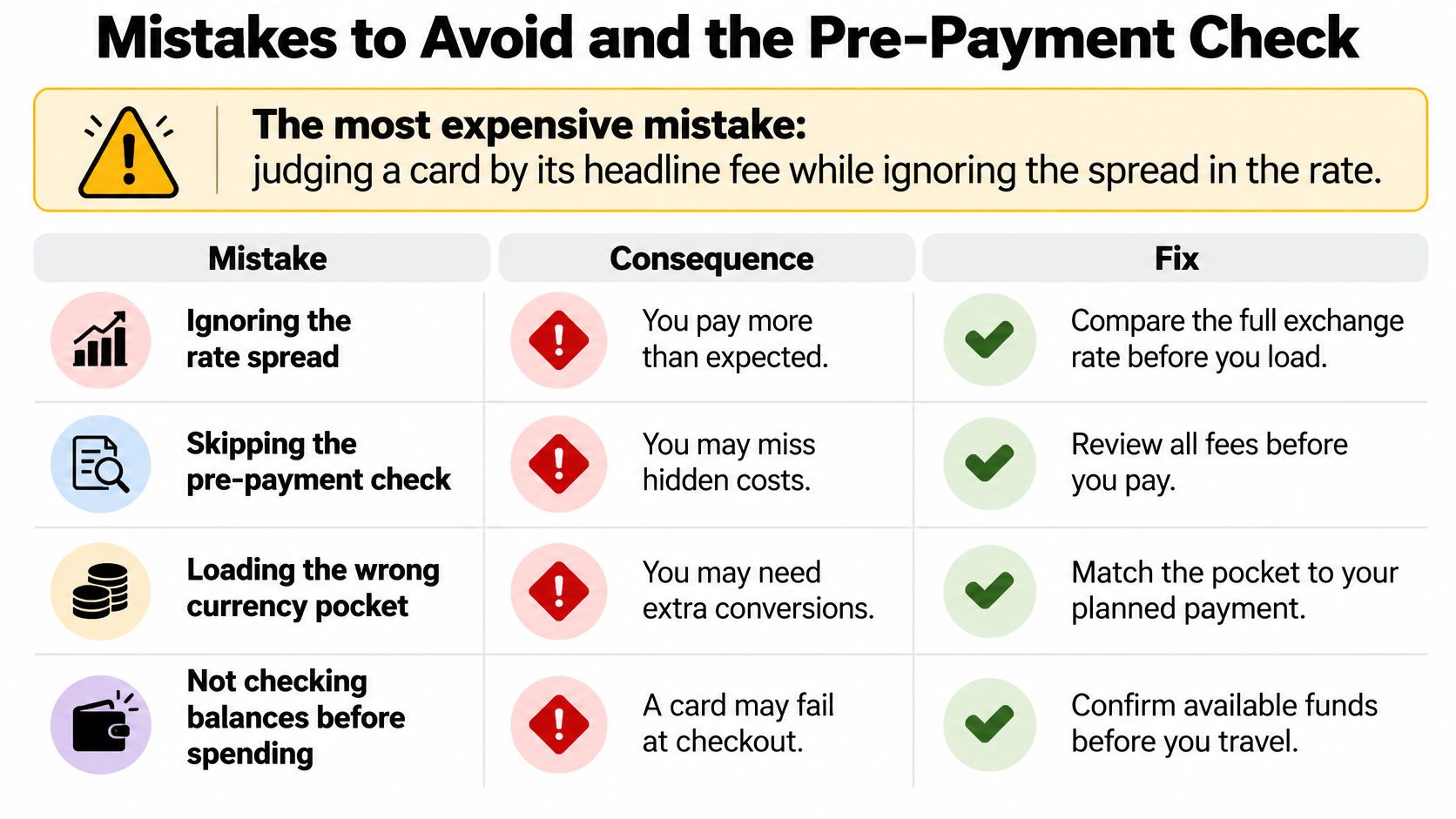
A foreign payment can look cheap and still cost more in rand than expected. The difference often sits in the exchange-rate spread: the gap between the mid-market rate and the rate used for your transaction. A card with no stated fee may therefore cost more than one with an annual charge. Compare the rand amount you will pay, not just the advertised fee.
The checklist
- Trusting a fee-free label. The cost may be built into the exchange rate. Compare the rand total for the same payment with the live mid-market rate.
- Loading far ahead of a trip without a booked date. You may lock in a rate before you know when you will spend, and the timing may not fit the applicable travel allowance. Load closer to the planned payment date and keep a record of the purpose.
- Paying in rand on a foreign merchant's site. The checkout conversion can add a fee on top of the card's own exchange-rate spread. Compare the rand totals shown at checkout and, where possible, choose the merchant's currency.
- Splitting one payment into smaller card transactions to stay under a limit. This can breach the applicable rules and complicate reporting. Use the authorised business payment route for the full amount.
- Leaving unused foreign currency unconverted beyond the allowed window. You may face a compliance query or have to convert at the rate available later. Use the authorised channel to convert the balance back within the permitted period.
- Keeping no purpose-of-payment records. Without supporting records, it can be difficult to explain a payment later. Store the invoice, approval and statement entry together.
For a small or medium-sized business, recurring foreign payments can appear as dozens of separate lines. Compare the rate and fees across the total spend, and keep each payment tied to its purpose and supporting documents.
Before paying, check three things: the conversion fee, the spread against the mid-market rate, and any fixed fees in relation to your expected spend. Then confirm that the payment's purpose is permitted and save the records.
The free USD to ZAR converter shows the live mid-market rate and compares it with what a bank may take in FX spread and SWIFT fees.
For business cross-border payments, Zaro quotes a transparent spread on the exchange rate and charges no SWIFT fees. Businesses sign up, complete KYB verification, and fund their ZAR and USD accounts by bank transfer. Payments can then be sent and received across borders; Zaro cards are coming soon. Fees and spreads are disclosed before a transaction is confirmed.