
Your export invoice has landed in US dollars, your offshore contractor is due, and a software renewal is about to hit a director's personal card. That's the moment most South African businesses realise cross-border payments aren't a banking errand. They're a treasury decision with compliance, cost and cash flow attached to every swipe.
The Payment Decision Every Growing SA Business Eventually Faces
A Cape Town exporter I'll describe in composite terms has a familiar Monday. A client abroad has paid, a supplier abroad wants payment, and the operations lead needs to renew a string of software subscriptions before access lapses. Someone suggests putting it all on a card. Someone else says do a transfer through the bank. Both answers sound simple. Neither is complete.
The card gets the subscription paid today, but finance can't easily show the purpose, the rand equivalent or who approved it. The transfer creates a cleaner paper trail, but it is slow and clumsy for small, recurring spend that needs a card number on file. Use the wrong instrument and you don't just pay more. You create reconciliation work, strand balances in the wrong currency and invite questions you can't answer neatly at month end.
The Question Has Changed
Stop asking which Forex Card in South Africa is best in the abstract. Ask which instrument fits this specific payment. Employee travel, a low-value online purchase, a supplier invoice and contractor pay are four different jobs. They differ in size, frequency, documentation and who the beneficiary is, and those differences should drive your choice.
Treat the card as one tool in a wider cross-border toolkit, not as the default answer to every foreign payment.
That shift matters because growth exposes weak defaults fast. A founder paying two subscriptions from a personal card can muddle through. A business with travelling staff, offshore contractors and regular imports cannot. At that point, informal habits become control failures.
My recommendation is blunt. Map your foreign spend by job before you compare any product. List what you pay, how often, in which currency and who initiates it. Once you can see the pattern, the right instrument usually becomes obvious, and so does the point where a card stops helping and starts costing you control.
What a Forex Card Actually Is in the South African Context
Think of a forex card as a prepaid foreign-currency wallet with a card attached. You load rand value, convert it into dollars, euros or another supported currency, then spend from that foreign balance online, in store or at an ATM. The appeal is certainty. You know what you converted, and the cardholder isn't exposing your main business account to every merchant.
That simple model hides three different products. A travel card is loaded for a specific trip and is tied to an individual's travel spending. A multi-currency card holds balances in several currencies on one card, which suits people moving between countries. A business-issued foreign-currency card is issued to staff or functions for defined company spend, and it should come with limits, merchant controls and reporting.
Why South Africa Changes the Picture
In many overseas guides, a card is treated as a consumer convenience. Here, it remains connected to exchange control. South Africa's framework has deep roots, including controls introduced in 1939 and a modern system that took distinct form in 1961, before later liberalisation, as set out in the Reserve Bank's account of exchange control reforms. That history explains why permitted purpose, residency and reporting still matter when a locally issued card is used abroad.
The issuer matters too.
- South African bank-issued card: It sits inside local reporting and authorised dealer processes, which usually makes purpose and allowance treatment easier to evidence.
- Offshore-issued card: It can look flexible, but you need to ask how funding it interacts with your authorised routes and record keeping.
- Virtual card: It's useful for online subscriptions and advertising, provided each card maps to a supplier, owner and cost centre.
Don't confuse the spending rail with the underlying account. A card doesn't, by itself, give you a place to receive export revenue, hold working balances across currencies or pay a beneficiary who needs bank details. It spends loaded value well. It does the rest poorly.
For travelling teams, the same preparation mindset applies beyond money, which is why practical trip resources, including a guide to a South Africa prepaid data eSIM, often sit alongside card planning for staff on the road. Sort connectivity and payment method before departure, not at the airport.
The SARB Rules That Quietly Govern Every Forex Card Swipe
You don't need to memorise exchange-control manuals. You do need to know the handful of rules that decide whether a card transaction is clean or problematic. Start with the person. The Reserve Bank states adults may use a single discretionary allowance of up to R1 million per calendar year, while locally issued cards may be used for small foreign-currency purchases such as online imports, under the Reserve Bank's exchange control frequently asked questions. Don't blur that allowance with a company payment route. They are not interchangeable.
Next comes transaction size. Permissible foreign-currency payments through resident-issued cards were limited to R50,000 per transaction, and the Reserve Bank announced in 2026 that the threshold would increase to R100,000 per transaction from the relevant circular's date, under the Reserve Bank's 2026 exchange control circular. A larger purchase can't be sliced into smaller card payments to sneak under the ceiling.
What This Means at the Finance Desk
That ceiling draws a practical line through your payables. Below it, qualifying online imports, services and subscriptions can fit a card route, subject to your bank's treatment. Above it, you need another route through appropriate banking channels. Trying to force a large supplier settlement through repeated card charges isn't clever treasury management. It's the kind of pattern that should trigger review inside your own business before anyone else asks about it.
Practical rule: If you'd struggle to explain a series of similar payments to one supplier as separate transactions, don't structure them as separate transactions.
Purpose matters just as much as size. Employee travel spending, company procurement, an own-account transfer and a payment to a third party follow different logic. A card can improve convenience without removing documentary, customs or tax obligations attached to the underlying purchase, particularly where goods are imported.
This is also where businesses paying people abroad go wrong. Contractor and payroll-like payments raise classification and documentation questions that sit outside ordinary card spend, so it's worth reading a founder's guide to payroll compliance alongside your payment review before you put people costs on a card. If the payment is really remuneration, say so and route it properly.
My advice is to build these rules into approval workflow, not staff memory. Set card limits with the transaction ceiling in mind, require a stated purpose before loading, and review repeat payments to the same merchant. The card should enforce the policy for you wherever possible.
The Real Cost Stack Behind a Forex Card
A card marketed as low fee can still be expensive once you add every layer. The headline charge is rarely the whole story. You need to interrogate the full stack before you roll a card out to a team, because small percentage differences repeat on every subscription, hotel bill and supplier purchase.
The biggest item is usually invisible at checkout. It's the foreign-exchange margin between the market rate and the rate applied when you load or spend. If that margin is wide, a zero issuance fee is a distraction. Ask for the actual rate you'll receive on a live transaction and compare it with the spot rate at that moment. Don't accept a brochure answer.
Typical Cost Items on a South African Forex Card
| Cost Item | How It Usually Appears | Why It Matters |
|---|---|---|
| FX spread | A load or conversion rate weaker than the market rate | It applies to the full balance, not only occasional withdrawals |
| Issuance and replacement | Upfront or card replacement charges | Costs multiply across staff cards and lost cards |
| ATM withdrawal | A fee from the issuer, possibly alongside an operator charge | Cash access can become the priciest way to spend |
| Inactivity fee | A periodic charge on dormant cards | It quietly erodes balances left after a trip |
| Reload or cross-border charge | A fee when value is added or spent abroad | Frequent small loads can undo the benefit of convenience |
| Dynamic currency conversion | A merchant offer to charge you in rand at the terminal | The merchant-set conversion is usually the option to decline |
That last item deserves a hard rule for travellers. Pay in the local currency of the transaction where your card holds that currency, and decline conversion into rand at the point of sale. Train staff before they travel. One careless tap can replace your negotiated economics with the merchant's.
Opportunity cost belongs in the stack too. Money preloaded too early is cash your business can't use elsewhere, and balances left offshore after a trip create follow-up work. Load in line with an approved budget, top up against evidence of spend, and review idle balances weekly. Convenience is only cheap when balances keep moving.
Choosing Between a Card, an FCA, and an International Transfer
Most businesses don't need to choose one instrument forever. They need to assign each payment type to the instrument that fits. A card, a business foreign-currency account, often called an FCA, and an international transfer solve different problems, and treating them as substitutes is where the trouble starts.
Use a card for spend that is card-native by nature. Software subscriptions, digital advertising, travel bookings, hotels and incidental purchases while staff are abroad all fit, provided the amount and purpose fit the applicable card rules. A card gives immediate payment, a usable audit trail and no need to collect bank details from every merchant.
Match the Instrument to the Job
An FCA earns its place when currency timing matters. If you receive dollars from exports and later pay dollar costs, holding dollars avoids converting into rand and back out again. That natural hedge can matter more than any card reward. An FCA also gives treasury a visible balance to plan against, rather than fragments of value sitting on individual cards.
An international transfer is better where the beneficiary expects bank settlement and documentation is central. Larger supplier invoices, structured settlements and payments that need invoice matching belong here. Traditional SWIFT routes can be slow and costly, but the answer is to compare modern alternatives and understand the settlement rail, not to force the payment onto plastic. For contrast on how domestic account-to-account rails are evaluated in the United States, Jumpstart Partners on ACH processors is a useful reminder to assess fees, speed and controls rail by rail rather than by brand name.
- Employee travel: Use a controlled card, backed by trip approval and post-trip reconciliation.
- Recurring SaaS and advertising: Use assigned virtual or physical cards with merchant-level ownership.
- Supplier invoices: Favour an account-based payment where invoice size or documentation goes beyond card suitability.
- Contractor payments: Route through a payment method that records the beneficiary and the nature of the payment.
- Export revenue: Receive and hold it in the right currency account before deciding when to convert.
Travel creates one specific trap. Unused foreign currency acquired for travel, including funds held on travel cards, must generally be resold to an Authorised Dealer or deposited into a foreign-currency account within 30 days after the traveller returns to South Africa, under the Reserve Bank's 2025 exchange control circular. Build that deadline into your travel close-out process.
My ranking is simple. Cards win on immediacy for small, legitimate, card-based spend. Accounts win on currency management. Transfers win on beneficiary settlement and scale. If a payment needs all three strengths, you probably need a platform workflow, not a bigger card limit.
Wiring a Forex Card Into a Real Treasury Workflow
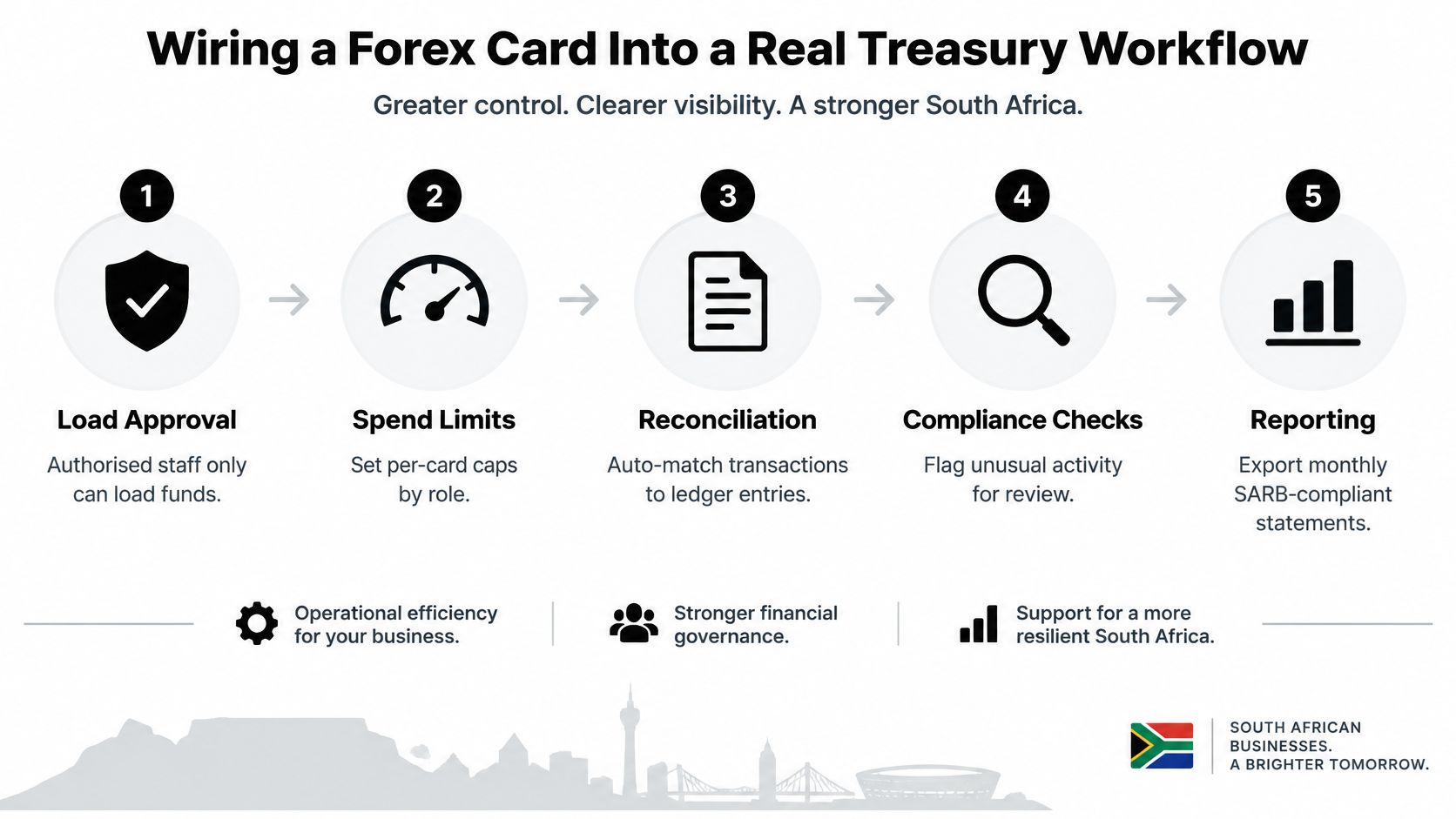
Don't issue cards first and invent controls later. Decide who may request a load, who approves it, who may spend and who reconciles. Those should not all be the same person once spend becomes material. Separation of duties sounds corporate, but even a small exporter benefits when the person travelling isn't also the person approving their own top-up.
Set limits by role and purpose, not by seniority. A sales executive on a trade trip, a BPO team lead buying software and a founder paying a once-off supplier need different caps, merchant access and evidence requirements. Review limits when roles change, and cancel cards promptly when staff leave.
The Controls That Make It Work
Build the workflow around five disciplines.
- Load approval: Require amount, currency, purpose, cost centre and expected spend window before funds move.
- Transaction capture: Record merchant, currency, rand equivalent, invoice or receipt, and the employee responsible.
- Weekly review: Flag repeat payments to one supplier, unusual merchants, cash withdrawals and transactions near approval limits.
- Month-end booking: Agree in advance how conversion differences and card fees are captured in the ledger, so finance isn't reinventing treatment each month.
- Balance sweep: Return or redeposit unused travel value through the required route and close the trip file with return evidence.
A card programme is only as strong as the evidence attached to each transaction. Convenience without purpose data is just faster disorder.
Compliance checks must be specific. The Reserve Bank's individual guidelines state cardholders remain responsible for customs compliance and applicable excise or import duties on card-funded purchases, and a transaction above the R50,000, rising to R100,000, threshold may not be split into multiple payments to evade the limit, under the Reserve Bank's Currency and Exchanges Guidelines for Individuals. Your review should therefore look for imports without supporting documents and patterns that resemble one purchase broken apart.
Report in a format management will read. Show spend by person, supplier, currency and cost centre, plus idle balances and exceptions. If that report takes days to assemble from statements and inboxes, your workflow is manual, regardless of how modern the card looks.
When a Modern FX Platform Outgrows the Card
You'll know you've outgrown a card-only setup when the exceptions become the process. Finance is chasing receipts, topping up in a panic, converting at loaded rates and trying to pay beneficiaries who never wanted a card payment in the first place. At that point, don't buy more cards. Fix the account and payment layer underneath them.
Zaro fits as one option to evaluate. It lets South African businesses hold ZAR and USD accounts, fund them via standard bank transfer, and transact at the current spot exchange rate with zero spread and no SWIFT fees, alongside issued ZAR and USD debit cards for low-cost foreign spend. That structure is different from a standalone travel card because the card spend sits inside a broader account and payments workflow.
Where the Platform Model Wins
The fit is strongest for exporters and BPO businesses that both receive and spend foreign currency. You can hold dollars, decide when to convert, pay international suppliers or contractors from the account side, and use debit cards where card payment is the right rail. Multi-user permissions also matter once finance, operations and founders all touch the same payment process.
That doesn't make a bank travel card useless. For a once-off trip, low foreign spend and no need to receive foreign revenue, a simple card may be enough. Don't adopt a platform to solve a problem you don't have. Equally, don't pretend a prepaid card is a treasury system when your business now lives across borders every week.
Evaluate onboarding closely. Business verification, authorised users and funding routes should be clear before you migrate recurring spend. Run the platform in parallel on a defined category first, such as software or one supplier stream, then compare rate, fees, settlement experience and reconciliation effort against your card baseline.
A Short Decision Framework for SA Finance Teams
Use the payment itself as the decision point. Small, recurring, card-native spend that fits the applicable card threshold belongs on a controlled low-spread card. Foreign revenue and repeat beneficiary payments belong in an account-led workflow where you can hold currency and evidence purpose. Large, irregular settlements deserve a deliberate transfer discussion with your bank or payment provider, based on the documents and beneficiary requirements.
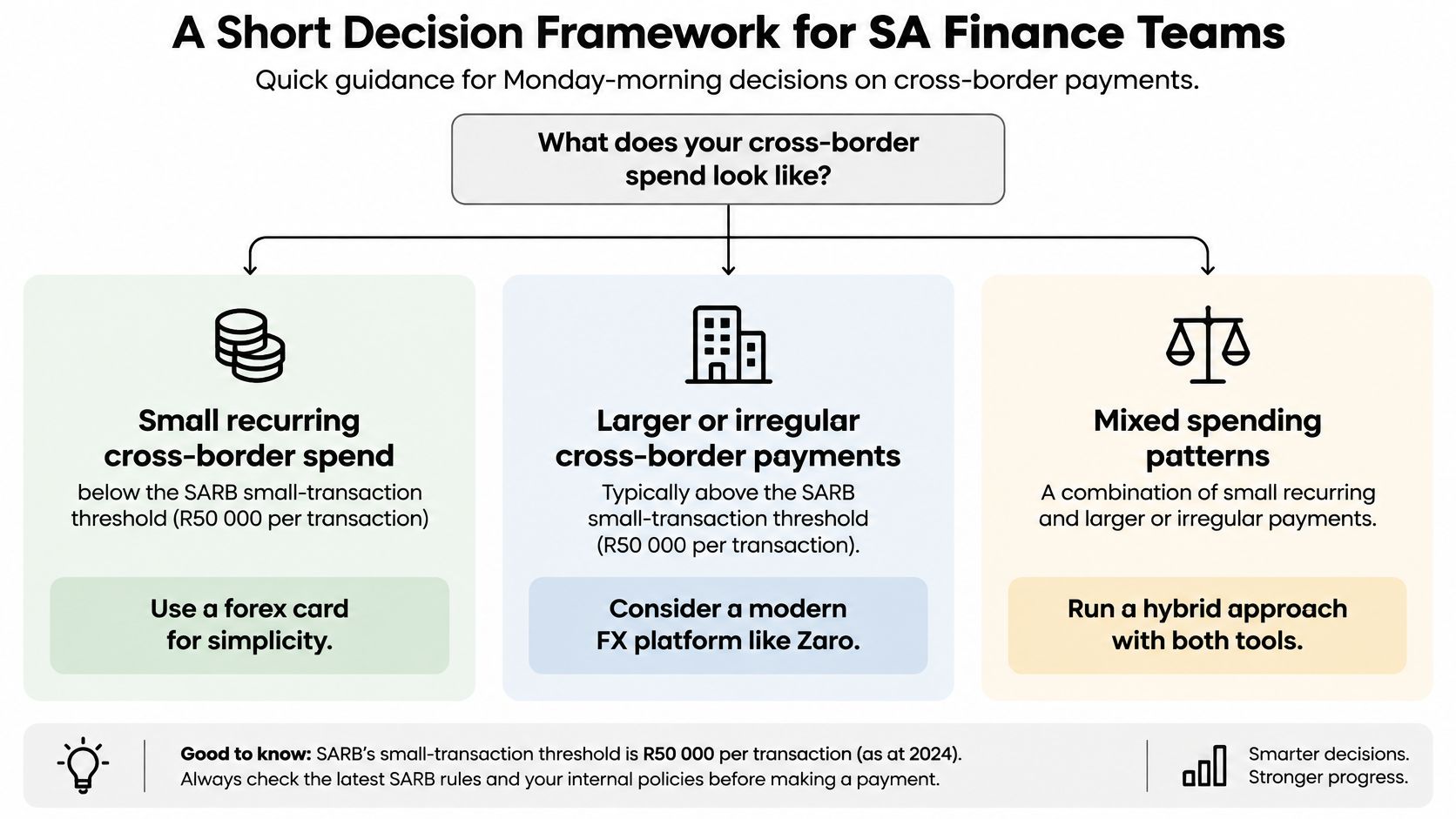
Watch for the signals that your current setup has failed. Manual reloads, stranded balances, unexplained conversion differences, staff using personal cards and an inability to state why a payment was made all point in the same direction. You don't have a card problem. You have a control and instrument-selection problem.
Your Monday Morning Checklist
- Classify the payment: Decide whether it's travel, procurement, a subscription, a supplier settlement or payment for a person's services.
- Check size and route: Confirm a card is permissible and suitable for the amount before anyone loads funds.
- Attach evidence first: Require invoice, trip approval or subscription ownership at approval stage, not after spend.
- Protect the rate: Compare the rate you'll receive against spot and decline merchant conversion at terminals.
- Close the loop: Reconcile promptly, review repeat beneficiaries and deal with unused travel balances immediately.
My final recommendation is a hybrid for most growing businesses. Keep cards for what cards do well, move account-based payments onto an account-based rail, and review the split quarterly as spend changes. That discipline will save you more than chasing the next card promotion.
If your team has outgrown prepaid loads and patchy card reconciliation, Zaro offers ZAR and USD business accounts, conversion at the spot rate with zero spread and no SWIFT fees, plus ZAR and USD debit cards for foreign spend. Visit Zaro to compare that account-led model against your current forex card costs and controls before your next international payment cycle.