
The rand-to-dollar rate tells you how many South African rand you need to buy one US dollar: a fall from R17.2294 to R15.9887 means the rand has strengthened, because each dollar costs fewer rand.
You've received a dollar payment from an overseas customer, and payroll is approaching. Your currency converter shows an encouraging number, but the bank's conversion quote produces a different rand balance. The difference can come from the provider's spread, payment charges and the moment the conversion takes place.
For a business searching for forex rand to dollar, the useful answer isn't just a rate. It's the amount available to pay salaries, suppliers and operating costs after the transaction settles.
How Many Rand One Dollar Buys and How to Read It
The South African Reserve Bank reports this measure as “SA rand per US dollar”. Its monthly exchange-rate publication records a sequence of R17.2294, R16.8542, R16.2790 and R15.9887, a decline of approximately 7.2% between the endpoints.
Think of the quote as a dollar's price tag. When that price falls, someone buying dollars needs fewer rand. Someone selling dollars, however, receives fewer rand.
Rand movement against the US dollar and its effect on a USD 100,000 receipt
The endpoint amounts below are arithmetic illustrations using those published rates, before any spread or fees. The monthly movement rows show the direction of the effect, not a separate executable exchange-rate quote.
| Rate reading | Rand needed for one USD | Effect on a fixed USD 100,000 receipt |
|---|---|---|
| SARB sequence start | R17.2294 | R1,722,940 before charges |
| SARB sequence end | R15.9887 | R1,598,870 before charges |
| Rand gains 1.9% against USD, April 2026 | Fewer rand per dollar; an absolute rate requires a starting quote | About 1.9% fewer rand on a fixed dollar amount |
| Rand gains 3.1% against USD, May 2026 | Fewer rand per dollar; an absolute rate requires a starting quote | About 3.1% fewer rand on a fixed dollar amount |
| Rand loses 0.9% against USD, June 2026 | More rand per dollar; an absolute rate requires a starting quote | About 0.9% more rand on a fixed dollar amount |
Check the units before doing the calculation
Currency-pair labels can cause confusion. USD/ZAR conventionally expresses rand per dollar, while a quote expressed as dollars per rand is the reciprocal. Don't rely on a converter's title alone; read the units beside the result.
For a rate expressed in rand per dollar:
- Selling dollars for rand: Multiply the dollar amount by the quoted rate.
- Buying dollars with rand: Divide the available rand by the quoted rate, allowing separately for charges.
- Comparing quotes: Confirm that both quotes describe the same conversion direction.
Separate a benchmark from a payment quote
A monthly average smooths day-to-day movements. A spot quote relates to the market at a particular time, and an executable customer quote includes the terms offered for your transaction.
Official statistics provide a useful benchmark, but they aren't a promise that a payment provider will transact at that figure. Check the date, source, units and quote type before using any displayed rate in a cash-flow forecast.
How Much Reaches Your Account After Fees and Markups
A supplier quotes you a headline rate. Your bank balance experiences something different: the total debit once markup and fees have been added. Take a USD 100,000 supplier invoice with the mid-market rate at R17 per dollar. The benchmark cost is R1,700,000. Every rand debited above that figure is the price of conversion.
Providers and channels price conversions differently, and markups vary between banks and specialist services. To see what a markup means in rand, apply a few sizes to that same payment:
What a markup costs on USD 100,000 at R17 per dollar
| Markup over the mid-market rate | Extra rand debited |
|---|---|
| 0.5% | R8,500 |
| 1% | R17,000 |
| 2% | R34,000 |
A single percentage point costs R17,000 on this payment.
Run the same calculation against the quote your provider gives you. Payment direction, transaction size and the applicable commercial terms must match before you compare offers.
Identify the layers in the price
The mid-market rate is the midpoint between market buying and selling prices. It works like a wholesale price: a useful benchmark for comparison, while a business customer may be quoted a different rate at the till.
The executable rate is the rate available for your transaction. A provider may build its remuneration into that rate, so a transfer described as having no transfer fee can still carry an FX cost inside the exchange rate itself.
Separate charges can include a fixed payment fee and deductions by intermediary or recipient banks. Whether they reduce the beneficiary's receipt or increase the sender's debit depends on the payment arrangement.
Practical rule: Compare the total account debit for an identical beneficiary receipt, or the net receipt for an identical amount sent. Don't compare a fee label in isolation.
Turn the quote into a business decision
For a supplier payment, calculate the benchmark rand value and compare it with the complete amount your account will be debited. For an export receipt, compare the benchmark rand proceeds with the amount that will become available. A free converter that checks the live mid-market rate, such as the one Zaro offers, shows the benchmark alongside what a bank may take in FX spread and SWIFT fees, so you can measure the gap before you commit.
Keep those comparisons separate. A markup that increases the cost of buying dollars uses a different calculation from a deduction taken out of dollar-sale proceeds.
A useful landed-cost worksheet contains:
- Benchmark details: The indicative rate, its source and the time checked.
- Transaction pricing: The executable rate and every separately charged fee.
- Settlement outcome: The final amount credited, with any unresolved deductions identified.
- Break-even requirement: The minimum receipt or maximum payment your contract margin can support.
The decisive confirmation is a written statement of the rate, total debit and final recipient amount before you authorise the transaction.
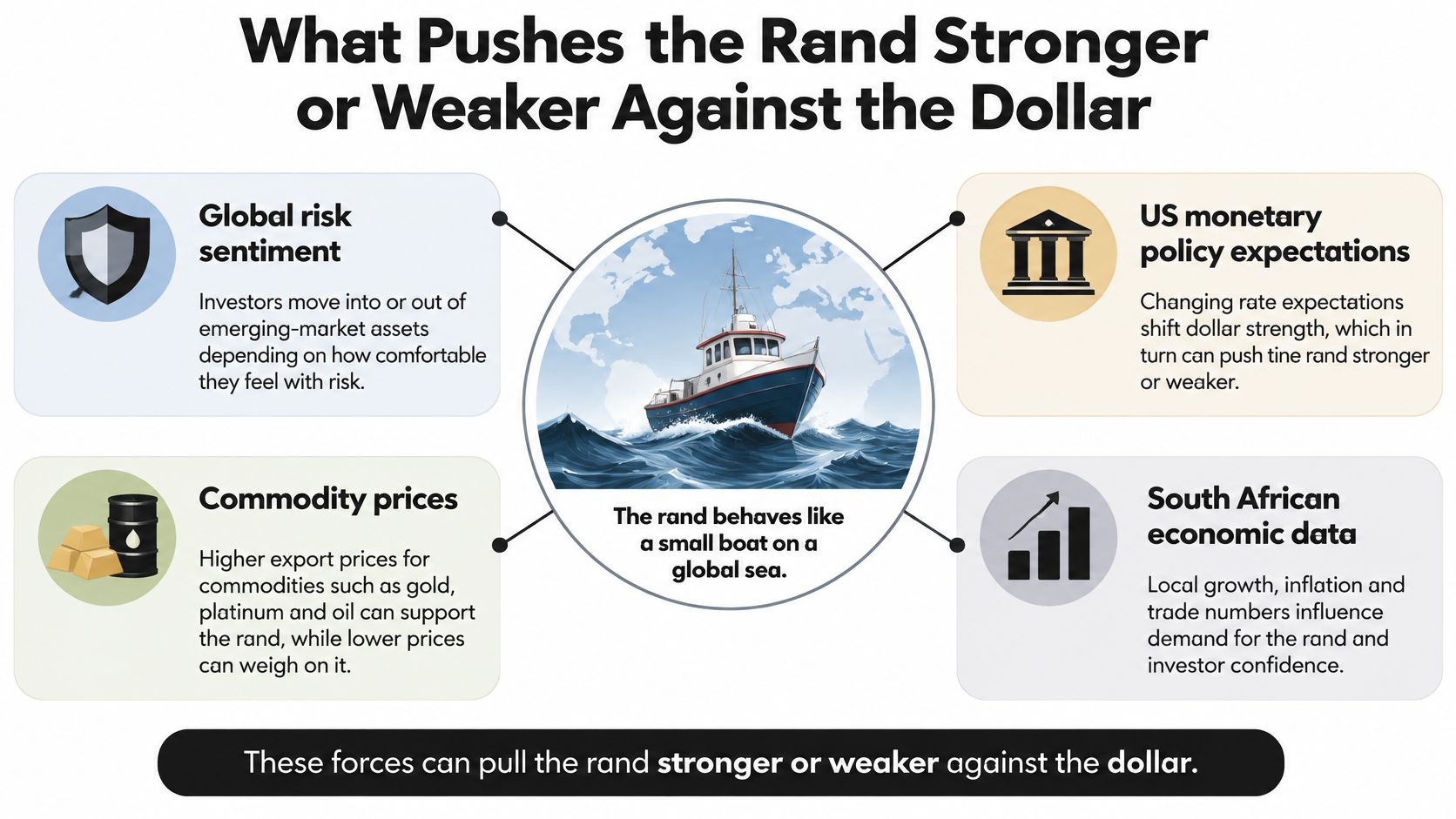
What Pushes the Rand Stronger or Weaker Against the Dollar
The rand floats like a small boat on a global sea. South African conditions matter, but international investors also adjust their exposure whenever global risk appetite, interest-rate expectations and commodity prices shift, and the exchange rate moves with them.
The SARB's market-rate commentary and statistics report rand appreciation against the dollar of 1.9% in April 2026 and 3.1% in May, supported by improved global risk sentiment and optimism about geopolitical developments. The same account notes that lower crude-oil prices helped the currency, while expectations of higher-for-longer US interest rates contributed to 0.9% depreciation in June.
Those forces rarely line up in a single direction. On any given week, one can push while another pulls.
Translate market news into invoice exposure
A stronger rand reduces the local-currency value of an unchanged dollar invoice. A weaker rand raises the local-currency cost of an unchanged dollar obligation. Your sales team needn't change a single contract for the finance team's expected bank balance to change.
Treat percentage headlines as approximate cash-flow signals rather than exact settlement calculations. Appreciation is measured on the reciprocal quote, so a reported 3.1% rand gain does not translate to exactly 3.1% less rand per dollar on your payment. Work the actual starting and ending rates into your own figures before adjusting a forecast.
The SARB also publishes a broader nominal effective exchange-rate index that weights the rand against its major trading partners' currencies, which gives a wider view than the bilateral dollar quote alone.
That wider view matters. If the dollar strengthens broadly, a move in USD/ZAR doesn't necessarily mean the rand weakened to the same extent against your European suppliers' currencies. Compare the currencies your business uses before changing budgets or customer prices.
Watch the driver, not just the headline
Build a monitoring routine around information that could affect scheduled payments:
- Global risk sentiment: Follow financial-market reporting on investor demand for emerging-market assets and geopolitical developments.
- US monetary policy: Read Federal Reserve announcements and distinguish an actual policy decision from expectations about a future decision.
- Commodity prices: Track the commodities relevant to your export income and imported costs, including oil where freight or fuel matters.
- South African economic releases: Monitor official growth, inflation and trade publications rather than relying only on currency commentary.
You don't need a confident exchange-rate forecast to manage a payment. You need to know which obligations become uncomfortable if the rate moves against you, and by roughly how much, before the settlement date arrives.
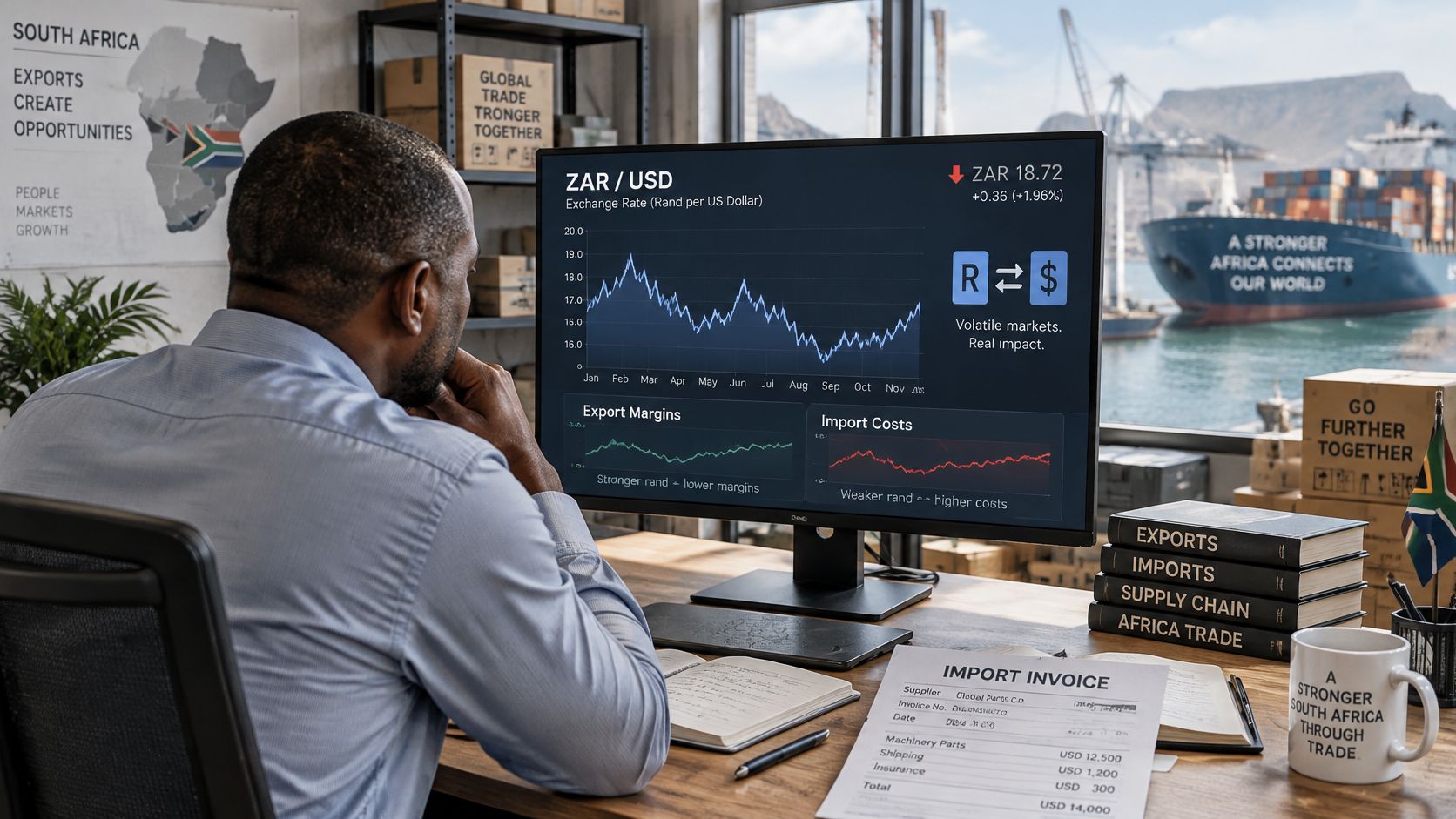
Why Currency Swings Hit Export and Import Margins
South Africa's longer-run exchange-rate volatility peaked at nearly 30% in 2003, according to a South African Reserve Bank working paper. Its historical analysis also finds that the rand's three-month annualised volatility generally exceeded that of the Mexican and South Korean currencies and closely tracked the more volatile Brazilian real and Turkish lira.
That's a historical risk measure, not a forecast that your next invoice will move by that amount. Its practical meaning is that leaving a foreign-currency balance unconverted involves uncertainty.
A finance review should connect the currency chart to actual settlement dates.
The exposure starts before the money arrives
Say an exporter agrees a dollar invoice today and expects payment several months later. Its staff and local subcontractors still need paying in rand, regardless of when the customer settles.
Between agreeing the price and converting the receipt, the business carries an unhedged receivable. A customer's late payment extends that exposure beyond the date originally used in the cash-flow forecast.
An importer has the opposite concern. It can agree a dollar purchase price while remaining uncertain about the rand needed to settle the bill.
A fixed foreign-currency invoice is not a fixed rand margin.
Build a settlement-date exposure schedule
Use a spreadsheet that records each foreign-currency cash flow against its expected availability or payment date. Keep receivables and payables visible separately before calculating any offset.
- Record the commercial commitment: Include the invoice currency, amount and expected settlement date.
- Attach the local obligation: Identify the payroll, supplier bill or other rand expense that depends on the receipt.
- Mark uncertainty: Flag disputed invoices, likely delays and payments that haven't yet been approved.
- Test the margin: Compare the contract's required rand outcome with the conversion terms available for the relevant date.
The following video can accompany a review of exchange-rate concepts.
Compare any guaranteed conversion terms with a suitable reference benchmark, but also check that the dates match. A future-dated guaranteed rate and today's spot reference aren't identical products.
For narrow-margin contracts, the useful question is whether the business can still meet its obligations under an adverse conversion outcome, not whether today's chart looks favourable.
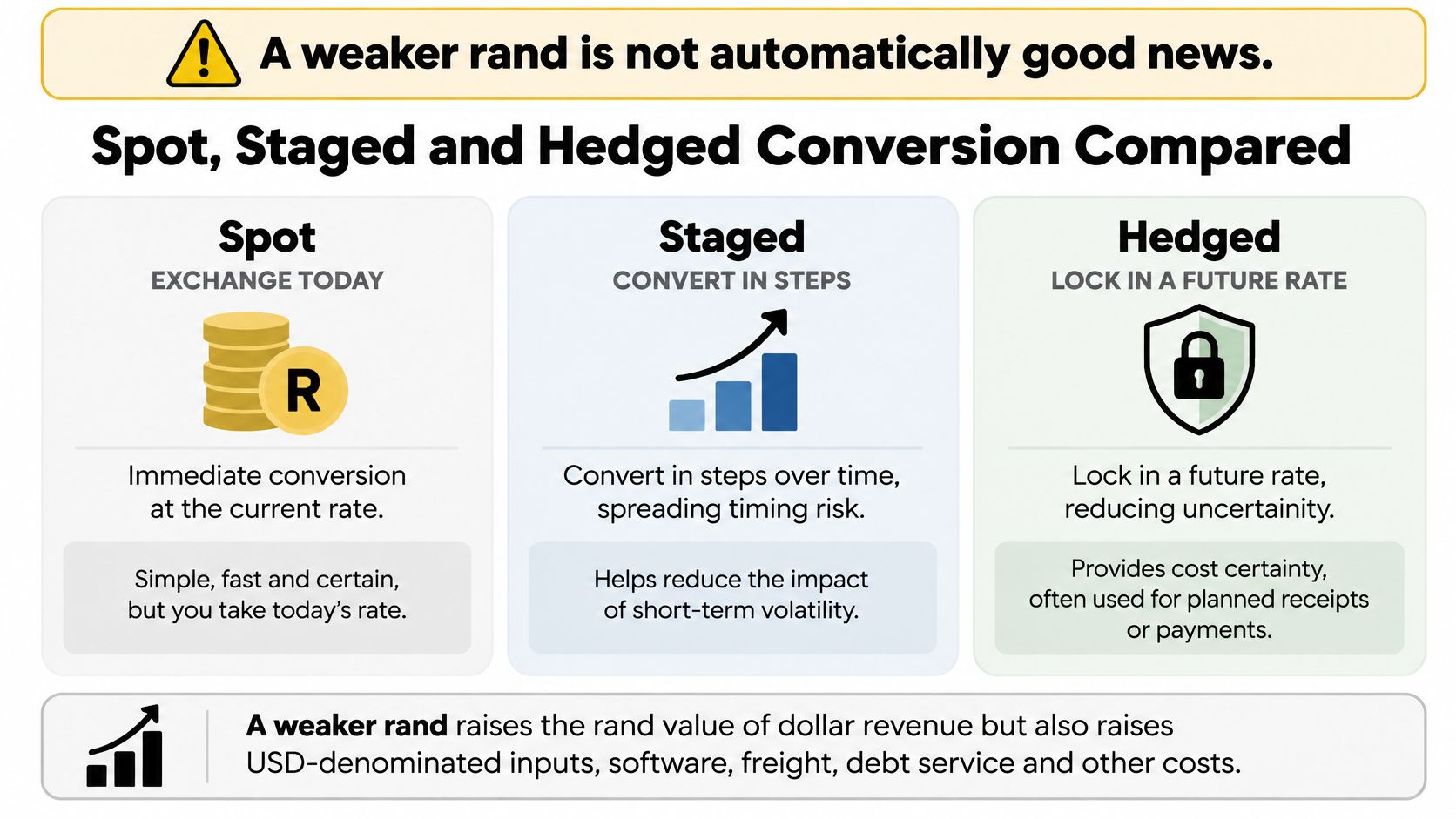
Spot, Staged and Hedged Conversion Compared
A weaker rand isn't automatically good news for an exporter. Dollar revenue may translate into more rand, while imported inputs, software subscriptions, freight, debt service and overseas customer acquisition also become more expensive.
South African trade commentary from EBC describes exchange-rate volatility as a financial risk requiring active management, including alongside commodity exposure. The relevant business measure is the net currency exposure, not the gross value of overseas sales.
Choose protection that matches the obligation
Conversion methods compared by protection and trade-off
| Method | Protects against | Main trade-off |
|---|---|---|
| Spot conversion on the day of payment | Nothing beyond that day's agreed rate | Full exposure to moves between invoice and payment |
| Staged conversion across several dates | Spreads timing risk over the period | More transactions, each carrying its own spread |
| Forward cover or hedge | Locks a rate for a future date | Provider costs, and a fixed rate can miss a favourable move |
| Natural hedge by matching USD costs to USD receipts | Reduces how much needs converting | Only works where the business has dollar costs |
Spot conversion fits a payment that needs executing now. It removes uncertainty about the amount converted once the transaction is agreed, but doesn't protect an unpaid invoice beforehand.
Staged conversion can suit a balance needed progressively rather than immediately. It spreads the choice of conversion date, but doesn't guarantee a better average outcome.
For background on the difference between an immediate market quote and other pricing arrangements, Colibri Trader's guide to understanding spot quotes in price action provides useful context. A business should still evaluate its payment terms rather than treat trading commentary as a treasury policy.
Test whether the natural hedge is real
A dollar receipt and a dollar bill only offset each other operationally if the funds are available when the bill must be paid. An expected receipt that arrives late won't fund an earlier supplier deadline.
Check the share of costs denominated in dollars, the reliability of customer payment dates and the currency in which management measures profit. Also distinguish the customer's location from the invoice currency; an overseas customer doesn't necessarily create dollar exposure.
Forward cover offers greater budget certainty, but the business must understand settlement obligations and what happens if the underlying customer payment changes. Don't lock a date merely because it matches the invoice's original due date.
Compare spot, staged and covered outcomes against your required margin. Choose the method that fits the commitment, rather than betting the operating budget on a single directional forecast.
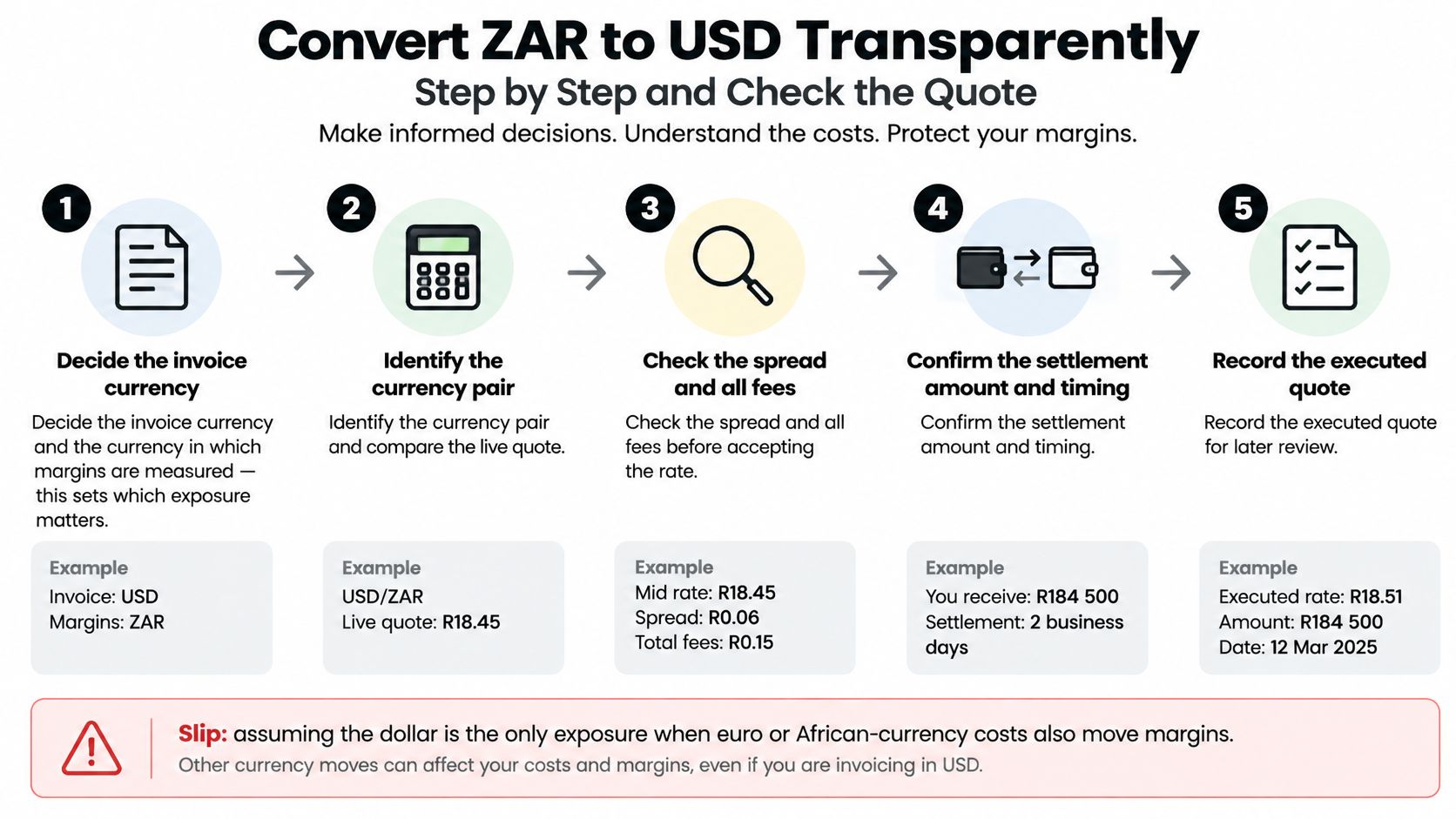
Convert ZAR to USD Transparently Step by Step and Check the Quote
A transparent conversion starts with a payment instruction and ends with a reconciled bank entry. Keep the invoice, quote and settlement record together so another person can reproduce the decision.
The process below works for dollar purchases and dollar-sale proceeds, provided you use the correct calculation for the conversion direction.
Prepare the instruction and comparison
Decide the invoice currency and margin currency.
Start with the commercial obligation. Record what the supplier must receive, or what the customer will pay, and identify the currency used to approve the contract margin.
A rand-based payroll budget needs a rand outcome, even when customer revenue is quoted overseas. Avoid the slip: assuming the dollar is the only exposure when euro, pound or African-currency obligations also affect the transaction.
Record a dated benchmark.
Save the indicative mid-market rate, its source and the time you checked it. Put the units in the worksheet heading so nobody mistakes dollars per rand for rand per dollar.
Compare transaction quotes collected close together. A quote checked later may differ because the underlying market moved, not because the provider changed its markup.
Avoid the slip: comparing an executable offer with a remembered rate or an undated screenshot.
Capture the executable rate and charges in writing.
Keep the actual conversion rate separate from the market benchmark. Record whether charges are included in the account debit, deducted from the transfer or potentially payable by the recipient.
MyFundedCapital's explanation of understanding the bid-ask spread helps clarify why buying and selling quotes differ. The transaction still needs its own written pricing record.
Avoid the slip: interpreting a small transfer fee as proof of a low total conversion cost. Under our terms, we disclose applicable fees before a transaction is confirmed; fees and spreads apply as set out in the agreement or quoted when using the service.
Calculate the outcome and choose execution
Calculate the landed amount in the correct direction.
For a dollar receipt converted into rand, use:
Net rand receipt = dollars converted × executable rand-per-dollar rate − rand charges
If a deduction occurs in dollars before conversion, subtract it from the dollar balance first. Don't subtract the same charge again from the rand result.
For a dollar supplier payment, calculate:
Total rand debit = dollars purchased × executable rand-per-dollar rate + separately payable rand charges
If instead you have a fixed rand budget, subtract applicable rand charges before dividing the remaining balance by the executable rate. Confirm whether any foreign-currency deduction would leave the supplier short.
Set a break-even threshold using the contract's required cash outcome. For an exporter, this is the minimum net rand receipt needed to cover the associated costs and required margin; for an importer, it's the maximum affordable rand debit.
Choose timing against the cash requirement.
Match the conversion decision to when money must be available, not merely when the invoice was issued. An immediate obligation, a progressively used balance and a firm future commitment call for different execution decisions.
Before splitting a conversion, check the charges attached to each transaction. Before agreeing future cover, check the consequences of a delayed receipt or changed payment amount.
Avoid the slip: choosing a method because it would have worked well on yesterday's exchange-rate chart.
Confirm the recipient outcome before authorising.
Read the full instruction back against the invoice: beneficiary details, payment currency, total debit, expected receipt and settlement terms. Confirm whether the rate is guaranteed and when the quote expires.
Our free USD to ZAR converter checks the live mid-market rate and compares what a bank may take in FX spread and SWIFT fees. It's a comparison aid, not a promise of a particular executable outcome.
Avoid the slip: treating an indicative calculator result or verbal estimate as the final payment instruction.
Keep a record that can be reconciled
File the quote and check the executed transaction.
Retain the written confirmation with the invoice, then compare it with the account debit and beneficiary receipt. Investigate any difference while the payment details are readily available.
Keep this checklist with the transaction:
- Benchmark record: Rate, units, date, time and source.
- Accepted quote: Executable rate, validity and conversion direction.
- Complete charges: Disclosed fees and any unresolved intermediary deductions.
- Cash outcome: Total sender debit and final recipient amount.
- Margin test: Break-even requirement and approval.
- Settlement evidence: Execution confirmation and reconciliation.
The number that matters is the confirmed cash outcome your business can use, not the most attractive number on a converter.
Zaro offers transparent exchange-rate pricing with no SWIFT fees, with a clear quote based on your payment volume and corridor. Visit Zaro to check the converter or speak with our team about the amount your business will pay or receive before confirming a cross-border transaction.