
A move from R18.00 to R18.50 per dollar adds R50,000 to a US$100,000 supplier payment, before fees or spreads, using the exchange-rate arithmetic associated with the South African Reserve Bank's historical-rate framework. Your supplier hasn't raised the price. Your business needs more rand to settle the same dollar invoice.
But that calculation is only useful if you can transact at the rate you've used. For South African businesses researching forex USD/ZAR, the first financial decision isn't whether the rand will strengthen. It's which rate belongs in the calculation, what you'll receive or pay, and how much room remains before the contract stops meeting your margin target.
Which USD/ZAR Rate Applies to Your Payment
USD/ZAR means the number of rand needed to buy one US dollar. When the quote rises, the rand weakens against the dollar. When it falls, the rand strengthens.
A historical reference series supports comparisons across dates. A live quotation describes a market price at a particular moment. Neither automatically tells you the rate your business can execute.
The distinction matters because a finance team can legitimately use different exchange rates for different purposes. SARS's published exchange-rate tables provide administrative rates, rather than a promise about the price available when you pay a supplier.
USD/ZAR rate types and where each applies
| Rate | Source | Best used for | Watch-out |
|---|---|---|---|
| Market spot rate | Interbank forex market | Benchmarking and cash-flow forecasts | Not the rate most SMEs receive |
| Bank customer rate | Your bank's dealing desk | Executing a payment | Includes a spread; check separately charged fees |
| SARS official rate | SARS published exchange-rate tables | Applicable tax and customs declarations | Set for administration, not for paying suppliers |
| Federal Reserve noon buying rate | New York noon buying rate | Historical comparison | Not a guaranteed South African execution rate |
| Provider delivered rate | Rate applied by your payments provider | Measuring true cost | Compare with a matching reference quotation |
Choose the rate basis before comparing the numbers. For an outgoing payment, establish how many rand the provider requires for the agreed dollar amount. For an incoming receipt, establish how many rand will reach your account after conversion and applicable charges.
Comparisons also need matching timestamps and transaction directions. An indicative buying rate viewed earlier in the day isn't a clean benchmark for a later dollar purchase.
Keep commercial and reporting definitions separate
Record the reference source, quotation time, transaction direction and treatment of fees beside your calculation. Confirm the appropriate accounting and customs basis with the person responsible for those records, rather than assuming the settlement rate applies everywhere.
Terminology needs similar care in an ecommerce business. Currency conversion and the proportion of visitors who purchase are different measurements. For the latter, see CIQRA's ecommerce metrics definitions, and keep that commercial metric separate from your FX worksheet.
Practical rule: Write the agreed currency and any contractual conversion basis on the invoice, and retain the accounting, customs and payment bases in the supporting records.
That documentation makes reconciliation possible without pretending every system should produce the same rand amount.
How a Rand Move Changes Your Rand Amounts
The useful arithmetic is straightforward:
Dollar amount × rand per dollar = rand value before fees and spreads.
For an importer, a higher result means a larger cash requirement. For an exporter, it means a larger rand receipt. The direction of the business's payment matters as much as the direction of the currency.
The opening example holds the dollar invoice constant and changes only the exchange rate. That isolates currency exposure from changes in purchase volumes, selling prices or operating costs.
Rand value of USD payments at three rate levels
The following is a hypothetical sensitivity calculation, not a set of current market quotations. Each cell is the stated dollar amount multiplied by the scenario rate, before fees and spreads.
| USD amount | At R17.00 per US$1 | At R18.00 per US$1 | At R18.50 per US$1 |
|---|---|---|---|
| US$25,000 | R425,000 | R450,000 | R462,500 |
| US$100,000 | R1,700,000 | R1,800,000 | R1,850,000 |
| US$500,000 | R8,500,000 | R9,000,000 | R9,250,000 |
Read across a row to see the effect of changing the rate on the same invoice. Read down a column to see how the rand exposure increases with the dollar amount.
An exporter uses the same multiplication, but interprets the result as revenue rather than expenditure. That doesn't mean a weaker rand automatically improves the whole business: dollar-denominated inputs could become more expensive at the same time.
Test the margin, not just the payment
A currency movement should be assessed against the margin available to absorb it. A payment difference that looks modest beside total revenue may be substantial beside the profit expected from a particular order.
Keep the commercial calculation separate from the cash calculation. An invoice can remain profitable while creating a funding problem if the supplier must be paid before the customer settles.
For a practical stress test, choose an explicitly hypothetical adverse rate and calculate the resulting rand amount. Importers should test a higher USD/ZAR quote; exporters converting receipts should test a lower one.
Then ask:
- Pricing: Would the adverse outcome leave enough margin to accept the order?
- Liquidity: Would available cash still cover settlement and operating commitments?
- Timing: Would you need to bring forward conversion or change the payment arrangement?
A useful scenario isn't a prediction. It tells you what your business would need to do if that rate became available.
What Moves the Rand Against the Dollar
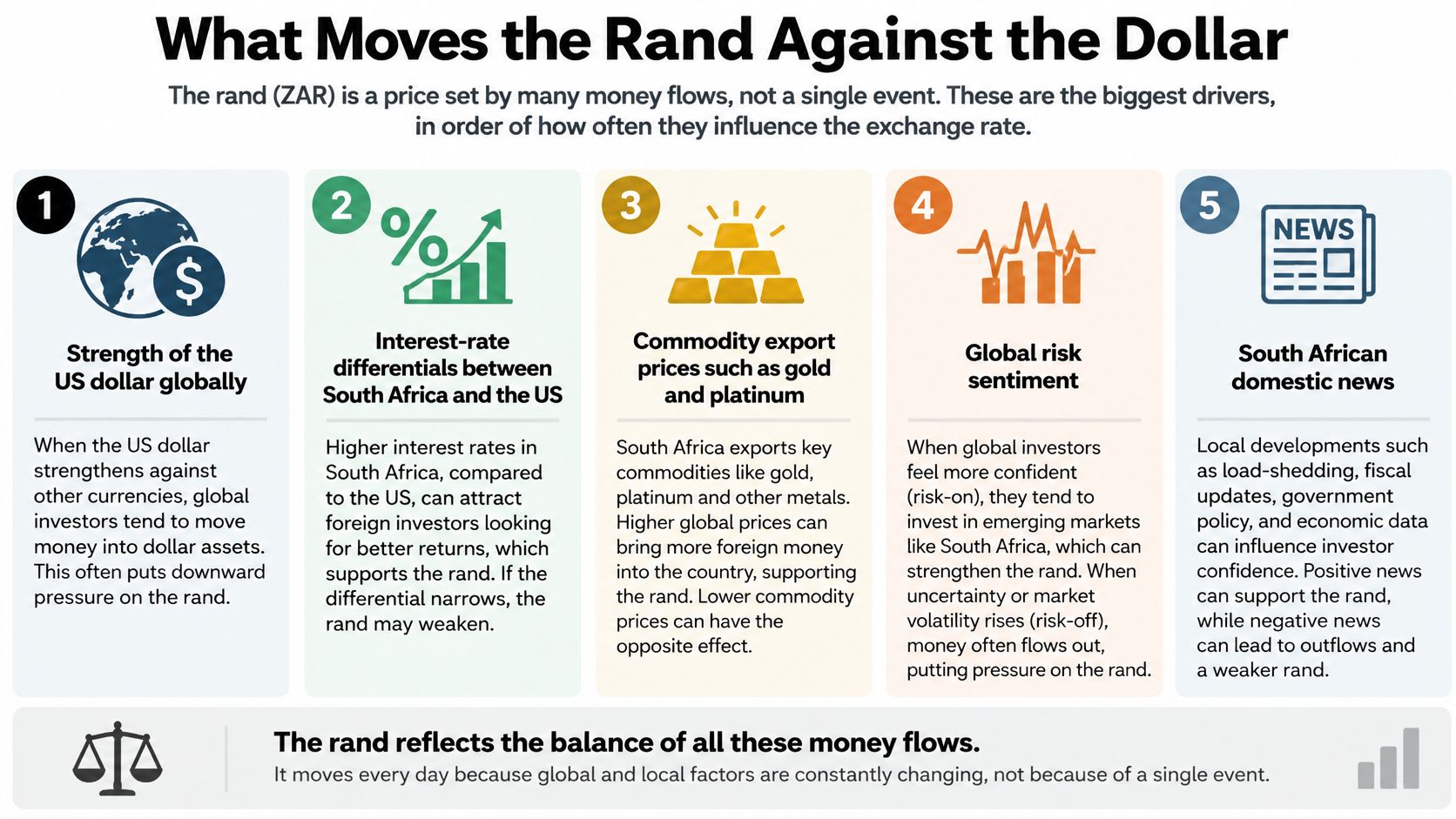
The rand is a price formed by buyers and sellers exchanging money. A local headline can move it, but so can decisions made by investors who aren't evaluating a South African business at all. That distinction matters for your payment planning: some of the pressure on your invoice total originates entirely outside South Africa, which means monitoring local news alone leaves half the picture unwatched.
Two forces act on the rate at once. Domestic conditions determine how investors price South African assets, while global demand for the dollar itself can shift USD/ZAR even on a quiet day in Pretoria. A stronger dollar worldwide is, mechanically, a weaker rand.
Follow the mechanisms, not a single explanation
- Global dollar strength: When investors increase demand for dollars across markets, USD/ZAR can rise without a new South African trigger.
- Interest-rate expectations: Changes in expected US and South African returns influence where investors want to hold money. Expectations can change before either central bank acts.
- Domestic political and fiscal uncertainty: Investors may demand greater compensation for holding South African assets or reduce their exposure.
- Commodity export prices: Changes in export earnings can affect foreign-currency inflows, although conversion timing and other flows also matter.
- Emerging-market risk sentiment: Investors reducing risk can sell rand assets alongside other emerging-market holdings.
Recent USD/ZAR monthly levels
The Federal Reserve's monthly average series for the rand-dollar rate shows how much the reference rate can drift within a single quarter.
| Period | USD/ZAR level | Change from previous month |
|---|---|---|
| August 2026 | 16.1650 | Baseline, Federal Reserve monthly average |
| September 2026 | 16.2221 | Increase of 0.0571 rand per dollar, calculated from monthly averages |
| October 2026 | 16.5725 | Increase of 0.3504 rand per dollar, calculated from monthly averages |
Read the movement in rand terms, because that is the unit your exposure is measured in. From the August average to the October average, the rate moved 0.4075 rand per dollar. On a $10,000 invoice, that drift alone reprices the payment by R4,075. On a $100,000 commitment, R40,750. No South African-specific event is required for a move of that size; the mechanisms above can produce it through ordinary global re-pricing.
Monthly averages also hide the rates available on individual payment dates. An average smooths every trading day in the month into one figure, while your conversion happens on a single day at a single quoted price. A business can budget near the average and still settle at a materially less favourable rate, and the gap between the reference rate and the rate your provider delivers widens that cost further.
The practical conclusion is not a forecast. It is a discipline: before any committed invoice reaches its payment date, calculate the break-even rate at which the order stops covering its costs, and treat any rate worse than that level as an exposure to manage rather than a surprise to absorb. No single driver provides a dependable prediction of where USD/ZAR will sit on your settlement day, so use these explanations to understand where pressure can come from, not as permission to leave an unaffordable exposure unmanaged.
How US Trade Ties Your Business to the Rand
South Africa's trading relationship with the United States makes dollar exposure a practical operating issue. The South African Reserve Bank's analysis of US trade puts the United States at approximately 7.7% of South African exports in 2024, making it the second-largest export market after China, with exports valued at R156.8 billion.
The relationship includes businesses selling abroad and businesses paying for imported goods or services.

Similar turnover, opposite currency risks
Consider a South African BPO firm billing customers in dollars while paying its team in rand. If it converts receipts after the rand strengthens, it receives fewer rand against its local payroll commitment, even when customer activity hasn't changed.
A business paying US-dollar contractors faces the opposite problem. Rand depreciation increases the local-currency cost of settling those obligations.
For a small exporter, the conversion date can therefore affect the realised margin on an otherwise unchanged order. The sale date, customer payment date and currency conversion date need not coincide.
The accompanying video provides additional context for the currency discussion.
Classify your business using cash flows, not its industry label:
- Net dollar earner: Dollar receipts exceed dollar payments over the relevant period.
- Net dollar payer: Dollar obligations exceed dollar receipts over that period.
- Mixed exposure: Receipts and payments partly offset, but their dates or certainty differ.
An exporter isn't necessarily a net dollar earner after imported inputs are included. Equally, matching annual totals don't eliminate a cash shortfall when payments fall due before receipts arrive.
Managing Rand Exposure Before Payment Dates
The Federal Reserve's monthly USD/ZAR series provides historical context, not an executable promise for an invoice's settlement date. Build the operating routine around what the business has committed to pay or receive.
Give every commitment a decision rule
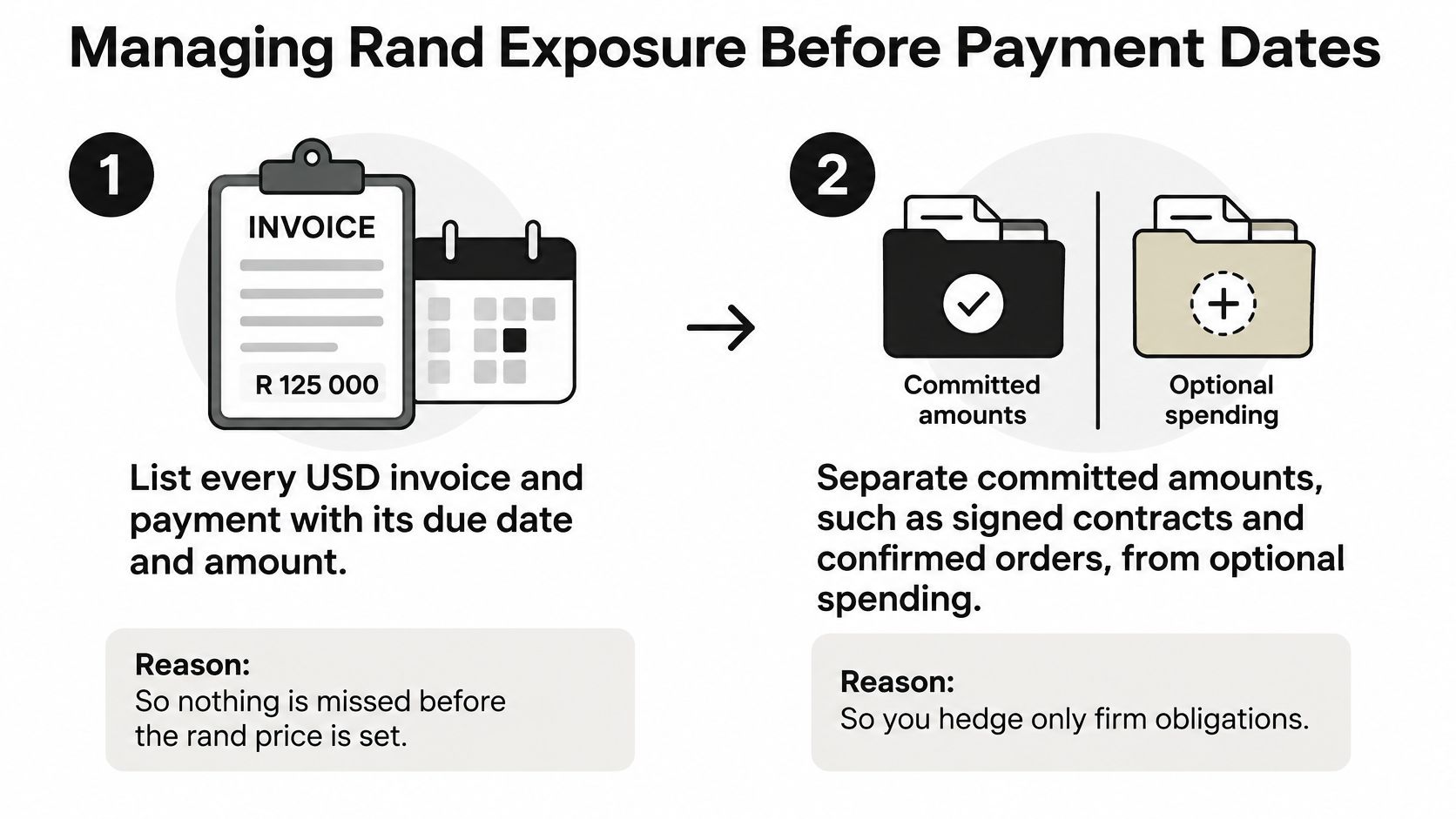
List the obligations and receipts. Record each dollar amount, due date, counterparty and responsible person. Include expected settlement delays so the worksheet reflects when funds are usable.
Separate committed from uncertain amounts. Signed contracts and confirmed purchase orders belong in the committed register. Prospective sales belong elsewhere, because covering money that never arrives can create another obligation.
Calculate the contract's limiting rate. For an exporter, divide the required rand proceeds by the committed dollar receipt to establish the minimum acceptable rate. For an importer, divide the available rand budget, after allowing for separate fees, by the dollar payment to establish the maximum affordable rate.
Run adverse, budget and favourable scenarios. Value the committed amount at each chosen rate, clearly labelled as hypothetical. Show the remaining margin and cash headroom, not just the converted amount.
Set a downside trigger. Write down the rate or rand outcome that requires action, who can authorise conversion and when approval expires. An alert is a decision aid, not a guarantee that execution will remain available at that price.
Schedule conversion or assess a forward contract. Match the decision to the payment obligation rather than waiting indefinitely for a better forecast. Keep uncertain receipts outside the committed cover unless you've explicitly assessed the risk of a shortfall.
The process starts with knowing which exposures are firm.
Compare a locked rate with the contract limit
A forward contract agrees an exchange rate for a future settlement obligation. For an importer, it removes the benefit of a subsequently stronger rand on the covered amount; for an exporter, it removes the benefit of a subsequently weaker rand.
Show the offered forward rate beside the contract's minimum or maximum acceptable rate. Review settlement obligations, charges and what happens if the underlying payment changes before signing. This isn't a claim that Zaro offers forward contracts.
For broader controls around liquidity and commercial commitments, AmbitionCFO's financial risk management strategies for SMBs can support the treasury discussion.
Before issuing the invoice: Record the margin-protection rate, the conversion decision date and the person authorised to act.
A strict break-even rate covers costs only. If your calculation includes a required profit, label it a minimum-margin rate, so nobody mistakes the target for bare cost recovery.
What Your Dollar Payment Really Costs and the Check to Run This Week
A favourable-looking exchange quotation doesn't establish that a payment is inexpensive. The useful question is how much rand leaves your account for the dollar amount the recipient receives.
Three beliefs can obscure that answer. Each needs a different test.
Belief that the headline rate is your payment rate
A headline live rate is a benchmark, not your transaction confirmation. The Federal Reserve noon observation is also a reference measurement, not a retail dealing commitment.
Retain the provider's executable quote and compare it with the settlement record. Check the currency direction, timestamp, dollar amount and separately charged fees before concluding that any difference is a markup.
Measure the benchmark gap in rand. For a dollar purchase, subtract the benchmark conversion amount from the actual rand conversion amount. For dollar receipts, subtract the actual converted proceeds from the benchmark proceeds.
Keep fees outside that calculation initially. You can then distinguish the rate difference from explicit charges rather than presenting a single unexplained loss.
Belief that the best quoted rate wins
Compare offers for the same recipient amount and settlement requirement. A quotation that excludes an applicable charge isn't comparable with an all-in offer.
Use a compact reconciliation:
| Cost component | What to record |
|---|---|
| Benchmark conversion | Dollar amount multiplied by the matching reference rate |
| Executed conversion | Rand amount charged or credited for conversion |
| Explicit transfer fee | Separately disclosed charge |
| Correspondent or recipient deduction | Amount withheld along the payment route, if applicable |
| Final outcome | Total rand paid or net rand received, with the recipient amount confirmed |
Don't add an embedded spread twice. If the provider's executed rate already contains its spread, the executed conversion amount already reflects that cost.
Zaro offers a free USD to ZAR converter that checks the live mid-market rate and compares what a bank may take in FX spread and SWIFT fees. Use the comparison to estimate the gap, then use the executable quote and completed transaction to establish the actual outcome.
Belief that reporting and settlement should match
A SARS or accounting conversion can serve a different purpose from the payment conversion. Reconcile the bases rather than replacing one with the other until the totals happen to agree.
Retain the invoice currency, applicable reporting rate, recorded rand value and settlement evidence together. Ask the accounting owner to classify the differences appropriately, with charges distinguished from exchange movements.
Digital sellers need this discipline too. If you're assessing storefronts using AmaJova's best tools to sell ebooks, check payout currency and deductions alongside selling features. A dollar sale isn't the same measurement as the rand eventually available to spend.
Run a transaction-level check this week
Choose a completed dollar payment or receipt and gather its invoice, quote, confirmation and bank entry. Write the rate basis beside every converted amount, compare the execution with a same-time reference where available, and record the explained difference as a separate cost line.
If an appropriate timestamped benchmark isn't available, mark the comparison as approximate. Don't turn market movement between quotation times into a precise claim about provider pricing.
For our payment workflow, you sign up, complete Know Your Business verification, fund ZAR and USD accounts by bank transfer, then make or receive cross-border payments. We disclose applicable fees before confirmation; fees and spreads apply as set out in the agreement or quoted when using the service.
Assign someone to repeat the reconciliation and investigate unexplained differences. That turns FX transparency into a financial control rather than a reaction to an unusually large payment.
Zaro offers a free USD to ZAR converter and cross-border payment services for South African businesses. Visit Zaro to compare the live mid-market benchmark with estimated bank costs, then review your applicable quote before committing your next dollar payment.