
A forward exchange contract is a binding agreement to exchange one currency for another at a pre-agreed rate on a future date, used to eliminate rand volatility for exporters; in South Africa, cover may not extend beyond 12 months. For an SME that knows what it will receive and roughly when it will receive it, an FEC turns an uncertain rand outcome into a planned cash-flow figure.
You may have priced a contract carefully, allowed for salaries and overheads, and expected a healthy margin from an overseas customer. Then the rand strengthens before payment arrives. Your client still pays the agreed foreign-currency amount, but the conversion produces fewer rands. The revenue shortfall comes straight out of your margin.
The Hidden Risk to South African Export Margins
A Cape Town software company invoices a client in US dollars for a project delivered over several months. The directors budget the expected rand receipt against developer salaries, office costs, and tax obligations. By the time the client pays, the rand has strengthened, and the same dollar invoice converts into fewer rands than the company expected.
Nothing went wrong with the software project. The client didn't reduce the invoice. The business lost ground because its income and expenses were measured in different currencies.
That exposure affects more than the final profit figure. It can distort pricing decisions, make cash-flow forecasts unreliable, and leave an owner deciding whether to delay hiring or draw less money from the business. Exporters often treat FX as an administrative detail until one unfavourable movement changes the economics of an otherwise successful contract.

The commercial problem
An exporter with a known foreign-currency receipt has two choices. It can wait for the payment date and accept the prevailing conversion rate, or it can agree a rate in advance with a bank or authorised provider. The first choice leaves the margin exposed. The second creates a defined rand outcome for the covered amount.
An FEC is a risk-management instrument, not a bet on where the rand will move. It doesn't make the foreign customer pay more, and it won't improve the commercial terms of the underlying contract. It protects the conversion assumption that the business used when it priced and planned the work.
Practical rule: If a currency movement could force you to rework your budget, the exposure deserves a deliberate hedging decision before the invoice becomes payable.
The sensible starting point is not to hedge every foreign-currency transaction automatically. Identify the receipts that are sufficiently certain, match the hedge to the underlying trade, and decide how much margin you need to protect. A forward exchange contract is usually most useful where the amount and payment timing are reasonably clear, and where a weaker rand receipt would materially affect the business.
How Forward Exchange Contracts Work
The mechanics are straightforward. Your business agrees with a counterparty to exchange a specified amount of one currency for another at a specified rate on a future settlement date. The agreed rate is fixed when the contract is entered into, so later currency movements don't change the rate applied to that covered transaction.
Think of it like agreeing the fuel price for a confirmed delivery route. If your truck must complete the route later, you can accept whatever fuel costs on the day, or arrange certainty in advance. You may miss a later price reduction, but you also avoid discovering that the route has become unprofitable because fuel rose unexpectedly. An FEC applies the same planning logic to a known currency exposure.
The three decisions
First, define the amount. An exporter expecting a foreign-currency payment should avoid hedging more than the amount it reasonably expects to receive. An oversized hedge can create its own settlement problem if the customer pays less, pays late, or cancels.
Second, agree the rate. The provider calculates and quotes a forward rate, which becomes the contractual exchange rate once both parties agree. That rate is not a forecast of the future spot rate. It's the rate that gives the business certainty for the agreed transaction.
Third, confirm the settlement date. A fixed FEC settles on the agreed date. South African banking guidance also distinguishes between fixed, partially optional, and fully optional structures, which can change when delivery takes place relative to maturity and how much timing flexibility the treasury team retains. Choose flexibility only when the payment timing genuinely justifies it. Flexibility doesn't remove the need to match the hedge to a real exposure.
The contract may involve physical delivery, where the currencies are exchanged and the exporter receives or pays the agreed funds. A cash-settled or non-delivery structure instead settles the difference between the contracted rate and the relevant market rate. The available structure depends on the provider, the currencies, the underlying transaction, and the applicable rules.
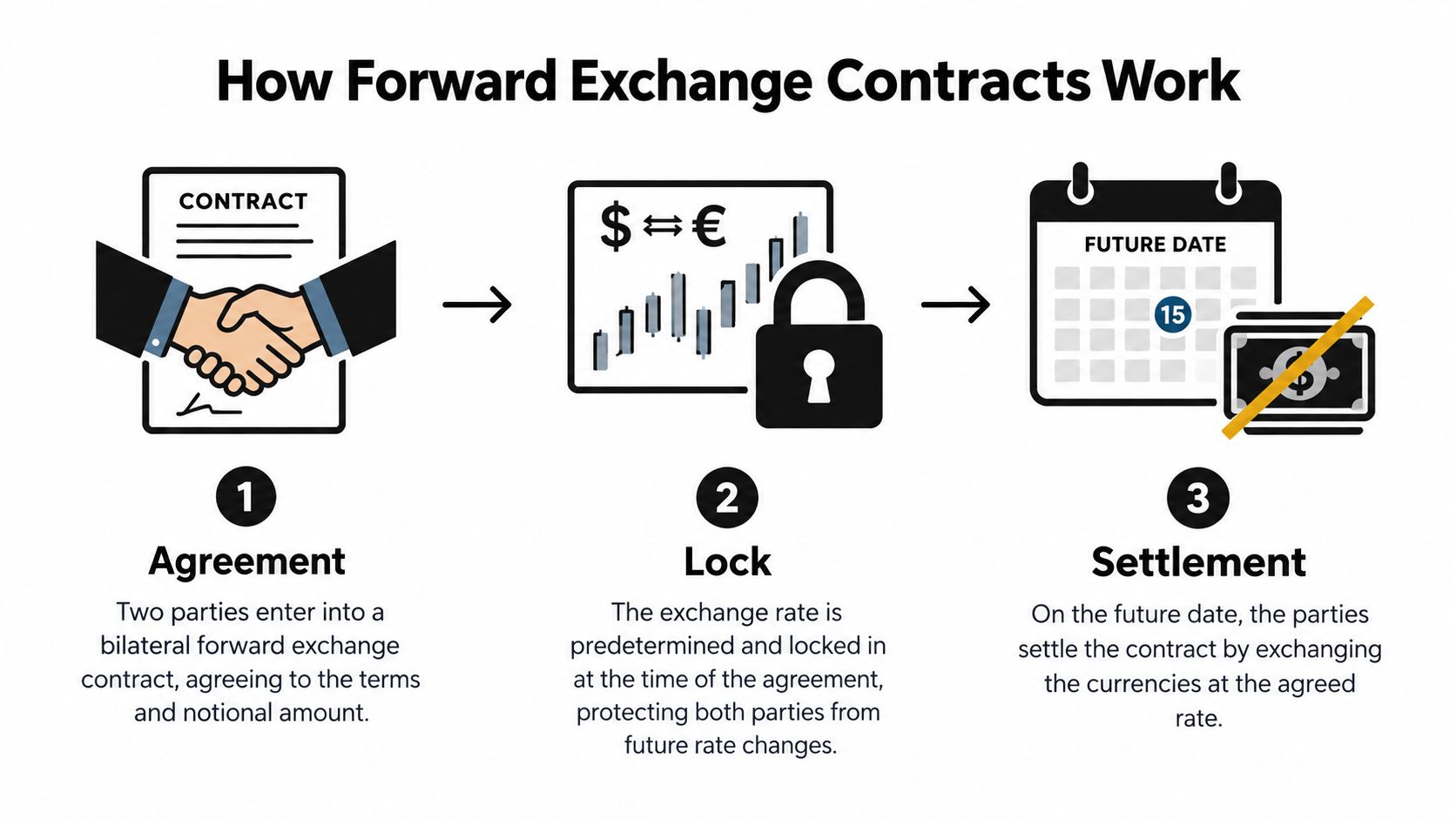
A forward is an obligation, not a casual reservation. If the market later moves in your favour, you generally won't participate in that improvement on the hedged amount. That's the price of replacing uncertainty with a known conversion rate.
The following video provides a visual introduction to the process:
Regulatory Framework and Tax Implications
South African exporters shouldn't treat an FEC as an informal agreement with a payments provider. It sits inside the country's regulated foreign-exchange system. South African residents' cross-border foreign-exchange transactions are subject to Exchange Control Regulations, administered by the Financial Surveillance Department of the South African Reserve Bank.
Bank guidance confirms that international payment transactions performed by South African residents fall under exchange control. The same framework recognises an FEC as a contract between a bank and customer that fixes an exchange rate immediately for delivery on an agreed future date and is used to hedge adverse currency movements. Standard Bank's guide to international payments explains that practical relationship between cross-border payments and exchange control.
Match the hedge to the trade
SARB reporting also captures forward-market activity. The B12 form instructions state that Row 16 of Table 1 records the total value of foreign-currency sales to residents, the SARB, authorised dealers, and non-residents using South African rand in the outright forward market. That means forward activity is not invisible administrative paperwork. It forms part of the official reporting infrastructure.
The operational consequence is simple. Keep the invoice, purchase order, export documentation, contract number, payment expectation, and settlement instructions organised before you request cover. A treasury file should allow someone else to understand what exposure the FEC covers and why the amount and date were selected.
South African Reserve Bank rules impose a firm tenor constraint. Cover may not be granted for a period extending beyond 12 months, although contracts can be entered into and exited at the client's discretion before the underlying commitment is due. At pay-away, supporting documents must evidence the underlying commitment or accrual and show the contract number and contract period. The SARB manual for authorised dealers sets out this documentary matching requirement.
Understand the tax record
SARS Interpretation Note 101 defines a forward exchange contract as an agreement to exchange one currency for another at a future date at a specified exchange rate. It also explains the distinction between realised and unrealised foreign-exchange gains and losses, which matters when your contract, invoice, and settlement fall into different reporting periods.
Don't leave that classification to the last day of the financial year. Give your accountant the FEC confirmation, the underlying invoice, settlement evidence, and any cancellation or amendment records. The tax treatment depends on the facts and accounting records, so obtain professional advice for your structure. A broader CGT guide for SMEs can also help business owners identify where specialist tax planning advice may be needed, although it isn't a substitute for advice on your specific FEC.
For contracts longer than six months, South African bank terms require proof of a fixed and ascertainable foreign-exchange commitment, such as a pro forma invoice. For contracts shorter than six months, those terms state that documents aren't required at booking. Applications for drawings under an FEC must be advised to the bank two business days in advance, and the contract can't fall past due under exchange-control rules. Build those requirements into your accounts-payable and receivables calendar instead of treating them as an afterthought.
Comparing Hedging Strategies for Exporters
An exporter doesn't need the same tool for every currency transaction. A confirmed customer receipt, an uncertain sales pipeline, and a small payment needed immediately represent different risks. The mistake is choosing an instrument because it sounds impressive rather than because it fits the underlying cash flow.
| Instrument | Cost | Upside Potential | Complexity |
|---|---|---|---|
| Forward exchange contract | The cost is reflected in the agreed forward rate | Limited on the hedged amount | Moderate, with documentation and settlement obligations |
| Spot purchase or conversion | The business accepts the prevailing market rate | Full participation in later favourable movements | Low |
| Currency option | Usually involves a premium or other priced flexibility | Retained, because the buyer can choose whether to use the protected rate | Higher, requiring clear understanding of the terms |
When a forward fits
Choose a forward when the amount is known, the payment or receipt date is credible, and the business values a predictable rand outcome more than the chance of benefiting from a favourable move. This is common when an exporter has already priced a contract and needs to protect the margin used in that quotation.
The benefit isn't that the forward will always produce the cheapest conversion. It may not. The benefit is that finance can plan around a rate that won't change for the covered exposure.
When spot is adequate
Spot conversion works when the business has no meaningful timing gap or when the amount is too uncertain to hedge responsibly. It also suits an exporter that has enough cash-flow capacity to absorb market movements and deliberately wants to retain full upside.
That choice should be conscious. Leaving a receipt unhedged is still a currency strategy. It means the owner has decided that flexibility matters more than certainty.
When an option deserves attention
An option may suit a business that needs protection against an adverse move but wants to preserve the opportunity to benefit if rates improve. That flexibility comes at a price and introduces terms that require careful review. For an SME with a narrow margin and a highly reliable invoice, the additional complexity may not justify the benefit.
Decision test: Start with the exposure, not the product. Ask what amount is real, when the cash will move, and whether the business can afford to lose the favourable side of a currency movement.
For most smaller exporters, a clearly documented forward is easier to govern than a collection of loosely monitored spot conversions. Options can be valuable, but only if the owner understands the premium, expiry, exercise mechanics, and accounting consequences before signing.
Practical Examples and Accounting Impact
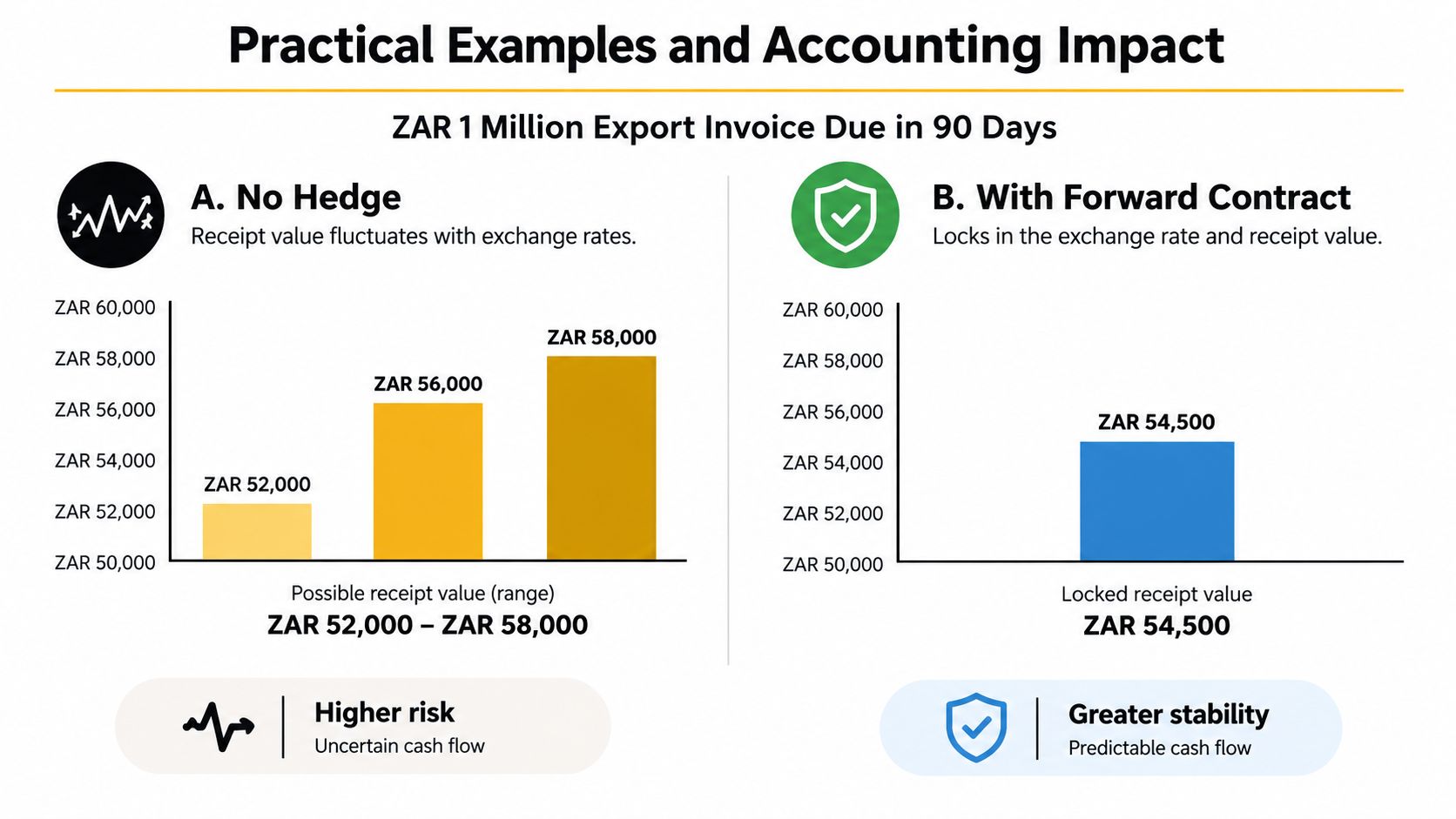
Consider a South African exporter with a foreign-currency invoice that is contractually due on a known future date. The finance manager has converted the expected receipt into rand using a planning rate and has allocated that expected cash to payroll, suppliers, and operating costs.
Without a hedge, the rand value remains unknown until the customer pays and the business converts the funds. A stronger rand reduces the receipt. A weaker rand increases it. The result may be favourable or unfavourable, but the finance manager can't treat the expected rand amount as dependable.
With an FEC, the exporter agrees the conversion rate for the covered amount in advance. The business can then build its cash-flow forecast around the contracted rand receipt, subject to the customer paying the expected amount and the hedge being settled in line with the underlying transaction.
The accounting question
The hedge doesn't erase the economic effect of currency movements. It changes where and when that effect appears in the business's records. The correct treatment depends on the underlying exposure, the contract terms, the reporting framework, and whether the business has formally documented a qualifying hedge relationship.
An accountant may need to assess:
- Underlying transaction: What invoice, receivable, or accrual does the FEC cover?
- Measurement date: What was recognised when the contract and underlying item were recorded?
- Valuation: How should the FEC be measured at the reporting date?
- Settlement: What entries are required when the currencies are exchanged?
- Hedge documentation: Has management documented the risk, hedged item, hedging instrument, and intended treatment?
Don't book the entire contract as a simple bank receipt without reconciling it to the underlying invoice. Keep the confirmation, rate, amount, maturity, supporting documents, settlement advice, and any changes in one controlled file.
Protect the forecast, not just the ledger
The most useful management report should show both views. The first is the contracted rand outcome for the covered exposure. The second is the amount that remains unhedged because the invoice is uncertain, the customer may pay late, or the company chose to retain flexibility.
That distinction helps directors avoid false comfort. A locked rate makes the covered cash flow predictable, but it doesn't guarantee collection, eliminate customer credit risk, or solve a mismatch between the hedge date and the actual payment date.
Use the accounting entries to improve treasury discipline. Each month, reconcile open FECs against outstanding invoices and expected receipts. Escalate any change in amount or timing before the contract reaches maturity. If the underlying exposure disappears, ask the bank or authorised provider what cancellation or close-out process applies rather than allowing the hedge to drift away from the trade.
Why Fintech Platforms Transform FEC Execution
The biggest obstacle for an SME often isn't understanding the principle of hedging. It's managing the operational work around it. Staff need to gather documents, obtain a rate, record approvals, track maturity, confirm the underlying payment, and reconcile the final settlement. A fragmented process creates avoidable errors even when the original hedging decision was sound.
A fintech platform can place those tasks into a single workflow. The practical value comes from visibility and control, not from making the underlying regulatory obligations disappear. Your team still needs to prove the trade, maintain accurate records, and respect the FEC's terms.
What to look for
Prioritise a platform that gives authorised staff a clear view of currency balances, payment instructions, pending approvals, and transaction history. Multi-user access and customisable permissions can separate the person who prepares a transaction from the person who approves it. That matters when an owner wants oversight without personally processing every payment.
Integration with ZAR and USD accounts can also reduce manual movement between systems. Look for a provider that explains its exchange rate, fees, settlement process, support model, and compliance responsibilities in plain language. A clean interface is useful, but transparent terms are more important.
Don't confuse convenience with cover
A payment platform may simplify spot payments, account management, and approvals. That doesn't automatically mean it provides an FEC or replaces a bank's authorised-dealer process. Ask specifically whether the product supports forward contracts for South African residents, how it handles underlying commitments, and which party is responsible for regulatory reporting.
For a small export business, the right technology should make the control process easier to follow. It should show who approved the transaction, preserve the supporting records, flag upcoming settlement dates, and help the finance team distinguish a future hedge from an ordinary currency conversion.
Implementing Your First Forward Contract
Start with one exposure that you understand well. Don't hedge a vague sales pipeline or an amount that depends on several uncertain events. Choose a confirmed foreign-currency invoice or contractual receipt with a credible payment date.
A practical checklist
- Measure the exposure. Record the currency, expected amount, source invoice, customer, and expected receipt date.
- Set the business objective. Decide whether your priority is margin protection, cash-flow certainty, or flexibility.
- Choose the tenor. Keep the maturity aligned with the underlying commitment and within the South African regulatory limit.
- Prepare the evidence. Keep the invoice, pro forma invoice, export documents, and contract details available.
- Compare providers. Review the rate, settlement terms, approval process, documentation requirements, and cancellation mechanics.
- Record the hedge. Give the FEC number, rate, amount, maturity, and underlying transaction to your accountant and treasury owner.
- Monitor the match. Reconcile the contract against the expected receipt until settlement is complete.
Your first FEC should make the process more controlled, not more complicated. Establish a written approval rule, assign one person to monitor open contracts, and review the exposure whenever a customer changes its payment timing. Predictability comes from disciplined matching, not from signing a contract and forgetting it.
The recommendation is clear. If a foreign-currency receipt supports a material part of your margin and the amount and timing are sufficiently certain, price the exposure before the market prices it for you. Use an FEC to protect the cash flow you need, document the underlying trade, and keep the settlement process visible from booking to receipt.
Zaro offers South African businesses a fintech platform for managing cross-border payment workflows alongside ZAR and USD accounts, with multi-user access and configurable permissions for finance teams. If you want a more controlled way to organise international receipts and payments around your FX process, visit Zaro and review whether its platform fits your treasury requirements.