
You're probably staring at a budget rate that made sense six months ago, then watching the rand move against you while invoices are still in transit. That's where bad FX decisions get expensive, not in theory, but in the gap between a signed order and the cash that lands.
FX hedging is not a product. It's a decision framework for protecting margins, payroll, supplier payments, and debt service when the rand moves faster than your operating cycle.
Why Rand Volatility Is a Board-Level Problem
A Cape Town exporter locks in supplier orders at one rate, prices the shipment on that basis, then the rand strengthens before the USD receipt lands. The P&L still looks fine until the cash converts at a worse number and the margin you expected is gone.
FX risk belongs in the board pack, not only in treasury. South African businesses carry it through export receipts, import bills, offshore contractors, foreign payroll, and any loan or lease tied to a foreign currency. The practical question is whether your business can absorb the move without breaking pricing, covenants, or working capital.
The right response starts with a proper risk framework. A useful reference on corporate risk management guidance is the Escrow Consulting Group note, because FX needs policy, ownership, and reporting discipline, not a trader's side task.
Practical rule: If a currency move can change your margin, your cash runway, or your investment timing, it belongs in board-level reporting.
South African survey evidence supports that view. Even in a 2013 survey of 192 companies, the pattern held, 91% said their businesses were sensitive or very sensitive to currency movements, 67% ranked currency risk among their three biggest risks, and 77% said exchange-rate volatility affected long-term investment decisions (Treasury Management survey).
That is the true test for a CFO. FX hedging should fit into a broader portfolio view, because cash-flow certainty, compliance, and capital allocation all move together when the rand swings. South African exchange-control rules matter here as much as the market does, and transparent spot execution, the kind Zaro-style pricing is built around, only helps if the hedge policy itself is tight.
The Three Faces of FX Exposure
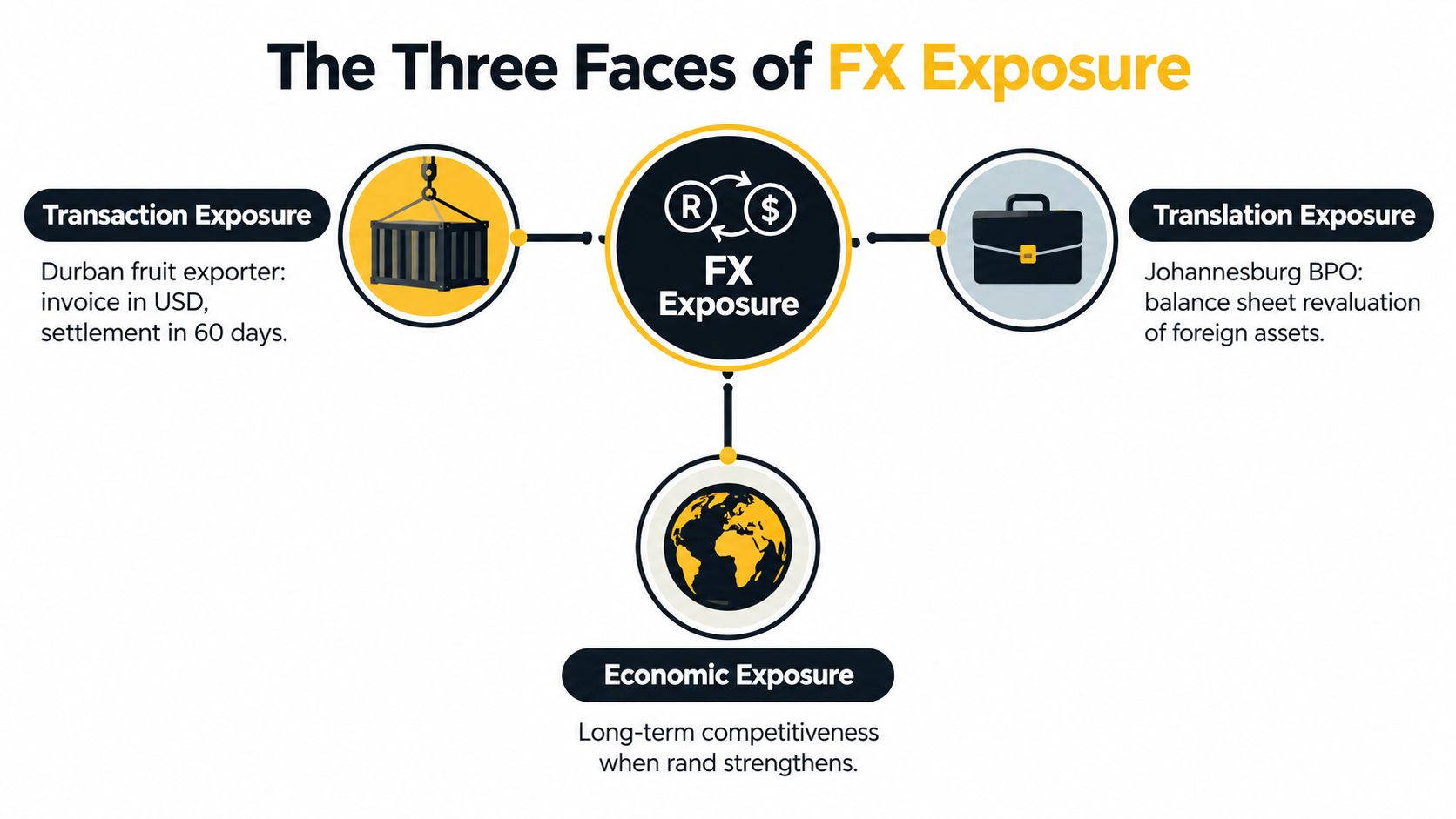
A Durban fruit exporter and a Johannesburg BPO do not face the same FX problem, even if both earn in USD. One is protecting a shipment invoice. The other is protecting payroll, balance-sheet values, and future competitiveness. If you mix those up, you'll hedge the wrong thing.
Transaction exposure
This is the cleanest one. A Durban exporter invoices a buyer in USD, or a BPO owes contractors in another currency, and there's a specific settlement date attached to the cash flow. The danger is straightforward, the rand moves before the payment or receipt clears.
For a CFO, this is the easiest exposure to label because it sits against a contract, invoice, or payroll run. If the amount and timing are known, the exposure is real and measurable.
Translation exposure
This one shows up when you revalue foreign assets or liabilities at reporting date. A Johannesburg BPO with USD cash, intercompany balances, or offshore working capital can see the ZAR value of those items move even when no cash changes hands.
The problem here is not day-to-day trading noise. It's the optics and accounting effects that hit reported numbers. If your board reviews consolidated accounts, translation risk can distort how healthy the business looks.
Economic exposure
This is the slow-burn version. A rand that strengthens can make your pricing less competitive, squeeze future margins, or force awkward repricing with customers. It's the exposure that changes your business model, not just your month-end report.
Bottom line: transaction exposure needs a hedge decision now, translation exposure needs balance-sheet discipline, and economic exposure needs strategy, pricing, and sometimes natural offset.
Natural hedges fit best where currency inflows and outflows already match. Financial instruments fit best where cash timing is uncertain or the mismatch is too large to self-offset. If you can label each line item that way, the rest gets much easier.
Forwards, Options and Natural Hedging Compared
Start with the cash flow, then choose the instrument. If a South African exporter has a R3 million invoice coming in, the decision is simple enough to test. A forward locks the rate, an option buys protection with flexibility, and a natural hedge leaves the conversion inside the business where possible.
A forward contract is blunt, but it does the job when the amount and timing are firm. It fixes the future exchange rate, which gives the finance team a clean budget number. The trade-off is obvious. You remove upside if the rand weakens further, but you also remove the risk of a bad move before settlement.
An FX option gives you the right, not the obligation, to deal at a pre-agreed rate. Use it when the exposure is uncertain, or when you want a floor without giving away every rand of upside. That flexibility has a price, and the premium should be justified by the quality of the cash flow, not by nerves.
Natural hedging is the first line of defence when the business already has matching inflows and outflows. USD receipts can fund USD costs, or receivables can offset payables, which reduces the amount you need to cover in the market. That is usually the cheapest protection because you are netting exposure internally instead of paying for full external cover.
| Dimension | Forward Contract | FX Option | Natural Hedge |
|---|---|---|---|
| Cost | Usually lower upfront, but you give up upside | Premium payable, so protection has a visible price | No direct market premium if flows already offset |
| Flexibility | Low, because you're committed | High, because you keep upside if the rand moves in your favour | High, but only if matching inflows and outflows exist |
| Budget certainty | Very strong | Good, but not as absolute as a forward | Moderate to strong, depending on matching accuracy |
| Best fit | Certain receivables or payables | Uncertain receipts or volumes | Businesses with natural currency matching |
Read instrument choice as a cash-flow question first. The underlying flow dictates the instrument, never the reverse. That is the same discipline that sits behind how to handle euro invoices in UAE, and it applies just as hard in South Africa. If your exposure is already tight and well matched, do less. If the timing or amount is still fuzzy, buy flexibility instead of pretending certainty exists.
For a CFO, the hard part is resisting the urge to hedge everything. Forwards suit certainty. Options suit uncertainty. Natural hedges suit businesses that have already built currency matching into the operating model.
Choosing the Right Cover Ratio for Your Cash Flows
A hedge ratio should follow certainty, not anxiety. If you cover everything just because you're nervous, you'll usually overpay for protection and give away rand-weakening upside that the business could have kept.
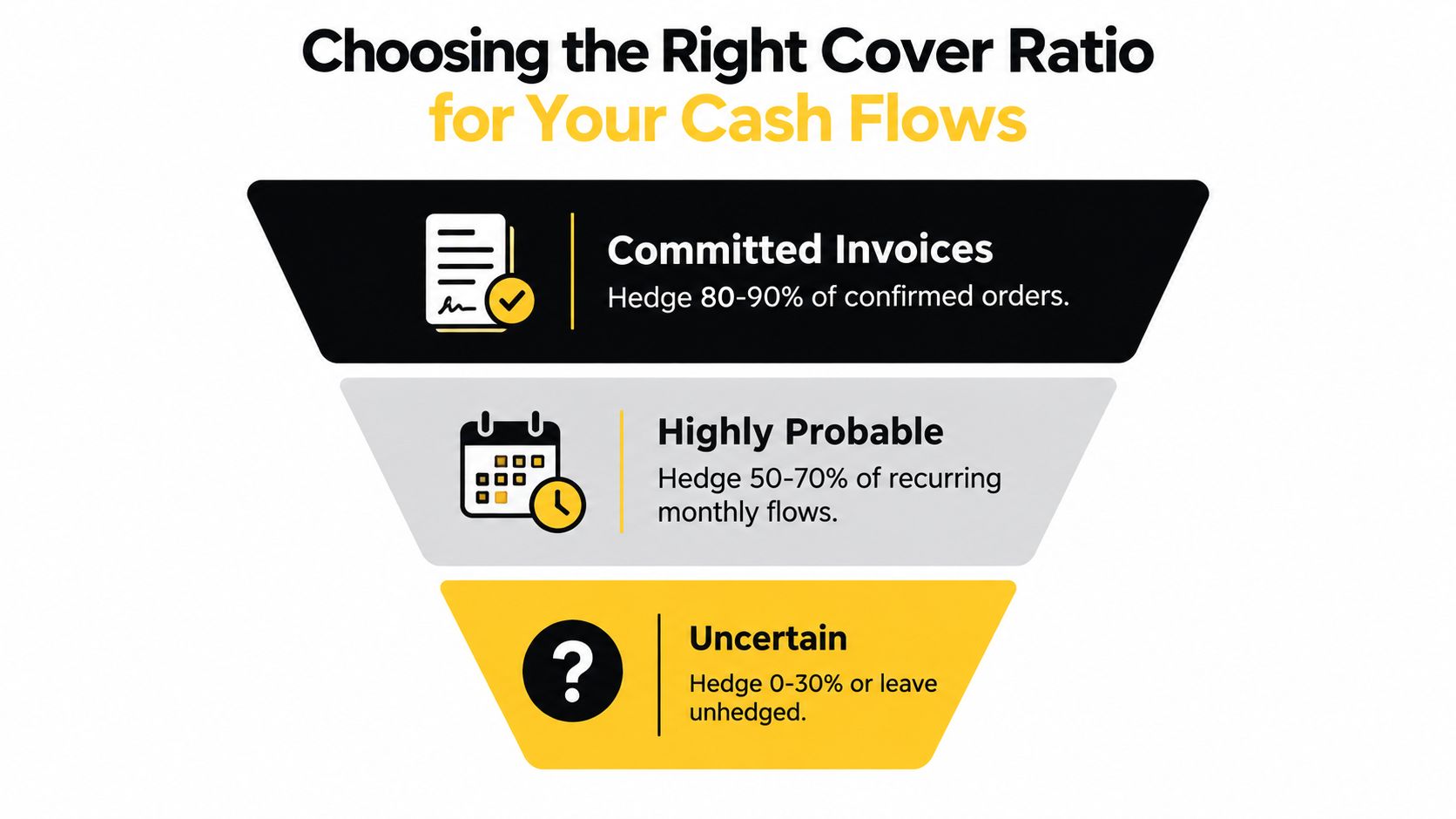
The cleanest structure is a three-tier ladder. Committed invoices get the heaviest cover because the cash is already expected. Highly probable flows get partial cover because timing or volumes can still shift. Uncertain pipeline should stay mostly open unless you have a very specific reason to protect it.
Practical rule: hedge the cash you can already see, not the revenue you hope will happen.
Build the ladder, not a single wall
A BPO with monthly USD revenue does not need one blunt hedge rate for everything. The signed contracts can sit in the top tier, recurring client work can sit in the middle, and new pipeline can remain flexible. That way, the cover ratio reflects invoice quality, not the finance team's mood.
That structure also helps with timing. Staged maturities are better than dumping all cover on one date because collections rarely arrive in a neat block. When you spread the protection, you reduce the risk of being wrong on a single fixing date.
The rand's hedging cost is also not static. A South African Reserve Bank working paper reports an average rand variance risk premium of roughly 25 variance units, and notes that the premium tends to rise in volatile markets (SARB working paper). That is why buying short-dated options right after a shock usually feels expensive, because it often is.
If you want the practical planning side of this, the fractional CFO cash flow insights from Bookkeeping and Accounting of Florida Inc. are relevant here because cash-flow forecasting is what tells you whether a flow is committed, probable, or still speculative.
The Opportunity Cost of Over-Hedging

The reflex to hedge everything sounds disciplined. In practice, it can be a bad capital decision if it locks in a rate that turns out to be unnecessary or too conservative for the business's real exposure.
A 100% cover policy protects the downside, but it also removes upside when the rand strengthens. If you budgeted around R19.00/USD and the business later receives cash in a stronger rand environment, full cover means you don't benefit from that move at all. A 60% policy, by contrast, leaves more of the receipt open to market movement, which can help when the rand ends up weaker than your budget assumed.
That trade-off is why cover ratios should be reviewed whenever the budget rate or margin assumptions change. If your margin buffer has widened, you may not need the same cover ratio. If the business has become more import-heavy, you may need more. The policy has to move with the balance sheet and sales book.
A short video can be useful for teams that still want the mechanics explained visually.
The deeper point is simple. Hedging is a portfolio decision, not a loyalty test to the idea of maximum protection. If the cash flow is uncertain, full cover can create inflexibility. If the cash flow is committed, leaving it open is just gambling with margin.
Exchange-Control Boundaries You Cannot Ignore
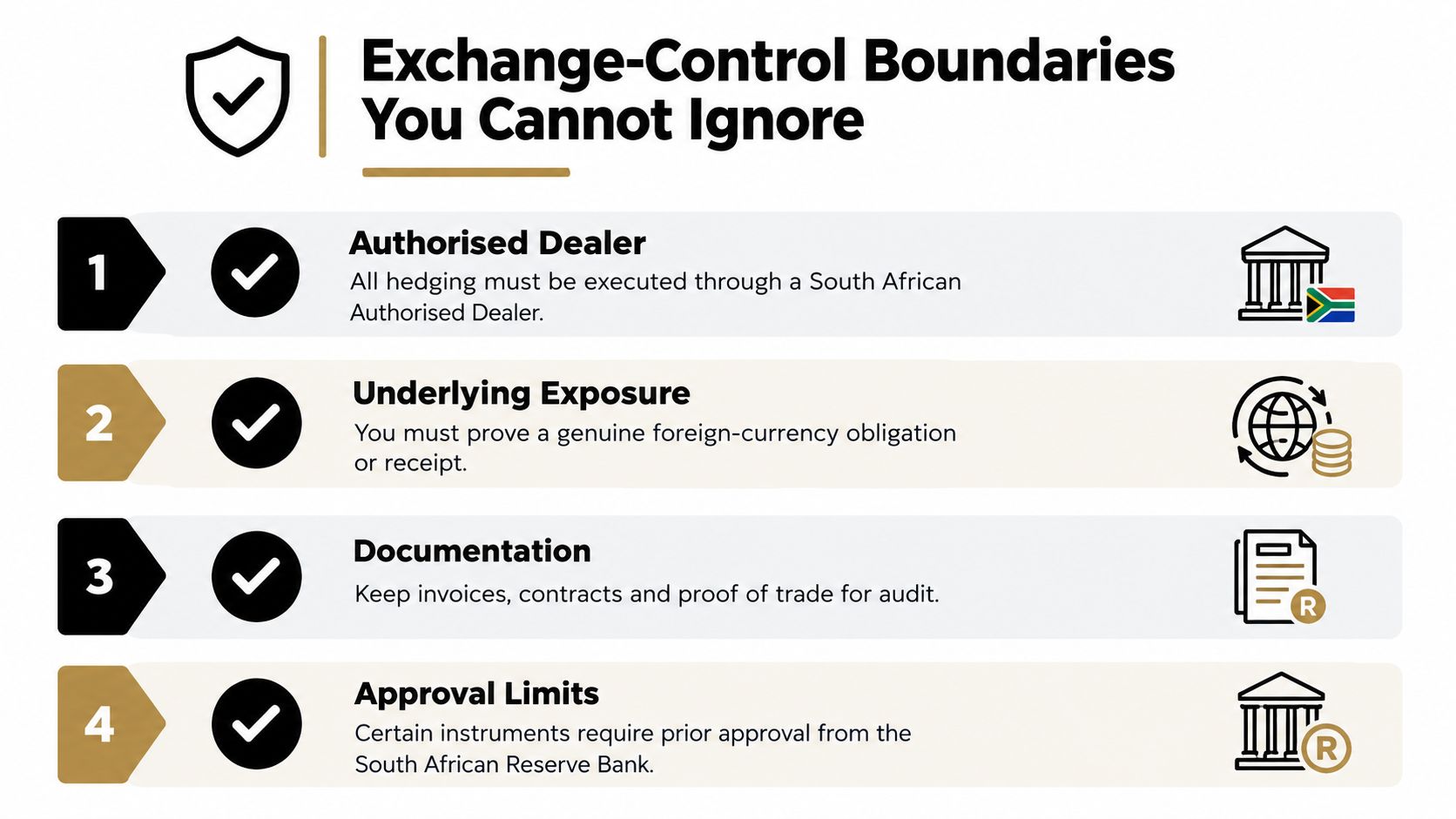
South African businesses do not get to hedge anything they like in any way they like. The rule is tighter than many CFOs realise. Business entities may hedge foreign-exchange risk through an Authorised Dealer only in relation to an underlying exposure, and for imports, the party required to convert rand into foreign currency is the party that may hedge that specific transaction (SARB guidance).
That distinction matters because it separates a genuine hedge from a directional position. If you cannot point to the invoice, contract, payroll commitment, or other commercial obligation, you are in dangerous territory. A speculative position dressed up as a hedge still looks speculative when the auditor, bank, or regulator asks for support.
What the dealer will expect
An Authorised Dealer will want evidence that the exposure exists and that the hedge matches the commercial purpose. For exports, that usually means an invoice or contract. For imports, it means the payment obligation and the party responsible for converting the currency. For recurring offshore contractors, it means the service agreement and a clear payment schedule.
Cross-border transactions also need proper reporting, and that is where weak documentation gets expensive. If the evidence is messy, the hedge may be harder to execute, harder to explain, or harder to defend later.
A 2025 SARB circular created a narrow route for resident agricultural commodity producers to hedge on foreign commodity exchanges, but that does not generalise to a normal exporter or BPO. It's a special case, not a broad licence.
Keep the file clean. If the exposure can't be proved, don't expect the hedge to survive scrutiny.
For most South African firms, the compliance question is not complicated once you name the exposure correctly. The hard part is operational discipline, not the instrument itself.
A Practical FX Hedging Playbook for ZA Businesses
Start with the exposure map, not the product brochure. If you know what is committed, what is probable, and what is speculative, the rest becomes a working policy instead of a monthly argument with the bank.
Use a simple one-page process. Classify each foreign-currency cash flow. Assign a hedge family. Set the cover ratio in writing. Check execution against the actual spot rate, not a vague bank headline. Review the policy on a fixed cadence and tighten it only when the business changes, not when someone gets nervous.
Transparent spot execution matters here because the unhedged portion still needs to be converted cleanly. If your execution rate is hidden inside a wider spread, you're leaking value even before the hedge decision is made. That's why a clean ZAR/USD benchmark should sit beside every hedge ticket.
Research on USD/ZAR shows that fat-tailed GARCH and jump-diffusion models capture the rand's variance, skewness, kurtosis, and volatility smile better than ordinary-variance models (Wits research). In plain English, the rand can move in ways that simple averages miss, so a static hedge ratio based only on history is a weak way to run a treasury book.
Here's the first 30 days I'd give a finance lead:
- Map every foreign-currency flow: Split payables, receivables, payroll, and loans into committed, probable, or speculative buckets.
- Set a written cover policy: Decide what percentage each bucket gets and who signs off on exceptions.
- Compare execution cleanly: Benchmark your actual conversion rate against the prevailing market rate so hidden spread does not distort the decision.
- Document the hedge file: Keep the contract, invoice, approval, and purpose together before you trade.
- Review quarterly: Revisit the ratio when margins, timing, or customer concentration shifts.
Zaro is one option for businesses that want to move cross-border payments at real exchange rates with transparent execution and treasury controls, but the bigger point is the same regardless of provider, clean execution belongs in the policy, not at the end of the month.
FX Hedging Questions South African CFOs Actually Ask
How often should a cover policy be reviewed? Quarterly is the right rhythm for most South African businesses. Review it sooner if your customer mix, payment timing, or budget rate changes materially.
How do I benchmark what the bank is charging? Compare the actual rate you receive on the day, not the marketing rate on the quote sheet, against the live spot market and the spread you can explain to your board. If the conversion cost is hard to explain, it's probably too high.
When do layered forwards beat a single bullet hedge? When your receipts arrive in stages or your forecast keeps shifting. Layering reduces the risk of being all-in on one date and one rate.
What if an export order is cancelled or delayed? Don't treat that as a reason to improvise. Check the documentation, update the underlying exposure, and work through the Authorised Dealer route so the hedge still matches a genuine commercial need.
How do I know a hedge is drifting towards speculation? The warning signs are simple. The hedge size no longer matches the exposure, the documentation is thin, or the team is defending the trade instead of the commercial risk.
South Africa's FX market is deep enough to support both hedging and spot execution, and August 2013 average daily turnover against the rand was approximately US$18 billion (academic analysis). Liquidity is not the problem. Discipline is.
If you want a clearer way to run foreign payments and reduce the noise around FX execution, take a look at Zaro. It's built for South African businesses that need transparent cross-border transfers, real exchange-rate conversion, and tighter control over payment timing. Use it when you want the operational side of FX to stop getting in the way of the hedging decision.