
South African businesses are already moving money at national scale, with the domestic settlement system processing R167 trillion in settlement value in 2025, including R148 trillion in wholesale value and R19 trillion in retail value, while card payments at point of sale reached R1.9 trillion across 6 billion transactions, EFT credits reached R37 trillion across 1 billion transactions, and PayShap reached R486 billion across 507 million transactions (South African Reserve Bank payments snapshot). That is the backdrop for global payment solutions in South Africa now. The old question is not whether cross-border payments are digital. It is whether your business can see the landed cost before it commits.
A Cape Town exporter waiting on a USD invoice does not need another glossy dashboard. She needs one answer, fast, what rand amount will land after FX, bank deductions, and beneficiary charges. If that answer arrives late, the finance team is left reconciling a spread, a fee, and a surprise deduction instead of managing working capital.
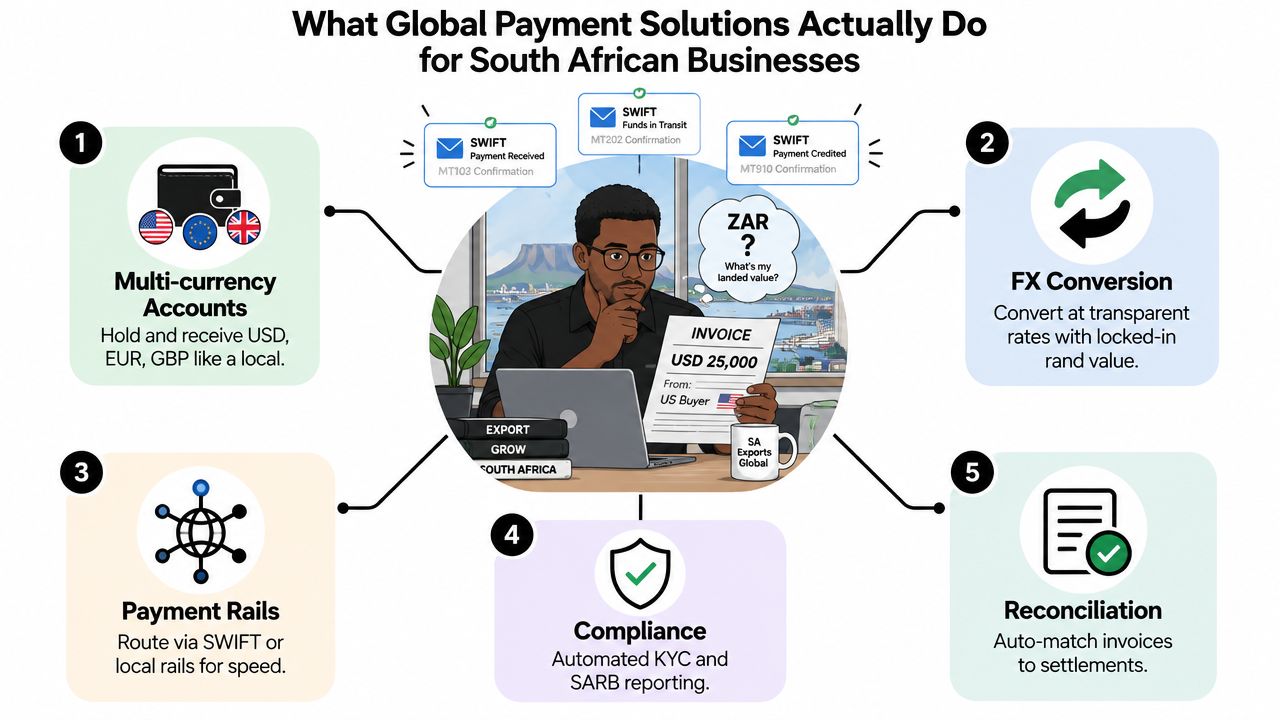
What Global Payment Solutions Actually Do for South African Businesses
Global payment solutions are not just “ways to send money overseas”. For a South African business, they are the infrastructure that lets you send, receive, hold, convert, and reconcile foreign currency without forcing every payment through a slow, opaque banking journey. That matters because the value is not only speed, it is control over the total stack, including compliance and visibility.
The job they actually perform
At a basic level, a global payment platform gives you three things a local bank transfer often doesn't deliver cleanly. First, it lets you collect or hold foreign currency in a business account. Second, it shows the FX conversion before you commit. Third, it gives your finance team a record that can be matched back to invoices, approvals, and settlement confirmations.
Practical rule: if you can't see the landed amount before you click send, you're not buying certainty, you're buying risk.
That is why exporters, importers, and BPO teams use these systems as treasury tools, not just payment tools. They want a workflow that starts with an invoice, moves through approval, and ends with settlement that's auditable and predictable. A cheap-looking transfer that hides margin in the rate is still expensive if it breaks reconciliation or delays delivery.
The trade-off in South Africa is straightforward. Banks bring familiarity and trust, but they often bundle the cost into the exchange rate and the payment chain. Fintech platforms can be sharper on pricing and visibility, but they usually expect better KYB readiness and more structured finance operations.
For a finance team, the test is whether the solution handles the full path, local ZAR collection, foreign currency holding, conversion, payout, and audit trail, without making you chase confirmations across three inboxes. That is the difference between a payment tool and a treasury workflow.
A useful starting point for smaller teams looking at the funding side of digital payment adoption is Business Loan Warrior financing cashless payments, because the infrastructure choice and the funding choice often get mixed together in real operations.
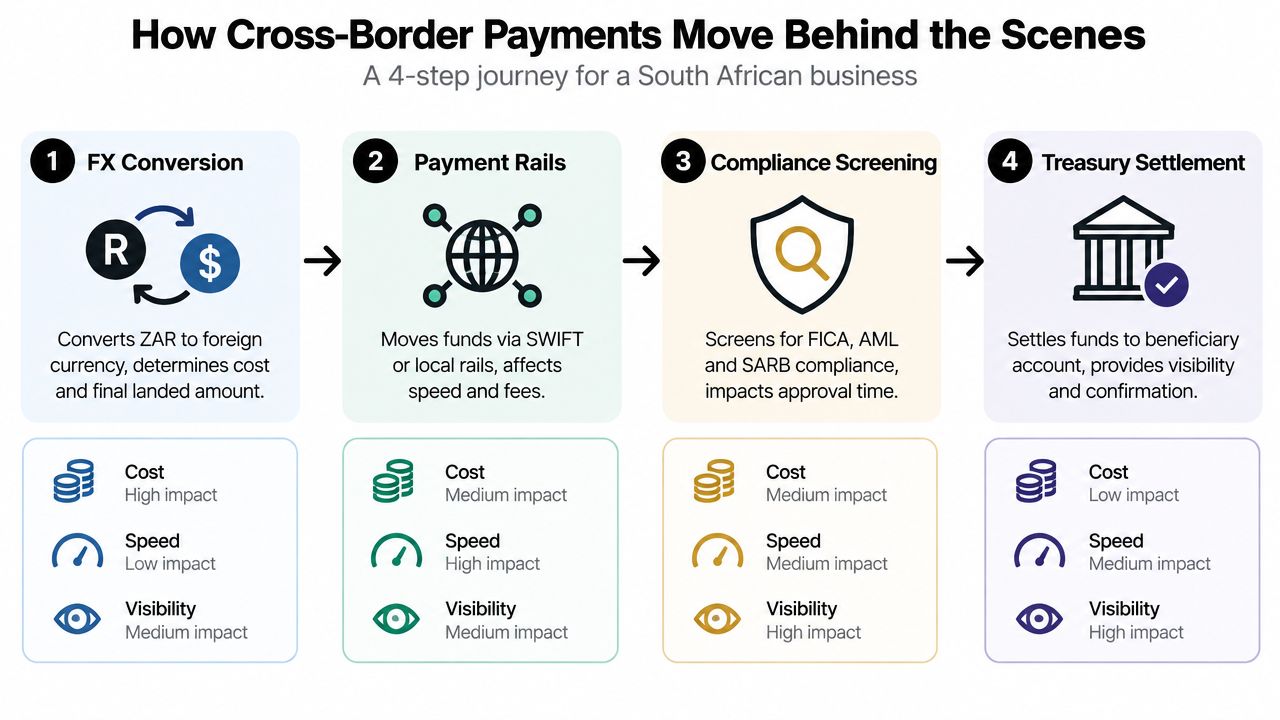
How Cross-Border Payments Move Behind the Scenes
A cross-border payment has four moving parts, and each one can add cost or delay. If your provider can't explain each link plainly, you're dealing with a black box.
The chain that creates the outcome
The first step is FX conversion. The platform or bank decides how much of your ZAR turns into the foreign currency you need, and whether you're paying near the mid-market rate or carrying a hidden spread. The second step is the payment rail, which determines whether funds move through SWIFT-style correspondent routes or through a local rail that can settle more directly.
The third step is compliance screening. For South African businesses, that means the provider must handle KYC and FICA checks properly, and the payment must sit within the exchange-control framework. The SARB and authorised dealers are part of that environment, and larger flows also need the right declarations and records for tax and regulatory review. The fourth step is treasury settlement, where the beneficiary receives funds and your finance team gets proof.
That's where cost and speed diverge sharply. A traditional SWIFT journey often starts with a local debit, then moves through one or more correspondent banks in another jurisdiction before reaching the beneficiary. Each hop can introduce its own deduction, its own timing, and its own FX mark-up. You don't always see those costs at quote time, which is why the final landed amount can drift away from the first estimate.
Modern providers try to collapse those steps into one platform. They combine conversion, routing, screening, and settlement so the payment behaves more like a managed workflow than a chain of handoffs. In South Africa, that matters because the business pain is not just remitting money, it is proving what happened to the money after it left your account.
The less visible the routing, the harder it is to trust the result.
The regulatory angle matters too. Businesses should treat exchange-control compliance as part of the design brief, not an afterthought. If the platform can't explain how it handles authorised dealers, reporting, and audit evidence, it's not ready for serious South African use.
A useful external reference if you're comparing licensing models and regulatory posture in payment infrastructure is registering your payment firm under PSD2. It's not South African law, but it's a good lens for understanding how regulated payment models differ in practice.
A quick visual on the flow sits well here.
The Full Cost Stack and Why FX Transparency Matters
South African finance teams lose money when they compare only the transfer fee. That is the wrong number to optimise. The all-in rate is what matters, and it has four parts, the headline platform charge, the FX spread, correspondent deductions, and beneficiary receiving fees.
What actually eats the margin
The spread is usually the quiet killer. It sits between the market rate you expect and the rate you are quoted, and on a large payment it can cost more than the visible fee. If a bank shows a neat transfer fee but loads the exchange rate, you have still paid for the service, just in a less obvious place.
The right question is simple. What is the landed value after every layer? That includes what the sender pays, what intermediaries deduct, and what the recipient's bank takes on arrival. If the provider cannot answer that cleanly at quote time, the quote is incomplete.
| All-in Cost Breakdown | Major ZA Bank (SWIFT) | Modern Provider |
|---|---|---|
| Cost Component | A low headline fee can hide the total cost | Fee structure is usually clearer upfront |
| FX Spread | Can be embedded in the quote, e.g. 1.5% spread on R500,000 = R7,500 hidden cost | Typically disclosed more directly |
| Correspondent Deductions | More likely on routed transfers | Reduced when rails are more direct |
| Beneficiary Receiving Fee | Can still appear on the payout side | Still possible, but easier to anticipate |
| Final Insight | A low headline fee can hide the total cost | Better visibility usually means better control |
A quoted fee of a few hundred rand can look attractive until you see the spread. If the exchange rate is padded, the small fee is just a distraction. Businesses that shop only for “cheap transfers” usually overpay.
Exchange-control reality also limits the idea that every payment can be perfectly optimised after the fact. You do not always get endless room to hedge, delay, or reroute, especially when supplier timing is fixed. In practice, spot-rate transparency at quote time is the lever that matters most, because it lets you approve the payment with the landed amount already known.
Bottom line: do not judge the transfer by the fee line. Judge it by the rand that leaves, the foreign currency that arrives, and the proof that ties them together.
For South African businesses, transparency is not a nice-to-have. It is the only way to make cross-border payments auditable enough for finance and fast enough for operations.
Where South African SMEs and Exporters Use Them Most
The use cases are not abstract. They sit in day-to-day finance work, and each one breaks in a different way when the payment rail is wrong.
Exporters who need certainty on arrival
A Cape Town fruit exporter invoicing a Netherlands buyer usually cares about one thing first, the rand value on landing. If the payment runs through a slow corridor, the finance team loses timing certainty and often loses visibility on deductions too. That's bad enough in a normal month. It's worse when the payment lands outside your normal reconciliation cycle.
The fix is not just faster settlement. It is a payment stack that locks the quote, shows the expected receipt, and returns proof in a form the team can match to the invoice without guesswork.
BPO and contractor payroll teams
A Johannesburg BPO paying contractors in Kenya, the Philippines, and the UK needs batch control, local-currency payout options, and clean proof for each recipient. Finance doesn't want to process those as one-off transfers. It wants a single approval flow and clear status on each line.
That matters because payroll and contractor payments are operational, not ceremonial. If the team has to chase missing references or ask contractors to confirm receipt manually, you've added work to both sides. The better platform makes the payout look local at the endpoint, even if the funding originated in ZAR.
CFOs repatriating money
A Durban-based CFO moving funds from a UK subsidiary has a different pressure point. Timing, compliance records, and audit visibility matter more than speed for speed's sake. The funds must be visible in time to support treasury planning and to keep the paperwork clean.
For this kind of flow, the payment solution has to handle more than execution. It needs to produce a clean trail that stands up to review, especially when the business wants to show exactly what moved, when it moved, and why it moved.
A useful way to compare these scenarios is simple:
- Exporter invoice settlement: predict the rand receipt, reduce reconciliation noise.
- Contractor payroll: batch payments with local-currency payouts and per-recipient proof.
- Repatriation: clear audit evidence and same-day visibility where possible.
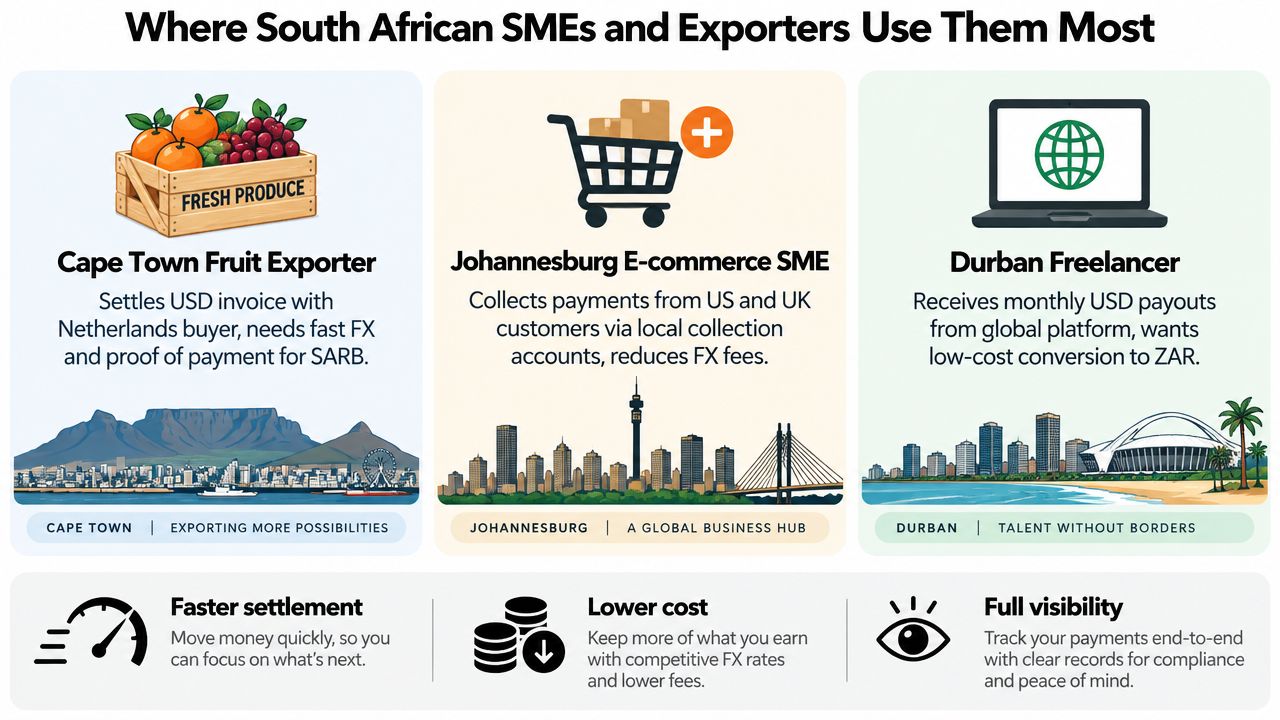
The common thread is that each business wants fewer unknowns. Not just lower fees, fewer surprises.
Choosing and Implementing a Global Payment Solution
Provider selection should start with your onboarding file, not your marketing wishlist. Most failed implementations don't fail on features. They fail because the business isn't KYB-ready, the approvals model is loose, or the team doesn't know who can release what.
Start with readiness, not price
You need the basics in order, CIPC documents, beneficial ownership records, SARS tax paperwork, and authorised signatory mandates. If those are missing or inconsistent, onboarding slows down before the first payment is even discussed. That's not a platform problem, that's a finance hygiene problem.
Once the compliance file is clean, test how the provider handles control. Good systems let you set multi-user roles, approval thresholds, and dual-control release for larger amounts. They also log who initiated, who approved, and who released the payment, which is exactly the kind of evidence a finance team wants when a transaction is reviewed later.
If a provider can't show an audit trail without a support ticket, keep looking.
Pressure-test the treasury mechanics
FX choices matter just as much as controls. Ask whether you can book at spot, lock rates, or time conversions around your payment window so you don't end up forcing a last-minute bank transfer. Also ask what happens on weekends, cut-offs, and third-currency routes, because that's where many “cheap” systems become expensive in practice.
A solid rollout plan looks boring, and that's a good sign. Week one is document collection. Week two is compliance review and permission setup. Week three is testing with a small-value transfer and one full reconciliation cycle. By the time you go live, your finance team should know where statements live, who approves what, and how beneficiary proof is stored.
A practical checklist for the finance lead:
- KYB readiness: gather the company and ownership documents before onboarding starts.
- Compliance fit: confirm FICA, SARB, and exchange-control support.
- FX and fees: compare the spread, transfer fee, and any receiving-side charges.
- Integration: check whether it fits your accounting or workflow tools.
- Settlement support: verify cut-offs, payout timing, and local support coverage.
The point is not to buy the cheapest rail. It is to buy a payment workflow your team can operate without hidden admin.
How Zaro Delivers This Stack for South African Businesses
Zaro addresses the problem directly, cost opacity. It gives mid-market FX, zero spread, and a live calculator that shows the rand amount before a payment goes out, so finance teams can see the all-in amount instead of guessing through bank marks, correspondent deductions, and receiving charges. For South African businesses, that matters more than a neat fee line.
What that means in practice
The operating model is straightforward. Businesses fund ZAR and USD accounts by bank transfer, then send and receive global payments with the exchange rate visible upfront. That makes reconciliation simpler, because the treasury team is not trying to reverse-engineer the landed amount after settlement.
Timing improves too. Where regional rails and direct payout paths are available, settlement is easier to plan than on a traditional multi-hop SWIFT route. For exporters, contractor payroll, and repatriation flows, predictable timing matters as much as price, because finance teams need to know when cash will move and when it will clear. In the SADC region, those rail choices now change the ground rules for South African businesses that pay and collect across borders.
Governance sits inside the workflow. Zaro includes multi-user access, configurable permissions, and bank-level security controls, so approvals stay in finance instead of drifting through email chains. That is the right setup for a South African business that needs visibility without turning every transfer into a manual project.
I would use Zaro when the brief is clear, transparent FX, no SWIFT fee noise, and a clean audit trail. It fits the decision set above, especially for teams that want a payment stack they can run without surprises.
Where Cross-Border Payments in South Africa Are Heading Next
South Africa's payment rails are changing in the right direction. The SARB has said the SADC-RTGS platform had processed more than 6.73 million cumulative transactions by April 2026 (SARB regulatory report), and the policy direction around low-value cross-border EFT routing points toward faster regional settlement. At the same time, PayShap is already a serious domestic instant rail, and the broad direction of CBDC and regional settlement work is clear, more digitised, more direct, less dependent on old correspondent patterns.
That doesn't mean every provider is suddenly equal. It means the benchmark has changed. Stop comparing banks and fintechs on a fee line alone. Force them to show the all-in landed cost, the cut-off time, the payout path, and the audit evidence in one view.
If you run finance for an exporter, a BPO, or a multi-entity group, pick one live corridor this quarter and run a side-by-side quote with your current provider. That single test will tell you more than any sales deck ever will.
If you want a cleaner way to send, receive, and reconcile cross-border payments from South Africa, Zaro is built for that workflow. It gives finance teams transparent FX, account visibility, and controls that fit the way SA businesses operate. Visit Zaro and compare your current landed cost against a payment stack that shows the number upfront.