
A local rand payment may clear before your coffee cools. An overseas payment to the same supplier can still be waiting the next day, with no clear answer on where it stalled, what it will cost, or when the funds will arrive. The delay can arise when payment rails, foreign exchange, message standards and compliance checks do not align.
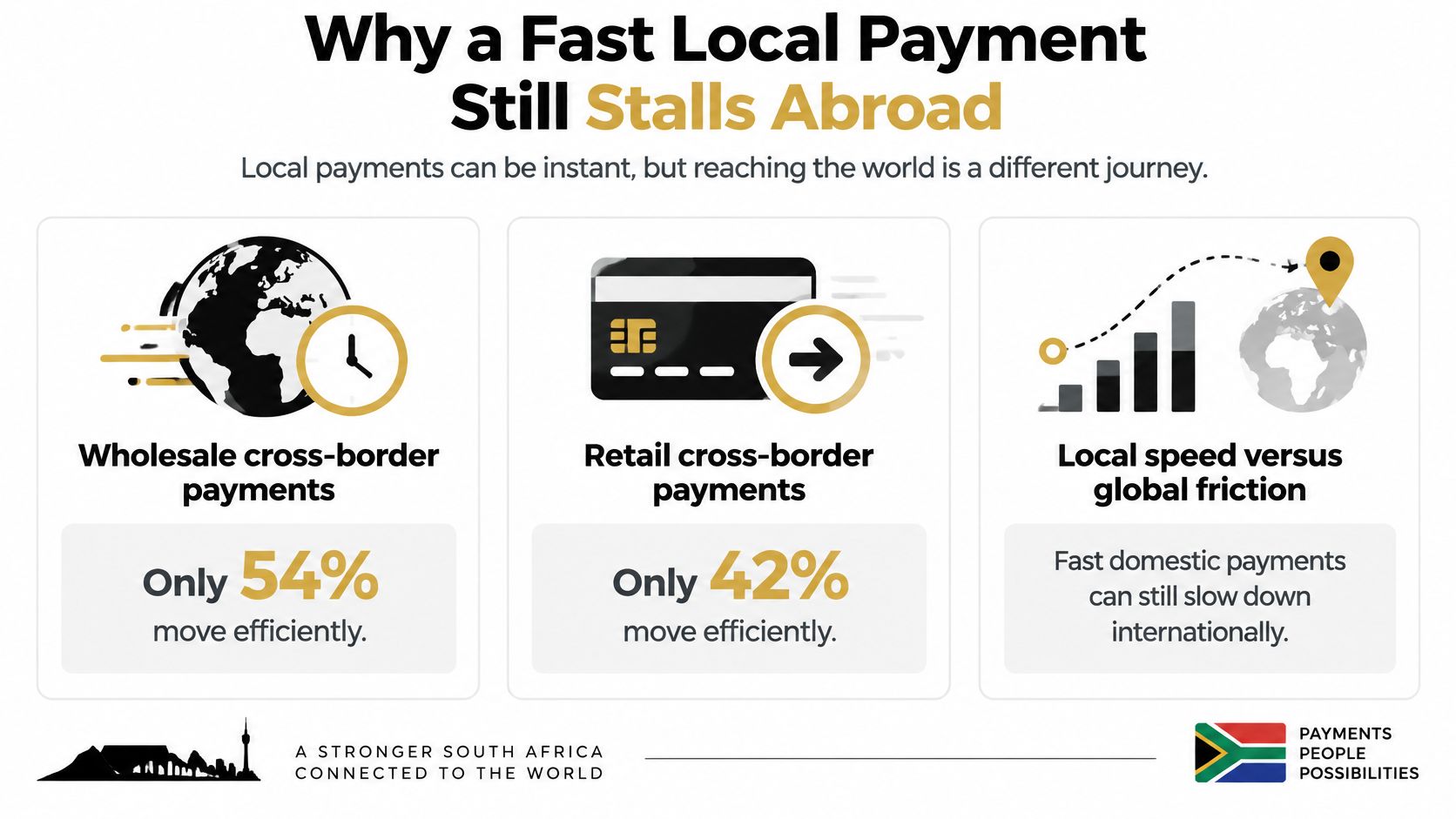
Why a Fast Local Payment Still Stalls Abroad
Only 54% of wholesale cross-border payments and 42% of retail cross-border payments in sub-Saharan Africa reached the intended recipient within one hour, compared with a target of 75%, in Financial Stability Board indicators cited by the South African Reserve Bank. That's the number to keep in front of you this week. It measures arrival, not how quickly you clicked send.
Say you're a Cape Town importer who pays a local warehouse by EFT in the morning and an overseas supplier in the afternoon. The first payment feels instant because South Africa's domestic system was built for rand to move between local banks. The second payment leaves that closed loop. It now needs a currency conversion, a route through banks in other time zones, screening against sanctions and anti-money laundering lists, and beneficiary details formatted in a way a foreign bank accepts.
What global payments technology actually covers
Don't think of it as a single app. It's the rails that settle value, the FX execution that converts rand, the message standards that describe who gets paid and why, and the screening that releases or holds the funds. If any one layer fails, the payment stalls even though your screen says submitted.
You'll leave with four practical tools. First, a map of the rails your money can travel on. Second, a way to price the all-in cost, not just the quoted rate. Third, the compliance checks that decide release. Fourth, worked cases for exporters, importers and BPO firms, so you can match the control to your own flow.
Measure the share of payments reaching the beneficiary within one hour, by corridor, currency and exception type. Initiation time tells you almost nothing about working capital.
The cost of the gap is concrete. A late supplier payment can hold a shipment at the factory or port. Late export proceeds force you to keep a larger cash buffer and carry intraday currency exposure while you wait. That's why speed claims need a corridor, a currency and an arrival definition before you trust them.
How Cross-Border Rails Move the Money
A cross-border payment can pass through several hands before the beneficiary receives cleared funds. Your bank or platform accepts the instruction, a payment message identifies the beneficiary, foreign exchange is priced, and compliance screening checks the transaction. A settlement system then moves value to the receiving bank. Missing or mismatched information can send the payment back for repair.
The rails in plain terms
Domestic systems move rand within South Africa. A payment to a supplier in Shenzhen or a contractor in London needs a route that can reach the foreign bank. That route might use a regional settlement system, a link between fast-payment schemes, or a chain of correspondent banks. Each option affects the information required and how clearly you can track the payment.
The South African Reserve Bank's G20 cross-border payments release reports that Africa has 31 live fast-payment systems, while interoperability and ISO 20022 adoption remain limited. The Transactions Cleared on an Immediate Basis (TCIB) scheme supports low-value payments across six corridors using ISO 20022. Its settlement-currency coverage is intended to expand. AI2Fin's explanation of ISO 20022 describes how structured fields can make payment instructions clearer than free-text references.
Payment rails South African firms use
| Rail | Best for | Settlement signal | Main friction |
|---|---|---|---|
| SAMOS and domestic EFT | Rand payments inside South Africa | Real-time domestic rand settlement | Doesn't deliver foreign currency |
| SADC-RTGS | Wholesale payments between participating SADC banks | Interbank settlement can be real-time or delayed | Not a simple SME payment screen |
| TCIB | Low-value ISO 20022 payments | Immediate-basis design across six corridors | Settlement-currency coverage remains limited |
| Correspondent or SWIFT chain | Suppliers, clients and contractors worldwide | Often multi-hop and outside the one-hour target | Fees, repairs, screening and cut-off times |
| Linked fast-payment systems | Retail corridors where a live link exists | Africa has 31 live fast-payment systems | Interoperability and ISO 20022 use remain limited |
How to read the table
SAMOS handles domestic rand settlement. It does not send foreign currency abroad. SADC-RTGS settles wholesale payments between participating banks, so it serves the interbank leg rather than providing an SME with a simple payment screen. TCIB uses structured data for low-value regional payments, but its limited settlement-currency coverage means it may not suit every invoice.
A correspondent chain can reach suppliers and customers in many markets, but each additional bank adds a handover. That can mean another fee, cut-off or request to correct beneficiary details. A payment submitted through a platform can still wait for routing, screening, conversion or a settlement window.
A payment platform can coordinate the instruction and its route, while a settlement rail moves the funds. For the finance team, the useful checks are practical: are beneficiary details complete, is the currency supported, and can you follow the payment's status? Faster rails help, but they do not by themselves validate an invoice or make the total cost predictable.
How FX Rates Are Set and When They Lock
Foreign exchange isn't one moment. It's a sequence you can check, and each step can change the rand amount you finally pay or receive. If a provider can't explain the sequence for your corridor, you don't have a price. You have an estimate.
Four steps to check
- Quote: The bank or platform shows a rate built from the wholesale spot rate plus a spread or margin. Ask whether that rate is indicative or locked at confirmation. 2. Execution: Conversion happens at a stated time. A payment held in screening can convert later, at a different rate from the one you saw when you approved it. 3. Value date: The rail and corridor cut-off set when money settles. A late-afternoon instruction can roll to the next business day, even if the screen accepted it today. 4. Exposure: Until conversion is done, someone carries the currency risk.
That last point confuses many teams. An exporter who receives dollars and converts later carries the risk that the rand strengthens before conversion. An importer who must pay dollars but holds rand carries the opposite risk. Neither risk disappears because a payment app looks modern.
A small worked example
Say, purely for illustration, your firm expects a dollar receipt worth about R500,000 at today's quoted rate, with an illustrative 0.5% spread. That spread alone is roughly R2,500 on that amount before any other fee. If the receipt then waits three days in screening and the rate moves against you, you absorb that move too, unless you've hedged it or agreed a locked rate upfront. The invoice amount hasn't changed. Your rand outcome has.
A USD account changes who controls timing. You can hold dollar proceeds and choose when to convert, instead of accepting whatever rate applies on arrival. Forward cover suits firms with regular, predictable flows, because you lock a rate for a future date and remove the guesswork. If your team lacks in-house treasury capacity to model those choices, Hire Financial Analysts is one route firms use to get forecasting and exposure reporting without building a full desk.
Three questions before you confirm: Is the rate locked, when does conversion happen, and what happens if the payment misses cut-off?
Write the answers next to the quote. If conversion timing is vague, treat the rate as unconfirmed and don't promise your supplier or your board a final rand figure yet.
What the All-In Cost of a Transfer Includes
A quoted exchange rate is only one part of a payment's cost. For small and mid-sized invoices, flat charges or the cost of fixing a payment can matter just as much. Compare providers using the same invoice, currency and value date.
Build the bill layer by layer
Start with the FX spread, the difference between the wholesale spot rate and the rate applied to your transaction. Published schedules may combine a percentage with a minimum and a cap. The Reserve Bank's overview of cross-border payments in sub-Saharan Africa gives a Nedbank category with a 0.63% fee, a R160 minimum and a R747 maximum. A small payment may therefore incur the minimum, while a larger one can reach the cap.
A SWIFT or handling fee is often a flat charge. It takes a larger share of a small contractor payment than of a large supplier invoice. An intermediary deduction is less predictable: a correspondent bank may deduct a charge in transit, leaving the beneficiary with less than you sent. The supplier may report the shortfall before it appears clearly in your payment records.
All-in cost layers on a cross-border payment
| Cost layer | What it is | Concrete marker | Who feels it most |
|---|---|---|---|
| FX spread | Markup on wholesale spot rate | One Nedbank FX-fee category is 0.63%, minimum R160, maximum R747 | Every conversion |
| SWIFT or handling fee | Flat message and processing charge | A fixed rand fee on each payment | Small invoices and contractor pays |
| Intermediary deduction | Correspondent takes a cut in transit | Beneficiary receives less than instructed | Supplier reconciling the shortfall |
| Compliance delay | Cash tied up before value is final | Missed cut-offs and manual reviews, separate from fee line | Exporters and importers waiting on release |
| Repair and reconciliation | Staff time fixing incomplete payments | Wrong beneficiary fields, purpose codes or references | Finance teams with many corridors |
The South African Reserve Bank Annual Report 2023/24 describes wholesale cross-border payments in SADC as relatively efficient, supported by SADC-RTGS, which began operating in July 2013. Low-value retail and business payments can still involve incompatible infrastructure, multiple intermediaries and currency-conversion costs. Improvements between banks do not, by themselves, make a business's payment predictable.
Price one invoice, three ways
Compare a bank wire, a regional rail where available, and a specialist platform using the same amount, currency and value date. Add the spread, flat fees and any expected intermediary deductions. Include staff time for repairs and reconciliation, too.
A faster rail does not automatically mean a cheaper or cleaner payment. Costs can sit in an opaque spread, a repair process or a fee that is unclear before confirmation. For a South African SME, the useful comparison is an all-in rand cost the finance team can audit, alongside clear beneficiary requirements and predictable handling. Ask for the fees before confirming, and check that the quote makes clear what the beneficiary is expected to receive.
Compliance Checks That Release or Block Funds
Compliance isn't a footer disclaimer. It's the gate that decides whether funds release or sit in a queue while your supplier, client or payroll waits. Most holds aren't caused by wrongdoing. They're caused by a missing document, a wrong purpose code or a beneficiary name that doesn't match the account.
A South African business payment needs an authorised dealer or accountable institution in the chain, plus know-your-customer and know-your-business checks on the firm and on the person who binds it. For trade flows, the Balance of Payments category and supporting documents decide how an export receipt or import payment is classified. Get the code wrong and a commercially clean transfer can wait for manual review.
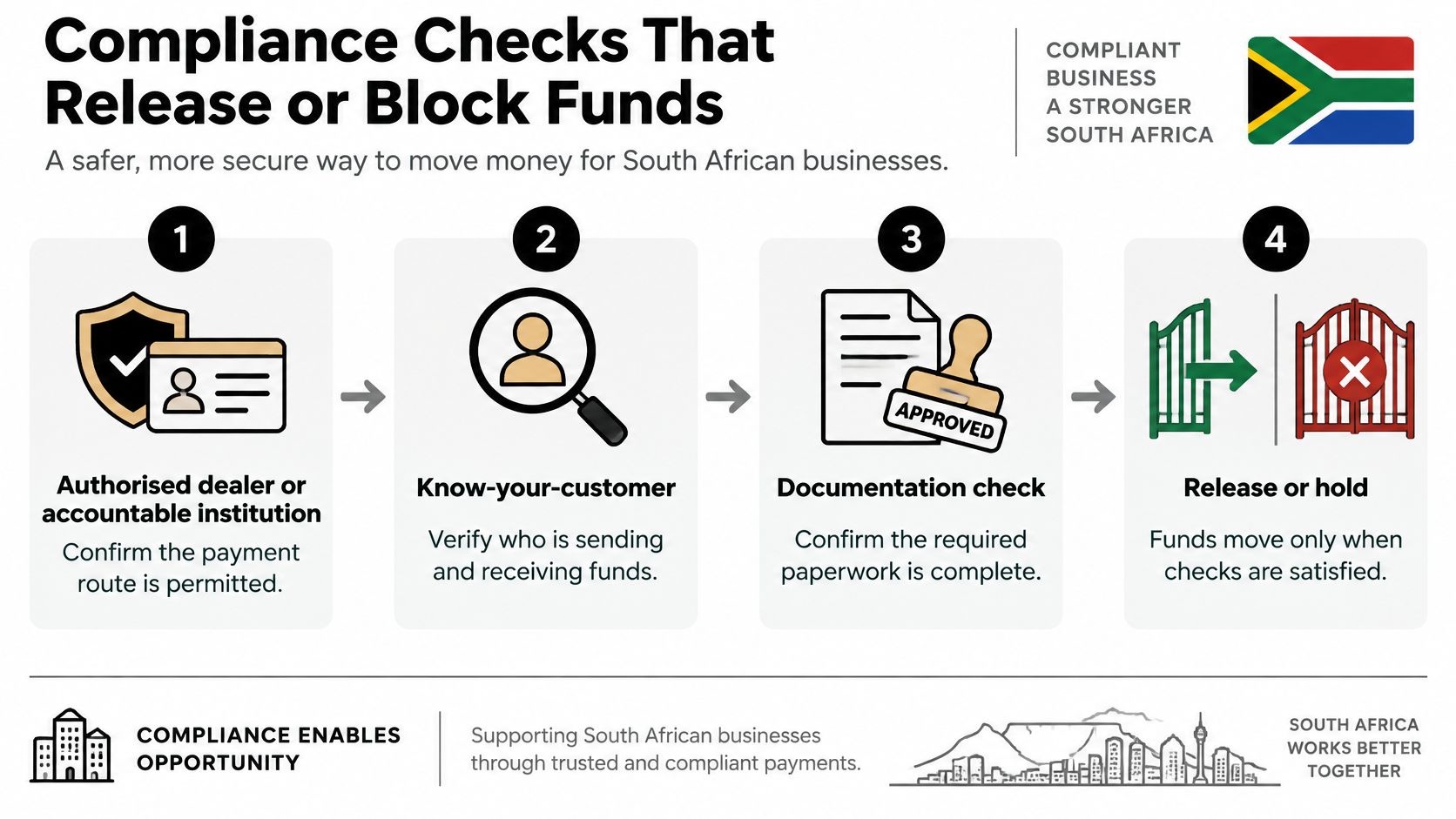
A pre-send checklist that prevents holds
- Confirm authority: The sending party is identified, authorised and using a permitted route, so the payment isn't rejected at the first gate.
- Code the purpose: Match the flow to the correct Balance of Payments category before submission, not after the bank queries it.
- Attach documents: Have the invoice, contract or shipping record ready, so a reviewer doesn't have to pause the payment to ask for proof.
- Validate the beneficiary: Check legal name, account identifier, bank and country in the exact format the receiving bank expects.
- Keep a status trail: Retain records from instruction to settlement and name which entity holds each record, so an auditor can reconstruct the payment later.
Sanctions and anti-money laundering screening add another gate. A name that resembles a listed party, an unclear ownership chain or an unexplained country in the route can stop a genuine payment until a person reviews it. Pre-payment validation moves that work earlier, when you can fix the data without cash already in transit.
Data location matters too. Ask where records are processed, which entity is regulated and how long records are retained. A speed claim without those answers is incomplete. For context on our own obligations, Zaro is FIC registered and meets FICA requirements for anti-money laundering and know-your-customer compliance. Whatever provider you use, ask for the equivalent answer in writing and file it with the payment approval.
Exporter Importer and BPO Payment Cases
For a South African SME, the hard part of a cross-border payment is often making it predictable: the right details, a clear expected amount and timing that fits the business cycle. These three cases show how those needs differ for exporters, importers and BPO firms.
The comparison below summarises the operating patterns before each case in detail.
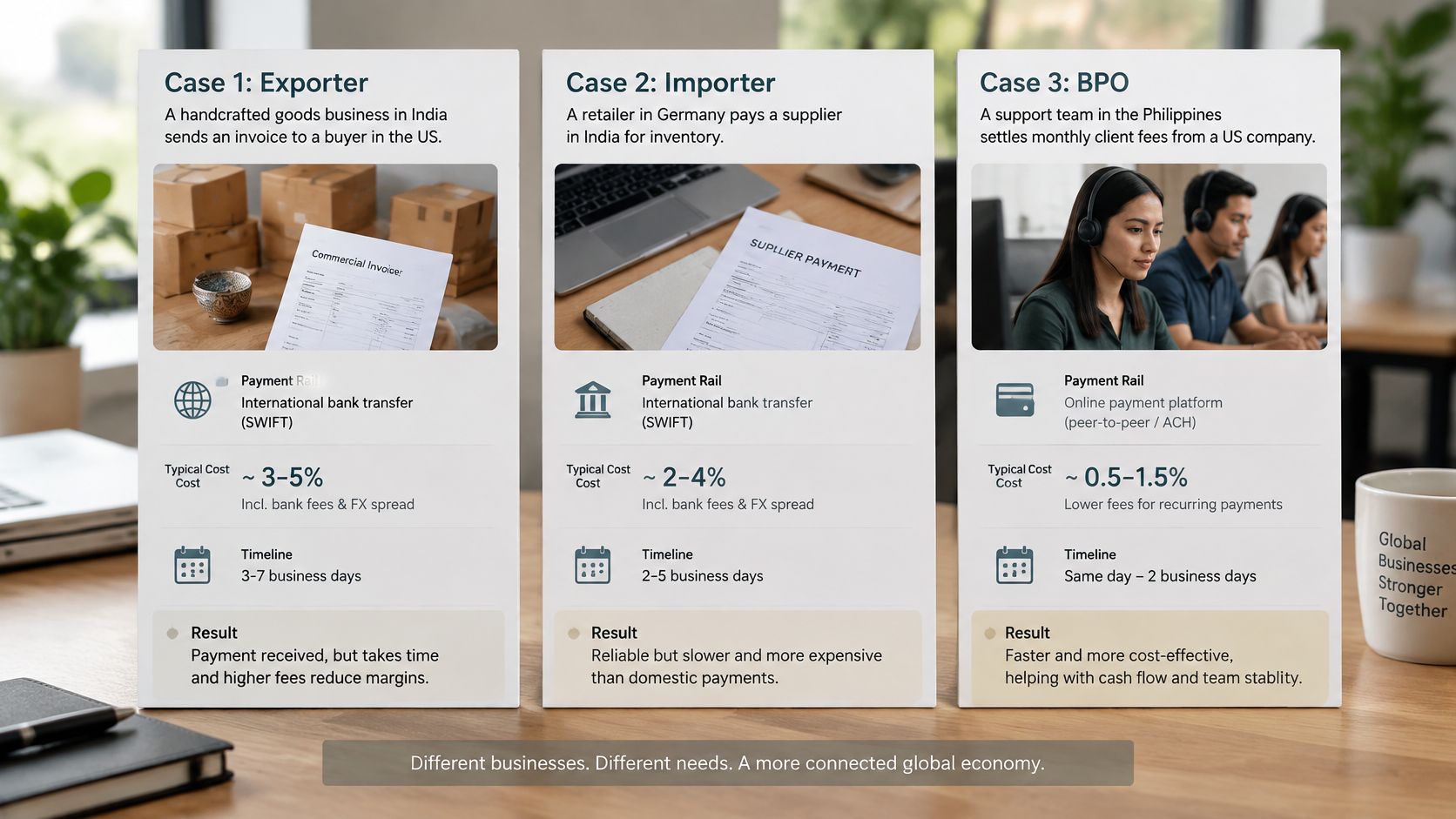
Case 1 the exporter receiving dollars
A Gauteng manufacturer ships goods and invoices a US buyer in dollars. The foreign payment still needs to be matched to the export and applied correctly before the rand proceeds are available for local costs. If the payment arrives without the information needed to identify it, the funds may sit unapplied while the business waits for a query to be resolved.
Control that prevents the delay: Prepare the invoice, shipping documents and payment-purpose details for the receipt. Clear information gives the bank or provider a basis to process the incoming funds without first requesting missing paperwork.
Case 2 the importer paying an Asian supplier
A Durban importer pays a factory in Asia for a production run. The amount the supplier receives matters more than the amount the importer instructs: intermediary deductions can leave an invoice short and put the shipment on hold. Plan payment milestones around jewelry manufacturing timelines in China and other factory schedules, so the payment date fits the production plan.
Control that prevents the delay: Confirm the expected received amount with the supplier before sending funds. If deductions may apply, agree who will cover them and adjust the instructed amount if the full invoice value must arrive.
This short explainer shows the handover points where these cases can stall.
Case 3 the BPO firm with monthly flows
A BPO firm receives US or UK client fees and pays offshore contractors each month. Its priority is a repeatable process, accurate beneficiary details and timing that fits the payroll calendar.
Control that prevents the delay: Keep a pre-validated beneficiary profile for recurring payments and reuse it. Re-entering account details each month creates another opportunity for a routine transfer to be held for correction.
An IMF technical-assistance review reported limited information on SME cross-border payments, that South African SMEs primarily use banks, and that authorised dealer limited providers had no relevant product offerings at the time of the review. These cases point to the practical gap: payment speed or a transparent rate alone does not ensure that a payment is correctly identified, reaches the intended amount or fits the business schedule.
Choose a Provider You Can Audit
Don't choose on a brand or a headline rate. Run one live payment through each option and let the audit trail decide. A provider that performs well on your busiest corridor, at your typical invoice size, has earned the next payment. One that won't show its workings hasn't.
Run the comparison on one invoice
- Pick the test case: Choose your most-used corridor, a real invoice amount and the value date you need. 2. Request matched quotes: Ask each option to quote the same amount, currency and value date. 3. Record five facts per quote: The rail that settles it, the all-in rand cost including spread and any SWIFT or intermediary charge, whether beneficiary details are validated before submission, who is accountable for know-your-customer and FICA-style checks, and whether status stays visible until funds land. 4. Reject opaque quotes: Drop any quote that won't show the rate, the fee and the amount the beneficiary should receive before you confirm. 5. Compare against your bank debit: Put the best quote next to what your bank charged on the same invoice, including any shortfall the beneficiary reported.
You can test us the same way. Our process is to sign up and complete KYB verification, fund your ZAR and USD accounts via bank transfer, then make and receive cross-border payments, with cards coming soon. We charge a transparent spread on the exchange rate and no SWIFT fees, pricing is based on volume and corridor, and you'll get a clear quote on sign-up or by speaking with the team. Funds from the US typically reach a South African account in a matter of minutes, and you should still verify that arrival time on your own live invoice before moving the rest of the corridor.
Confirm fees, the accountable entity and the expected receive amount in writing before the first payment, not after the first shortfall.
Keep the comparison sheet. When volumes grow or a new corridor opens, rerun the same five facts instead of renegotiating from memory.
If your firm is tired of guessing what an overseas payment will cost or when it'll land, test Zaro on one live invoice and audit the quote, rail and arrival time for yourself. You'll get ZAR and USD business accounts, a transparent spread with no SWIFT fees, and a status trail your finance team can reconcile.