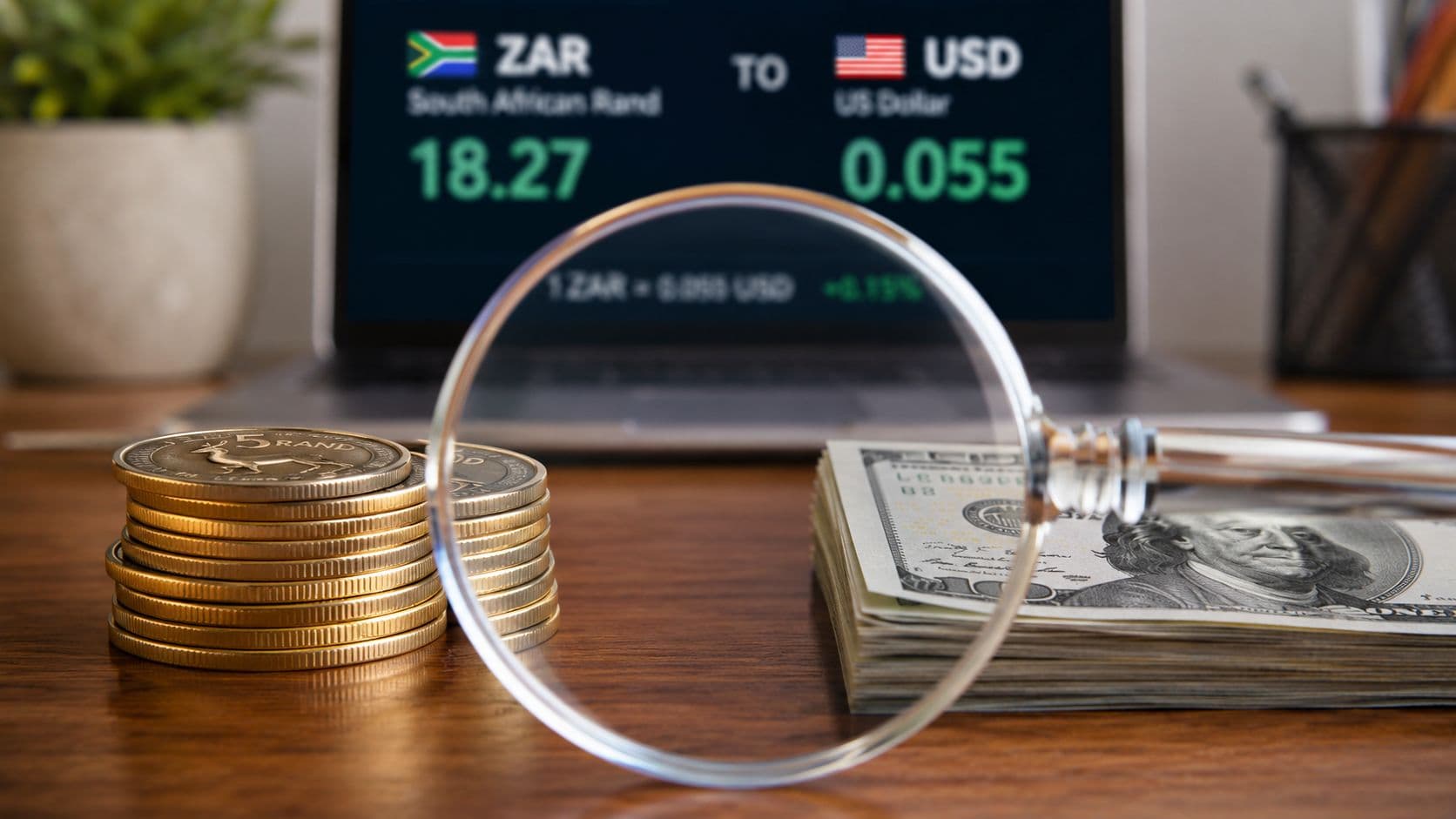
1 South African rand is 0.06109703 US dollars, which puts 1 USD at about 16.37 rand at the live XE mid-market timestamp of 09:29 UTC. That's the clean benchmark, but if you're about to pay a supplier or receive export proceeds, the rate in your bank portal is often the number that hurts.
A director can check how much is rand to dollar today, feel confident, and then lose money on the transfer because the quoted rate isn't the actual rate. The gap is where banks make their margin, and for South African businesses that gap can matter more than the headline quote.
Your Instant Rand to Dollar Rate
The immediate answer is 1 ZAR = 0.06109703 USD, or about 1 USD = 16.37 ZAR at the XE mid-market timestamp of 09:29 UTC. That is the benchmark rate you should use when you want to see whether a bank, card provider, or transfer service is charging above market. The live XE rate is useful because it strips out the retail markup and shows the underlying spot reference that professional treasury teams watch. You can check that benchmark on the live XE ZAR to USD converter for the current mid-market quote.
A lot of business owners stop at that number and think they've answered the question. They haven't. If you're paying a US supplier, collecting export revenue, or settling contractor invoices, the only number that matters is the amount that lands after conversion costs.
A practical way to think about it is this. If you're quoted a rate that's weaker than the mid-market benchmark, the bank is taking a slice before the money even moves. On larger transfers, even a small spread shows up fast, because the difference compounds across the full payment value.
Practical rule: always compare the quote you're given against the mid-market rate first, then ask what fees sit on top of it.
That comparison is what separates a clean FX transaction from an expensive one. The headline question might be how much is rand to dollar today, but the business question is whether you'll get a fair conversion or a retail rate dressed up as “market”. When you see the two side by side, the cost becomes much easier to spot.
Understanding the Real Exchange Rate

The mid-market rate is the cleanest benchmark in FX. It's the rate between buyers and sellers in the wholesale market, before any bank adds a margin, much like a wholesaler's price before the retailer marks it up. If you buy stock for your business, you already know the wholesale and retail prices aren't the same, and FX works the same way.
As of the live XE quote, 1 ZAR = 0.06109703 USD, which implies about 1 USD = 16.37 ZAR at that exact timestamp. XE labels this as the mid-market rate, and that matters because it's the fairest point of comparison for any quote you receive. If a bank offers you a materially worse rate, the difference is not mysterious. It's the margin.
This is why treasury teams treat the mid-market number as the control line. Anything below it, from your perspective, is a cost. Anything above it, if you're buying USD with rand, means you're paying more rand for the same dollars.
The easiest way to judge an FX provider is to ask one question. How far is the offered rate from the mid-market rate right now? That single comparison tells you more than a glossy brochure, and it tells you more than a transfer confirmation after the fact.
A clean benchmark also stops people from comparing apples to oranges. One provider may advertise “low fees” but widen the rate. Another may quote a tighter rate but add separate charges later. The only honest comparison is the full effective rate, measured against the mid-market reference.
Why Your Bank's Quoted Rate Is Different

A bank quote usually starts with an exchange rate spread, which is the margin added on top of the market rate. That spread is often the hidden cost a business only notices after the transfer has already gone through. Once you add transfer charges, intermediary bank deductions, and admin fees, the amount delivered to your supplier can end up far below the headline quote.
Foreign exchange is a product banks sell, and they price it to protect their margin. They are not just moving money from one account to another. They are setting the rate, and that is why the number on the screen often sits above or below the live market at that moment, depending on whether you are buying or selling USD. If you want a practical example of how pricing pressure shows up in spreads, reducing spreads with MyFundedCapital gives a useful view of how spread management works in a trading setting.
The live market also moves fast. Investing.com lists USD/ZAR at 16.6311 with a previous close of 16.5282, a move of about 0.63% in one session. That matters for a business payment because the rate you see in the morning may not be the rate you get later in the day, even before the bank adds its own markup.
A second source of confusion is that different screens can show different rates at the same time. That is normal in a live market, but it means “today's rate” is not one fixed number. The quote time matters, and so does the provider you choose.
Bank-style pricing also stacks up through hidden fees banks charge. In practice, the quoted rate and the transfer fees work together, so the bank's “rate” is often a package of costs rather than a single number. For a South African business owner, the important question is not just what the bank says the rand to dollar rate is today, but what amount of USD will land after the spread and fees are applied.
Calculating the True Cost of an FX Transfer
Suppose your business sends R100,000 to a US supplier. If you benchmark that payment against the live XE mid-market rate of about 1 USD = 16.37 ZAR, the transfer should convert to roughly $6,109.70 before fees, using the live benchmark as the reference point. The core question is how much of that amount survives once the bank applies its own spread and charges.
If a provider widens the rate by a small percentage, the loss shows up in the USD received. The supplied data shows that a 1% spread on a R100,000 transfer changes the USD received by roughly $61 at the benchmark rate, while a 2% spread roughly doubles that impact. That's before any separate transfer fee gets added.
For a larger payment, the effect becomes more visible. Independent trackers show that a move of only 0.63% on a R1 million conversion changes the USD amount by about $38 to $63 depending on direction. That's not market noise when you're balancing supplier deadlines, export receipts, or month-end cash flow. It's the difference between a forecast that holds and one that slips.
| Provider | Exchange Rate (USD per ZAR) | Fees | Total USD Received | Hidden Cost |
|---|---|---|---|---|
| Mid-market benchmark | 0.06109703 | None | About $6,109.70 | None |
| Bank quote with spread | Lower than benchmark | Transfer charges may apply | Lower than benchmark outcome | Spread plus fees |
| Faster transparent provider | Near benchmark | Clear fees or none | Closer to benchmark outcome | Reduced or disclosed |
The table is the story. The bank may present the transfer as routine, but the hidden cost sits in the rate itself, then gets reinforced by service fees. If you want to keep more of the value you earned, you need to see both pieces before you approve the payment.
How SA Businesses Get the Real Exchange Rate
For South African businesses, the cleanest solution is to stop relying on a bank's packaged quote and work from the actual spot rate instead. That means using a provider that shows the market rate clearly, separates any fee from the exchange rate, and doesn't bury the markup inside the conversion. The goal isn't just lower cost, it's predictability, because finance teams can't manage cash flow properly when the rate is unclear.
A transparent setup gives you three advantages. First, you know what the conversion is really costing. Second, you can time payments with more confidence when the market moves intraday. Third, you can compare providers on a like-for-like basis instead of guessing where the margin sits.
Simple test: if you can't tell whether the provider is using the mid-market rate or adding a spread, you don't yet know the true cost of the payment.
That's where modern fintech platforms have an edge over old banking workflows. They're built to show the effective rate upfront and keep the transfer mechanics simpler for finance teams. For South African exporters, importers, and service businesses, that transparency matters because every cross-border payment is part pricing exercise, part treasury decision.

Zaro is positioned around that exact problem. It offers South African businesses a way to move between ZAR and USD at the actual rate, with zero spread and no SWIFT fees, which directly addresses the hidden-cost problem that makes FX hard to budget. For a CFO, that's not just convenience, it's control over the actual cost of the transaction.
There's also a governance angle. Multi-user access, permissions, and clear visibility matter when more than one person touches payments. A transparent rate plus clean controls is a better operating model than relying on a bank quote that only becomes clear after the money has already left your account.
Stop Asking for the Rate Start Asking for the Cost
The better question isn't how much is rand to dollar today. It's how much will arrive after the rate, the spread, and the fees are all applied. That shift in mindset changes how you compare providers, how you time payments, and how you protect margin on international business.
For South African companies, the effective exchange rate is the number that decides whether a cross-border transfer is efficient or expensive. If your current provider can't show that number plainly, you're carrying unnecessary FX risk.
If you want a clearer view of what your transfers are really costing, take a look at Zaro. It's built for South African businesses that want the exchange rate, transparent costs, and simpler cross-border payments without the usual bank markup.