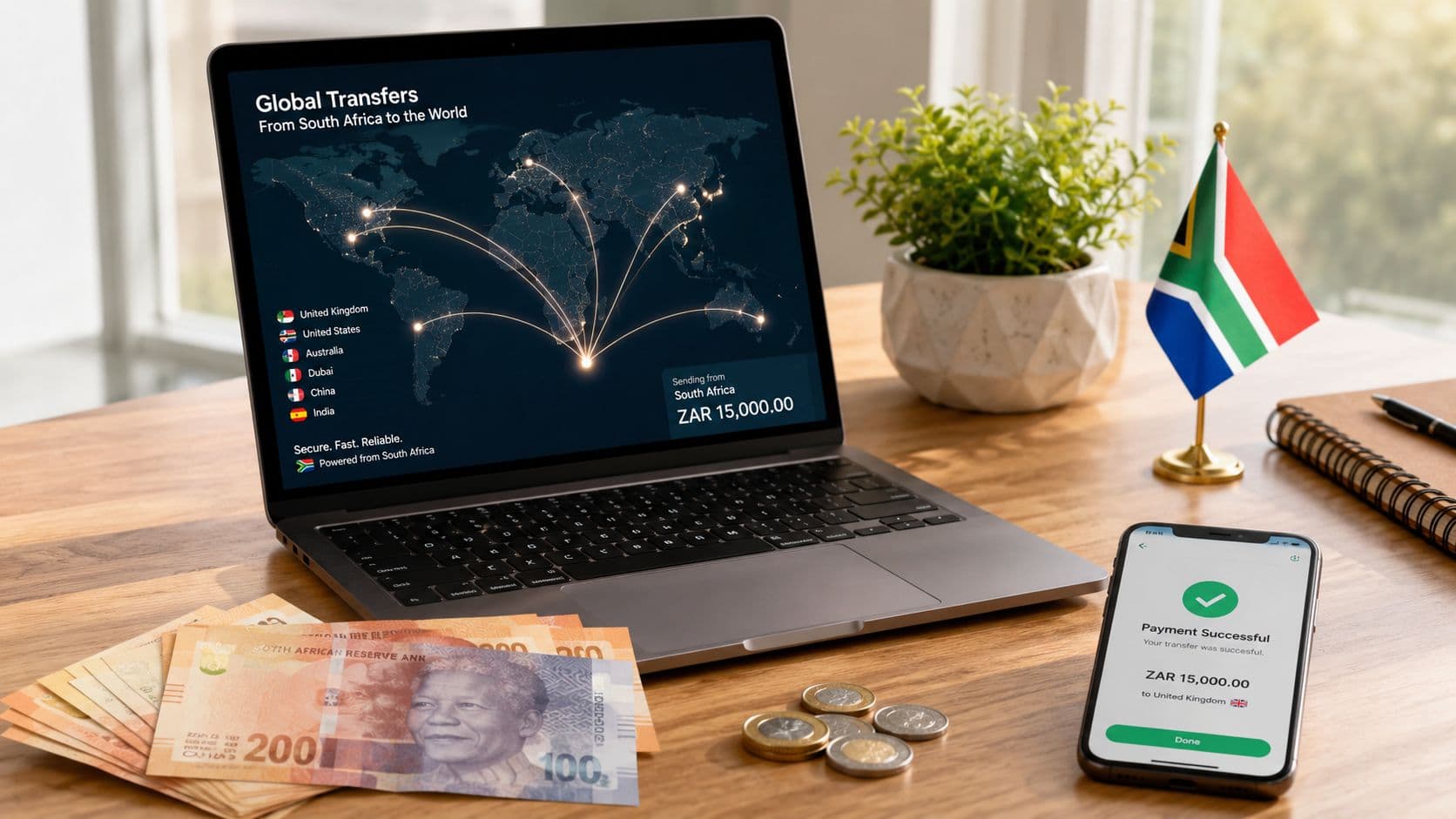
South Africa's outbound remittance market is already huge, and the price tag is still painful. The South African Reserve Bank recorded formal outflows rising from R6 billion in 2016 to R19.3 billion in 2024, with total remittances to SADC reaching R112.6 billion between 2016 and 2024, while the average cost of sending money from South Africa was still 12.03% in Q3 2024 and 8.78% in Q1 2025 for a $200 transfer to sub-Saharan Africa Nedbank's summary of exchange-control rules and FinMark Trust's remittance cost review. If you're trying to figure out how to send money overseas from South Africa, the question isn't just which provider you use. It's how much disappears in spread, intermediary charges, and compliance friction before the beneficiary sees a cent.
For South African SMEs, the visible fee is usually the smallest part of the bill. The hard part is the cost that gets buried in the exchange rate, the bank chain, and a payment that sits in review because one field was coded badly. That's where margins get lost.
Why Cross-Border Payments from South Africa Cost More Than You Think
The first mistake finance teams make is comparing the transfer fee alone. That number can look reasonable while the rest of the payment leaks value through the exchange rate and the banking network. FinMark Trust found that South Africa's average remittance cost was 16.59% in Q4 2015, far above the 7.37% global average at the time, and the South African Reserve Bank later reported that the cost was still 12.03% in Q3 2024, down from 13.12% in Q2 2024 FinMark Trust.

The three hidden cost layers
The first layer is the exchange rate spread. Banks and some payment providers often build margin into the rate they quote, so the fee you see isn't the full cost. The second layer is correspondent bank deductions, where an intermediary bank can take a cut on the route to the beneficiary.
The third layer is BoP coding errors. A wrong purpose-of-payment code, missing beneficiary detail, or inconsistent supporting document can trigger manual review, which delays settlement and can create extra admin work for your team. The payment may still go through, but the time cost is real.
Practical rule: if a quote looks cheap, ask what rate you're actually getting, who can deduct fees mid-route, and what documents could cause a hold.
South Africa's exchange-control framework adds another reason costs feel higher than in simple domestic payments. Adults with a South African ID can transfer up to R1 million per year offshore without a tax compliance status letter, and up to R10 million per year for investment purposes if they obtain the required SARS tax compliance status letter Nedbank's exchange-control summary. That means every outbound transfer sits inside a compliance system, not just a payments system.
For a business, the practical result is simple. A supplier payment that looks routine can become expensive fast if the quote hides rate margin, the route introduces deductions, or the paperwork slows everything down.
Choosing the Right Payment Channel for Your Business
Traditional banks still make sense for some payments, but they're rarely the whole answer. The right channel depends on how often you pay, how urgently the money has to arrive, and whether your team needs tighter cost visibility. What works for a one-off director transfer can be a poor fit for recurring supplier runs.
Compare the options against the realities that matter
| Criteria | Traditional Banks | Fintech Platforms | Specialist FX Providers |
|---|---|---|---|
| Total cost transparency | Often weak, especially once spread and route fees are added | Usually stronger, with clearer pricing | Can be good, but structure varies by provider |
| Settlement speed | Reliable, but sometimes slower because of manual checks | Often faster for straightforward flows | Usually efficient for repeat payments |
| Multi-currency account access | Available in some cases, but not always easy to manage | Often built in | Sometimes available, depending on provider design |
| SARB compliance automation | Strong process control, but often manual | Can reduce admin if the product is built for it | Often depends on operating model |
| Scalability for recurring payments | Fine for occasional use, less elegant at scale | Usually better for repeat workflows | Strong when the provider supports batching and approvals |
A bank SWIFT transfer makes sense when the counterparty insists on it, when the payment is high-stakes, or when your internal policy demands a familiar banking trail. The problem is that the cheapest-looking option can create more admin work later if the payment needs chasing, rework, or reconciliation across multiple bank statements.
Fintech platforms tend to win when the business wants cleaner visibility, faster setup, and fewer manual handoffs. Specialist FX providers sit somewhere in the middle, often useful where treasury needs more control than a retail-style app but doesn't want a fully manual bank process.
If your team sends one-off payments, simplicity matters. If it sends the same supplier invoice every month, consistency and auditability usually matter more than a headline fee.
A good rule is to match the channel to the payment pattern. Use your bank when policy or complexity forces it. Use a modern platform when you need repeatability, clearer pricing, or a multi-currency workflow that doesn't collapse under routine volume.
Preparing Your Documentation and SARB Compliance
Cross-border payments from South Africa need more than beneficiary details. They need a complete paper trail, because the transfer has to satisfy exchange-control checks and the provider's internal review process. Nedbank's summary of the rules is a useful starting point for understanding how the compliance file affects whether a payment moves quickly or gets held for review Nedbank.
What the payment file has to answer
A compliant payment file should answer three questions clearly. Who is the beneficiary, what is the money for, and under which route is the payment allowed to leave the country. In practice, finance teams should have the business profile, the supporting invoice or contract, and the tax status information required for the specific transfer type ready before the payment is loaded.
The distinction between the R1 million annual allowance and the R10 million annual investment allowance matters because the documentation is different. The higher route requires the SARS tax compliance status letter mentioned in the source above, while the lower allowance does not. That is the kind of gap that turns a payment from a same-day release into a compliance queue item.
A clean file also reduces back-and-forth with the provider. If the payment purpose is vague, or if the beneficiary details do not match the invoice, the bank will usually ask for more information before it releases the funds.

The documents that save time
- Purpose of payment letter: State exactly why the money is leaving the country and tie it to the invoice or contract.
- Supporting invoices or contracts: Match the amount, beneficiary, and currency to the payment request.
- Tax compliance proof where required: Use the SARS status letter when the transfer falls under the higher allowance route.
- Beneficiary and business verification records: Keep your KYC and KYB information current so the provider does not need to stop and re-verify the file.
If your finance team handles compliance across multiple jurisdictions, practical compliance for finance firms is a useful reference for building approvals, document tracking, and audit trails around payments.
The fastest outbound payments are usually the ones that are prepared before anyone clicks send. That sounds basic, but it is where many delays start. A transfer can be technically valid and still stall if the file is incomplete, the supporting documents do not line up, or the purpose-of-payment wording is too loose.
Calculating the True Total Cost of Your Transfer
The right way to judge any quote is to price the full path, not the advertised fee. The total cost sits across four places, the upfront charge, the exchange rate margin, deductions along the route, and the amount the beneficiary's bank may charge on receipt. If you ignore one of those, your comparison is incomplete.

Use a simple working formula
Start with the quoted transfer fee. Then compare the provider's exchange rate to the live market rate you can verify at that moment. The gap between the two is your hidden FX cost, even if the platform markets the transaction as cheap.
From there, ask whether any intermediary or correspondent bank can deduct fees before the funds arrive. That step is often missed because the deduction happens in the middle of the route, not at the point of initiation. The beneficiary's bank can also apply a receiving charge, which means the amount delivered can be lower than your finance team planned for.
Working rule: true cost equals transfer fee plus FX spread plus route deductions plus receiving charges.
A large payment makes the gap obvious. On a R1 million supplier payment, even a modest difference in rate treatment can materially change the landed cost, which is why comparing only the upfront fee is such a weak habit. The actual amount received abroad depends on the full chain, not the first screen in your banking portal.
Ask your provider for the rate they're applying, not just the fee. If they won't state the rate clearly, you can't calculate the true cost. For a finance lead, that's usually the point where the quote stops being comparable.
Executing the Transfer and Avoiding Common Errors
Once the paperwork is in place, the transfer itself is still easy to get wrong. The operational flow for South African outbound payments is straightforward on paper, collect the beneficiary's full name and address, bank account number or IBAN, SWIFT/BIC, any country-specific routing or SORT code, and the purpose-of-payment code, then initiate the payment through the bank's International Payment or Forex channel, choose the destination country and currency, and complete authentication after review Standard Bank's guide.
The details that cause avoidable delays
The beneficiary's banking identifiers have to be exact. A wrong SWIFT code, a missing routing number, or a name that doesn't match the account can all trigger rejection or manual review. That's especially painful when the payment is time-sensitive and procurement is already chasing the supplier.
Fee allocation also matters. Standard Bank's flow lets the sender choose who pays beneficiary bank fees, which affects the delivered amount and the way your books reconcile on the receiving side Standard Bank. If you don't decide that upfront, the beneficiary may receive less than expected and come back asking why the invoice is short.
The purpose-of-payment code is not a formality. It helps the bank classify the payment correctly and supports the compliance trail if anyone audits the transaction later. Get that wrong and you can create a delay that looks like a banking issue but started as a coding problem.
Check every beneficiary line against the invoice before submission. Most transfer problems start with a mismatch, not with the payment rails themselves.
A clean execution checklist is boring, but boring is what you want in cross-border payments. The strongest teams verify details before payment day, not after the bank has already put the transfer into review.
How Zaro Simplifies Cross-Border Payments for South African Businesses
A South African export company with recurring supplier payments usually wants three things, predictable pricing, cleaner approvals, and less time spent chasing bank queries. Zaro is built around that workflow. Businesses onboard through KYB verification, fund both ZAR and USD accounts via standard bank transfers, and then send or receive global payments at the actual spot exchange rate with zero spread and no SWIFT fees.
A more controlled operating model
A finance manager can set up multi-user access and assign team permissions so the person preparing the payment isn't the only person who can approve it. That matters when one person handles treasury and another owns procurement, because the business still needs governance without bottlenecks.
Issued debit cards in ZAR and USD also give teams a direct way to pay for foreign purchases without forcing every expense through the same manual wire process. For recurring operational spend, that can simplify reconciliation and reduce the amount of admin that lands on finance at month-end.
The bigger change is how documentation sits in the workflow. Instead of gathering compliance files separately for each transfer, the payment process can be structured so that the right checks happen before the payment is released. That reduces the back-and-forth that normally slows down traditional bank transfers.
For businesses comparing payment ops tools more broadly, a cash flow software for small businesses guide can be a useful companion when finance teams want to tighten forecasting alongside cross-border controls.
Zaro fits the kind of operation that wants transparency without building a full treasury stack from scratch. It doesn't remove the need for good internal controls, but it does cut out the parts of the process that usually waste time and hide cost.
Best Practices for Ongoing Cross-Border Payment Operations
Cross-border payments stop being a one-off problem once suppliers, contractors, and offshore invoices become routine. The companies that stay in control treat international payments like a repeating finance process, not an emergency task. That means standardising how payments are prepared, approved, timed, and reconciled.

A practical operating checklist
- Use one payment partner consistently: Fewer providers usually means fewer reconciliation formats and less duplicate admin.
- Automate recurring documentation: Keep beneficiary files, invoices, and approval records ready before payment day.
- Monitor rates before you fund: A small difference in the quote can change the landed cost enough to matter on recurring transfers.
- Review costs on a schedule: If the payment stack starts feeling opaque, your team should challenge the pricing and routing again.
A disciplined cash view helps here too. Teams that use cash flow software for small businesses alongside payment controls usually find it easier to see when offshore settlements are distorting working capital, especially when payment dates and receipt dates don't line up neatly.
The warning signs are usually obvious. If your team keeps asking why recipients got less than expected, if reconciliation takes too long, or if every payment needs a fresh round of clarification, the setup is probably costing more than it should.
Keep an eye on compliance changes as well, because exchange-control expectations and provider procedures can evolve. The best payment process is the one your finance team can repeat without guesswork.
If you want a cleaner way to handle supplier payments, contractor payouts, and international receipts from South Africa, Zaro is built for that workflow. It gives finance teams a more transparent route through cross-border payments, with real exchange rates, zero spread, and controls that reduce manual friction. Visit Zaro to see how it fits your payment process.