
South African businesses collectively financed or settled an average import flow of approximately R156.4 billion per month in 2025, according to the SARS Trade Statistics for December 2025. That scale reframes import finance as a daily cash flow discipline, not an occasional loan. You're usually paying an overseas supplier weeks or months before your local customer pays you, and the rand cost, customs cash and paperwork all move in between.
Import Finance Options at a Glance
Think of import finance as a bridge. On one side, your supplier wants payment before, on or soon after shipment. On the other side, your customer pays after you've received, stored, processed or resold the goods. The bridge has to carry the money, the documents and the risk for that whole gap.

A letter of credit puts a bank's promise behind the payment, so the supplier ships against documents rather than trusting you alone. Supplier credit does the opposite. The supplier funds the gap and lets you pay later on open account terms. Both solve timing, but they place risk and cost in different hands.
The Six Instruments You'll Meet Most Often
Most South African importers mix a small set of tools rather than relying on one product for every shipment. A documentary collection routes shipping documents through banks, so you pay or accept a bill before the documents are released. An overdraft or trade loan gives you rand liquidity from a lender, which you then convert and remit.
Purchase-order finance funds the supplier against a confirmed order from a creditworthy buyer, before you've invoiced anyone. A forward FX contract isn't funding by itself, but it fixes the exchange rate for a known future payment date, so the funding amount stops moving while you wait.
Import finance instruments compared
| Instrument | Who carries the payment risk | Main cost driver | Best fit |
|---|---|---|---|
| Letter of credit | Issuing bank, once it confirms the credit | Issuing and confirmation fees plus interest on any drawn amount | Large or first-time overseas suppliers |
| Documentary collection | Importer, until documents are released | Collection fees and FX conversion | Established suppliers and moderate values |
| Supplier credit (open account) | Supplier, who finances the gap | Price premium or late-payment interest built into the agreement | Trusted suppliers with a proven payment history |
| Overdraft or trade loan | Importer, through a lender facility | Interest rate and facility fees | Recurring import flows that need a cash buffer |
| Purchase-order finance | Lender, which funds the supplier against a confirmed order | Discount fee for each funding period | Confirmed orders not yet invoiced |
| Forward FX contract | Importer, with currency exposure fixed | Forward points or spread in the agreed rate | Known payment date and a large foreign-currency amount |
Let Risk Choose the Instrument
Practical rule: the newer the supplier and the larger the shipment, the more you should lean on a bank-backed instrument. The longer the clean payment history, the more supplier credit or a plain facility can do the job.
A first order for machinery from an unknown factory points to a letter of credit, even if the fees sting. A monthly components order from a supplier you've paid on time for two years points to open account terms backed by an overdraft, with a forward contract if the invoice currency worries you. Don't price all six for every shipment. Narrow it to the two or three that match the risk, then compare those properly.
Most instruments are arranged through a bank or authorised dealer. Expect to provide the supplier invoice or proforma, your purchase order, shipping documents and business verification such as Know Your Business checks. Supplier credit depends on terms the supplier agrees, and purchase-order finance depends on a confirmed order from a creditworthy buyer.
Ask two or three providers for indicative pricing on the same shipment, same date and same amount, so the quotes line up. If your operation also involves owners or partners based abroad, it helps to compare bank accounts for non-residents before you settle on where funds will be held and moved.
Why South African Importers Need Import Finance
The national flow is continuous, not occasional. It covers fuel, machinery, components, technology and inventory that businesses can't pause when cash is tight. If your inputs stop, your production or your shelves stop with them.
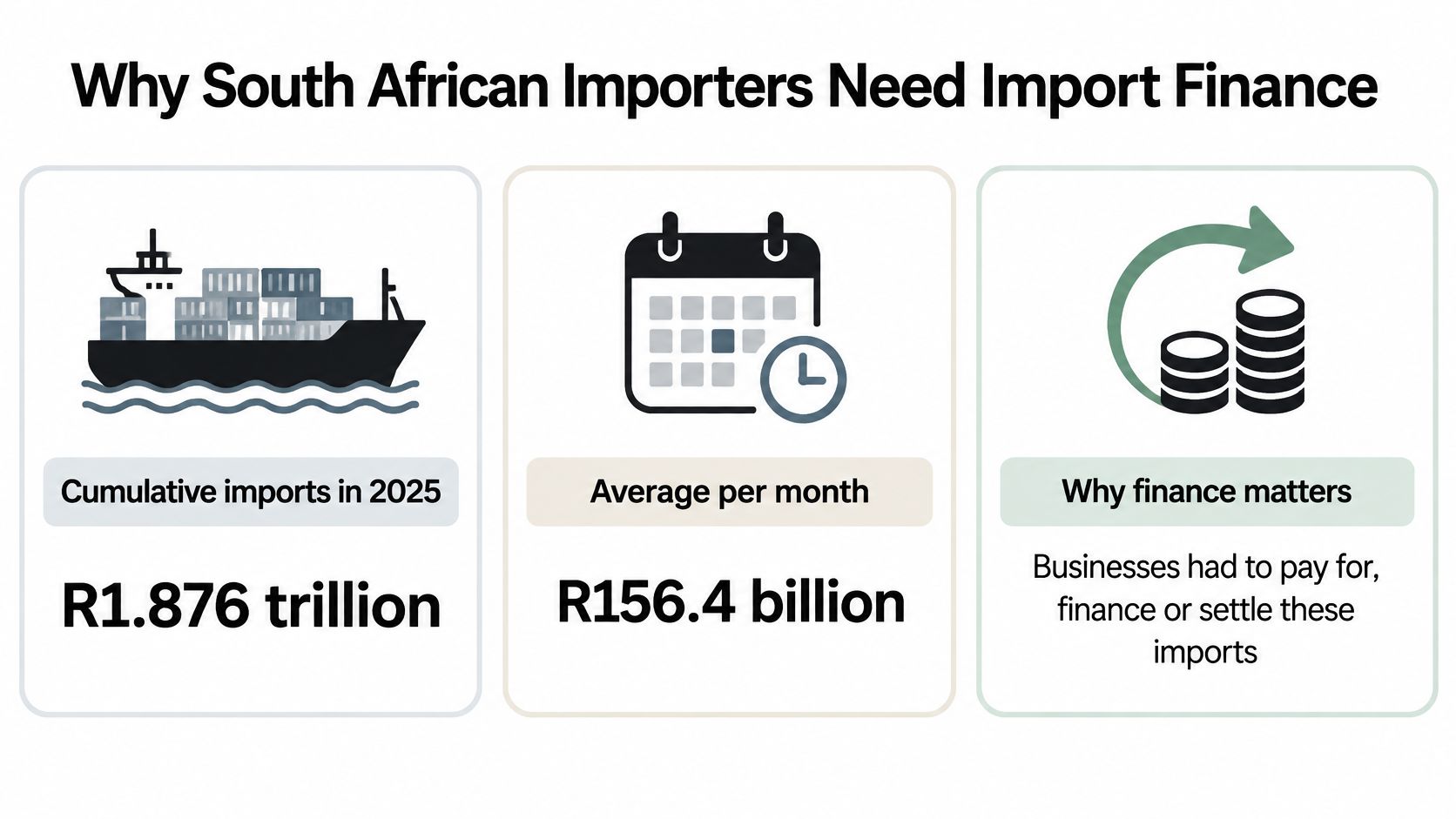
Volatility sits on top of that volume. The SARS July 2025 media release recorded imports of R164.0 billion in July 2025, compared with R157.0 billion in July 2024, and imports rose to R176.6 billion in October 2025 from R164.5 billion a year earlier. For context on how quickly a single month can shift, the SARS media release archive for 2024 recorded imports of R146.2 billion in November 2024.
Two Pressures on Every Shipment
- Timing pressure: you often pay the supplier, freight and border taxes before the goods have earned a rand locally.
- Currency pressure: the rand cost of a dollar, euro or yuan invoice can change between purchase order, shipment and payment.
Say you agree a dollar price in March and settle in June. If the rand weakens in between, the same invoice needs more rand, and your margin absorbs the difference unless you've priced for it or fixed the rate. That's why funding and FX can't be planned separately.
The pattern isn't only about distant suppliers. National totals include trade with Botswana, Eswatini, Lesotho and Namibia, so regional corridors carry the same timing and settlement discipline. Treat import finance as an ongoing treasury function covering liquidity, FX execution and payment records, and you'll plan facilities for the busy months rather than scrambling in them.
Work Out the Border Cash Before You Pay
The supplier invoice is not your cash requirement. It's only the starting point, and importers who size a facility on the invoice alone discover the shortfall at the border, which is the worst place to discover it. Duty and import VAT are payable before the goods are yours to sell.
The SARS duties and taxes for importers guidance sets out that import VAT is charged at 15% on the Added Tax Value, where the Added Tax Value is the customs value plus customs duty plus 10% of the customs value. Read that formula slowly, because it's where the surprise lives. VAT is not charged on the invoice. It's charged on a bigger number that includes duty and an uplift.
One Shipment Worked in Full
Take a shipment with a customs value of R1,000,000 and a duty rate of 10%. Duty is R100,000. The Added Tax Value becomes R1,200,000, being the customs value plus duty plus 10% of the customs value. Import VAT at 15% of that amount is R180,000.
Add duty and VAT together and you need R280,000 in border cash on a R1,000,000 shipment. That's before port charges, freight, insurance and clearing fees. If your facility was sized on the invoice only, you're R280,000 short at exactly the moment the goods are waiting for release.
Border cash example for a R1,000,000 shipment
| Line item | Basis | Amount (R) |
|---|---|---|
| Customs value | Commercial invoice value | 1,000,000 |
| Customs duty | 10% of customs value | 100,000 |
| Added Tax Value | Customs value + duty + 10% of customs value | 1,200,000 |
| Import VAT | 15% of Added Tax Value | 180,000 |
| Border cash need | Customs duty + import VAT | 280,000 |
| Port, freight, insurance and clearing | Actual supplier and forwarder invoices | Add each quoted rand amount in full |
Classification Comes Before Commitment
Size the facility against the full landed-cost tax base, not the commercial invoice, and model the duty classification before you fix supplier payment dates.
The duty rate in the example flows from the tariff heading for your product. A different heading can mean a different rate, which changes duty, which changes the Added Tax Value, which changes VAT. One classification error moves three numbers at once, so confirm the heading with your clearing agent before you commit to payment dates you may not be able to fund.
Origin matters here too. The 10% uplift generally applies to imports, while qualifying goods originating in Botswana, Eswatini, Lesotho or Namibia, the BLNS countries, may qualify for a specific exception. Don't assume either way. Check the origin evidence first, then run the calculation that matches it.
Build a one-page landed-cost sheet for each product line and reuse it. Start with customs value, apply the duty rate for the confirmed heading, build the Added Tax Value, add VAT, then layer in freight, insurance, port and clearing quotes. When the sheet is done before the purchase order goes out, the facility conversation with your lender becomes precise, and the border stops producing surprises.
Costs Beyond the Interest Rate
A finance quote can look affordable while the shipment still strains your cash flow. The interest rate is only one part of the bill. FX pricing, bank and permit charges, border payments, and the staff time spent on paperwork all affect what the import ultimately costs.
The IMF country report on South Africa identifies business regulations, financing constraints and inadequate infrastructure as leading operating constraints for South African firms. It also notes that bureaucratic and administrative costs disproportionately burden SMEs. Permit applications can bring processing and bank charges, so include them in your estimate rather than treating them as incidental.
Where the Rest of the Money Goes
Cost stack for one import payment
| Cost component | How it is charged | What to check |
|---|---|---|
| FX spread or conversion margin | Built into the rate you receive | Compare the rate with the mid-market rate on the day |
| SWIFT and intermediary bank fees | Per payment, often deducted from the amount sent | Ask whether the quote includes intermediary charges |
| Import permit processing | May apply to an application | Confirm the processing charge before applying |
| Bank charges on permits and payments | Charged to the applicant | Get the rand amount in writing before you submit |
| Duty and import VAT timing | Payable at entry for home consumption | Cash needed before goods are sold |
| Staff time for documents and reconciliation | Internal hours | Log hours per shipment and cost them at your internal rate |
The FX spread is easy to miss because it sits inside the exchange rate rather than appearing as a separate fee. Two quotes with identical listed charges can still deliver different amounts of foreign currency. Compare the total rand leaving your account with the foreign currency the supplier receives.
Timing also has a cost. Duty and VAT are due at entry, while sales revenue may arrive later, leaving working capital tied up in the shipment. Staff hours spent chasing permits, correcting documents and reconciling payments add to the cost, even when no supplier sends an invoice for them.
A low headline rate paired with slow, error-prone paperwork can cost more overall. Count staff time and delays alongside the fees.
Use the same method for every funding option. Add the invoice value, payment timing, expected currency movement, duty, VAT, fees and compliance labour into one total landed financing cost. Then compare supplier credit, an overdraft, purchase-order finance and staged FX funding against that figure. The lowest interest rate is not necessarily the lowest-cost option.
Sequence Each Import Payment and Avoid Cash Traps
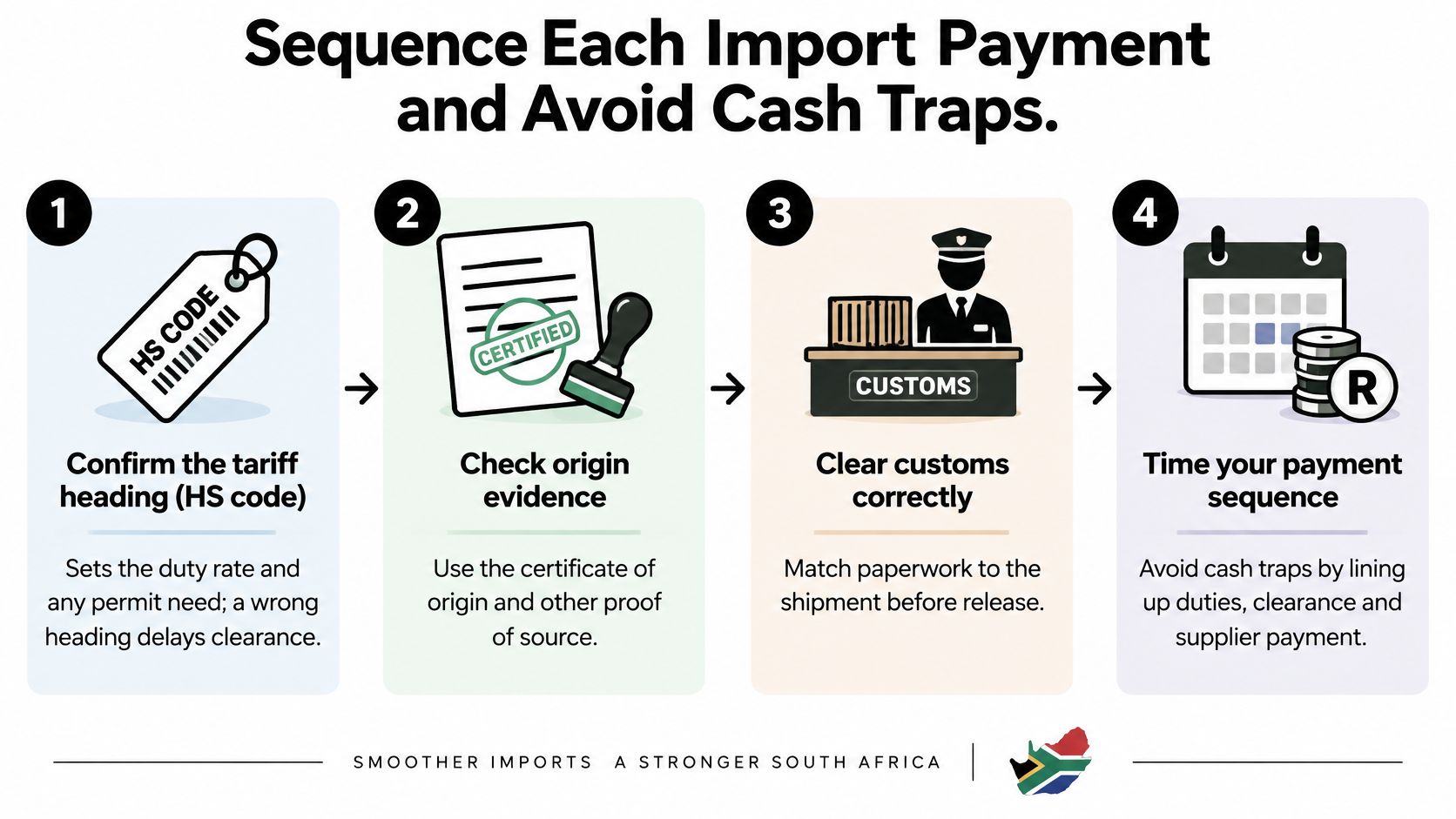
Most import disasters aren't caused by a bad product or a dishonest supplier. They happen when a well-funded shipment meets a missing document, a wrong code or a payment made in the wrong order. Sequencing is how you prevent that.
Run These Steps in Order
- Confirm the tariff heading: the SARS duties and taxes guidance explains that every commercial import must be declared under the correct tariff heading, which determines the applicable customs-duty rate and can also affect import-control permits, rules-of-origin treatment and customs rebates.
- Check origin evidence: obtain the certificate of origin and confirm whether BLNS treatment applies before you model costs.
- Fix the Incoterm and customs value: the duty estimate must use the same basis as the invoice, so both sides are pricing the same shipment.
- Calculate landed cost and border cash: use the Added Tax Value method so the facility covers duty and VAT, not only the supplier.
- Choose the instrument: match supplier risk and payment date to the comparison of letters of credit, collections, credit, facilities and forwards.
- Check the advance-payment threshold: recheck the rand value at settlement, not only at quote stage.
- Confirm Customs registration: do this before money moves, not while goods are on the water.
- Keep the trail: reconcile each supplier payment to its customs entry so any query can be answered from one file.
The Advance Payment Trap
The SARS Advance Import Payments external policy requires an Advance Payment Notification (APN) through eFiling before an authorised dealer processes an advance foreign-exchange payment of R100,000 or more, the importer must also be registered with Customs, and import documentation must generally be submitted within four months of the payment. A payment that starts below R100,000 can cross that line if the currency moves before settlement, so the check belongs at payment date. Split invoices and staged shipments complicate the trail further, which is why each payment needs a shared reference that follows it to the customs entry.
Cheaper FX alone doesn't solve this. A good rate on a payment that can't be matched to proof of importation becomes an expensive problem. Payment timing, invoice matching and the APN workflow decide whether a transaction is genuinely low-cost.
Failure Points and Their Controls
- Classification error: a wrong heading changes duty and can trigger a permit need, so validate the HS code before approving any remittance.
- Missing documents: clearance checks the declaration against the commercial invoice, bill of lading, certificate of origin and permits, and discrepancies can delay release while duties and VAT remain payable.
- Broken payment trail: staged payments without a shared reference can't be reconciled cleanly to the customs entry.
- Late logistics costs: port, freight or insurance invoices arriving after funding turn a funded shipment into a cash gap.
Build one approval gate that validates the HS code, origin evidence, Incoterms, customs value and duty estimate before any supplier remittance or documentary instrument is approved. It also helps to plan these gates alongside broader small business cash flow planning so import deadlines don't collide with payroll, rent and tax dates. One gate, applied every time, stops most cash traps before money leaves the account.
Compare Total Cost Before You Commit
Before any payment, run three checks and don't skip to the quote. First, confirm total landed cost using the border-cash method, covering invoice value, duty, import VAT, port, freight, insurance and the FX margin. Second, shortlist two or three instruments and price each on that same total-cost basis, including every item in the cost stack.
Third, confirm the compliance file. That means the tariff heading, origin evidence, APN status for any advance payment, and a document trail linking each payment to its customs entry. A cheap rate doesn't offset an incomplete file, so treat the quote comparison as settled only after all three checks pass.
The same discipline applies in other import categories, and worked breakdowns such as the total cost of importing a car show how quickly taxes and fees outgrow the purchase price. For general cargo, request a written all-in quote from each provider on your shortlist and compare it line by line.
On our side, we charge a transparent spread on the exchange rate and no SWIFT fees, with pricing based on volume and corridor, and a clear quote provided upon sign-up or by speaking with our team. We're an authorised Financial Services Provider registered with the FSCA, FSP number 55133. The process is sign up and complete KYB verification, fund your ZAR and USD accounts via bank transfer, then make and receive cross-border payments, with cards coming soon.
Take your next shipment and run it through the three checks before you commit to a rate or a facility. Then visit Zaro to sign up, complete KYB verification and get a clear, line-by-line quote for paying your overseas supplier with a transparent spread and no SWIFT fees.