
South African banks cleared 1.13 billion EFT credit transactions in 2024, up from 406.9 million in 2010, and cheque volumes fell by about 43.2% in a single year as businesses abandoned paper for electronic account-to-account transfers, according to the South African Reserve Bank's 2024 National Payment System report. Moving money inside South Africa is, for most finance teams, a solved problem.
Sending that same money to a supplier in Shenzhen, Manchester or Gaborone is a different exercise. The rail is rarely what slows it down. What slows it down is a missing BoP code, an invoice whose amount doesn't match the transfer, a beneficiary name that doesn't match the account holder, and an exchange rate that absorbs one or two percent of the value. Here's how an international EFT works, what it costs, and where the delays hide.
What an International EFT Costs and How Long It Takes
An international EFT from a South African bank carries three costs, not one. There's the transfer fee on the tariff sheet. There's the exchange-rate spread folded into the rate you're quoted, which never appears as its own line. And there are intermediary deductions, taken by banks in the middle of the chain, which reduce what your supplier receives. Two business days is the usual outer limit once the paperwork is complete.
Scale is why the small percentages matter. Formal remittance outflows from South Africa to other SADC countries rose from about R6 billion in 2016 to more than R19 billion in 2024, growth of roughly 216.7%, based on SARB Balance of Payments data collected through its FinSurv system. Over the same period the number of payment service providers authorised to deal in foreign exchange rose from 48 in 2021 to 55 in 2024, a rise of about 14.6%. More providers means more quotes to compare, and more room for a cheap headline fee to hide an expensive rate.
A mature domestic rail doesn't reduce any of this. The domestic clearing system is fast and cheap because it settles one currency inside one set of rules. Foreign exchange, cross-border reporting, correspondent banking and international settlement are separate layers, and each one is priced separately.
The four things you're comparing, not one
| Component | Typical cost or timing | Where it appears |
|---|---|---|
| Transfer fee | Set by bank tariff; varies by amount and bank | Statement line item |
| FX spread | Built into the rate you're quoted; 1% on a R180,000 payment is R1,800 | Rate quoted, not a separate fee |
| Intermediary or SWIFT charges | Can be deducted en route; amount varies by route | Lower amount received by the beneficiary |
| Bank processing time | Up to two business days when documents are complete | Beneficiary account credit |
Four lines, four different places to look. A finance manager who compares quotes on the transfer fee alone is reading a quarter of the invoice.
The transfer fee is the easy one. It sits on the bank's tariff sheet and it moves with the amount sent and the channel you use, with online or app instructions typically cheaper than a branch visit. Ask for the tariff sheet in writing rather than accepting the number a call-centre agent quotes from memory.
The spread is the expensive one, and nobody quotes it as a fee. When a bank gives you a rate, it isn't the mid-market rate you'll see on a currency site. It's that rate plus a margin, and the margin scales with the amount. On a R180,000 payment, one percent is R1,800. Across a year of monthly supplier invoices, it's a junior salary.
Intermediary charges are the ones that surprise people after the fact. If your bank and your supplier's bank don't hold accounts with each other in that currency, a correspondent bank moves the funds in the middle and can take its own fee. That's how a supplier invoices you for USD 10,000 and confirms receipt of USD 9,965.
A rand example you can check against your own quote
Say you need to pay a supplier USD 10,000 and the mid-market rate on the day is R18.00. The pure currency cost is R180,000. If your bank's quoted rate is R18.36, the gap is 2%, and your rand cost becomes R183,600. That's R3,600 you paid without ever seeing a fee line.
Now add an illustrative R350 flat transfer fee. You're at R183,950, before any correspondent bank has touched the payment. If a competitor quotes you "R150 flat" on the same deal, you can't judge it until you see the rate attached. A R150 fee at R18.50 costs you more than a R350 fee at R18.36.
There's a fourth variable with no rand figure attached: whether your documents are complete on the day you submit. A payment captured at 10:00 with the invoice attached and a valid BoP code moves. The same payment captured with "services rendered" in the reference sits in a review queue, and the supplier waiting on it doesn't care which bank caused the delay.
Four steps to compare any two quotes
- Get the mid-market rate for the same moment. Use a live rate source, not the figure a bank last updated on its website.
- Calculate the gap to your quoted rate. Divide the quoted rate by the mid-market rate and subtract one. That percentage is your real FX cost.
- Add every fee on both sides. Yours, the beneficiary's, and any deduction the route allows for.
- Compare total rand cost and the amount the supplier receives. Two numbers, same payment, side by side.
Run that on your last three international payments and a pattern usually appears. Most of the cost sits in step two, not step one.
Ask for it in one sentence: "If I send R180,000 today, what rate will you apply, what fee will you charge, and exactly how many dollars will land in the beneficiary's account?"
A bank that can't answer all three parts in writing before you pay has told you something useful. Request the tariff sheet and an all-in rand quote by email, keep both, then reconcile them against the beneficiary's confirmation when the money lands.
How an International EFT Travels Between Banks
Think of an international EFT as a parcel handed between sorting offices. Your bank accepts it at the counter, a second office sorts it for the destination country, a third confirms the handover, and only then does it reach the address. Every handover adds time, and every handover is a place where a fee can be taken.
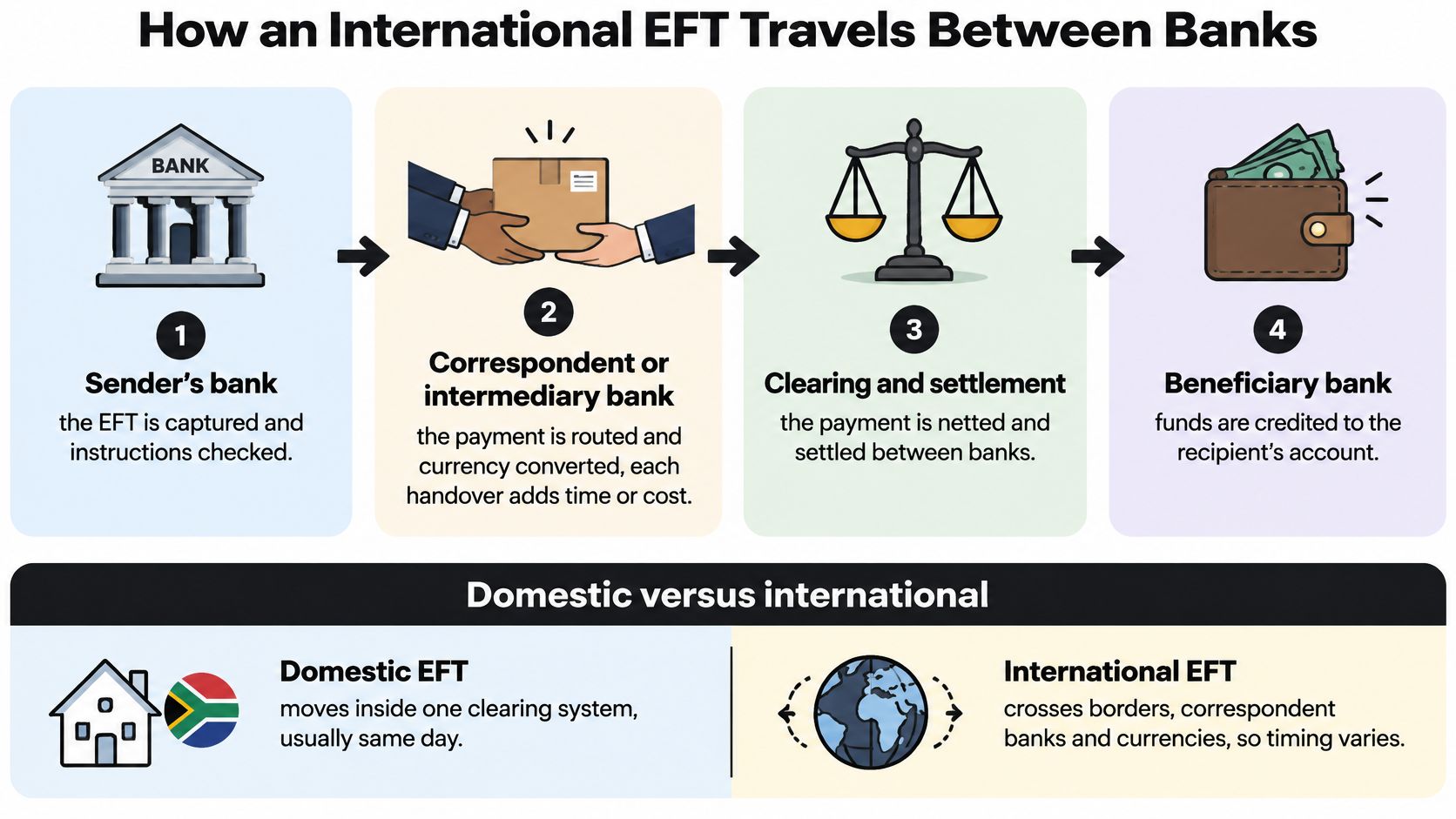
Stage one, your bank captures the instruction. The sending bank debits your rand account and checks the instruction against your mandate, your available balance and the beneficiary details on file. A mismatch between the account holder's name and the name you typed stops the payment here, before it has gone anywhere.
Stage two, the rand becomes the payment currency. If you're paying a US supplier, the bank converts rand into dollars at its own rate, and that's where the spread enters the transaction. Paying in the beneficiary's currency where you can is usually cheaper than letting a second conversion happen at the other end.
Stage three, the payment message goes out. The bank transmits the instruction, typically over SWIFT, to the beneficiary's bank or to a correspondent bank that holds the currency account for the destination.
Stage four, the beneficiary bank credits the account. Funds land once the correspondent has passed them on. Until that moment, the supplier sees nothing, even though your account has been debited for days.
Four fields travel with every handover: the beneficiary's legal name, the account number or IBAN, the bank identifier (a SWIFT/BIC code, or an IBAN that embeds one), and the payment reason. Any mismatch on those fields becomes a query that travels back up the chain, and the delivery clock only restarts when you answer it.
The regional rule that changes the route
Payments to Namibia, Lesotho and Eswatini don't automatically follow the same path as a payment to Germany. Under the SARB's payment system framework for cross-border transfers, payments involving Common Monetary Area countries can run as EFT credits, EFT debits or SWIFT transfers, and obligations cleared through a South African payment clearing house must settle in rand through the South African Multiple Option Settlement (SAMOS) system by or to the relevant sponsoring bank. Those flows must also be reported separately from domestic payments.
That matters commercially. A payment can travel across domestic clearing infrastructure and still be classified and reported as cross-border, so the route your bank picks affects how the payment is recorded as well as when it lands. Before your next regional payment, ask which route it will take and which currency it will settle in. The answer tells you where the deductions can appear.
Documents and Codes That Keep Payments Moving
A supplier invoice for R180,000 can leave your account and still sit at the receiving bank because the reason code says "services" and the paperwork says goods. The rail did its job. The file did not.
A Balance of Payments (BoP) code is the short category that tells the authorities why money is crossing the border. Cross-border payments are reported to the Reserve Bank through the FinSurv system. A description such as "services" or "payment for invoice" gives a reviewer nothing to file. Treat the code the way a customs officer treats a tariff line: the closest match on your bank's published list, copied in that list's exact wording into the payment reference, not into a covering email that the clearing system never sees.
Two more details decide whether the payment moves. The payer name on the transfer must match the registered business name on your documentation. Zaro is FIC registered and meets FICA requirements for anti-money laundering and know-your-customer compliance, so the sender name has to be the registered entity, not a trading name or a group brand. The beneficiary side follows the same rule. The name must match the account, not the logo on the invoice header.
What to keep for each kind of payment
| Payment case | Documents to keep | Usual hold trigger |
|---|---|---|
| Supplier goods import | Invoice, bill of lading, BoP goods code | Invoice amount differs from payment amount |
| Service import (contractors, software) | Signed contract or order, invoice, BoP services code | Vague payment reference |
| Export proceeds received | Sales invoice, export shipping documents, BoP export code | Payer name differs from customer name |
| Refund to overseas customer | Original transaction record, refund reason, BoP code | Reason not explained |
| Intercompany transfer | Intercompany agreement, invoice, BoP code | Recipient entity unclear |
| Recurring contractor payment | Standing contract, monthly invoice, BoP code | Same description used for different services |
Read the third column before you press send. You control every row on it. An amount mismatch is usually a partially paid invoice, a bank charge you left off the instruction, or two purchase orders merged into one transfer. A vague reference is the easiest trigger to avoid. Reusing "consulting services" for six contractors in four countries is the trap finance teams fall into most often, because the wording looks tidy and the reviewer still cannot tell the jobs apart.
The audit pack that ends most arguments: one folder per payment, holding the invoice or contract, the shipping or service document, the BoP code you used, and the proof of payment. Store it where an auditor or a bank reviewer can find it a year later.
When a payment passes through more than one institution, coordinating sending and receiving banks before the first transfer, with the beneficiary's registered details confirmed in writing on both sides, removes most of the corrections that follow a rejected field. Twenty minutes confirming an account number costs less than a week explaining a returned payment to a supplier who has paused your order.
If the category is unclear, the free BoP code checker finds the likely BoP category for an export receipt or import payment, copies bank-ready wording for the reference field, and shows which documents to have ready before you submit.
Payment Endpoints and Corridors That Change Delivery
Delivery is decided after the rand leaves your bank. The receiving endpoint, and the corridor that joins the two countries, sets both the clock and the cost.
An account-to-account credit works like handing a sealed envelope to a named clerk. Funds land in a business account, the beneficiary can see them, and the reference field shows on the statement. If your supplier or contractor has a working business account, send there. When a finance manager asks whether the invoice number will survive the trip, this endpoint is the one most likely to keep it.
A mobile wallet depends on the local operator and its registration rules. The credit can show in minutes, or sit for a day while the recipient finishes a verification step neither side was told about. Keep the registered wallet name and number in the same pack as the invoice. A mismatch here is a data error, not a slow network.
Cash pickup adds a payout step and often a second charge at the collection point. Choose it when the beneficiary has no bank account. When they do have one, that extra handover is money spent on a step you did not need, and the collection agent may drop the invoice wording your auditor later wants.
Corridors do not behave alike. Remittance costs and interoperability vary by route: one corridor can load a wide exchange-rate spread and a payout fee onto the same transfer, while a neighbouring corridor prices a thinner spread and maps fields more cleanly. Speed on the local rail stops at the border. What crosses is only as clean as the name, account number and currency code you typed, and a field your South African bank accepts can still be stripped or rejected at the far institution.
Match these fields to the corridor before you send:
- Beneficiary legal name, exactly as the receiving institution holds it
- Account or wallet number, with no transposed digits
- Bank name plus branch code or SWIFT/BIC, matching the country of the account
- Country and payment currency, since the settlement currency may not be the one on the invoice
- Endpoint type, so you know whether you are funding an account, a wallet or a collection point
Send a small test amount on any corridor you have not used. A R500 test that reveals a wrong branch code costs far less than a R250,000 supplier payment that bounces three weeks before a production deadline. The test also shows whether the reference, the currency and the endpoint type arrived intact. That paperwork check is the cost headline fee tables leave out.
Common Delays and How to Fix Them
Once the documents are right, the delays that remain are mechanical. They come from cut-off times, field mismatches and charge allocation, not from the network being slow.
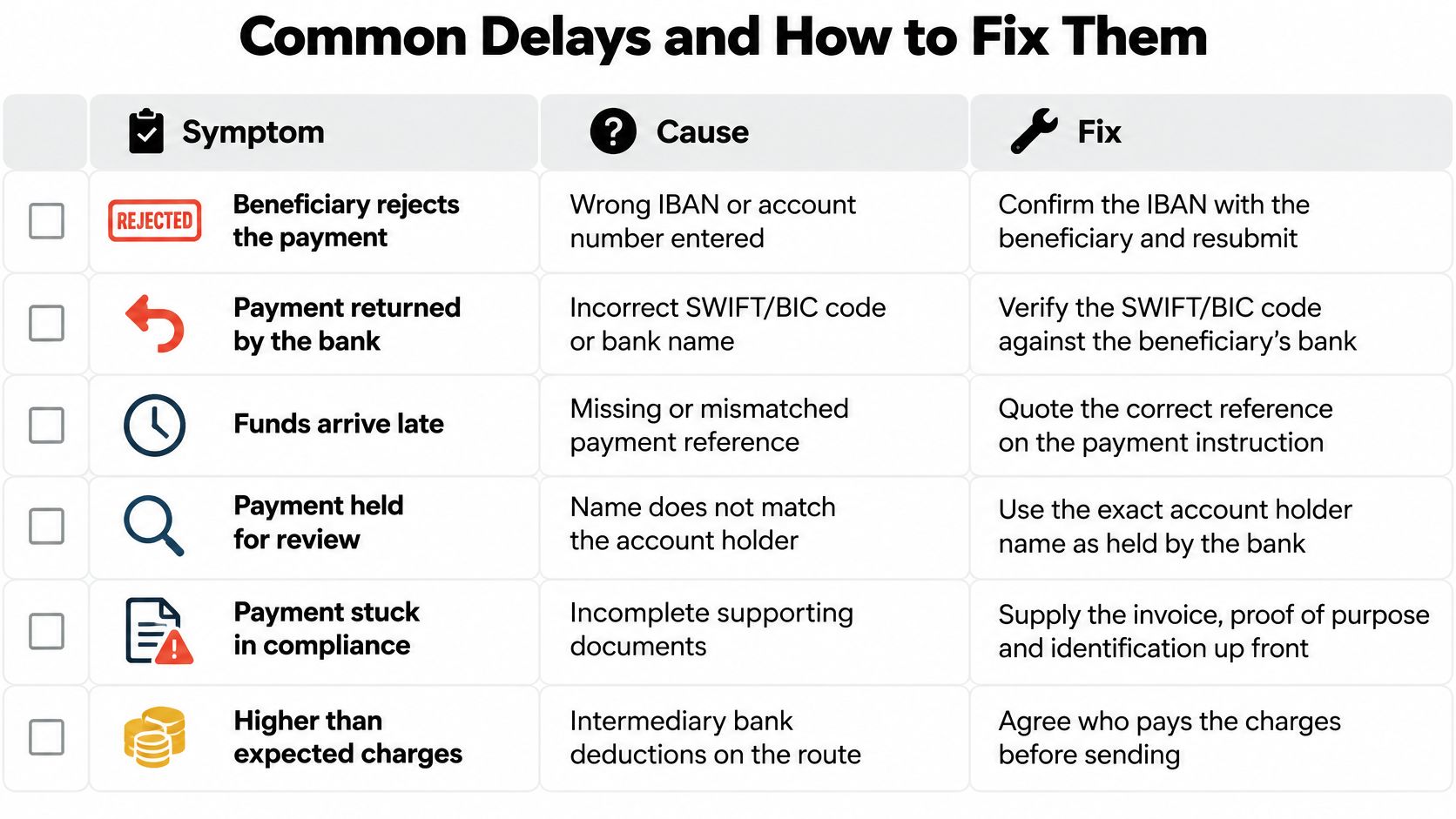
| Symptom | Likely cause | Fix |
|---|---|---|
| Beneficiary rejects payment | Wrong IBAN, SWIFT/BIC or account digits | Verify details with the beneficiary bank in writing |
| Beneficiary receives less | Intermediary deduction | Ask for the sender-pays charges option where available |
| Delay past the bank's processing window | Missed cut-off or missing document | Send before cut-off with supporting documents attached |
A rejected payment almost always traces back to a wrong digit or a mismatched bank identifier, and the fix is verification with the beneficiary's bank, not with the beneficiary's email signature. Confirm new account details by phone using a number you already hold, because invoice fraud works by sending you a convincing "updated banking details" message that changes exactly one digit.
A short receipt is a charge allocation problem. Intermediary deductions come off the amount in transit unless the charges instruction says otherwise, so ask for the sender-pays option where your bank offers it, then check the deduction against the all-in quote you were given. If the gap is bigger than the quote implied, that's a question for your bank, not your supplier.
A delay past the processing window is usually a missed afternoon cut-off or an attachment that never made it onto the instruction. Submit early in the day, attach the supporting document to the payment itself rather than emailing it separately, and keep the submission timestamp.
A rule that saves hours: confirm every new beneficiary account by phone, using a number you already have on file, never a number printed on the invoice.
This walkthrough covers the same sequence if you'd rather watch than read:
If reconciling these payments is where your team loses time, compare accounting outsourcing options before you add headcount. Matching a bank debit to an invoice, a BoP code and a supplier statement is repeatable work, and it's the part most likely to fall behind when payment volumes rise.
Confirm the Route Before Your Next Payment
You have three routes for the next international payment, and the right one depends on the numbers rather than the marketing.
A bank SWIFT or EFT transfer keeps everything inside your existing banking relationship. The spread and any intermediary deductions sit inside the rate, so the total cost has to be reconstructed rather than read off a statement.
A specialist provider should give you the all-in rand cost before you commit, including the rate they'll apply. Compare that single number against your bank's reconstructed total for the same payment on the same day.
A small test payment on a new corridor tells you more about delivery time and endpoint behaviour than any published timetable. Send it early in the month, not the week a supplier deadline lands.
The test: if you can't state the all-in rand cost of your last five international payments, you're choosing a provider on faith.
Zaro is one option for South African businesses that pay and receive across borders. You sign up and complete KYB verification, fund your ZAR and USD accounts by bank transfer, then send and receive international payments, with cards coming soon. We charge a transparent spread on the exchange rate and no SWIFT fees, pricing depends on volume and corridor, and fees are disclosed before a transaction is confirmed.
Route choice is only half the control. Stronger payables controls and fraud prevention, starting with call-back verification of every new beneficiary account, will stop more money leaving than a better exchange rate will save. Build both.
Then do one thing this week. Pull your last five international payments, write down the all-in rand cost of each one, and request written quotes from two routes for the next payment you know is coming. The comparison takes an afternoon. The answer changes how you budget the year.
Zaro gives South African businesses ZAR and USD accounts funded by ordinary bank transfer, so you can see the exchange rate and the fee before a payment is confirmed rather than reconstructing them from a statement afterwards. If your supplier invoices are landing in foreign currency and the cost is still a mystery, get a live quote on your next payment. Visit Zaro to compare the all-in rand cost against what your bank charged you last month.