
Month-end in a South African business is rarely about one payment. It's a stack of them. USD customer receipts are still floating somewhere between counterparties, a EUR supplier wants proof of value date, your Shenzhen invoice has picked up an unexplained bank deduction, and the rand has moved enough in a few days to turn a decent gross margin into an awkward board slide.
That's the moment when they realise they never had a payment gateway problem. They had a cross-border infrastructure problem.
Too many buyers still evaluate an international payment gateway like it's a prettier checkout page. That's the wrong frame. If you're based in South Africa, the question is whether the provider helps you collect, convert, settle, report, and reconcile money across borders without leaking margin at every handoff. If it can't do that, it's plumbing theatre.
The Cross-Border Problem South African Finance Teams Actually Face
A Randburg finance manager and a Stellenbosch exporter usually describe the same pain in different language. One says cash flow is unpredictable. The other says margins are getting chewed up. They're talking about the same four frictions.
Volatility, delay, opacity and suspicion
First, currency volatility. You quote in foreign currency, but you report in rand. If your collections arrive late or your conversion timing is poor, finance wears the hit.
Second, settlement delay. A payment approved today doesn't always mean money available today. There's a big difference between “processed”, “sent”, “received”, and “reconciled”. Boards don't care about the distinction. Treasury does.
Third, opaque charges. The worst costs don't sit on the invoice from the provider. They surface as FX markups, intermediary bank deductions, or deductions your supplier notices before you do.
Fourth, regulatory friction. South African cross-border flows are treated as something that must be explained, coded, checked, and reported. That's not paranoia. It's the operating environment.
Practical rule: If your provider markets convenience before settlement visibility, expect pain at month-end.
South Africa isn't a side market
Anyone still treating South Africa as a small peripheral corridor is missing the scale of the issue. In one major cross-border payment flow study, South Africa accounted for 78.16% of total value in the sub-Saharan sample, at USD 1,022,468,162 over the latest measured 12-month period, with average year-on-year growth of 124.96% and 44 unique merchants in the sample according to the South African Reserve Bank cross-border payments study.
That matters because a proper international payment gateway for South African businesses must do more than accept a foreign card. It must handle high-volume, fast-growing corridor activity with clean reporting and predictable settlement.
What finance teams should demand
Before you compare vendors, decide what problem you're solving:
- Collections problem: You need export receipts to land with fewer deductions and cleaner reconciliation.
- Payout problem: You need to pay offshore suppliers or contractors without mystery bank fees.
- Control problem: You need approval workflows, auditability, and role separation.
- Compliance problem: You need a provider that won't leave your team scrambling for documentation after funds move.
An international payment gateway earns its keep when it reduces those frictions together. Not when it gives marketing a nicer payment button.
What an International Payment Gateway Really Does
Think of an international payment gateway as a freight forwarder for money. It doesn't always hold every asset or own every rail. It routes, clears, validates, and hands over value across different systems so your payer and beneficiary can complete a transaction without seeing the mess underneath.
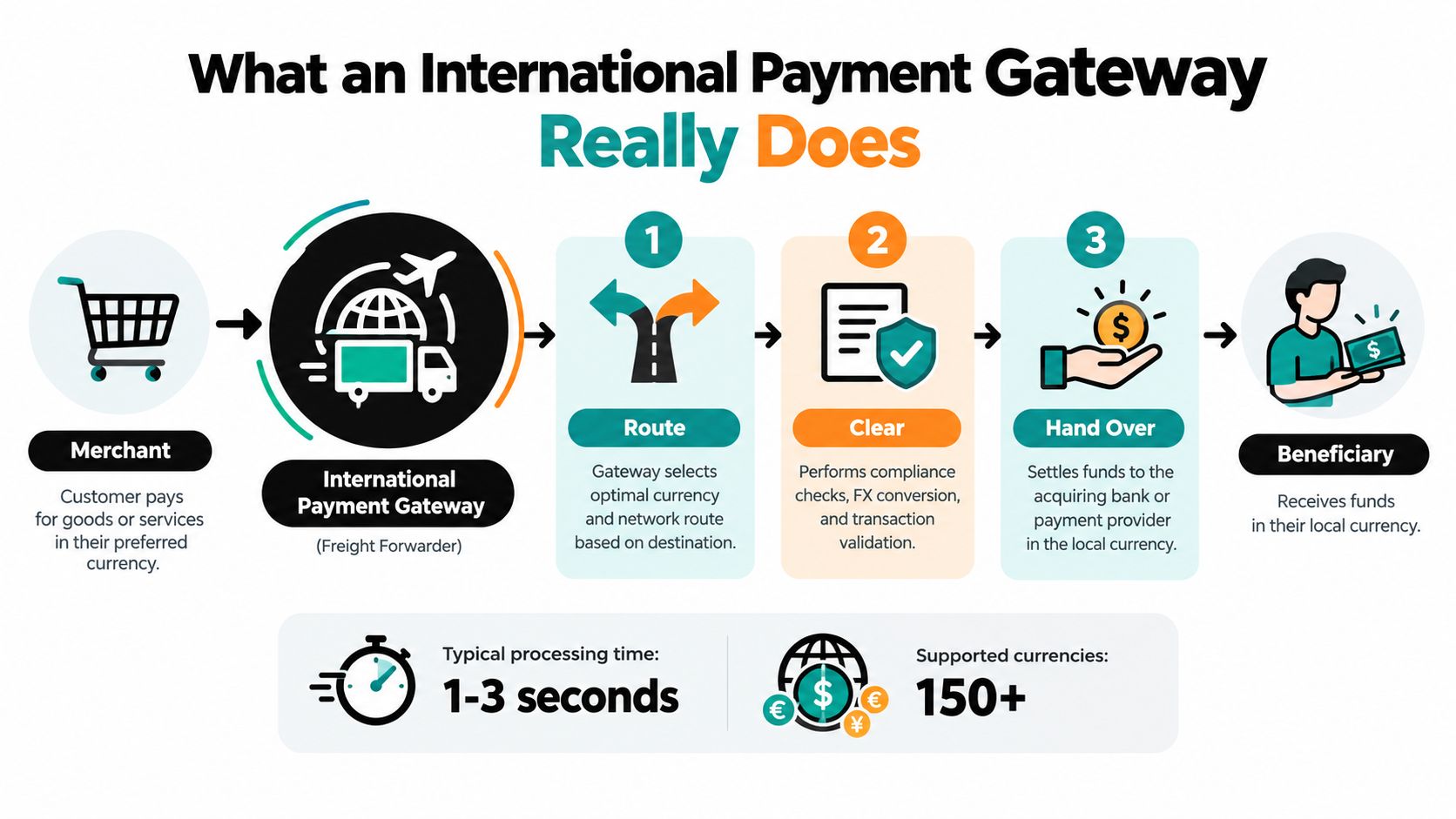
It starts with transaction submission
The transaction enters the gateway through a checkout page, payment link, API call, ERP trigger, or batch payout file. The instruction gets packaged with the basics. Amount, currency, beneficiary, purpose, and reference data.
For South African finance teams, this step matters because bad input data creates downstream reporting pain. If your gateway can't preserve invoice references and payment purpose cleanly, reconciliation gets ugly fast.
Then the gateway screens and validates
Before money moves, the provider typically runs compliance checks. Sanctions screening, AML logic, identity checks, beneficiary validation, and transaction monitoring happen here.
That's where a checkout-focused tool and a cross-border infrastructure provider diverge. A card processor may be excellent at authorisation and fraud checks for online sales. It may still be weak at beneficiary screening, payout controls, or cross-border documentation support.
Most buying mistakes happen when a business chooses a good ecommerce processor for a treasury problem.
FX is where honesty gets tested
If the transaction needs conversion, the provider either applies a quoted rate, executes FX through a partner, or settles from a pre-funded balance. This is the point where many “low-fee” products recover margin.
A serious provider tells you how the rate is determined, when it's locked, whether it moves during approval, and whether the spread is disclosed separately. If they can't answer in plain language, assume the rate is doing the commercial heavy lifting.
After that, the money rides the available rails
Settlement may happen through correspondent banking, a local clearing relationship, an in-country partner, or an internal multi-currency balance model. The route depends on currency pair, destination, cutoff time, and the provider's network.
That routing layer is why two providers can both claim international capability while delivering completely different outcomes on speed, traceability, and deductions.
The last step is beneficiary delivery and reconciliation
The beneficiary receives funds, confirmation is generated, and your finance team needs a usable audit trail. Not a vague “completed” status. A real trail with timestamps, references, rate details, and settlement data.
Checkout gateway versus finance gateway
These are not the same buying category:
- Checkout-led gateway: Best when your main problem is taking payments from foreign customers online.
- Payout-led gateway: Best when your main problem is sending supplier, contractor, or treasury payments abroad.
- Hybrid provider: Useful when you both collect and pay across borders and want one control layer.
A lot of South African firms need the third category. They just don't describe it that way yet.
The True Cost of Moving Money Across Borders
The advertised fee is rarely the fee. Finance teams know this instinctively, but many still compare providers on the wrong line item.
The honest way to price an international payment gateway is simple. Ask what it costs in rand to move value from payer to beneficiary, fully settled, fully converted, fully reconciled.
The hidden cost stack
A single cross-border payment usually includes several layers:
| Anatomy of a Cross-Border Payment Cost Stack | ||
|---|---|---|
| Cost Layer | Typical Range | Where It Hides |
| FX spread | Varies by provider and corridor | Inside the quoted exchange rate |
| Correspondent or third-party bank charges | Varies | Deducted in transit or netted from beneficiary amount |
| Card scheme and acquiring costs where card rails are used | Varies | Bundled into transaction pricing |
| Platform or payout fee | Varies | Shown on tariff sheets or statements |
| Settlement delay cost | Qualitative but real | Working capital drag while funds are in transit |
I'm being deliberately blunt here. “No transfer fee” often means “we'll earn it in the FX”.
What matters more than the headline fee
Take a large supplier payment from South Africa into Europe. The visible platform charge may look manageable. The damage usually comes from four quieter leaks:
- Rate slippage: You approve at one point, the conversion happens later, and treasury carries the move.
- Intermediary deductions: The beneficiary receives less than expected and asks you to top up.
- Misaligned rails: The provider uses a route that's cheap for them, not clean for you.
- Cash in transit: Funds sit between systems while your payable is technically gone but not commercially settled.
Compare providers on the delivered amount, the final rand cost, and the time to usable confirmation. Everything else is sales choreography.
South African corridors are still expensive
This isn't a theoretical complaint. Cross-border remittances linked to South Africa remain expensive. A South Africa-Zimbabwe corridor technical assistance report found remittance costs as high as 12.7%, while another South African Reserve Bank-linked study estimated the average cost of a typical USD 55 transfer at 13.6%. The same IMF-linked source also notes FinMark research showing formal remittances reached R10.56 billion in 2018, with total market size rising from R16.6 billion in 2016 to R21.87 billion in 2018, which underlines both the scale and fee sensitivity of these flows in South Africa, as set out in the IMF technical assistance report on South Africa-Zimbabwe cross-border payments.
Those figures are about remittance corridors, not every corporate payment type. But the lesson carries over. Cross-border pricing in South Africa is still full of friction, and finance teams should assume hidden cost unless transparency is proven.
The CFO test for any quote
When a vendor sends pricing, ask these questions in writing:
- What exchange rate benchmark are you using?
- Is the spread shown separately from the transfer fee?
- Can intermediary bank deductions still happen?
- When is the rate locked?
- What reference data returns with settlement confirmation?
If the answers arrive wrapped in marketing language, move on.
Regulation, FX Controls and Compliance in South Africa
Cross-border payments in South Africa don't sit in a casual regulatory environment. They run through a framework built around exchange control, reporting, anti-money laundering duties, and bank intermediation. If your provider pretends this is back-office admin, they either don't understand the market or expect you to carry the risk.
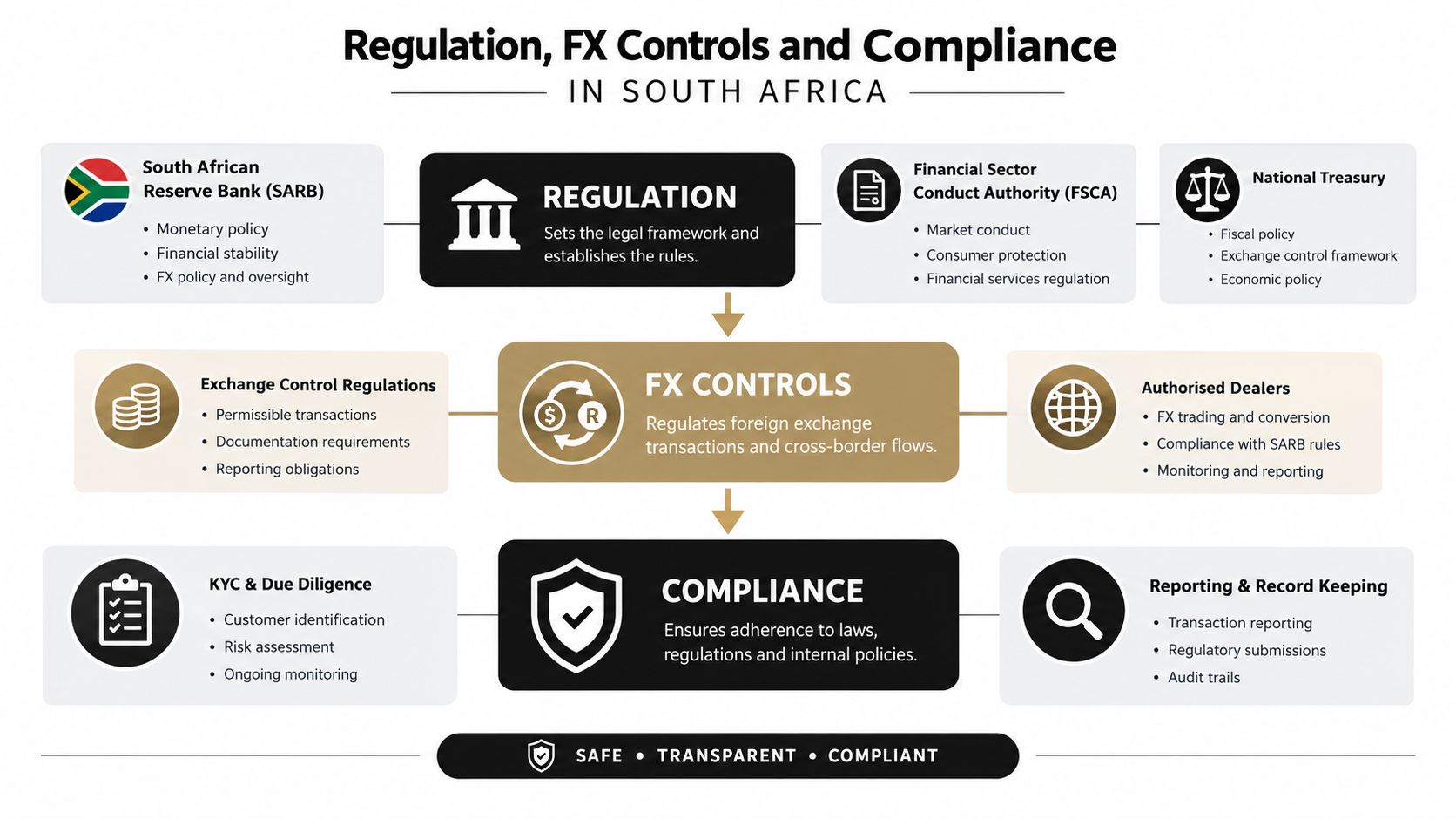
What corporates need to understand
Most businesses don't need to master every legal instrument. They do need to know who in the chain is licensed, who is performing reporting, and who is responsible when a transaction gets queried.
An international payment gateway operating into or out of South Africa will usually depend on regulated banking or authorised dealer infrastructure somewhere in the flow. If the vendor can't explain that structure clearly, procurement should stop there.
Where the rules are moving
The regulatory direction matters as much as the current state. The Reserve Bank has said that payment facilitators in South Africa are currently not regulated, while also signalling a tighter cross-border framework through draft circulars and a 2026 directive covering offshore merchants, settlement, and reporting, as explained in the South African Reserve Bank cross-border regulation release.
That's the practical issue many buyers miss. A gateway isn't just a software vendor anymore. It sits in a changing compliance perimeter.
Here's a short explainer before the video below.
What to ask a provider
Don't ask whether they're “compliant”. Everyone says yes. Ask narrower questions.
- Licensing chain: Which regulated entity handles settlement and in which jurisdiction?
- Reporting support: What transaction data do you return for balance-of-payments or other bank reporting needs?
- Screening process: How are counterparties and beneficiaries screened before release of funds?
- Exception handling: What happens when an authorised dealer or partner bank asks for documentary support?
If a gateway only talks about checkout conversion and never mentions reporting, settlement structure, or partner disclosures, it isn't built for South African finance reality.
Grey areas are procurement risks
The dangerous vendors aren't always fraudulent. Many are vague. They use broad language like global accounts, borderless transfers, or instant settlement while the legal and settlement chain remains hidden.
Treat that vagueness as a red flag. Your team needs to know whether the provider is licensed directly, relies on bank partners, or operates through a payment facilitator model that may face changing treatment under South African cross-border rules.
The procurement filter is simple. If they can't show the entity map, compliance flow, and documentation path, they haven't earned your volume.
Fee Models and Integration Options Compared
The right integration model depends on your payment pattern, not your admiration for good product design. South African exporters, BPO operators, and SaaS firms often buy the wrong setup because they inherit a tool chosen for sales or ecommerce, then ask finance to live with it.
Four common models
| International Payment Gateway Fee and Integration Models for South African Businesses | |||
|---|---|---|---|
| Integration Model | Typical Per-Transaction Fee | FX Spread | Best Suited For |
| Hosted checkout | Varies by provider | Often embedded in the rate | Online merchants collecting from foreign customers |
| API-first gateway | Varies by provider | May be disclosed or embedded | SaaS platforms, marketplaces, finance-led operations needing control |
| Embedded finance in ERP or workflow tools | Varies by provider | Depends on partner model | Mid-sized firms wanting payment controls inside operations |
| Bank-direct or bank-partner rails | Varies by bank and route | Often negotiated or relationship-based | Larger importers and exporters with treasury oversight |
I'm not giving you fake precision here. The exact fees differ too much by provider, corridor, and contract. What matters is where the economics sit.
Hosted checkout is fine for sales, weak for treasury
If you sell online to offshore customers, a hosted checkout can work well. It's quick to launch, easier for smaller teams, and usually good enough for basic collections.
Its weakness is operational depth. Treasury teams often discover later that the provider is strong on card acceptance and weak on multi-currency settlement, payout orchestration, or finance-grade reconciliation.
API-first works when finance and product cooperate
API-first providers suit firms that need control over payment flows, approval logic, and downstream data. If you run recurring offshore billing, platform payouts, or mixed inbound and outbound flows, this model gives you room to build around real operational needs.
For companies that want a tool purpose-built around business cross-border movement rather than consumer checkout, Zaro is one example of a platform focused on sending and receiving international business payments with ZAR and USD accounts, KYB onboarding, multi-user controls, and spot-rate based FX mechanics.
ERP-embedded options reduce manual damage
This model is underrated. If your finance team lives inside an ERP or accounting workflow, embedded payments can reduce copy-paste errors, missing references, and approval gaps.
It won't suit every business. But for firms with regular supplier runs and a modest internal systems team, it can beat a glamorous standalone dashboard that finance has to reconcile manually afterwards.
Bank-direct still matters for some firms
Banks are often slower to modernise the user experience, but they remain relevant for businesses that need documentary trade support, relationship pricing, or tight treasury governance.
This route usually makes sense when:
- Documentation is heavy: Trade paperwork and purpose codes matter every week.
- Treasury is centralised: Group finance wants one relationship for control.
- Volumes justify negotiation: You have enough flow to push for better commercial terms.
The right choice is profile-specific. A BPO paying many offshore contractors won't choose the same model as a wine exporter collecting foreign receipts or a software company funding subscriptions.
Security and Compliance Best Practices for Gateways
Most vendor security decks are designed to calm procurement, not inform finance. You'll see badges, acronyms, and a reassuring tone. That isn't enough. A gateway touching cross-border funds needs controls your team can test, not slogans you can paste into a board pack.
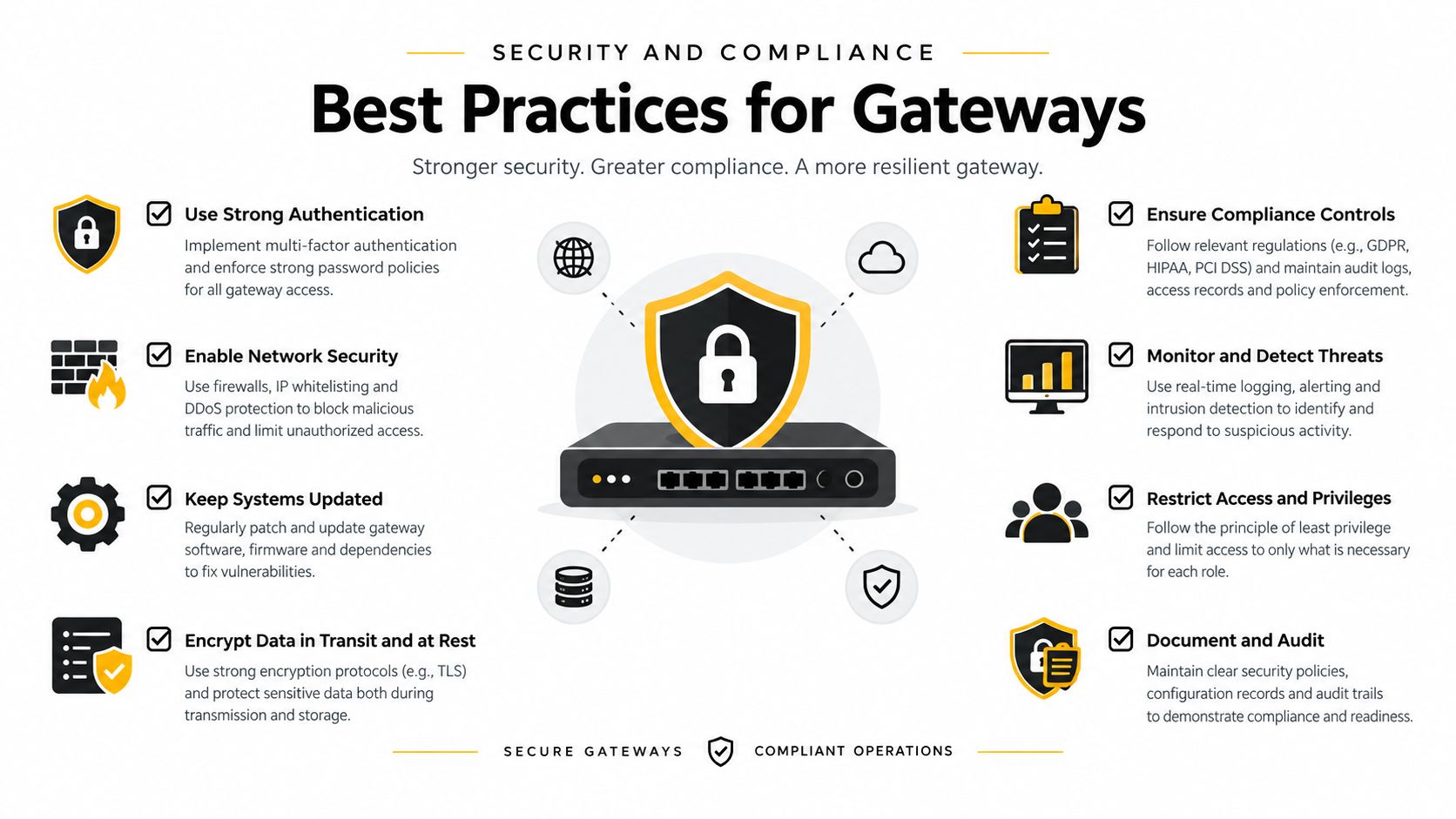
Ask questions that expose the real operating model
Start with the basics, but don't stop there.
- Card data scope: If card acceptance is part of the flow, what PCI DSS scope applies and what does the merchant still own?
- Access control: Can you enforce role-based permissions, dual approvals, and least-privilege access?
- Operational logging: Are audit logs exportable, readable, and complete enough for finance review?
- Incident response: Who contacts you, how quickly, and what information do you get during an event?
A useful engineering cross-check is whether the provider takes code quality and control evidence seriously. If your technical team wants a benchmark for disciplined review practices, audit-ready code review with DevArmor is a practical reference point for what mature control thinking looks like in software delivery.
Security controls finance should insist on
A good gateway should support day-to-day prevention, not just compliance theatre.
Approval and authority controls
Insist on maker-checker workflows for payments, changes to beneficiary details, and permissions. One person should not be able to create a beneficiary, release a payment, and alter the audit trail.
Session and access hygiene
Look for SSO support where possible, enforced multi-factor authentication, IP restrictions for admin functions, and clear device or session management. Fraud doesn't always start with a breach. Sometimes it starts with stale access and weak internal discipline.
Transaction monitoring that catches human error too
The best controls don't just look for criminal patterns. They catch operational mistakes. Unusual beneficiary changes, amount spikes, duplicate references, and new corridor usage should trigger review.
A lot of payment losses start as finance errors that nobody intercepted in time.
Data handling and compliance reality
South African buyers sometimes overfocus on whether data stays local. The more useful question is whether the provider can support POPIA obligations through contracts, access controls, processor disclosures, and incident procedures. Plenty of credible providers process offshore while still meeting sensible governance expectations.
For AML and counterparty compliance, ask the vendor to explain in plain English:
- How they screen senders and beneficiaries.
- When they escalate to enhanced due diligence.
- How suspicious activity is internally reviewed and documented.
- What audit evidence they can provide after the fact.
If they answer in jargon, that usually means operations is being hidden behind sales.
Choosing and Switching to the Right Gateway
If you remember one thing, make it this. Choose for landed cost and settlement certainty, not for interface charm. South African businesses don't lose money because a checkout was ugly. They lose money because rates were vague, reporting was weak, deductions were hidden, and reconciliations arrived too late to fix anything.
Weight your scorecard like a finance team, not a marketing team
Here's the shortlist framework I'd use.
| Procurement scorecard for international payment gateways | |||
|---|---|---|---|
| Criterion | Weight (%) | What good looks like | Red flag |
| FX spread transparency | High | Clear explanation of rate source, timing, and markup treatment | “Competitive rates” with no methodology |
| SARB-aligned reporting support | High | Returns usable payment data and documentation support | No answer on reporting or authorised dealer dependencies |
| Settlement certainty | High | Clear payout path, references, and exception handling | Vague status labels and no route clarity |
| Reconciliation quality | Medium to high | Exportable data with invoice-level references | Manual statement matching |
| Controls and permissions | Medium | Dual approvals, roles, audit logs | Shared logins or admin sprawl |
| Local support quality | Medium | Responsive support that understands ZA cross-border issues | Offshore-only support reading scripts |
| Integration fit | Medium | Matches your operating model | Tool chosen because it demos well |
I'm avoiding fake numerical weighting because your profile changes the ranking. But the order above is the right default for most South African firms.
Match the gateway to the business model
Different businesses should shortlist differently.
Exporters
Prioritise inbound collections, FX transparency, dual-currency handling, and clean proof of settlement. If export revenue is your lifeblood, don't let a provider distract you with card feature lists you'll barely use.
BPO and contractor payers
Focus on payout orchestration, beneficiary controls, batch capability, and approval workflows. Support volume matters, but data integrity matters more. A fast payout process that creates reconciliation chaos isn't efficient.
SaaS and subscription businesses
You may need both worlds. Strong checkout capability for collections, plus a sensible way to handle offshore operating spend, refunds, vendor payments, or platform disbursements. Don't assume one provider is automatically good at all of it.
Buy for your dominant cash movement first. Add adjacent capability second.
Red flags that should end the conversation
Walk away if you see any of these:
- Undisclosed third-party charges: They “may apply” but nobody can explain when.
- Compliance hand-waving: Lots of badges, no entity map.
- Support without ownership: Sales is local, operations is invisible.
- Reconciliation as an afterthought: CSV dumps with weak reference structure.
- One-size-fits-all positioning: The same pitch for ecommerce, treasury, and payroll.
A practical 30-day switching plan
Switching gateways doesn't need a six-month drama. It does need discipline.
In the first week, map payment types. Separate inbound collections, supplier payments, subscriptions, refunds, and exceptional manual flows. Then map the fields you need preserved. Invoice number, customer reference, beneficiary name, approval record, and settlement timestamp.
In the second week, onboard and test with a small but representative set of transactions. Include at least one awkward case. New beneficiary, unusual currency path, document-backed payment, or a transaction close to cut-off.
In the third week, run both systems in parallel. Keep thresholds for exception review tight. Treasury, finance ops, and whoever owns compliance support should sign off together, not sequentially.
By day 30, hold a hard reconciliation review. Don't ask whether the new provider feels better. Ask whether landed cost is clearer, settlement data is stronger, and fewer people are chasing payment status manually. If not, you haven't switched infrastructure. You've just changed logos.
Zaro is built for the part of the international payment gateway problem that South African finance teams care about: moving money across borders with clearer FX, cleaner controls, and less dependence on expensive legacy transfer rails. If you want to compare your current setup against a platform designed for business collections and payouts rather than generic checkout plumbing, visit Zaro.