
Your German supplier's invoice arrives on a Tuesday, for €9,400 of components, payment due in 30 days. You approve the transfer that afternoon and the rand leaves your account before close of business. Three days later the supplier emails to say the money has landed, but it's short of the invoice, and nobody can point to the step where the difference disappeared.
That small unexplained gap is what international payments look like from the inside. At national scale the flows are enormous: merchandise exports rose from R1.054 trillion in 2016 to R1.922 trillion in 2023, while services receipts grew from R219.7 billion to R263.0 billion, according to SARB balance-of-payments data. Every one of those rands crosses at least one border, and each crossing carries a price and a wait.
What follows is the chain in order: who touches the money, where it shrinks, how the rate is set, why some payments land in minutes while others take a week, and what a finance team can control before anything leaves the account.
How an International Payment Moves from Your Bank to the Beneficiary
Say a Johannesburg business that builds packaging machinery owes a German supplier for a set of servo motors. The finance manager approves the invoice on Monday morning and instructs the bank. The rand leaves the account that afternoon. What happens next is invisible from the dashboard.
Think of an international payment as a parcel passed along a chain of post offices. Each handler stamps it and moves it on, and some of them charge for the stamp. The parcel arrives. It's just lighter than when it left.
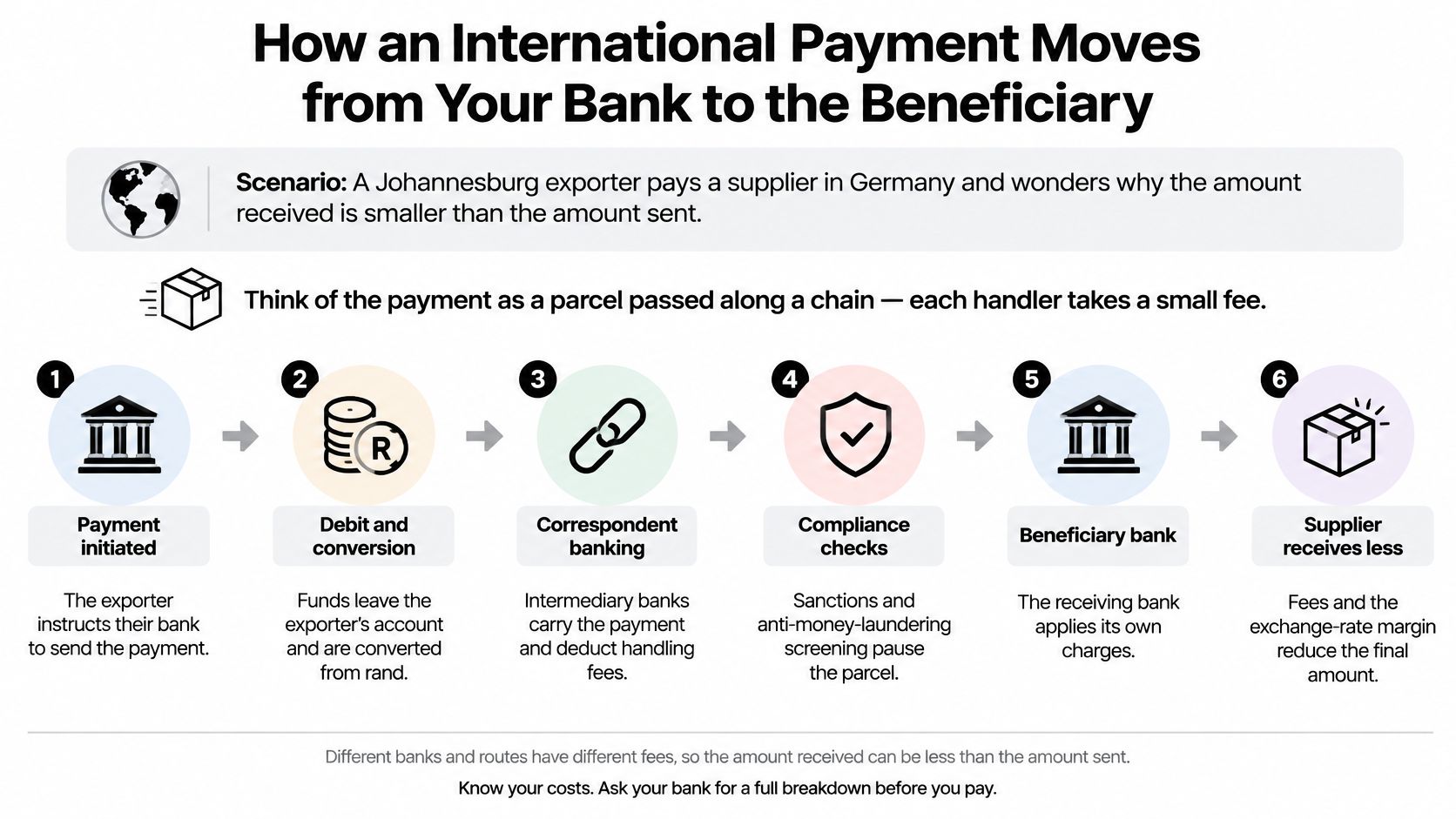
Step one, the instruction. Your bank doesn't move currency at this point. It sends a payment message over SWIFT, the network most banks use to exchange payment instructions, carrying the amount, the currency, the beneficiary details and a purpose. A transposed digit or a blank purpose field causes more delay than any downstream bank.
Step two, the correspondent. Your bank may not hold euros itself. When it doesn't, a correspondent bank that does hold euros moves the funds between accounts. This is the classic place for a deduction, because the intermediary takes its handling charge out of the amount in flight rather than billing you separately.
Step three, the compliance check. The receiving bank screens the payment against sanctions and anti-money-laundering rules before it credits anything. A payment that raises a question doesn't bounce back the same day. It sits, and someone has to answer questions about who is being paid and why.
Step four, the credit. Funds reach the beneficiary account, sometimes in a different currency from the one you sent. If your supplier holds a dollar account but invoiced in euros, the beneficiary bank converts at its own rate, and that conversion is a second spread stacked on the first.
Four details prevent most of that. Get them right before release:
- The beneficiary name and account number exactly as the receiving bank holds them, not as they appear on the invoice letterhead.
- The bank identifier code for the beneficiary's branch, since a wrong code can send a payment to the right bank and the wrong account.
- The payment currency, decided before the payment is raised, because a currency the beneficiary doesn't hold adds a conversion nobody quoted you.
- The payment purpose, because it determines which documents the bank wants and how long the compliance check takes.
Payment Routes Compared on Cost, Speed and Control
Choosing a route is a cash-flow decision dressed up as an admin one. Five routes cover nearly everything a South African business needs, and they differ on three things: how fast the money lands, how the cost is charged, and how much of the process you can see while it happens.
Payment routes compared by speed, cost pattern and best use
| Route | Typical speed | Cost pattern | Best for |
|---|---|---|---|
| Bank SWIFT transfer | 1 to 5 business days | Bank fee plus FX spread and possible intermediary deductions | Large one-off payments needing a formal trail |
| Foreign-currency account | Same day to 2 business days | Account fees plus FX spread | Regular payments in the same currency |
| Fintech payment platform | Usually within a business day | Transparent spread or fee quoted before confirmation | Recurring supplier and contractor payments |
| Letter of credit | Days to weeks, depending on document checks | Issuance fee, document fees and FX cost | High-value trade with unfamiliar buyers |
| Card payment abroad | Immediate | Issuer FX markup plus card fees | Small travel and software expenses |
SWIFT suits the large one-off. A single machinery purchase where you need a formal, auditable trail and the counterparty expects a bank-to-bank transfer. It's the least efficient way to pay the same supplier twelve times a year.
A foreign-currency account earns its fees when the currency repeats. If you pay three German suppliers in euros every month, holding euros and paying from that balance avoids converting rand to euros and back again, and removes a second spread from every invoice.
Fintech platforms fit the recurring rhythm. Supplier retainers, contractor invoices and subscription costs where you want the rate and the fee visible before you press confirm, rather than reconstructed from a statement a week later.
Letters of credit buy certainty rather than speed. When the buyer and seller don't know each other well, a bank guarantees payment against documents. The cost is real and the paperwork is heavy, which is why it's reserved for high-value trade rather than routine supplier invoices.
Cards handle the small and the urgent. Software subscriptions, travel, a spare part bought on a foreign site. Convenient, but the issuer's markup sits inside the rate rather than appearing as a fee.
Route choice isn't only about trade either. South African residents held foreign assets worth R9.237 trillion at the end of March 2024, up 3.4% from R8.933 trillion at the end of December 2023, while foreign liabilities fell from R6.905 trillion to R6.700 trillion, according to the SARB quarterly bulletin. A mid-sized firm can be running four flows at once: export receipts, supplier payments, contractor fees and a management fee to a parent. No single route is best for all four.
The only comparison that counts: ask every provider for a quote in the destination currency and compare what the beneficiary actually receives, not the fee printed on the quote.
Speed varies by corridor, currency and bank, so confirm the timing on your specific route before you stake a contractual deadline on it.
Exchange Rates Explained Through Mid-Market, Spot and Forward
An exporter watching the rate board sees one number and gets quoted another. The gap between them is the whole subject.

The mid-market rate is the midpoint between the buying and selling price in the wholesale currency market. It's the price a fruit wholesaler pays at the market gate. A bank or bureau quote is the price at the roadside stall: same fruit, marked up for the stall's rent and margin. Neither price is dishonest. They're different stages of the same supply chain.
The spot rate is the rate for settlement now, which by market convention means two business days for most major currency pairs. When a provider quotes you a customer rate, it's the mid-market rate adjusted by its spread. A spread of 2% on a R500,000 payment is R10,000, which is why the spread deserves more attention than the few hundred rand of fixed fee printed next to it.
A forward contract fixes a rate today for a payment you'll make on a set future date. If you owe a supplier €40,000 in 90 days, a forward removes the guesswork from your margin calculation and lets you price the job with confidence. The trade-off is symmetrical: if the rand strengthens before the date, you've locked in the worse rate and you don't get the benefit. Forwards hedge predictable obligations like a supplier invoice or monthly payroll. They are not bets on direction.
The short explainer below shows how these rates connect when a quote lands on your desk.
A rate quoted to four decimals isn't more accurate than one quoted to two. It's just harder to check.
Four Questions to Ask Any Provider
- What is the benchmark rate? Ask which mid-market source the quote is measured against, so you can check it yourself at the moment the quote is issued.
- What is the spread in percentage terms? A number to four decimal places tells you nothing. Ask for the spread as a percentage of mid-market, because that's the figure that scales with the payment size.
- Is the rate executable for my value date? An indicative rate for today isn't the rate you'll get for a payment that settles on Friday, and the difference lands on your margin.
- When does the quote expire? Rates move within minutes. A quote with no expiry is an estimate wearing a quote's clothing.
What You Really Pay in Fees, Spreads and Deductions
The transfer fee is usually the smallest cost in the transaction, and it's the one customers often check first.
Cost layers on an international transfer
| Cost layer | Where it appears | What to ask |
|---|---|---|
| FX spread | Built into the exchange rate, not shown on the invoice | Compare the rate with the live mid-market rate |
| Explicit transfer fee | Charged on the statement or quote | Ask for the total fee in rand |
| SWIFT or wire fee | Sender bank, sometimes the beneficiary bank too | Ask whether the charge code is OUR, SHA or BEN |
| Correspondent deduction | Taken en route, so the beneficiary receives less | Ask for the guaranteed net amount credited |
| Receiving bank charge | Deducted by the beneficiary bank | Ask the supplier to confirm the amount credited |
Three codes on a wire decide who absorbs the middle layers. OUR means you pay all charges and the beneficiary receives the full amount sent. SHA splits them, so your bank's charges come from your side while intermediary and receiving charges come out of the payment. BEN puts everything on the beneficiary, who then receives noticeably less than the invoice.
Here's the arithmetic, with illustrative numbers. Buying US$10,000 at a mid-market rate of R18.00 costs R180,000. At a rate 2.5% worse, R18.45, the same dollars cost R184,500. The spread alone adds R4,500 before a single fixed fee appears on the statement.
Scale doesn't protect a small business here. South Africa's over-the-counter foreign-exchange market handled an average of US$15.8 billion a day in April 2022, down from US$20.4 billion in April 2019, according to SARB's review of over-the-counter foreign-exchange turnover. That 22.5% decline between survey periods shows how quickly liquidity and pricing shift with the cycle. Deep turnover at market level still doesn't hand a small business the interbank rate, because customer pricing depends on the intermediary's spread, the route and the compliance work attached to the payment.
Cost predictability matters more than the headline number because the flows themselves swing. South Africa's current-account deficit widened from R47.8 billion in the first quarter of 2025 to R82.8 billion in the second, equal to 1.1% of GDP, per the SARB current account release. A finance team that can't forecast the net cost of a payment can't forecast its margin either.
Now add an intermediary. Suppose a correspondent bank deducts US$25 from the US$10,000. The beneficiary receives US$9,975. At R18.45 that's R184,038.75, so the deduction costs R461.25 before anything else is charged. The direction of the check is the lesson: compare the amount credited, not the amount sent.
The formula worth putting in your spreadsheet: total cost equals the mid-market value of the amount sent minus what the beneficiary receives, with both converted at the same rate.
Contracts carry part of this too. The charge code and the invoicing currency are contract terms, not banking settings, and a supplier agreement that leaves them vague turns a small deduction into a monthly argument. Finance teams without in-house counsel often hire legal virtual assistants to review those clauses once, before the first payment, rather than reconciling the difference every quarter.
Why Payments Take Days and How to Shorten Them
Speed is where the regional gap shows most clearly. Swift data analysed by the SARB shows that in 2025, 46% of cross-border payments globally reached beneficiaries within 60 minutes, compared with 29% in sub-Saharan Africa, per SARB's cross-border payment performance paper.
The obvious explanation, a long chain of correspondent banks, doesn't hold. The same analysis found that 82% of regional transactions settled directly or through only one intermediary. The time is being lost somewhere other than the number of hops.
Where international payments stall and how to fix each stage
| Stage | Typical cause | Fix |
|---|---|---|
| Instruction and approval | Missing approver or wrong beneficiary details | Standardise beneficiary data and set approval limits in advance |
| Compliance screening | Sanctions or AML checks triggered by missing payment purpose | Attach the purpose and invoice before release |
| Correspondent and clearing | Cut-off times and extra intermediaries | Submit before the cut-off and ask how the payment will be routed |
| Beneficiary credit | Local clearing hours or currency control review | Track timestamps and confirm receipt with the beneficiary |
Those four stages map onto the causes the SARB identifies: incomplete beneficiary data, sanctions and anti-money-laundering screening, local clearing cut-offs, currency controls and payment messages that don't carry the fields the next bank needs. None of them are about distance. Most are about information arriving incomplete and being sent back for repair while your supplier waits.
Regional Rails and What They Actually Cover
The SARB describes SADC-RTGS as a regional high-value settlement system that uses the rand as its settlement currency, and low-value payments within the Common Monetary Area are being directed toward the TCIB scheme. Both can cut manual handling. Neither is universal: availability, corridor eligibility, value limits and compliance requirements have to be checked for each transaction before you build a deadline on them.
The habit that saves the most time: log a timestamp at instruction, at approval, at release and at beneficiary credit. A pattern of two-day delays is a data problem. A pattern of one-day delays is an approval problem. You can only fix the stage you can name.
Compliance Readiness and the Pre-Send Routine
A payment held for review is a cash-flow problem wearing a legal costume. While a supplier waits, the length of the hold is usually set by how fast you can produce documents you should have had ready before you sent anything.
South Africa's external position swings between deficit and surplus often enough that this isn't a hypothetical risk. Firms receiving export proceeds or paying overseas suppliers operate inside that volatility, which is why documentation readiness belongs in the cash-flow discussion rather than the legal one. A held payment isn't an administrative delay. It's working capital you planned on and can't use.
What to Keep on File for Every Payment
- The invoice or contract that supports the payment, matching the amount and the currency you're sending.
- The stated payment purpose and its category, consistent across the invoice, the instruction and the bank's reporting field. If you're unsure which category applies, Zaro's free BoP code checker finds the likely one for an export receipt or import payment, copies bank-ready wording and shows which documents to have ready.
- Shipping or customs evidence for export receipts, so an incoming payment can be tied to a shipment rather than queried later.
- Verified beneficiary details and bank identifiers, checked against a document the supplier sent you rather than a forwarded email.
- Know Your Business records and FICA documents for the company and its directors, kept current rather than assembled in a panic.
- The approval threshold and the names of who prepared, approved and reviewed the payment, because the three roles shouldn't sit with one person.
When a payment is held, the bank asks for the document it doesn't have. The clock on that delay is your response time, not the bank's processing time, which is why those six items belong in a shared folder rather than in one person's inbox.
Running the Routine in Order
- Choose the currency and route that suit the amount, the frequency and the urgency.
- Request a quote in the destination currency and record the rate, the spread, the fees and the expiry.
- Confirm the six items are on file before the payment goes to approval.
- Choose the charge code deliberately so the cost split is a decision rather than a surprise.
- Compare the amount your beneficiary received against the quote, so the next transfer starts from a measured baseline rather than a guess.
Tax and exchange control aren't the same question, and clearing a bank's checks doesn't settle the tax side. Teams sending royalties, service fees or contractor payments across borders often need international transfer tax help from EndureGo Tax to work out which party carries which liability, and getting that answer before the transfer is cheaper than getting it afterwards.
The Zaro process follows the same sequence. You sign up and complete KYB verification, fund your ZAR and USD accounts by bank transfer, then make and receive cross-border payments, with cards coming soon. Zaro is FIC registered and meets FICA requirements for anti-money-laundering and know-your-customer compliance. Pricing is a transparent spread on the exchange rate with no SWIFT fees, applicable fees are disclosed before you confirm a transaction, and a clear quote is provided at sign-up or by the team. Request that quote and set it against your bank's net credited amount.
One caution before you optimise for speed. A payment that clears in an hour and fails a check is worse than one that clears in a day with every document attached, and the stronger position is fast settlement with controls already embedded. Confirm the exchange-control requirements for each transaction with your authorised dealer or bank.
Zaro gives South African businesses ZAR and USD accounts, a transparent spread on the exchange rate and cross-border payments with no SWIFT fees, so the amount you quote is close to the amount your supplier can expect. That's the difference between managing a payment and guessing at one. Visit Zaro to see the rate and the net amount before your next transfer leaves the account.