
South Africa recorded about US$1.022 billion in cross-border transaction value over a 12-month period in the South African Reserve Bank's analysis of selected sub-Saharan African payment flows. That single market accounted for 78.16% of the total value across every country the study examined. One country in the sample carried roughly four fifths of the money.
That concentration explains why South African finance teams feel international payment costs so sharply. A rand that leaves a Johannesburg or Cape Town account for a supplier in Shenzhen, a client in London or a partner in Nairobi passes through far more hands than a domestic EFT, and every hand adds a charge or a day.
Three things decide what a transfer really costs: the fee printed on the statement, the gap between the rate you're given and the mid-market rate, and the number of days the money sits in transit. A fourth decides whether it clears at all, which is the documentation your bank or platform files with the regulator. Get the first three wrong and you overpay. Get the fourth wrong and the payment comes back.
Three types of business carry that exposure every week. An exporter invoices an overseas buyer and waits for the cash to land. An importer owes a supplier and the shipping documents release only on payment. A BPO bills a foreign client monthly and runs payroll from the same account. Different businesses, one requirement: money that arrives on a known date at a known cost.
The only number that matters: what leaves your account, minus what lands in the beneficiary's, converted at the mid-market rate on the day.
Start with the benchmark you can run today. Take your last international payment, note the rand amount debited and the foreign currency amount credited, then divide the difference by the rand amount. That percentage is your real cost, and it usually sits well above the fee you were charged.
Why Your International Payment Costs More Than You Think
Domestic EFTs have trained South African finance teams to expect near-zero marginal cost. A local payment clears inside one system, in one currency, under one set of rules, and the charge is small and fixed. Cross-border breaks all three assumptions at once. The currency changes, the settlement systems change, and the reporting obligations change.
Each of those transitions has a price attached, and not all of them appear on the transaction advice. The correspondent bank that handles the offshore leg takes its cut before the beneficiary sees anything. The platform quoting you a rate builds its margin into that rate rather than into a line item. The supplier's bank may deduct an incoming fee on the other side. None of these show up as "fee" on your statement, which is precisely why they're easy to miss.
The question worth asking isn't "what does a transfer cost?" It's "what proportion of this payment never arrives?" A R500,000 supplier payment that lands as the equivalent of R487,500 has cost you 2.5%, whether or not a single fee line was printed.
Timing is the second half of the cost. Money in transit isn't money in your account. If a payment takes four business days longer than it should, you've funded four days of working capital for someone else, and in a business with tight margins that's a real expense, not a rounding error.
The rest of this comes down to mechanics: what each channel charges, how a payment travels, what the regulator needs, and where cheap routes fail.
Fees, Exchange Rates and Transfer Times Compared
A cross-border quote bundles three separate charges into one number, and providers rarely itemise them. The table below pulls them apart so you can see where each channel makes its money and how long delivery takes.
| Payment channel | Typical FX markup | Explicit fees | Typical transfer time | Best suited for |
|---|---|---|---|---|
| Major bank SWIFT wire | 1.5% to 3% above mid-market | R200 to R500 per payment, plus $10 to $40 deducted at each correspondent hop | 1 to 5 business days | Large, occasional payments where the banking relationship matters |
| Bank payment on SADC corridors | Often 3% or more all-in | Stacked intermediary deductions | 1 to 5 business days | Regional trade where no direct rail exists |
| Transparent fintech platform | 0.2% to 1%, or a published volume-based spread | Usually no SWIFT fee | Minutes to 1 business day | Frequent supplier, contractor and client payments |
| Worst-reported Southern African corridors | 12% to 25% all-in | Multiple intermediary fees | 5 business days or more | Avoid where a direct rail or fintech route exists |
What Each Layer Actually Costs You
Explicit fees are the visible ones. A bank typically charges a flat handling fee per international payment, and each correspondent bank in the chain may deduct its own amount before passing the funds on, so the deduction happens offshore where you can't see it.
The FX spread is the difference between the rate you're quoted and the mid-market rate, the midpoint between buy and sell prices on the wholesale market. Traditional banks commonly build 1.5% to 3% into that rate. Transparent platforms run closer to 0.2% to 1%, or publish a volume-based spread you can verify before you commit.
Indirect costs are the ones finance teams forget: beneficiary-bank deductions that shrink the amount received, and the working capital tied up while a payment is in limbo.
Run the arithmetic on a R500,000 supplier payment at a 2.5% spread. R12,500 disappears before a single fee is added. At 0.5%, the same payment gives up R2,500. Ten payments a year and the difference funds a junior hire.
When the Destination Changes the Maths
The channel you choose matters less than where the money is going. Reported settlement times on Southern African corridors run from one to five business days, and some corridors have been reported to cost 12% to 25%, according to a 2025 assessment of cross-border payments in Southern Africa. At the broader sub-Saharan Africa level, the same assessment found that only 24.2% of wholesale cross-border payments were credited within one hour, while retail cross-border costs sat around 3.1% to 3.5%.
Regional routes stack up intermediaries, separate licensing regimes, inconsistent KYC requests and several currency conversions. A provider advertising fast global transfers can still be slow into Lusaka or Maputo, because speed there depends on local settlement access and currency liquidity rather than on the user interface.
Practical rule: price the destination, not the provider's average. A corridor quote you can hold a provider to is worth more than a headline rate that only applies to London and New York.
What an International Payments Bank Actually Does
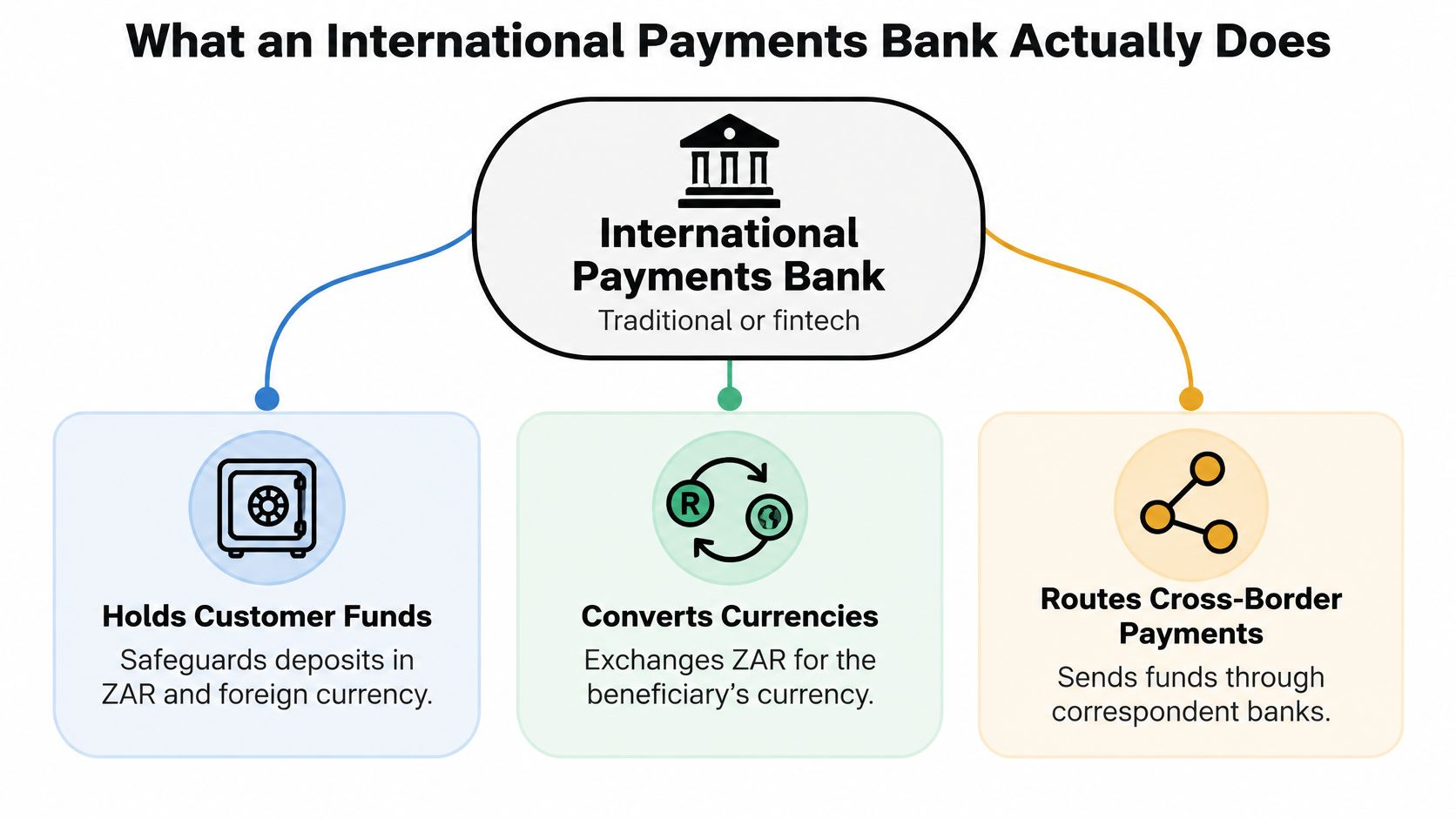
An international payments bank is any institution, traditional or fintech, that holds your funds in one or more currencies, converts between them, and routes the resulting payment into another country's banking system. Some hold banking licences. Others are payment institutions that partner with banks. The label on the door matters less than which parts of the chain the provider controls itself.
The closest everyday comparison is a parcel. A courier collects it, customs inspects it, and a local delivery partner hands it over at the far end. A cross-border payment works the same way: your bank or platform debits you, an FX desk converts, compliance screens the instruction, one or more correspondents carry it, and the beneficiary bank credits the recipient.
The key idea: a cross-border payment is never one transaction. It's a chain of funding, conversion, clearing and settlement legs, and every leg carries its own price and its own clock.
South Africa's domestic rails are already digital, which pushes the friction to the border. The South African Reserve Bank reported that EFT credit transactions grew from 406.9 million in 2010 to 1.13 billion in 2024, in its 2024 National Payment System regulatory report. The local leg is rarely the problem. The handoffs are.
When you assess a provider, ask which legs it owns and which it rents. Each rented leg is a fee you can't see and a delay you can't chase. A useful way to read a fee page is to separate the spread from the per-payment charge, which is exactly what the Airwallex pricing breakdown on KeenVerdict does.
The Paperwork That Decides Whether Your Payment Clears
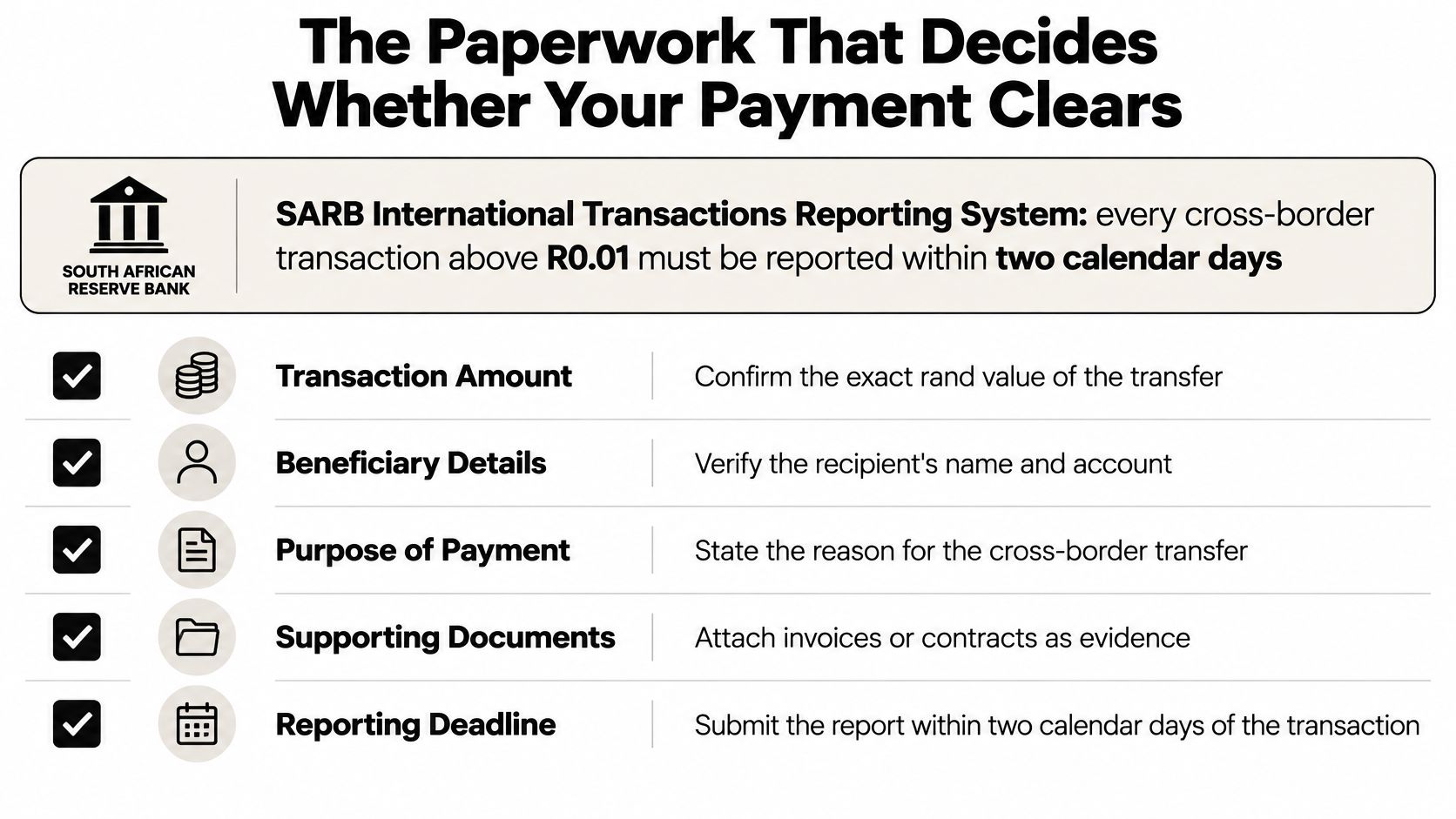
South Africa's International Transactions Reporting System sets the bar lower than many assume. Cross-border transactions above R0.01 must be reported to the South African Reserve Bank, with no upper threshold, and licensed entities must submit the counterparties, partner country, value and purpose-of-payment (BoP) code together with supporting documents within two calendar days, as the Reserve Bank's note on changes to the ITRS explains. In practice, every business payment qualifies.
Assemble six things before you initiate anything:
- Commercial invoice matching the amount and currency exactly.
- Contract or purchase order that gives the invoice its context.
- Beneficiary details, including the full legal name rather than a trading name.
- The correct BoP code for the purpose of the payment.
- Internal approval evidence from whoever is authorised to sign off.
- Source-of-funds records for the rand or dollar balance being spent.
An IMF technical assistance report on South Africa identifies compliance with the country's exchange-control and data-protection requirements as a source of longer processing times. Translation: documentation gaps become queue time.
That reframes how you should choose a provider. A lower headline rate is economically inferior if weak document collection causes holds, failed settlements or supplier penalties. Judge on compliance predictability instead: does the provider validate the instruction before the money moves, who owns the reporting, and can you retrieve the evidence six months later?
Practical rule: build a one-page document checklist for each payment type you run, invoices to contracts to BoP code, and keep it next to the banking screen. Most holds are missing paper, not missing money.
How a Payment Travels From Your Account to the Beneficiary
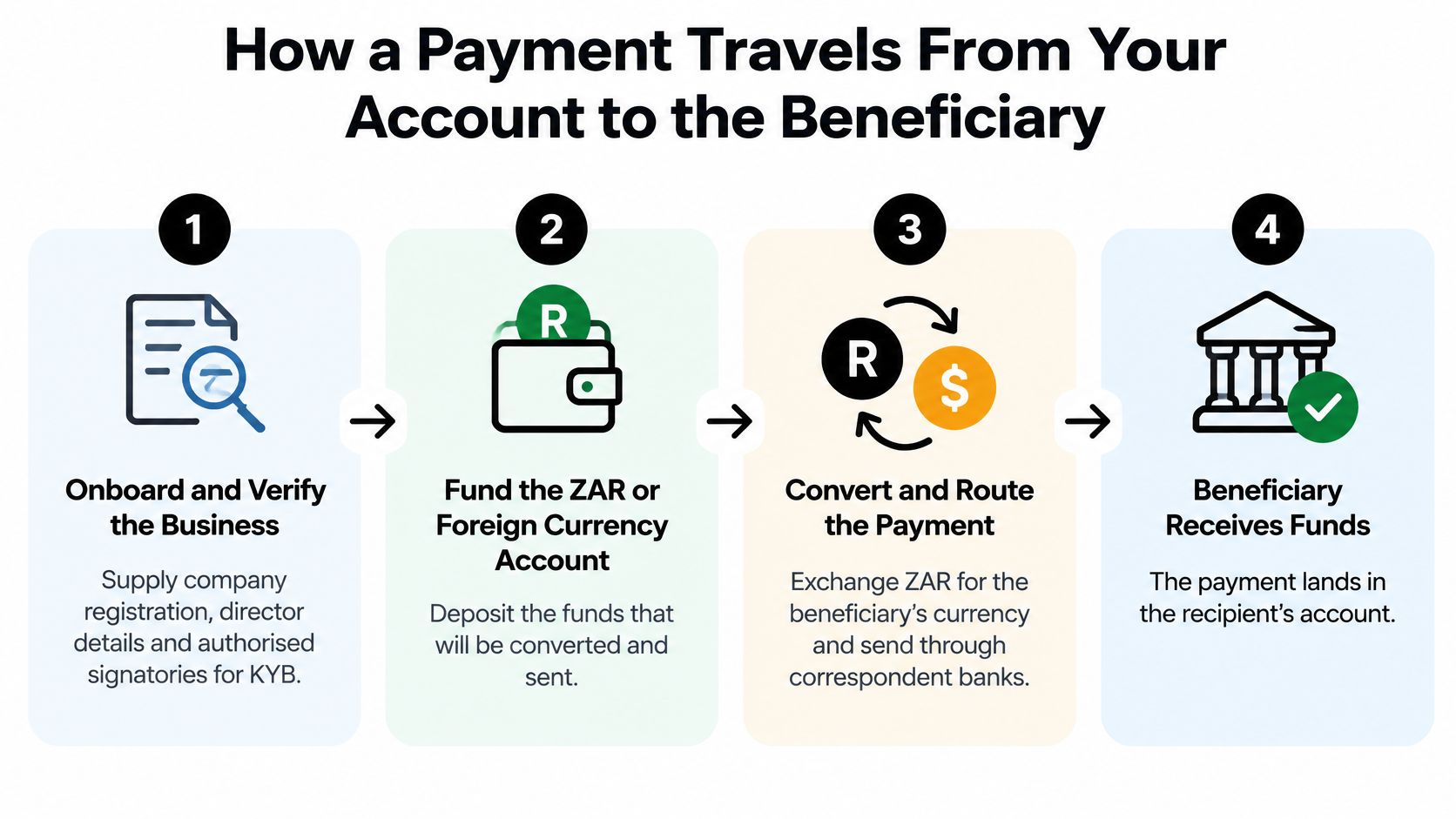
Eight steps sit between the decision to pay and cash in the beneficiary's account. Each one has a standard failure point, and knowing them saves more money than shopping around for rates.
1. Onboard and verify the business. You supply company registration, director details and authorised signatories for KYB checks. The failure here is a signatory who isn't on the mandate, so the person pressing send can't legally bind the organisation. With Zaro, that authorisation requirement is built into the account.
2. Fund the ZAR or foreign currency account. A standard bank transfer from your own account does the job. The failure is funding from a third-party account that doesn't match the business name, which triggers a source-of-funds query and stops the clock.
3. Submit the instruction. Beneficiary name, account, amount, currency, invoice or contract and the BoP purpose code go in together. The failure is a missing or guessed BoP code, which stalls the payment at screening.
4. Pass compliance screening and accept an all-in rate quote. Good providers quote before anything moves. The failure is assuming the rate displayed in your dashboard is the rate you'll be dealt.
5. Convert at the quoted rate. Straightforward, once the quote is locked. The failure is a quote that expires mid-approval, so the second approval happens at a different number.
6. Settle through correspondents, partner banks or regional rails. The failure is a currency the route doesn't support, or an intermediary that isn't expecting the payment.
7. The beneficiary is credited with a remittance reference. The failure is a vague or abbreviated beneficiary name, which bounces at the receiving bank's name check.
8. Close the file. Reporting completes after settlement, and the documents from step three become the evidence you retrieve if there's a query.
A payment that has left your account has not arrived at theirs. Track the legs, not the status badge.
The reason this matters is structural. The South African Reserve Bank's guidance notes that payments cleared through a South African Payment Clearing House settle in rand through the South African Multiple Option Settlement system, while Common Monetary Area cross-border payments must be reported separately from domestic payments, as set out in SARB's payment position paper on cross-border flows. A rand funding leg settles domestically while the conversion and the offshore payout are separate legs with separate states.
Treat an international transfer as one undifferentiated payment and timing differences, fees, returned funds and reporting obligations all blur together. Run separate ledgers for customer funding, FX conversion, domestic settlement, offshore partner settlement and final beneficiary credit, and cash visibility stops being guesswork.
What This Looks Like for South African Businesses
An Exporter Waiting on a US Buyer
A Cape Town hardware firm invoices a US buyer $50,000, roughly R900,000. On a bank route at a 2.5% spread plus a SWIFT charge and two correspondent deductions, close to R24,000 disappears from that invoice. The same payment at a 0.5% spread costs about R4,500. One invoice, R19,500 recovered, before factoring in the days of waiting. When the receiving route is built properly, dollars sent from the US land in the South African account the same day rather than the following week. Match the route to the direction of the money, not to the bank you happen to hold.
An Importer Working Against Shipping Documents
A Durban electronics distributor pays a Shanghai supplier $80,000 against documents. At a 2.5% spread that's around R36,000 gone, against roughly R7,200 at 0.5%. The bigger risk sits elsewhere: a payment held for documentation freezes the shipment, and a frozen shipment triggers demurrage and missed retail windows. For importers, predictable settlement beats a marginally cheaper headline rate every time.
A BPO Billing Monthly in Pounds
A Johannesburg services firm bills a UK client £40,000 a month. Even a 1% spread costs £400, which lands north of R9,000, repeated twelve times for more than R100,000 a year on a single client relationship. That's the case for volume-based pricing, multi-user approvals and a second reviewer on anything above a set threshold. Recurring flows deserve a negotiated spread, not a retail one.
Regional payments deserve their own line in your model. A transfer to a neighbour country can feel domestic and still carry separate reporting and settlement handling, so quote it as its own corridor.
Price every channel annually rather than per transfer. A R150 saving repeated 400 times funds a system; a R150 saving on one payment funds lunch.
Misconceptions That Quietly Cost Businesses Money
"The quoted rate is the rate I get." Test it. Compare the rate on your advice against the live mid-market rate for that timestamp. The gap is the spread, and for most South African businesses the spread outweighs the fee several times over.
"SWIFT is the fastest and safest option." SWIFT is a messaging network, not a settlement system. It tells banks what to do with money, and the number of correspondent hops between you and the beneficiary decides how long that takes. Routes that connect directly to local rails can settle in minutes.
"The cheapest headline fee wins." A zero-fee transfer held for a week can cost more in supplier penalties, demurrage and duplicated compliance work than a 0.5% spread ever would. Price the delay as well as the fee, in rands, on the same line.
"This is a big-corporate problem." SMEs lose proportionally more. They lack the volume that buys a negotiated spread, so the retail markup applies in full on smaller margins. Ask for a published, volume-based spread and a written quote before you send.
Test all four against your last statement. If the spread line isn't visible, it's still there. It's just inside the rate.
Choosing the Right Payment Partner
| Criterion | Traditional bank | Specialised platform |
|---|---|---|
| Pricing | 1.5% to 3% FX spread plus per-payment SWIFT and correspondent charges | Published spread on the exchange rate, no SWIFT fees |
| Speed | 1 to 5 business days | Minutes to 1 business day on major corridors |
| Corridor coverage | Strong on major currencies, weaker on African corridors | Confirm each destination and local rail in writing |
| Compliance support | Generic guidance and batch processes | Pre-payment validation, BoP guidance, fees disclosed before confirmation |
| Governance | Relationship manager and branch processes | Multi-user access, team permissions, FSCA-authorised |
The verdict depends on your payment profile. A traditional bank still fits large, occasional payments inside an existing credit relationship, particularly where the facility is tied to the transfer. A specialised platform fits frequent payments, thin margins and clients spread across several currencies.
Zaro is built for the second group. Businesses onboard through KYB verification, fund ZAR and USD accounts by bank transfer, and send payments at real exchange rates with a transparent, volume-based spread and no SWIFT fees. Zaro is an authorised Financial Services Provider registered with the FSCA, FSP number 55133, and its free BoP code checker finds the likely category for an export receipt or import payment, copies bank-ready wording and lists the documents to have ready.
Then do the audit. Pull your last ten international payments, calculate each one's all-in cost against the mid-market rate for its date, and request a written quote before your next supplier run. The number you arrive at is the only comparison that means anything.
Send your next payment at a rate you can check rather than one you have to trust. Zaro gives South African businesses ZAR and USD accounts funded by standard bank transfer, a transparent volume-based spread with no SWIFT fees, and a free BoP code checker that tells you which documents to attach before you send. Bring your last ten international payments and see the difference in rands on your own statement.