
South Africa's business process outsourcing sector is a significant employer and earner of export revenue, so offshore outsourcing is a decision most local companies will weigh at some point. For founders and CFOs it cuts both ways: buying services from overseas providers, or selling South African skills into foreign markets and earning foreign currency.
A supplier's hourly rate is only the starting point. The decision also has to cover service quality, compliance paperwork, foreign-exchange exposure and the rand cost of getting the right amount into the right bank account.
Payment terms work like a second contract sitting underneath the first. The fee structure, the exchange rate applied and the settlement speed decide what an overseas supplier costs, and a quote that looks cheap on paper can grow quickly once conversion and transfer charges land on your statement.
What Offshore Outsourcing Means for South African Companies
South Africa's global business services sector created 20,518 new international jobs and generated $328 million in export revenue in 2024, according to Business Process Enabling South Africa. That makes it an established export industry, not merely a niche cost-saving tactic.
Offshore outsourcing means handing a business process to an external provider in another country. A Johannesburg retailer might appoint an overseas customer-support desk, while an international retailer might appoint a Cape Town BPO firm to answer customer enquiries.
The same arrangement therefore looks different depending on which side of the contract you're on:
- The South African buyer purchases an overseas service and needs to manage supplier payments, performance and information shared abroad.
- The South African provider delivers services to foreign customers and needs to manage export receipts, contractual obligations and local operating costs.
- A business doing both earns foreign revenue while paying international contractors or software suppliers, creating connected currency exposures.
Buying capacity rather than building it
Think of renting a specialist commercial kitchen instead of building your own. You gain equipment, trained staff and production capacity without owning the premises, but you still specify the menu, quality standards and delivery schedule.
An outsourcing provider works similarly. You buy an agreed output or capacity, such as resolved support tickets or processed invoices, rather than assembling every operational component yourself.
The global team might look like this in practice.

The analogy has a limit: outsourcing doesn't remove your responsibility to customers. If the kitchen mishandles an order, your customer still expects you to resolve it; if a support provider mishandles a complaint, the relationship remains yours.
Before comparing locations, write down whether you're buying services, selling them or doing both. That determines which contracts, currencies, compliance checks and payment controls deserve attention.
Practical rule: Define what you're buying before deciding where to buy it. A named process with measurable outputs is easier to price, supervise and move than a vague promise of extra capacity.
Offshore Outsourcing Models Compared
| Model | How It Works | Best Suited For | Control Level | Typical Payment Pattern |
|---|---|---|---|---|
| Third-party offshore BPO | Provider runs the process under a service contract | Contact centres and back-office processing | Medium, governed by service-level agreements | Monthly invoice to the provider |
| Captive or GBS centre | Your own subsidiary runs the team offshore | Long-term, high-volume processes | High | Intercompany transfers and local payroll |
| Freelancers or contractors | Individuals engaged per project, directly or through platforms | Short projects and niche skills | Low to medium | Per-invoice payments, often in a foreign currency |
| Project-based delivery | A firm delivers a defined scope, such as a software build | Fixed-scope work with clear deliverables | Medium, managed through milestones | Milestone payments released on acceptance |
| Nearshore (for contrast) | Similar work in a closer time zone | Teams needing hours that overlap with local business | Medium to high | Monthly service invoices or agreed milestone payments |
These options aren't all the same kind of choice. Nearshore describes location, while project-based delivery describes a commercial arrangement; you can hire a nearshore firm under a project contract.
A captive centre is also offshoring rather than outsourcing in the strict sense, because you own the operation. GBS describes how business services are organised and can include owned operations, external providers or a combination.
Control carries responsibilities
More direct ownership usually means taking on more management work, infrastructure decisions and employment obligations. Less ownership can reduce that burden, but it increases your dependence on the provider's reporting and contract.
Don't assume the lowest hourly rate automatically means the least control. Compare what each quote includes, who supervises staff, how changes are approved and whether you can inspect the underlying work.
Say a South African insurer appoints an overseas BPO to process routine claims. The provider manages staffing and submits a monthly invoice, while the insurer retains authority over exceptions and claims decisions.
A retailer with sustained demand might instead establish its own offshore subsidiary. It gains direct authority over recruitment and workflows, but must also arrange local management, payroll and corporate administration.
Match the arrangement to the work
Software projects need particular care because buying developer time isn't the same as buying an accepted, maintainable product. The devPulse guide to offshore engineering for enterprise modernization provides additional context for evaluating that distinction.
South African BPOs encounter these choices from the receiving side too. A provider might deliver a managed process for an international client while separately engaging overseas specialists for a defined assignment.
Choose according to process volume, standardisation and data sensitivity. Stable, repeatable work can support a managed-service arrangement; uncertain work needs tighter discovery, change control and acceptance criteria before you commit.
Benefits That Hold Up Beyond Salary Savings
The strongest benefits of offshore outsourcing solve operational problems, not just payroll comparisons:
- Access to specialist skills: Find capabilities that are difficult to recruit locally, such as a particular software integration or multilingual support function.
- Flexible capacity: Add or reduce agreed service capacity without building a permanent internal team for every fluctuation.
- Wider service hours: Use working-day differences to cover customer demand outside South African office hours.
- Management focus: Let a partner supervise a defined process while your managers concentrate on customers, products and commercial decisions.
- Process discipline: Adopt documented workflows, quality checks and reporting rather than relying on individual employees' unwritten knowledge.
None of these benefits is automatic. A partner can only scale within its available capacity, and extended coverage is useful only if handovers preserve the information needed to resolve customer issues.
For South African providers, the opportunity also runs outward. According to BPESA figures reported by ITWeb, the country's global business services sector created more than 14,000 jobs and generated just under R13.6 billion in export revenue in the first nine months of 2024.
Give each benefit a measure
Track skills access through time to productive deployment, not the date someone signs a contract. Track extended hours through coverage and resolution quality, rather than counting available seats.
For management focus, record how much internal supervision the process still needs. A service that requires constant checking may shift work between teams without reducing the management burden.
Use cost per accepted transaction for processing work and revenue per employee for a service-export operation. Include rejected work, reprocessing and escalation effort so that a low quoted rate doesn't hide expensive mistakes.
A saving is real only after the business has paid for supervision, rework, technology and settlement.
Say a firm reduces staffing expenditure by moving invoice processing offshore. If employees must repeatedly correct the output and finance loses additional value during currency conversion, the original salary comparison won't describe the result.
Build a baseline before the handover, then compare like-for-like output afterwards. Keep service quality and total cost together: cheaper transactions aren't an improvement if customers wait longer or financial records become less reliable.
Risks South African Firms Underestimate
The risk that's easiest to underestimate is cash-flow dependence. A provider can meet its delivery targets and still struggle if a major customer pays late, a supplier fails or currency movements make the contract uneconomic.
| Risk | Early Warning Sign | First Response |
|---|---|---|
| Power and connectivity outages | Missed service-level windows on outage days | Confirm backup power and failover connectivity before go-live |
| Staff attrition | Rising resignations and longer average handling time | Track attrition monthly and fund cross-training |
| Personal data exposure | Access logs show unexplained downloads | Restrict access by role and review cross-border transfer terms |
| Client concentration | One client drives most of the revenue | Set a maximum revenue share per client and develop other prospects |
| FX volatility | Margin falls when the rand moves against invoice currency | Match contract and cost currencies where practical, or set a review trigger |
| Supplier failure | Late deliveries or cash strain at a key vendor | Maintain a contingency provider and write exit terms into the contract |
Power and internet interruptions can cause a missed service window even when staff perform well. Ask for a demonstration of failover arrangements, including how employees access systems and communicate with clients during an interruption.
Don't accept a photograph of a generator as a continuity plan. Establish which equipment it supports, who maintains it and how the provider tests operation under actual working conditions.
Growth can hide concentration
South Africa's international-facing GBS sector created 26,346 jobs in 2025, with the Western Cape accounting for 13,056, according to BPESA figures reported by ITWeb. That regional concentration is a planning consideration as well as evidence of a substantial services ecosystem.
A business drawing staff, connectivity and contingency suppliers from the same hub should check whether its backup arrangements share the same vulnerabilities. A different building doesn't necessarily provide an independent recovery option.
Consider a BPO that loses its largest client while outstanding invoices remain unpaid. Payroll, premises and software commitments continue, so management may face a funding gap before it can replace the revenue.
Assign owners before trouble starts
Maintain a monthly risk register with an owner, an observable trigger and an agreed response for each material exposure. Keep the response concrete: pause recruitment, restrict access, invoke continuity arrangements or renegotiate a payment schedule.
Separate what operations can resolve from what leadership must approve. A queue manager can redistribute work, but shouldn't decide alone to extend significant credit to an overdue customer.
Use a combined-warning escalation rule: when warning signs appear together, such as slower payment alongside reduced customer volumes, refer the decision to leadership. Waiting for a missed payroll or failed service obligation leaves fewer useful options.
Legal and Compliance Duties Before the First Payment
Paying an overseas supplier for routine services still requires a clear transaction purpose and supporting records. Don't treat the invoice description as an administrative detail to invent when the bank requests it.
This is general information, not legal or tax advice. Use the following table as an adviser-review checklist, not a complete statement of every rule or exception.
| Requirement | Applies When | Practical Step |
|---|---|---|
| POPIA cross-border transfer rules | Personal information is sent or made accessible offshore | Have an attorney confirm the permitted transfer basis, recipient protections and contractual terms |
| Exchange control through an authorised dealer | Arranging cross-border payments or receipts | Confirm the appropriate authorised channel and supporting documents for the transaction |
| Balance of Payments (BoP) category | Reporting an export receipt or import payment | Select the applicable category and retain matching invoices |
| VAT on exported services | Supplying services to a non-resident client | Ask a tax adviser whether the specific supply meets zero-rating conditions |
| Withholding tax and tax-compliance evidence | Assessing payments to non-resident suppliers | Confirm whether withholding applies to the payment type and what evidence is needed |
| Contractor classification | Engaging offshore individuals, particularly under close direction | Check local employment rules and ensure the contract reflects the actual working arrangement |
Make the descriptions agree
The contract, invoice and payment declaration should describe the same commercial activity. If the agreement covers customer support, an invoice labelled only as consulting makes the payment harder to explain and reconcile.
Don't choose a BoP category because its wording seems convenient. Give the authorised dealer the actual service description and ask for clarification where the arrangement combines services, licences or other payment types.
Likewise, a foreign customer doesn't automatically settle the VAT question. The nature of the supply, the recipient and the circumstances need a transaction-specific assessment.
Withholding tax also shouldn't be assumed to apply to every overseas service invoice. Have the adviser distinguish ordinary service fees from other payment categories and assess any relevant treaty treatment.
Treat information access as part of the contract
Map what customer and employee information the provider can see, where it will be processed and whether subcontractors can access it. Ask your attorney to assess the cross-border arrangement rather than assuming a confidentiality clause is sufficient.
Include instructions for permitted processing, security controls, incident notification, deletion and return of records. Contractual promises should be supported by access controls and evidence that the provider follows them.
For creative or software assignments, address ownership separately from confidentiality. If the supplier uses generative tools, the LegesGPT discussion of AI content ownership is a useful starting point for questions about deliverables, licensing and third-party material, not a substitute for jurisdiction-specific advice.
Keep a transaction file
Maintain a searchable record containing:
- Signed contract: Include the scope, payment terms and approved amendments.
- Invoice: Retain the service description, currency and supplier identity.
- Payment-purpose statement: Record why the money is being sent or received.
- Proof of payment: Attach the bank confirmation and reconciliation outcome.
Rules and thresholds can change. Before the first payment, confirm current requirements with an authorised dealer, a tax adviser and an attorney, and document who approved the treatment.
What Offshore Payments Really Cost
| Cost Element | How It Shows Up | How to Measure It |
|---|---|---|
| FX spread | Applied rate is less favourable than the reference mid-market rate | Compare rates for the same currency pair and time |
| SWIFT or intermediary fees | Deductions from the amount the supplier receives | Compare the amount sent with the amount credited |
| Receiving bank charges | Supplier-side fees weren't included in the quote | Obtain written confirmation of receiving charges |
| Settlement delay | Funds arrive after the invoice due date | Record the actual credit date against the due date |
| Invoice currency mismatch | Revenue is earned in USD while costs are payable in ZAR | Track contractual revenue, costs and margin in both currencies |
| Hedging cost | Currency protection changes the all-in cost | Record explicit charges and forward-rate adjustments against the exposure covered |
A payment quote isn't complete unless it explains what you pay and what the beneficiary receives. Ask whether charges are included, deducted in transit or collected separately.
An invoice can remain partly unpaid even after your bank confirms that the transfer was sent. The supplier may then request a top-up, creating another approval and reconciliation task.
Follow the money through the calculation
Suppose your business approves a dollar invoice and records its rand equivalent using a reference exchange rate. At execution, the payment provider applies a less favourable rate, so the rand debit exceeds the amount originally budgeted.
An intermediary then deducts a charge before the supplier receives the funds. The supplier's net credit is lower than the invoice, even though your business has already paid more rand than expected.
Calculate the result using:
Effective exchange rate = total rand paid ÷ foreign currency actually received by the supplier.
Include separately debited payment charges in total rand paid. Compare that effective rate with the reference rate for the same currency pair and execution time, not an unrelated daily rate.
For finance teams, this gives a more useful comparison than the advertised transfer fee. It also separates an exchange-rate difference from deductions that prevent full invoice settlement.
Build a payment-cost worksheet
Record the supplier, invoice currency, invoice amount, quoted rate, reference rate, total rand debit, beneficiary credit and credit date. Add any subsequent top-up so that the payment's final cost stays attached to the original invoice.
Reconcile every transfer and review patterns monthly. Investigate whether shortfalls come from the chosen payment route, the supplier's receiving bank or the fee allocation agreed in the contract.
For hedging, don't assume every forward contract has a separately stated premium. Ask how forward points, explicit charges and any security requirements affect the overall arrangement.
Apply two pricing rules: match revenue and payment currencies where practical, and agree a documented review threshold for material changes in effective cost. Choose that threshold according to your contract margin and ability to reprice, rather than copying another business's tolerance.
How to Onboard an Offshore Supplier
Use a staged handover rather than granting full access as soon as the contract is signed. The process starts with a defined output and ends with evidence that the supplier can deliver and receive payment correctly.
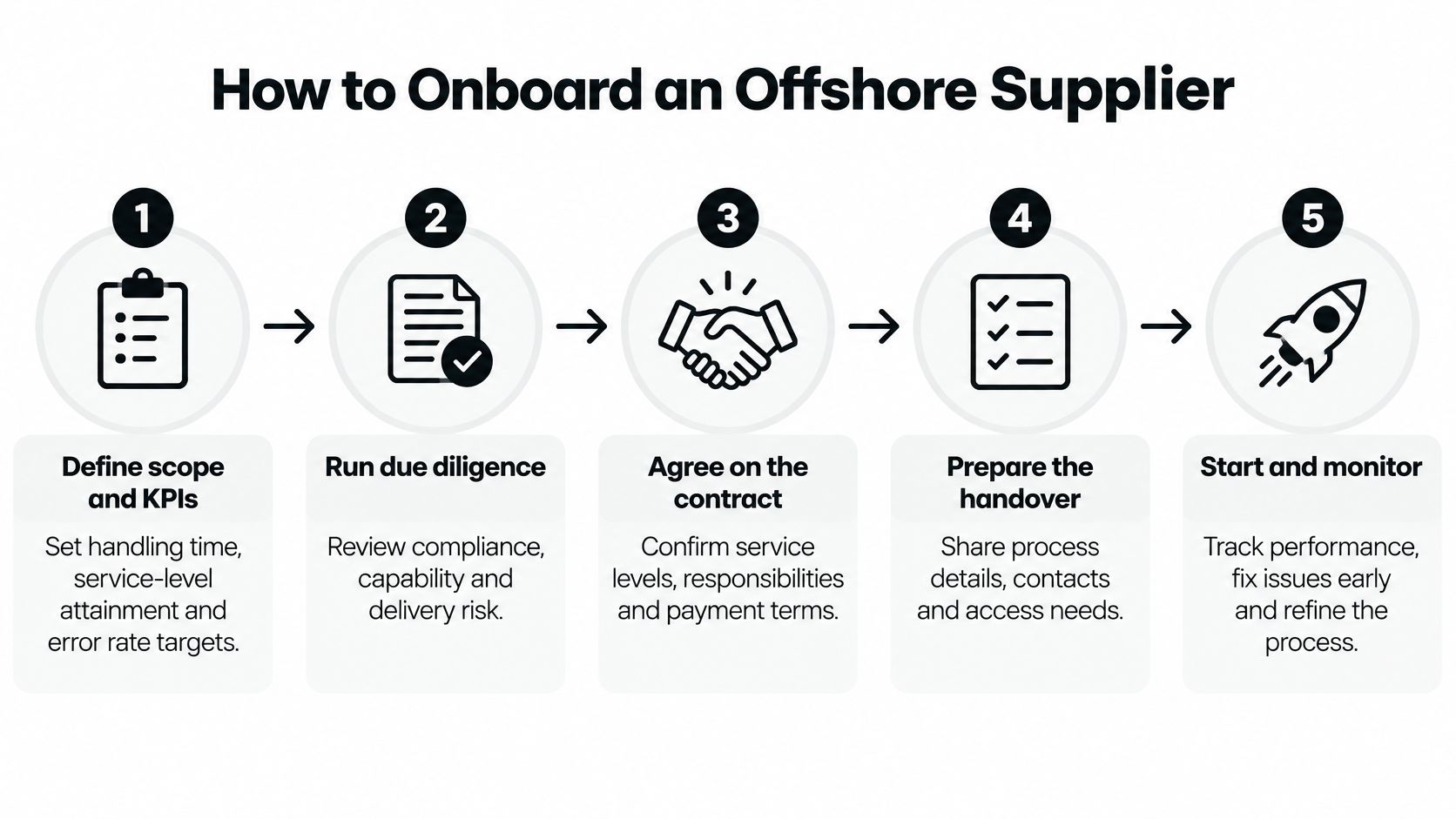
This visual summarises the main onboarding phases.
Move from specification to controlled delivery
Define the scope and KPIs. Specify inputs, outputs, exclusions and acceptance criteria, then agree measures such as handling time, service-level attainment and error rate. Avoid rewarding speed alone, because staff can close work quickly without resolving it correctly.
Run due diligence. Verify registration, references, financial health and data-handling practices, and inspect any security certification's scope rather than accepting a logo. Ask references how the supplier handled exceptions and transitions, not merely whether the relationship was pleasant.
Agree an enforceable contract. Define service levels, escalation thresholds, audit rights, data-transfer terms and an exit process that covers records and access. The common omission is a practical handover obligation, leaving the buyer contractually entitled to leave but unable to move smoothly.
Complete KYB and supplier verification. Confirm the legal entity and beneficiary details, then call back using a telephone number independently established before receiving the payment instruction. Never treat a changed bank account in an email thread as sufficient authority to amend the supplier record.
Set payment permissions and approvals. Require dual authorisation for new beneficiaries and separate supplier-record maintenance from payment release. Record who can prepare, approve and amend instructions so that convenience doesn't become unrestricted access.
Run a controlled pilot. Use a limited batch of work and invoices, inspect the output and reconcile each payment to its invoice. Don't expand the assignment merely because the supplier completed the work; confirm that exceptions, reporting and settlement also functioned correctly.
Monitor and reassess. Review operational KPIs and payment costs monthly, and reassess the supplier quarterly for material changes in ownership, capacity, security or financial position. Keep corrective actions with named owners and completion dates rather than recording concerns without follow-through.
Verify the organisation and its authority
Know Your Business checks concern the business itself, not just the identity of the employee completing a form. At Zaro, businesses must pass KYB and compliance checks, and users must be authorised to bind their organisation.
Make the bank-detail call-back a documented control, especially when beneficiary information changes. An urgent payment request shouldn't allow someone to bypass the verification method agreed during onboarding.
Before expanding access, test the handover contacts and exception process. The person responsible for delivery, the person authorised to change scope and the person handling payment queries may be different people.
Pick Your Offshore Model and Payment Setup
Choose the operating arrangement according to the work you need done, then test whether the payment setup supports it.
Use the comparison as a decision aid, rather than selecting on headline price.
- Choose third-party BPO for a standard process with steady volume and measurable service outputs.
- Choose a captive or owned GBS centre when sustained scale and direct ownership justify running the operation yourself.
- Choose freelancers for short assignments requiring specific skills.
- Choose project-based delivery when scope and acceptance criteria can be defined clearly.
- Choose nearshore when working-hour overlap matters more than the lowest quoted rate.
Make the shortlist financially comparable
Run the payment-cost worksheet against your shortlisted suppliers using equivalent work and payment assumptions. Confirm whether invoice and settlement currencies differ, and identify who bears any conversion or receiving charges.
Use the compliance transaction file before authorising a transfer, and complete the onboarding sequence before increasing volume. A signed service contract isn't evidence that the operational handover or beneficiary verification is complete.
For an additional perspective on the decision, watch the accompanying video.
Treat Zaro as one payment option to assess against the same worksheet. Verify current fees, applicable FX spreads, settlement times and BoP support before committing to a payment arrangement; don't assume a general product description establishes the terms for your transaction.
Pick the model, compare the full payment cost and clear the onboarding steps in order. That's a more dependable decision than choosing a supplier first and discovering the financial constraints afterwards.
We offer a free BoP code checker that identifies a likely category for an export receipt or import payment, provides bank-ready wording and shows which documents to prepare. Visit Zaro to use it while preparing your offshore payment file, then confirm the transaction's treatment and current payment terms before sending funds.