You're already banking online. You check balances on your phone, you approve payments from home, and you haven't queued in a branch for months. Yet a foreign payment lands short, or costs more in rand than you expected, and nobody can quite explain where the difference went. That's the gap this guide works through, step by step.
Why Online Business Banking Matters Now
A Cape Town exporter sends an invoice in US dollars. The customer pays in full. Days later, the rand amount in the account is less than the finance manager expected from the rate she saw online that morning.
She isn't imagining it. She's looking at three different numbers and treating them as one. There's the invoice amount, the quoted exchange rate, and the rand that arrived after deductions along the way.
That confusion is common, and it's the job of online business banking for an SME. It isn't only about logging in without a branch visit. It's about seeing balances clearly, releasing payments safely, and keeping a record you can reconcile later.
Digital Access Is Already Normal
That digital habit is widespread. Digitally active customers at South Africa's major banks reached 18.5 million in financial year 2023, up 8.8% from 17 million in FY2022, where digitally active means using at least one digital channel for transactional banking, according to PwC's analysis of South Africa's major banks.
Read that figure carefully. It mixes retail and business customers, so it isn't an SME penetration rate. What it does show is that online and app based banking is now a mainstream operating layer for payments, account administration and transaction monitoring.
For your business, that familiarity helps. Your team already knows how to check a balance, load a beneficiary and approve a payment on a screen. You're not learning a new habit from scratch.
Normal digital access tells you that you can move money online. It doesn't tell you what a cross-border payment really costs, or who was allowed to release it.
That's the distinction to hold onto. A local EFT to a supplier in Durban is a simple, visible transaction. A US dollar receipt from a customer in Texas passes through exchange rates, intermediary banks and compliance checks before it becomes rand you can spend.
If your banking only shows you the start and the end, you'll keep guessing about the middle. Good online business banking makes that middle visible, and controllable, before you confirm.
What Online Business Banking Actually Covers
Think of online business banking as a workshop bench, not as an app bolted onto a branch account. The account itself is the bench. Beneficiaries, approvals and limits are the labelled tools. The statement is the job card that proves what was done.
The Four Everyday Jobs
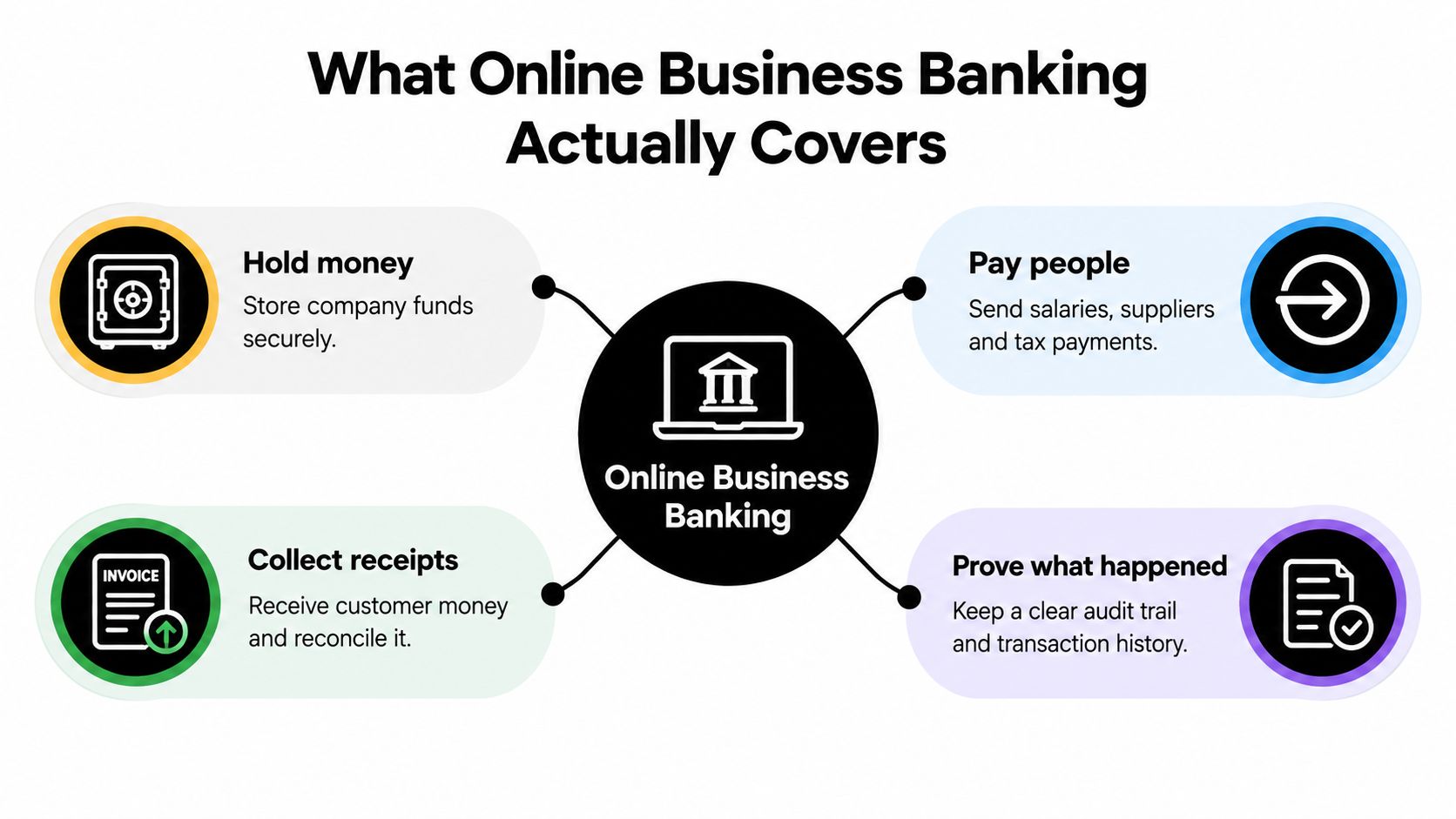
Most of what you do each week fits into four jobs. Naming them helps you spot what's missing when something feels clumsy.
- Hold money: Keep operating cash where you can see it, separate from money set aside for payroll or tax.
- Pay people: Run local EFTs, salaries, supplier payments and debit order collections.
- Collect receipts: Receive customer payments with references your bookkeeper can match to invoices.
- Prove what happened: Download statements and keep an audit trail of who created, approved and released each payment.
Beneficiary management sits underneath all four. You load a supplier once, check the details carefully, then reuse them. User roles sit there too, because not everyone who can view a balance should be able to move money.
The Bench Has to Work on a Phone
This bench no longer lives on one office desktop. In a 2025 study of 725 valid online-banking users, 72% primarily used mobile devices and 20% used both mobile and desktop, while 80% banked daily or weekly and 57% had banked online for at least five years, as reported in the study of South African online-banking users.
That study describes active users, not the whole country. Still, the pattern is clear. Owners approve urgent payments from a phone, check a foreign currency balance between meetings, and respond to a cash flow dip the same day.
A desktop only design fights that behaviour. If an approver can't act securely from a phone during load-shedding or while travelling, payments stall or, worse, someone shares login details to keep work moving.
Here's the boundary worth remembering. Everyday local banking is mature and familiar. Holding more than one currency, understanding an FX spread, and settling money across borders is a different job on the same bench, and it needs its own tools.
Payments, Accounts and Controls That Matter
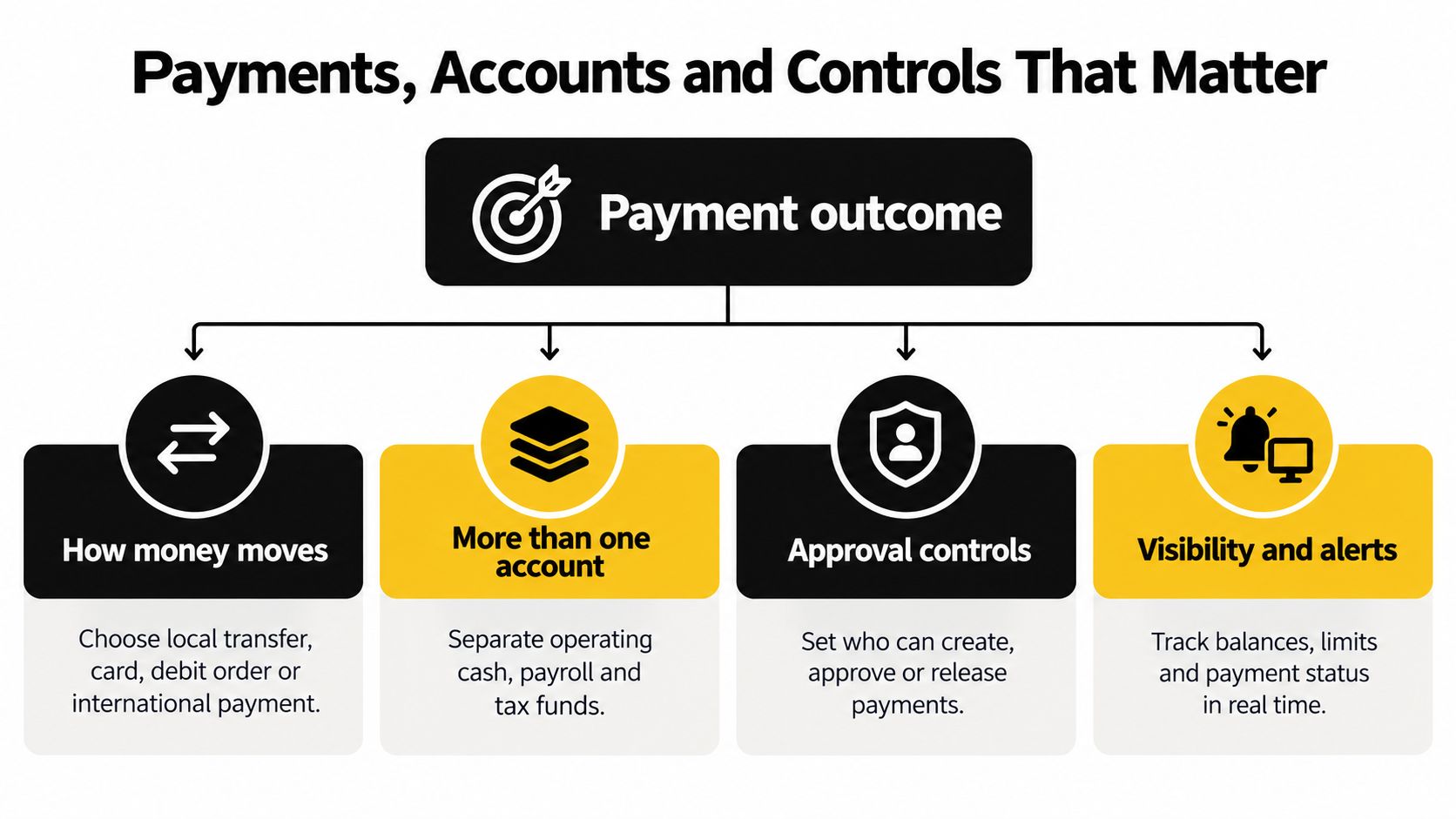
A long feature list doesn't tell you whether a payment will land correctly. Four practical pieces do. How money moves, how currencies are held, how records connect to your books, and who may release a payment.
Preparing a Payment Is Not Approving It
When you set up a beneficiary, you're making a lasting decision. Set a sensible payment limit, decide whether payments can be same day or future dated, and separate two roles. One person prepares the payment. A different person approves and releases it.
That separation sounds bureaucratic until something goes wrong. It's your cheapest control.
For money coming in, the equivalent discipline is how customers pay you in the first place. If you're reviewing that side too, setting up card and wallet payments is a useful companion topic, because clean collection references make reconciliation far easier later.
Why a Rand Only View Misleads You
If you only ever see rand, a US dollar invoice looks simpler than it is. You can't tell whether you lost money on the exchange rate, on a fee, or on an intermediary deduction, because everything collapses into one rand figure.
Holding a foreign currency balance, even briefly, separates those questions. You can see the dollars arrive, then choose when and at what quoted rate to convert them.
Integrations matter for the same practical reason. You don't need vague connectivity. You need statements, references and transaction details that a bookkeeper or payroll tool can match without retyping.
Login Security Alone Won't Stop a Large Loss
The risk picture explains why controls can't stop at passwords. Online-banking fraud was only 11.1% of reported digital-fraud incidents in 2020 but generated 45.1% of gross digital-fraud losses, with phishing and vishing the leading ways credentials were obtained and a 33% increase in the success rate of digital fraud, according to the FSCA Financial Sector Outlook Study.
In plain terms, these incidents are less frequent but far more expensive. One stolen business login can release one very large payment.
So pair authentication with transaction level safeguards:
- Dual approval: A second authorised person must release payments above a set limit.
- Beneficiary allow-listing: New or changed beneficiaries face extra checks and lower initial limits.
- Out-of-band verification: If a supplier emails new bank details, phone a known contact on a known number before you change anything.
Practical rule: Stolen credentials may get an attacker through the door. Segregation of duties decides whether they can leave with your money.
Test any platform with one question. Does it separate access to the account from authority to pay? If it doesn't, the feature list doesn't matter.
How to Judge the Real Cost of a Provider
Most comparisons start with the monthly account fee. For an exporter, that's usually the smallest number in the room.
A 2025 South African business report cited typical SME banking costs of roughly R700 to R1,200 per month, while noting cross-border transaction charges can reach 3.5% per payment, as described in Vutivi Business reporting on hidden bank fees for small businesses.
Do the mental maths on your own invoices. A percentage charge on a large or recurring foreign payment can pass that monthly fee quickly. A low or free account can still be expensive once the exchange rate spread and intermediary deductions are included.
Price One Real Payment, Line by Line
Don't compare brochures. Take one recent US dollar payment and rebuild it on paper. You're answering one question. What was the all-in rand cost, and can you reconcile it to the invoice?
| Cost line | What to record | Why it changes the rand result |
|---|---|---|
| Quoted exchange rate | The rate you were actually given | This is the rate applied to your money |
| Benchmark rate | The mid-market or spot rate at the same time | The gap between the two rates is the spread you paid |
| Explicit fees | SWIFT, beneficiary and payment repair charges shown to you | These reduce the amount sent or received |
| Intermediary deductions | Amounts taken by correspondent banks en route | These often explain a receipt that lands short |
| Settlement time | When funds left and when they became usable | Slow settlement ties up working capital |
| Final amount | Rand that left your account or landed in it | This is the only figure your books must match |
If a provider can't fill in those lines before you confirm, you aren't comparing prices. You're comparing promises.
When a Specialist Route Makes Sense
Your domestic bank may remain the right home for local EFTs, debit orders and salaries. That doesn't mean it must also handle the international leg.
We built Zaro for South African businesses that need to fund ZAR and USD balances and send or receive cross-border payments, with the spread disclosed before confirmation and no SWIFT fees. That structure lets you price the foreign leg on its own, using the table above, instead of burying it inside a general account fee.
Use the same single payment test for both routes. Keep the local account where it works. Move or complement only the leg where the all-in cost, settlement time or approval trail is weak.
How Exporters and BPOs Use These Accounts
Criteria are easier to judge once you see them inside a working week. These three jobs cover most cross-border activity for South African SMEs.
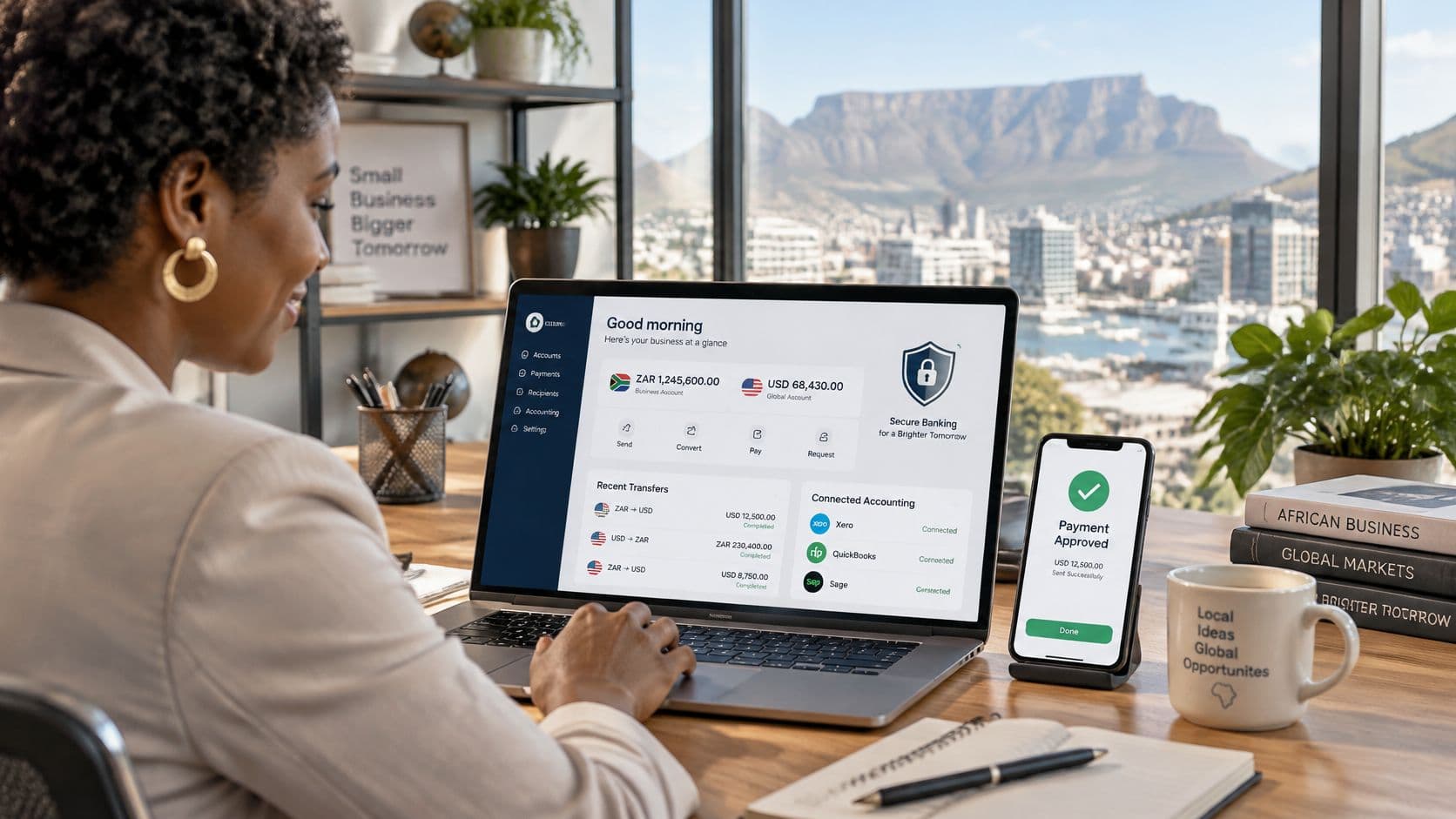
The photo below reflects how this work usually happens now, spread across laptops and people rather than at one branch counter.

An exporter repatriating a receipt. A customer pays a US dollar invoice. The finance manager needs the amount, reference and timing to match the sales invoice, so the receipt can be allocated without a string of emails asking what it was for.
A manufacturer paying an overseas supplier. The operations lead confirms the order, finance prepares the payment, and a director releases it only after the beneficiary details are verified. The value here isn't speed alone. It's proof of who checked what.
A BPO or professional firm paying contractors. International contractors are paid in foreign currency on a regular cycle, while local salaries still run through the domestic bank. Two rails, one set of books, and references that keep them reconcilable.
The short video below is worth watching before you redesign your own approval flow, as a prompt for how your team currently divides these tasks.
Speed and Maturity Are Not the Same Thing
Adoption is high, but so is exposure. Reporting cited approximately R2.4 billion in client claims connected to digital-banking crime in 2025 among participating banks, and separate reporting found 90% of surveyed South African SMEs had adopted digital payments, as summarised by SME South Africa on fraud risks for SMEs.
For a five person finance team, translate that into roles. One person creates, another approves, and release sits with someone who didn't do either. New beneficiaries start with a low limit. Your outsourced bookkeeper gets view and prepare access, not release rights.
Design for real conditions too. Approvers work remotely, load-shedding interrupts office routines, and a dispute will need statement evidence, beneficiary history and approval logs. If your workflow only works when everyone is at one desk, it doesn't really work.
Onboarding, KYB and Compliance Checks
Opening a business account isn't a personal sign-up with a company name added. The provider must know the business, and the person applying must be authorised to bind it.
What to Have Ready
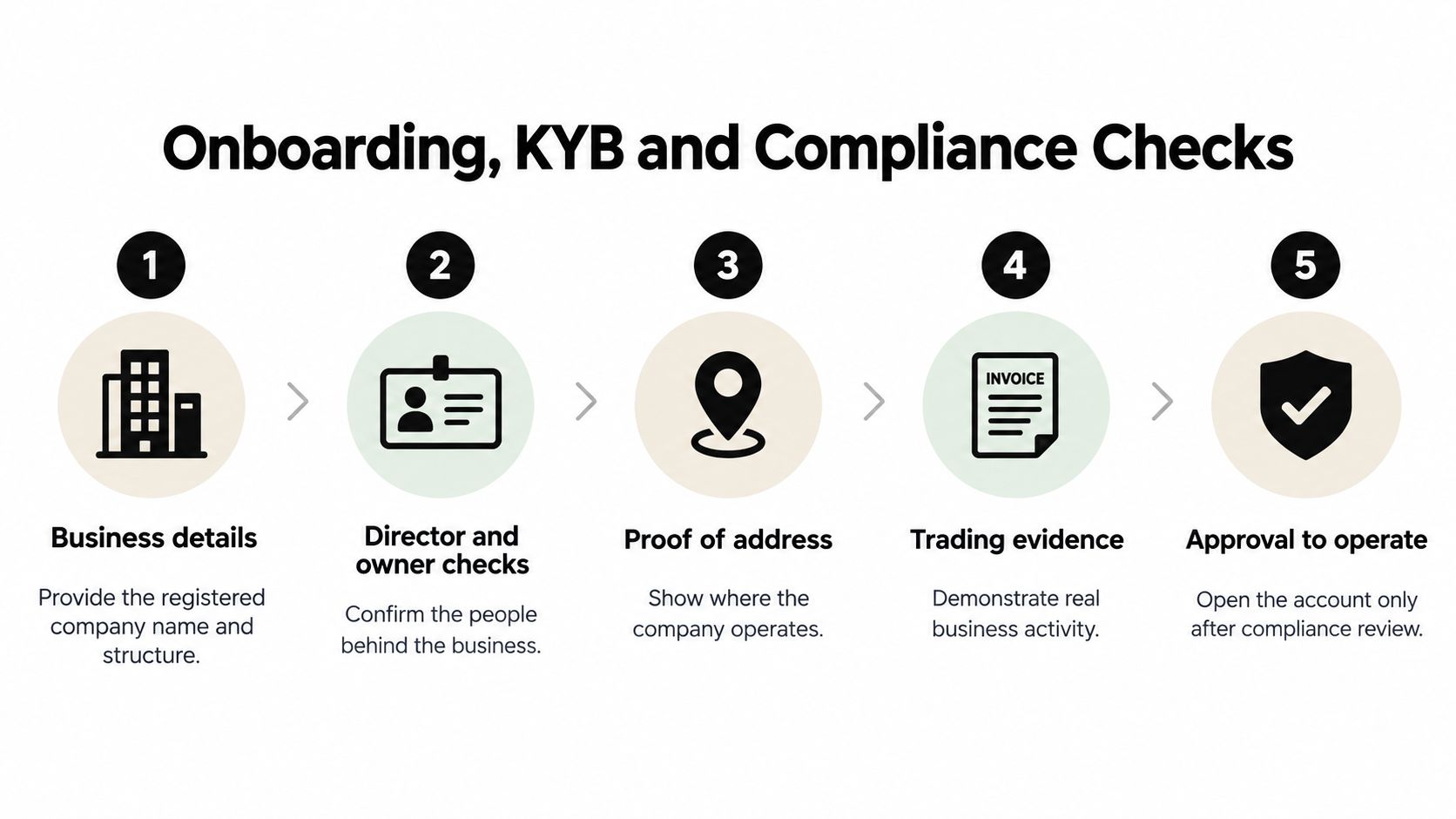
Gather these before you apply, and onboarding stops being a stop-start email chain.
- Company registration details: Your registered name and structure, exactly as recorded.
- Director or member identity: Identification for the people behind the business.
- Proof of address: Evidence of where the company operates.
- A plain description of trade: What you sell, who pays you, and why foreign currency moves through the account.
This is FICA style customer due diligence in plain language. The provider is confirming that the business is real, that you may act for it, and that the expected transactions make sense.
For a cross-border receipt, expect one more layer. A Balance of Payments category and supporting documents may be needed before funds are accepted, because the bank must record why money entered the country. An invoice that matches the receipt makes that step far easier.
Why the Checks Protect Your Account Too
Compliance isn't paperwork for its own sake. More than 90% of South Africa's banking sector offered internet or mobile-app banking, while locally controlled banks recorded 1,237 cybercrime or online-fraud attempts over 24 months and affected large banks incurred net losses of R322.1 million, including approximately R159.1 million at locally controlled banks, as reported in ITWeb coverage of the SARB findings on digital banking risk.
That exposure is why onboarding should end with controls, not just an account number. Set least-privilege access from day one, keep user level audit logs, and agree on how you'll disable and recover a compromised user before you need to.
We onboard South African companies only after a Know Your Business (KYB) check, we're FIC registered and meet FICA requirements, and we're an FSCA-authorised FSP, number 55133. Our services are for lawful business use, and users must be authorised to bind their organisation.
Prepare the documents once, carefully. Your first foreign payment will move faster for it.
Choosing a Next Step for Cross-Border Payments
A recent US dollar payment can show where your business is losing margin. Record the exchange rate, the rand amount received or paid, every visible fee, and how long settlement took. Then compare those figures with a fresh quote for the same amount and corridor.
Keep What Works, Fix the Weak Leg
Keep your domestic bank for local EFTs and salaries if it serves those needs well. Compare providers for the international leg, where the total rand cost or approval process may fall short. Changing one part of your setup can be a practical first step.
Different exporters face the same need to match payment details with supporting paperwork. For example, Canadian vehicle export guidance for brokers highlights the value of checking parties and documents before a transaction proceeds.
Judge a provider by the all-in rand cost of a payment, not just its monthly account fee.
With Zaro, businesses sign up and complete KYB verification, fund ZAR and USD accounts by bank transfer, then make and receive cross-border payments. Cards are coming soon.
Zaro charges a transparent spread on the exchange rate, based on volume and corridor, and no SWIFT fees. Applicable fees are disclosed before a transaction is confirmed. Funds from the US typically reach a South African account in a matter of minutes.
Compare your payment record with a quote from Zaro. Check the rand amount alongside settlement time and the approval trail. That gives you a clearer basis for deciding whether to use a different provider for that corridor.
If foreign receipts arrive short or supplier payments cost more in rand than expected, Zaro lets businesses fund ZAR and USD accounts by bank transfer and make cross-border payments with no SWIFT fees. Get a quote for your corridor and compare the all-in rand cost before confirming a transaction.