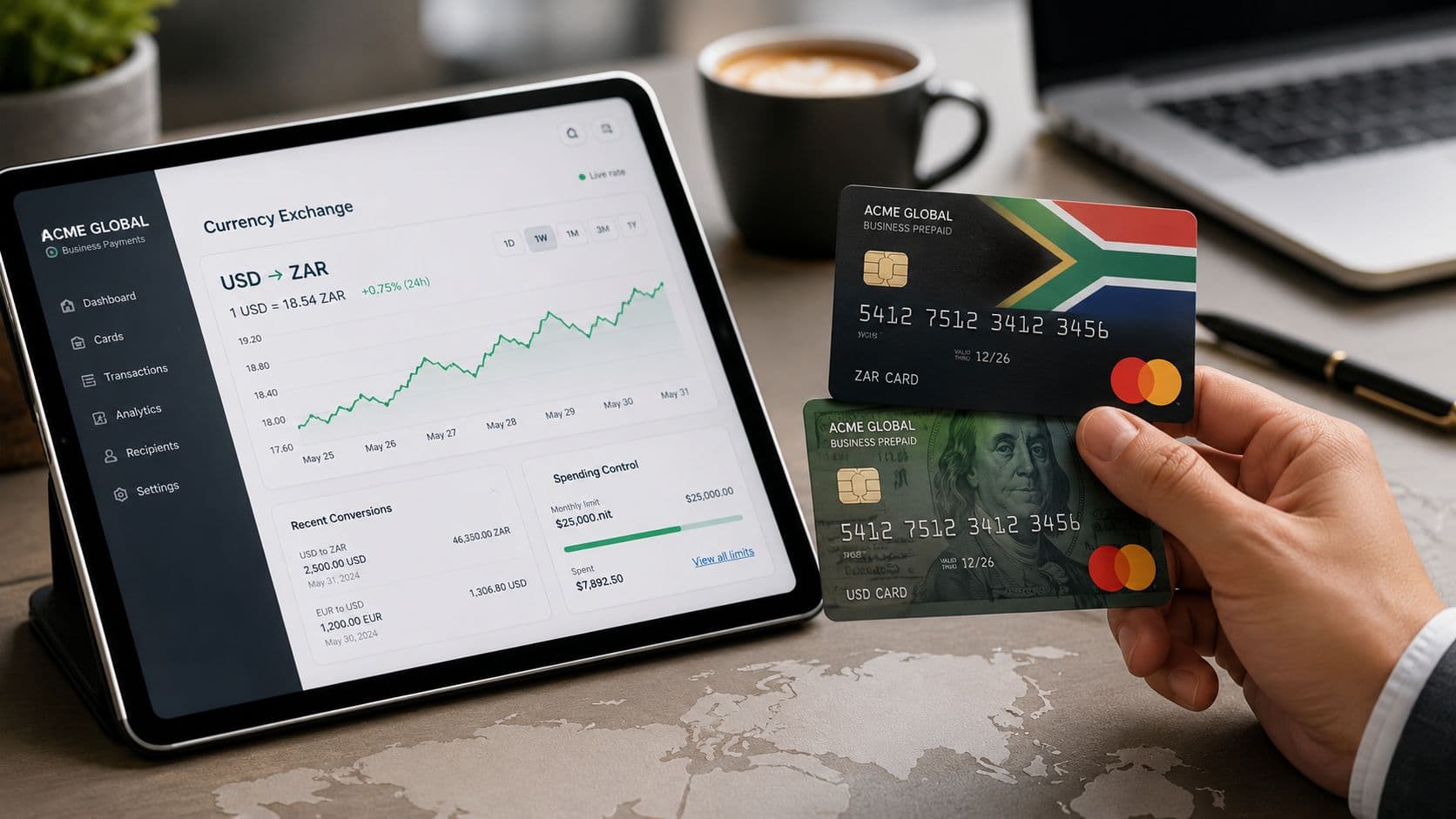
A South African exporter can price a shipment correctly and still lose money before the supplier receives payment. The problem often appears when a finance manager pays a USD invoice from a ZAR bank account, accepts the bank's exchange rate, and then discovers additional international transfer costs. The same friction repeats across software subscriptions, overseas contractors, freight providers, and digital services.
Prepaid business cards offer a more controlled alternative for these recurring expenses. A business can fund an account in advance, hold ZAR and USD, and give approved employees access to the relevant balance without exposing the main operating account. The card isn't a replacement for every banking product, but it can turn unpredictable foreign spending into a budgeted, visible process.
Why South African Exporters Are Rethinking Business Cards
A typical exporter's problem isn't a dramatic one-off loss. It's a series of ordinary payments. A design agency pays for international software, a logistics manager settles a foreign booking, and a director approves a contractor invoice. Each transaction looks manageable in isolation, but bank conversion spreads and transfer charges make the final cost difficult to predict.
The business may also convert ZAR into USD only when an invoice arrives. That timing leaves the finance team accepting the rate available at the moment of payment, rather than planning currency purchases around expected supplier commitments. A prepaid arrangement can separate funding, currency conversion, and employee spending, which gives the business more control over the process.

The use case is broader than petty cash
South Africa's prepaid card market has long included business and employee-payment applications. One market assessment estimated a ZAR 29.4 billion current opportunity value, with government disbursements, consumer gifting, corporate incentives and benefits, and payroll among the leading use cases, while the top five opportunities represented 80.3% of the 2011 market opportunity. These figures come from the South Africa prepaid card and digital wallet market assessment, and they show that prepaid instruments aren't a new fringe product in the country.
The practical shift for exporters is to apply the same control logic to international spending. A USD card can cover approved supplier tools or subscriptions, while a ZAR card can handle local operating costs. Employees spend from assigned balances, not from an unrestricted company account, and finance can review activity without waiting for a month-end statement.
Finance rule: Treat the card as a controlled currency wallet, not as a convenient piece of plastic.
A prepaid card won't automatically eliminate every FX cost. The provider may apply a conversion fee, use a different rate for card purchases, charge for withdrawals, or impose limits on certain merchant types. The value comes from comparing the full cost against the bank's usual conversion and payment route, then using the card only where its pricing and controls make commercial sense.
How Prepaid Business Cards Actually Work
A prepaid business card is funded before use. The company places money with the provider, and each cardholder can spend only from the balance made available to that card. There's no revolving credit line, and the business doesn't incur interest because an employee uses the card.
The easiest analogy is a digital wallet with a debit card attached. The wallet holds the money, the card provides access at a merchant or online checkout, and the administration platform records the transaction. If the balance is empty, the payment normally declines rather than creating a debt.

The operating flow
Fund the programme. The business transfers ZAR from its bank account to the card platform. Finance can retain the funds in ZAR or convert an approved amount into USD, depending on the provider's supported currency accounts.
Allocate balances. Administrators assign funds to a physical card, virtual card, department, project, or named employee. A virtual card can be useful for a software subscription, while a physical card suits travel or procurement at a counter.
Authorise the purchase. When the cardholder pays online or at a terminal, the card network checks the balance and any configured restrictions. The transaction is either approved within those rules or declined.
Record and reconcile. The platform deducts the amount, displays the transaction, and may allow the employee to attach a receipt or business purpose. Finance then matches the transaction to the relevant supplier, cost centre, invoice, and currency balance.
The currency choice matters. If the business holds USD and pays a USD supplier directly, it avoids converting the same funds at the point of every transaction. If it pays from ZAR, the provider's conversion methodology becomes part of the cost, so finance should test the actual rate and fees before rolling out the card.
This model works best when funding is planned. Prepaid cards don't solve a cash-flow shortage, and they can create failed payments if finance doesn't reload an account before a subscription or supplier charge is due.
Prepaid Cards Versus Corporate Credit Cards
The right choice depends on what the business needs the card to do. A prepaid programme is strongest when the priority is spend containment, currency visibility, and rapid issuance. A corporate credit card remains useful when the company needs a formal credit facility, payment terms, rewards, or capacity for a large purchase that doesn't fit a pre-funded budget.
| Feature | Prepaid Business Cards | Corporate Credit Cards |
|---|---|---|
| Funding source | Company funds loaded in advance | Borrowed funds under an approved credit line |
| Spending control | Balance-based limits, user controls, and merchant restrictions | Credit limit, policy controls, and issuer rules |
| FX capability | May support holding and spending in separate currencies, subject to provider terms | Often converts an international transaction through the issuer's banking process |
| Approval speed | Virtual cards may be issued quickly after account approval | Usually depends on credit assessment and underwriting |
| Cost structure | Platform, issuance, reload, ATM, and FX charges may apply | Annual, service, interest, foreign transaction, and FX-related charges may apply |
| Reconciliation | Dashboard activity can support continuous review | Statements and card feeds support periodic reconciliation |
| Debt exposure | No borrowing if the product is genuinely prepaid | Balance can become debt if not settled |
| Best fit | Controlled recurring spend, contractors, subscriptions, and defined travel budgets | Large or infrequent purchases, credit history, payment terms, and rewards |
Where prepaid cards have the edge
Prepaid cards give finance a hard ceiling. If a contractor receives a card for a defined project, the business can load only the approved amount and disable the card when the work ends. A virtual card assigned to one software vendor can also isolate that subscription from other company payments.
The FX advantage depends on the account design. A provider that lets the business hold USD and spend from the USD balance can reduce repeated conversions for USD-denominated costs. A provider that merely applies a conversion at checkout may still be useful for controls, but the exporter must compare its FX rate with the bank route.
Where credit cards still make sense
Credit cards can be better for a substantial, infrequent purchase when the business deliberately wants payment terms. They may also support features that a prepaid product doesn't offer, such as credit-building or rewards. That flexibility comes with repayment obligations, and the finance team must assess whether the working-capital benefit outweighs interest and annual costs.
Decision test: Choose prepaid cards for controlled access to existing money. Choose credit cards when borrowing capacity is part of the purchase decision.
Neither product should be selected from the card branding alone. Compare the same supplier payment through both routes, including conversion, transaction, platform, and settlement costs.
Understanding Fees and Interchange Costs
The headline card fee rarely tells the whole story. A provider may charge an initiation fee when the programme opens, a recurring platform fee, a fee for issuing physical cards, and a charge when staff withdraw cash. Reloading, replacing a card, receiving support, or closing an account may also carry conditions that don't appear prominently on the pricing page.

Read the pricing page as a cost map
Build a simple total-cost worksheet before signing up:
- Account costs: Record initiation and monthly platform charges.
- Card costs: Separate physical card issuance, replacement, and virtual-card fees.
- Funding costs: Check whether bank transfers, reloads, or currency conversions attract charges.
- Usage costs: Review ATM withdrawals, international transactions, declined payments, and refunds.
- FX costs: Ask whether the provider uses a transparent exchange rate, adds a spread, or applies a separate foreign transaction fee.
The last line deserves the most attention from exporters. A product can appear inexpensive because it has a low card fee while adding cost through the exchange rate. Conversely, a platform fee can be commercially sensible if the provider gives the business transparent conversion and strong controls. Compare the all-in cost for a realistic payment pattern, not the cheapest individual line item.
For businesses also reviewing incorporation or expansion administration, a resource such as all-in-one incorporation pricing can help separate company-formation costs from the ongoing costs of operating a card and payments programme. Those are different budget lines and should be evaluated separately.
Interchange is part of the ecosystem
The South African Reserve Bank has published a formal interchange framework rather than leaving card pricing entirely to private negotiation. Its 2014 determination differentiated rates by transaction type and security configuration, including a 0.48% card-not-present debit interchange rate where both issuer and acquirer were 3D Secure compliant, and a 0.44% card-present debit rate where both sides were EMV compliant, as set out in the SARB interchange policy paper.
These are network economics, not a complete quotation of what a business pays. The card rail, authentication controls, acceptance channel, and provider pricing all affect the final result. For an exporter, the operational lesson is clear. Ask how the provider handles EMV and card-not-present security, then obtain a written explanation of which interchange and processing costs are passed through.
Regulatory Requirements and KYB Onboarding
A legitimate prepaid provider must know who the business is before issuing cards. Know Your Business, or KYB, protects the payments system from fraud, money laundering, and misuse of corporate accounts. In South Africa, the process sits within the wider compliance obligations associated with the Financial Intelligence Centre Act, so a provider that skips meaningful verification shouldn't be treated as offering a frictionless advantage.
The exact checklist varies, but finance teams should expect to provide:
- Company registration records: The provider needs evidence that the entity exists and operates under the stated name.
- Director identification: Directors and authorised representatives must usually verify their identities.
- Address evidence: The business address and, in some cases, residential details for relevant individuals need confirmation.
- Ownership information: Beneficial ownership declarations identify the people who ultimately control or benefit from the company.
- Business-purpose information: A provider may ask about expected payment activity, countries, suppliers, and source of funds.
Prepare the file before applying
The fastest onboarding usually comes from consistency. The legal entity name on the application should match the registration documents, bank account, invoices, and authorisation records. Scanned documents should be current and readable, and the person completing the application should have authority to answer questions about ownership and expected transaction activity.
A well-designed KYB process can feel demanding at first, but it should become a one-time setup task rather than recurring operational friction. Once the business is approved, the finance team can typically fund supported currency balances, configure users, and issue cards under the provider's operating rules.
Businesses still building their export infrastructure may also review guidance on how to open a business bank account for exports. The bank account and the prepaid programme serve different purposes, but the documentation used for one often helps prepare the business for the other.
Questions to ask compliance teams
Don't assume approval means every transaction will be accepted. Ask whether the provider supports the countries and merchant types relevant to your business, how it handles enhanced due diligence, what happens when a transaction is flagged, and how quickly an administrator can respond to a verification request.
The provider should explain safeguarding, refunds, card suspension, and access to unused funds in plain language. If the answers are vague, the product may not be suitable for an exporter with regular international payment obligations.
Best Practices for Rolling Out Cards to Your Team
A card rollout succeeds when the policy is designed before the first card is issued. Start with the business purpose, not the employee list. Decide which expenses belong on cards, which must remain in the purchase-order process, and who owns the budget when a transaction is disputed.

Build controls around roles
A procurement employee may need supplier and logistics access, while a salesperson may need travel or client-related spending. Give each person a limit that matches the role and approved budget. Avoid issuing a high general-purpose balance just because the platform makes it easy.
Use merchant category restrictions where the provider supports them. A card intended for software can be blocked from cash withdrawals and unrelated retail categories. These controls won't replace judgement, but they reduce the number of transactions that require investigation.
Use virtual cards as disposable boundaries
Virtual cards work well for subscriptions, advertising accounts, and individual vendors. Assign one card to one service or project where practical. If the supplier changes its pricing, renews unexpectedly, or suffers a security incident, finance can freeze that card without replacing unrelated payment credentials.
For international suppliers, name the currency purpose in the card record. A USD subscription should be linked to the USD budget, while a local ZAR expense should remain visible in the domestic cost centre. This makes currency variance easier to explain during month-end review.
Make reconciliation part of the transaction
Real-time notifications are valuable only when someone acts on them. Set a routine for employees to attach receipts, identify the cost centre, and add a short business purpose immediately after payment. Finance can then match the card transaction to the invoice while the context is still fresh.
A workable rollout checklist looks like this:
- Assign ownership: Name the administrator who can issue, freeze, reload, and review cards.
- Document approvals: Require manager approval for amounts or categories outside the cardholder's normal authority.
- Test acceptance: Run controlled purchases with important suppliers before moving recurring charges.
- Review exceptions: Investigate declined payments, duplicate charges, refunds, and unexplained currency conversions.
- Remove stale access: Freeze cards for departing staff, completed projects, and cancelled services promptly.
Implementation lesson: The card isn't the control. The limit, approval path, notification, and review process around it are the control.
Choosing the Right Provider for Cross-Border Spending
Domestic acceptance is only the starting point for an exporter. A prepaid card provider that handles local employee expenses but can't support USD balances, international merchants, or clear foreign-exchange reporting will leave the central problem unresolved.
Start with five questions:
- What exchange rate will the business receive? Ask whether the provider uses a real exchange rate, adds a spread, or combines the conversion with a separate transaction fee.
- Can the business hold and spend in ZAR and USD? Holding the currency needed for a supplier can be more useful than converting at every checkout, but confirm how balances are funded and settled.
- Can finance separate users and permissions? Look for multi-user access, approval roles, card-level limits, and an audit trail.
- Are all fees visible? Request pricing for funding, conversion, card issuance, ATM use, refunds, replacement cards, and account closure.
- Does the security model fit the risk? Confirm controls for virtual cards, card-not-present payments, EMV transactions, alerts, freezing, and administrator access.
South African consumer data indicates that prepaid cards and vouchers remained a recognisable payment behaviour, with point-of-sale use reported at 16% in 2018 and 15% by Q2 2024, while online voucher use fell by 6 percentage points over the same period, according to the South Africa prepaid market assessment. For exporters, the implication isn't that every business needs a prepaid card. It's that providers should be judged on the actual acceptance and currency mix your team uses, not on the label alone.
Run a provider comparison using your own supplier invoices, subscription renewals, travel costs, and expected reloads. Record the ZAR amount funded, the USD value received, every explicit fee, and the final amount charged. A provider with fewer headline features may be the better choice if it gives you transparent FX, reliable controls, and a lower total cost for the payments you make.
Zaro gives South African businesses ZAR and USD accounts, real exchange rates with zero spread, and debit cards designed for controlled international spending. Visit Zaro to compare a transparent cross-border payments setup for your export suppliers, contractors, and overseas operating costs.