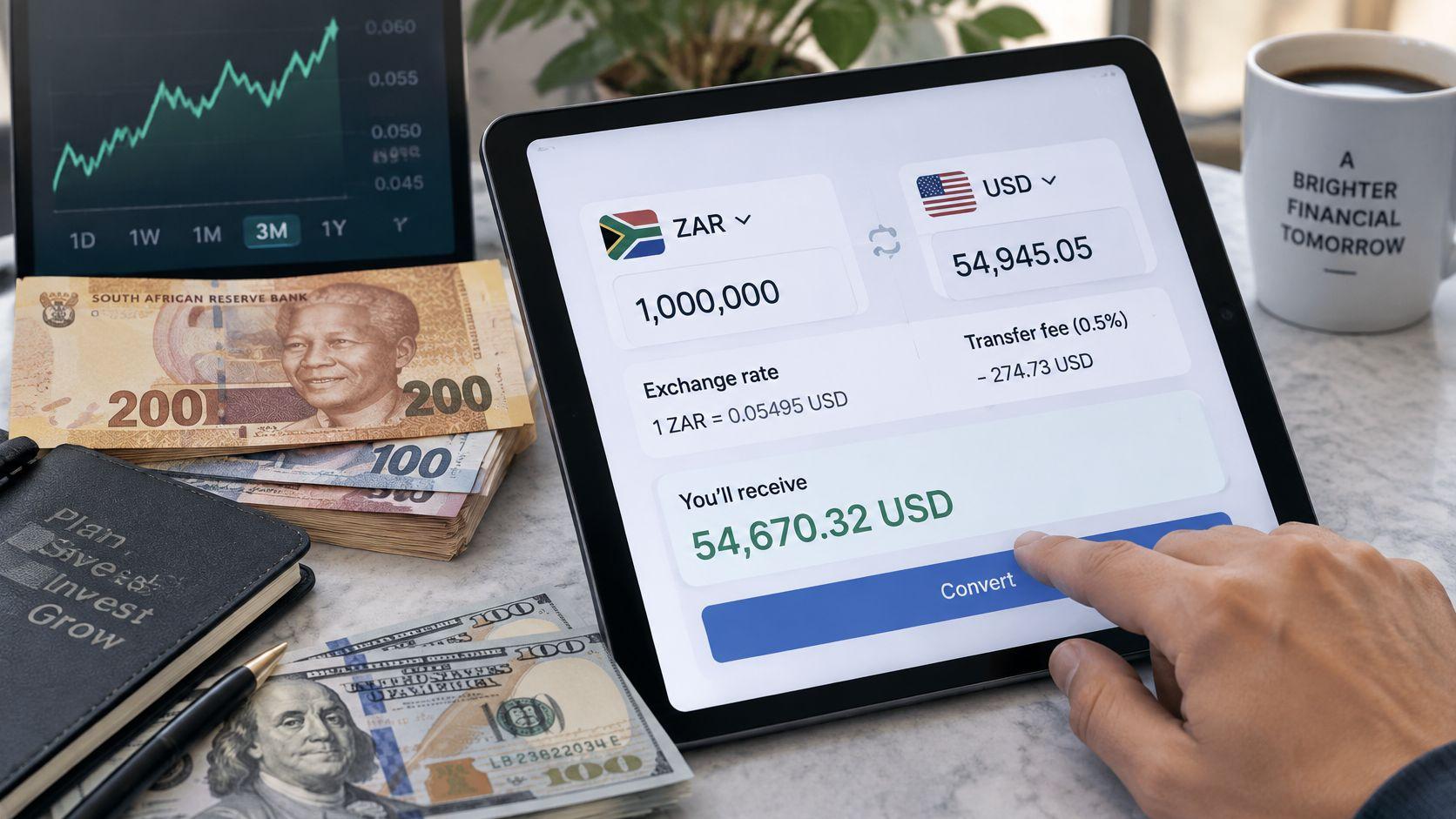
A 2% foreign-exchange spread on a R1 million payment to the United States costs about R20,000 before fixed charges, at an illustrative spot rate of R17.70 per dollar. Moneyweb's reporting on international transfers puts major-bank FX margins at roughly 2 to 3%, with SWIFT and administrative charges adding about R500 to R1,000. A real exchange rate calculator that stops at the headline quote hides that rand cost. The lowest number on the screen is often the wrong comparison, because the spread and the fixed fee land together, and the fixed fee takes a much larger bite from a small payment than from a large one.
Mid-Market, Quoted and Real Rates Compared
Four labels get swapped in ordinary conversation, and each one answers a different question. The mid-market spot rate is the midpoint of the interbank market, the benchmark you use to judge whether a quote is fair. The provider quoted rate is that midpoint plus the provider's spread, and it is the rate that sets the rands you pay or receive. The bilateral real exchange rate adjusts the spot rate for consumer prices in the two countries, so you can tell whether a currency looks cheap or dear over time. It is not a price for one invoice.
The real effective exchange rate (REER) is different again. The South African Reserve Bank treats it as the rand's trade-weighted exchange rate adjusted for inflation differences across major trading partners, a competitiveness indicator rather than a quote for one payment. In the September 2026 Quarterly Bulletin, the Reserve Bank reported that the rand's REER rose 3.5% from March 2025 to March 2026, eroding domestic producers' competitiveness in foreign markets. A stronger index can mean your goods are less price-competitive even when a particular dollar rate looks favourable on the day.
That is why the dollar rate on your bank screen does not match the “real” rate on a public chart. One is a payment price. The other is an index against a basket.
| Rate type | What it measures | Question it answers | Where to find it |
|---|---|---|---|
| Mid-market spot rate | Midpoint of the interbank market | Is my quote fair? | Live market data |
| Provider quoted rate | Mid-market rate plus the provider's spread | How many rands will I pay? | Your bank or payment provider |
| Bilateral real exchange rate | Spot rate adjusted for price levels in both countries | Is the currency cheap or dear over time? | Calculated from consumer price indices |
| Real effective exchange rate (REER) | Trade-weighted, inflation-adjusted index against trading partners | Is the rand competitive for exporters? | South African Reserve Bank and BIS series |
Use the quoted rate for the rand cost of a payment, the mid-market rate to benchmark that quote, and the REER when the question is export competitiveness.
Your Transfer Amount Worked Through in Rands
For a R1,000,000 payment, a 2% spread costs R20,000 before fixed fees are added. Comparing only the headline rate misses that cost. A useful calculation puts the percentage spread and any fixed charges into rands, then shows the amount the recipient receives.
Three ways the same million rands can leave
Assume an illustrative mid-market rate of R17.70 per dollar. The table compares three scenarios; the figures are examples, not live quotes.
| Scenario | Rate applied (R per USD) | Rand cost of spread | Fixed fee |
|---|---|---|---|
| Mid-market, no spread | 17.70 | R0 | R0 |
| 2% spread, R500 fixed fee | 18.05 | R20,000 | R500 |
| 3% spread, R1,000 fixed fee | 18.23 | R30,000 | R1,000 |
At the mid-market rate, R1,000,000 converts to about US$56,497. With a 2% spread and R500 fee, the recipient gets about US$55,340. With a 3% spread and R1,000 fee, the amount is about US$54,800.
The smaller transfer can change the comparison. On R50,000, a R1,000 fixed fee alone equals 2% of the principal, before the spread is counted. A narrower spread may therefore cost more overall if it comes with a larger fixed charge.
Zaro's free USD to ZAR converter checks the live mid-market rate and compares it with what a bank may take in FX spread and SWIFT fees. Zaro charges a transparent spread and no SWIFT fees. Pricing depends on volume and corridor, and applicable fees are disclosed before a transaction is confirmed.
Practical rule: Compare the rand cost of the spread and fixed fees, then check how many dollars arrive. The lowest visible rate is not necessarily the lowest all-in cost.
How to Run the Calculation Step by Step
Run the same ZAR-to-USD payment in order, and don't skip a line because the quote looks simple. The flow below is the sequence. The rand example sits on the bottom strip of the graphic.
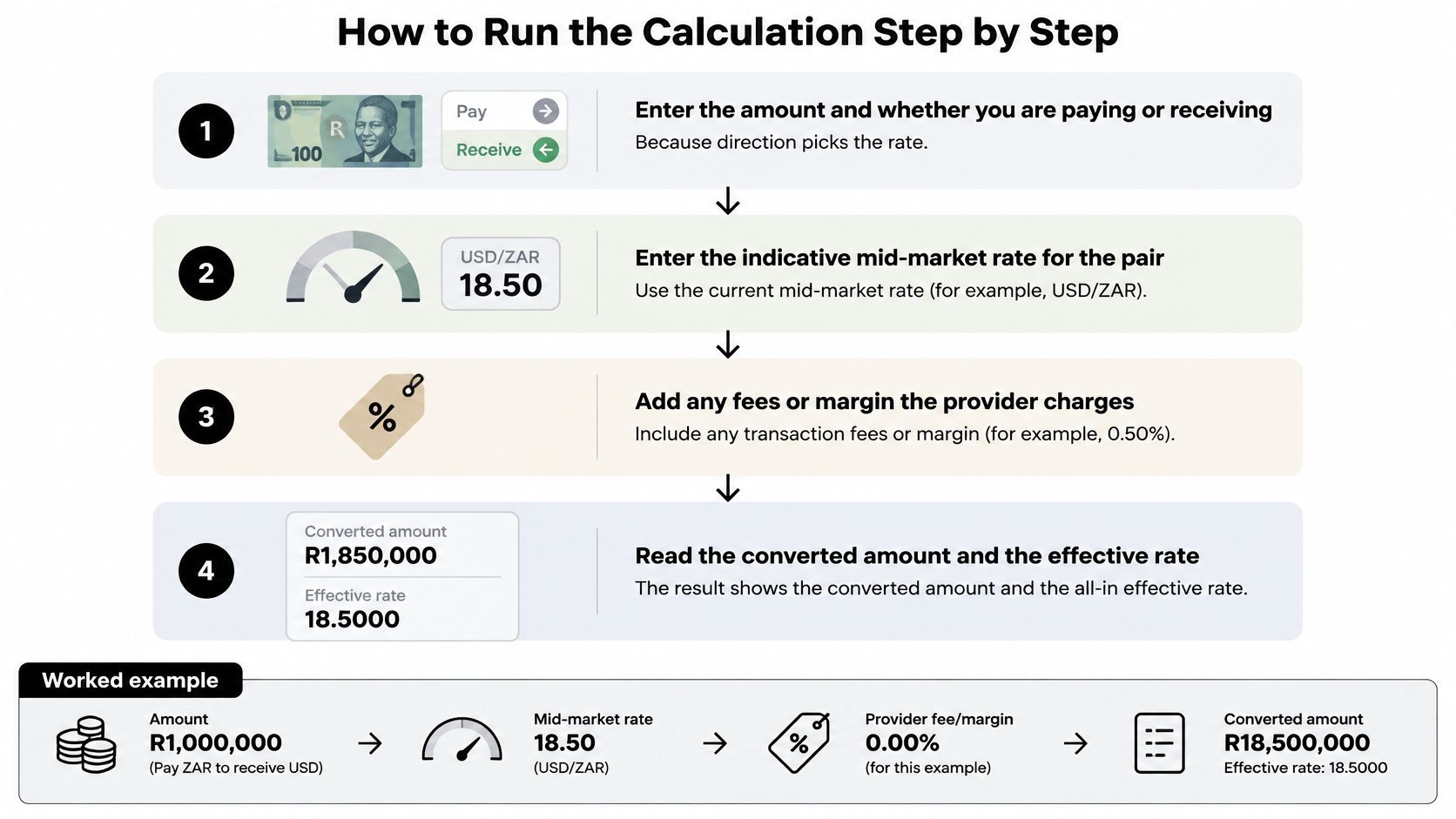
The fee steps
- Enter the amount and the direction. State whether you are paying rands away or receiving dollars in. Direction picks which side of the quote you stand on, the same way you fix the loan amount before you start using a mortgage calculator step by step.
- Enter the indicative mid-market rate for the funding date. This illustration uses R17.70 per dollar. A rate you searched yesterday morning is already a different market.
- Enter the provider quote and the percentage gap. On R1,000,000, a 2% gap is R20,000 and a 3% gap is R30,000. Write the gap in rands, not only as a percentage, so the cost is obvious.
- Add every fixed charge. SWIFT or admin in the region of R500 to R1,000, plus any correspondent-bank deduction that comes off the beneficiary amount. A quote that says the rate has “no fee” can still carry these charges.
- Read dollars received. In this illustration that is about 56,497 with no spread, about 55,340 after the 2% case with a R500 fee, and about 54,800 after the 3% case with a R1,000 fee.
Then adjust for prices, not for the payment
Build a bilateral real rate only after the cash figure is done. Divide or multiply the nominal rate by the relative consumer-price change in South Africa and the United States since your chosen base. That result tells you whether the rand's purchasing power has shifted. It is not the rate the bank will apply on Thursday.
Repeat the cash steps with the rand 1% to 2% weaker than today's mid-market print. If the dollars that arrive fall below the invoice you promised, you have a settlement gap, not a rounding difference. Two slips cause most of the bad surprises: a search rate that is hours old, and a “no fee” quote that still takes a fixed charge on the way out.
A short walk-through of reading a live pair, before you type your own numbers:
Reading the Real Effective Rate for Exporters
The BIS real broad effective exchange-rate series for South Africa, published through the Federal Reserve Bank of St. Louis, is a monthly, trade-weighted index. It adjusts bilateral rates with relative consumer prices. The published observations were 175.05 in January 1994, 160.35 in June 1994, and 102.22 in January 2025.
A higher reading means South African goods have become relatively more expensive than goods from trading partners. A lower reading means better price competitiveness. January 2025 sits about 42% below January 1994, a long decline in the inflation-adjusted external value. The drop from January to June 1994 alone was about 8%.
| Month | REER index value | What it signals |
|---|---|---|
| January 1994 | 175.05 | Higher index: South African goods relatively expensive against partners |
| June 1994 | 160.35 | About 8% lower than January 1994: relatively more price-competitive |
| January 2025 | 102.22 | About 42% below January 1994: a large long-run gain in price competitiveness |
What the index does not do
Say a manufacturer's wage bill and local inputs rise with domestic inflation, while prices in the buyer's market do not. The firm can lose price room even when the dollar rate on the invoice looks steady, because the United States is only one partner in the basket. Europe, China and the rest of the weights still sit inside the index. A calculator that prints only the spot dollar rate misses that gap.
The index is not a rate for invoices. Use it to judge pricing power and whether a contract should be repriced. Use the quoted bilateral rate to set the rand amount on a single payment. Teams that invoice in several currencies can see Fundpilot's currency support when they line receipts up in one ledger. The index still has a separate job: each quarter, put the REER next to the quoted rate and note the months they move in opposite directions. That split is when a “good” dollar rate is masking a weaker competitive position, or the reverse.
What a Trustworthy Calculator Should Disclose
If you can't rebuild the number, you can't trust it. Two tools can print different real-rate values for the same month because one is a bilateral conversion and the other is a trade-weighted index, or because they use different base periods. Without the base year, those two prints look like a market move when they are only a change of ruler.
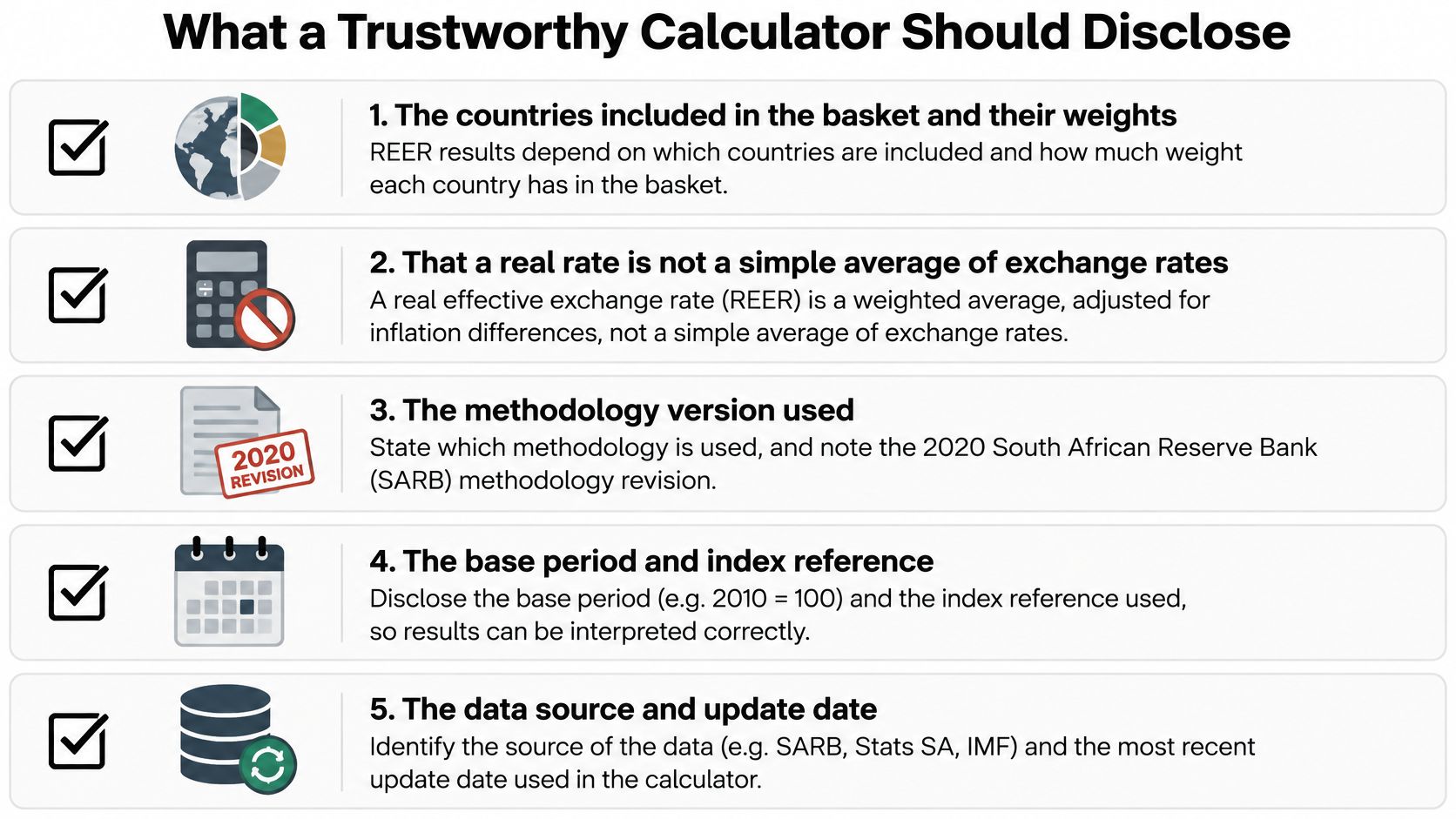
What to look for on the page
- Base year: An index level only means something against the period it was set to 100. Say which year that is.
- Inflation measure: Consumer prices and producer prices tell different stories. Name the one in the formula.
- Currency basket and weights: The countries included, and the share each one carries, decide the result. A flat average of exchange rates is not the same object.
- Date of the exchange-rate data: A monthly index and this morning's spot rate are not interchangeable.
- Output type: State whether the figure is a bilateral conversion you could settle, or a trade-weighted index you should not put on an invoice.
- Fee assumptions: Any “net amount” needs the spread and the fixed charges written out, or the dollars are a fiction.
A page that hides the basket is asking you to treat a competitiveness index as a bank rate. A page that hides the fees is asking you to treat a mid-market print as the money that arrives. Neither one is a finished real exchange rate calculator.
If two calculators disagree for the same month, check the base period before you assume the rand moved.
Confirm the Lowest All-In Cost Before You Send
Keep the quote that delivers the most foreign currency after the spread and every fixed charge. Run the same amount through at least two providers on the same day. A rate that looks sharper on the banner can still send less once the fixed charge is in the total, and that charge is a larger share of a small transfer than of a large one.
Set our free USD to ZAR converter beside the quote in your hand. It checks the live mid-market rate and lines that up against what a bank may take in FX spread and SWIFT fees. We charge a transparent spread and no SWIFT fees, with pricing set by volume and corridor, and we show the applicable fees before you confirm. Hold the funding-date mid-market rate only as the benchmark for that last check, then choose the higher net amount.
If you want the mid-market benchmark and the all-in rand cost in one place before the next supplier payment or export receipt, start with Zaro's USD to ZAR converter and a quote that shows the spread before you confirm. Zaro is built for South African businesses that send and receive cross-border payments and want the fee visible before the money moves. Open a quote on your own amount and keep the option that leaves more with the recipient.