
You're probably dealing with the same mess right now, a buyer says the funds left their bank this morning, a supplier wants proof before dispatch, and your team is still checking whether the payment is visible on the other side. In South Africa, real time payments fix part of that problem, but not all of it. They make the local rand leg faster and cleaner, yet the cross-border leg still has its own FX, compliance, and settlement friction.
That distinction matters because finance teams keep getting sold speed as if speed alone solves cash flow. It doesn't. Faster domestic clearing helps, but an exporter who pays contractors, suppliers, or agents offshore still has to deal with currency conversion, intermediary steps, and beneficiary settlement outside the domestic rail. If you want a useful map of where payment data and control sit, navigate the map data before you assume the payment itself is the whole story.
Why a Faster Rand Does Not Finish the Job
A Jozi exporter can still feel stuck on a Monday morning. The client says the payment has left the account, the supplier wants proof before dispatch, and the contractor offshore wants to know whether the invoice will clear before the day ends. Finance is watching one transaction, but it is really dealing with two systems.
real time payments help with the rand leg inside South Africa. They shorten domestic transfer time, which improves cash flow, reconciliation, and supplier confidence. They do not fix everything around the payment. If the obligation sits in USD, EUR, or GBP, the business still has to handle FX conversion, account details, and cross-border settlement on a separate rail.
Which leg of the payment is getting faster?
The answer CFOs need is simple. A payment can move quickly inside South Africa and still crawl once it leaves the domestic system. Domestic rails handle the rand movement. They do not remove the timing and cost of the foreign leg.
Practical rule: if the problem starts with local collection, instant rails help. If it starts with foreign settlement, speed alone will not solve it.
That is the frame I would use in a finance meeting. Treat real time payments as domestic infrastructure first. Then decide what has to sit on top for exports, offshore contractors, and supplier disbursements. If you keep those layers separate, the sales pitch loses its shine and the operating decisions become clearer. For a useful map of where payment data and control sit, navigate the map data.
What Real Time Payments Mean in South Africa
In South Africa, “real time” is not one product. It is a payment architecture that moved from fast clearing with deferred settlement to newer instant rails that can carry value and confirmation much faster. For a CFO, that difference changes treasury timing, approval design, and reconciliation.
Clearing and settlement are not the same thing
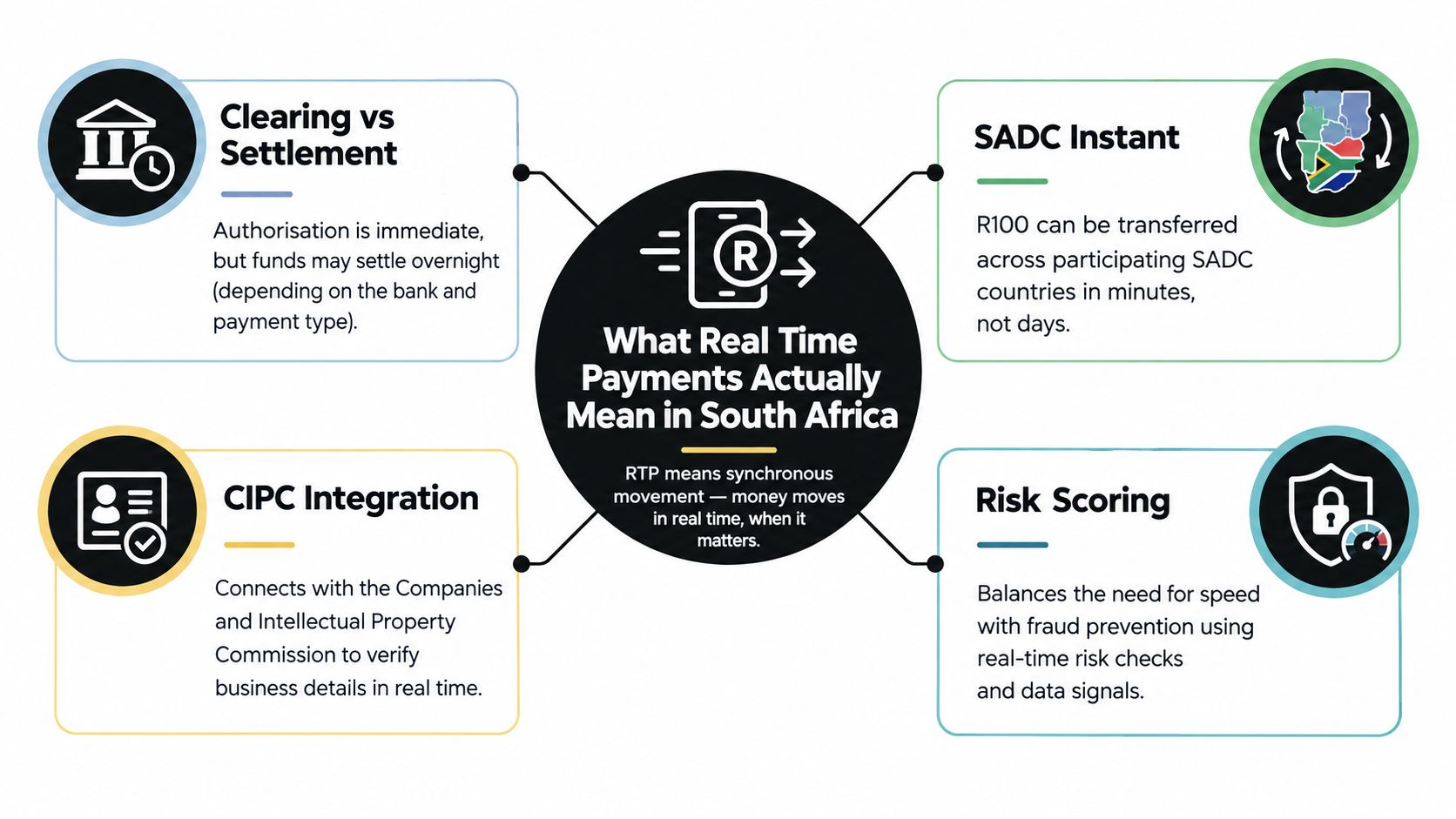
The older Real-Time Clearing system could credit a beneficiary within 60 seconds, and it ran continuously, 24 hours a day and 365 days a year, but settlement still happened in scheduled batches, seven times on weekdays, twice on Saturdays, and once on Sundays and public holidays World Bank case study on South Africa's payments evolution. A payment can reach the recipient quickly and still be settled between banks on a separate timetable.
PayShap added a newer instant account-to-account rail under South African Reserve Bank oversight in March 2023. In its first year, from March 2023 to March 2024, it processed more than 18 million transactions worth over R11 billion, about US$588 million, with an average transaction of roughly US$32, and interoperability across ten commercial banks World Bank case study on South Africa's payments evolution.
Why that matters to an export business
South Africa now runs a layered payments environment where customer-facing speed and interbank settlement discipline are separate. The South African Reserve Bank's faster-payments framework set a 60-second crediting objective and mapped the sequence from fraud screening to validation, clearing, posting, and final settlement SARB faster-payments consultation paper.
That distinction matters for exporters and finance teams handling supplier payments, contractor payouts, or refunds. A credited beneficiary is not the same thing as a fully settled interbank position. If your operation moves money across borders, the domestic instant leg helps with local cash flow and visibility, but the foreign leg still needs its own FX, account, and settlement setup.
Inside the Path of a Real Time Payment
A payment can show as instant on the screen while four separate checks run in sequence behind it.
The message path inside the rail
The paying bank first screens the instruction for fraud and other risk signals. It then sends a non-financial message through the payment-clearing-house system to the beneficiary bank. The beneficiary bank checks the account and decides whether to accept the credit. After that, the paying bank submits the financial instruction, the beneficiary bank posts the funds, and interbank settlement follows through participants' accounts at the South African Reserve Bank, as set out in the SARB faster-payments consultation paper.
That sequence is why finance teams need two views at once, the customer-facing status and the clearing response underneath it. Watch only the front end, and you can miss where a payment is failing in the rail. Watch only settlement, and you miss what your customer or supplier experiences.
A fast confirmation is useful, but it is not a substitute for knowing where the payment sits in the chain.
What finance teams should monitor
A payment control stack should separate the stages. It should show whether the instruction was accepted, whether the beneficiary bank validated the account, and whether the credit posted. If those steps collapse into one status, ops staff are left guessing where the break occurred.
That matters in South Africa because the national payments system already carries serious volume. The SARB reported that SAMOS settled R153.7 trillion in 2024, up 2% year on year, while electronic funds transfer credit transactions rose from 406.9 million in 2010 to 1.13 billion in 2024, roughly 178% growth over fourteen years SARB NPS Regulatory Report 2024. Real-time discipline is already part of the system, not just the customer interface.
Real Time Payments Compared to EFT and Card Rails
South African finance teams should stop asking which rail is “best.” The right question is which rail matches the payment's urgency, control needs, and reconciliation load.
| Dimension | Real Time Payments (RTC, PayShap) | Standard EFT | Card Acceptance |
|---|---|---|---|
| Speed to beneficiary | Near-instant domestic crediting | Slower, batch-based movement | Immediate authorisation, settlement depends on the scheme |
| Finality | Fast domestic crediting with structured interbank settlement | More flexible posting and batch handling | Strong scheme rules, with dispute processes |
| Cost profile | Usually used for urgent, lower-friction payments | Efficient for routine spend | Merchant fees apply |
| Disputes and reversals | Requires tighter pre-payment controls | More room for correction | Chargeback and dispute processes exist |
| Best use case | Urgent supplier payments, off-cycle disbursements, time-sensitive domestic transfers | Scheduled payroll, routine vendor runs, bulk payments | Customer payment acceptance, sales collection |
Where each rail earns its place
EFT still does the heavy lifting for routine business payment runs because it is built for batching and control, not speed. Real time rails fit the payments that cannot wait, where the cost of delay is higher than the fee on the transaction. Cards belong on the acceptance side, where customer checkout, dispute handling, and scheme rules matter more than pushing money directly.
The difference shows up in operations. EFT often means later posting, more batch reconciliation, and more tolerance for corrections. Real time payments tighten the process, so finance teams need cleaner beneficiary data and better pre-payment checks. Cards shift the burden again, since merchant fees, scheme settlement, and chargeback handling sit in the background.
South African payment volumes already show why no single rail covers every job. The SARB has reported the scale of the national system, and electronic transfers continue to carry a large share of business activity SARB NPS Regulatory Report 2024. That is not an argument to replace EFT everywhere. It is a reason to reserve real time for payments where speed and certainty matter more than batch efficiency.
Use real time rails for urgent domestic payouts and supplier pressure points. Keep EFT for scheduled runs that can wait. Use cards where acceptance and reconciliation belong in the card scheme, not in your bank file.
The Cross-Border Leg That Real Time Does Not Solve
Domestic instant payments are not the same thing as cross-border settlement. That's the point too many sales decks skip over. A business can receive ZAR quickly inside South Africa and still wait longer, and pay more, to settle the actual offshore obligation.

Why the offshore leg stays slow
Common Monetary Area cross-border flows now route through SWIFT after a 2024 rule change, which increases fees and settlement time on corridors involving Namibia and Eswatini, even as domestic instant payments become more accessible South Africa real-time payments market overview. That is the hard commercial reality for exporters, importers, contractors, and BPO firms.
The bottleneck isn't just speed. It's also foreign exchange execution, correspondent-bank processing, sanctions screening, and beneficiary settlement. A local instant rail can help you move the rand leg quickly, but it does not make the foreign leg disappear.
What to do instead
A CFO should separate three problems: local collection, FX conversion, and cross-border delivery. If you collapse them into one “faster payment” conversation, you'll misread both cost and timing. The right infrastructure needs transparent FX, clear account logic, and controls that show where the delay sits.
Later in the process, your treasury team can revisit payment routing with more precision. For now, the important call is simple, domestic instant payments are useful, but they do not make international supplier or contractor payments real time by themselves.
Faster Rails, Sharper Controls
Speed without governance is a bad trade. Real time payment rails compress the window for supplier verification, dual approval, sanctions screening, and anomaly detection, so finance teams need faster controls, not fewer controls.
Fraud risk moves faster too
The South African Reserve Bank's 2025 consultation paper warns that interoperability and payment speed can let fraudsters move funds faster and conceal proceeds, while industry reporting cites global evidence that fraud in instant payments is ten times higher than in regular payments SARB 2025 interoperability consultation paper. That warning should change how you build approvals.
If your team is still relying on a single approver, a loose email instruction, or a static supplier record, instant payments raise the risk profile immediately. Faster rails need better beneficiary-change verification, role-based permissions, payment limits, transaction monitoring, and an immutable audit trail.
One useful reference point for teams reviewing payment authorisation is vendor payment authorization forms from Closer Innovation Labs Corp., because the control question is not paperwork, it's whether the person approving the transfer has independent evidence that the recipient details are correct.
What good control design looks like
Practical rule: if a payment can't be paused safely, it shouldn't be approved casually.
A good instant-payment process makes it harder to change beneficiary details unnoticed, harder to bypass approval thresholds, and easier to reconstruct every action after the fact. That matters even more for recurring payroll, supplier, and client flows, where fraudsters know the payment patterns well.
A CFO's Working Checklist for Real Time Payments
Start with beneficiary-change verification through an independent channel, not the same email thread that requested the change. That closes off the most common spoofing path. Then force maker-checker approval, with different people preparing and releasing the payment.
Set payment limits by role and by payment type. A contractor refund should not sit under the same approval threshold as a supplier settlement. Add transaction monitoring for unusual timing, frequency, bank details, and destination patterns, then keep an immutable audit trail so you can reconstruct what happened without relying on memory.
Do not let speed replace reconciliation discipline. If your team cannot reconcile the payment cleanly, the faster rail only makes the mistake show up sooner.
- Verify beneficiary changes independently: Call back on a trusted number before changing bank details.
- Use maker-checker controls: One person prepares, another approves.
- Set role-based permissions: Limit who can create, edit, and release payments.
- Apply transaction limits: Keep high-risk payments inside pre-set thresholds.
- Track every step: Maintain a clean audit trail and a clear recall or escalation process.
When teams ask what to implement first, I tell them to start with the controls that stop irreversible mistakes. Everything else can follow.
Treating Real Time as Architecture, Not Just Speed
Real time payments are a genuine upgrade for South African domestic cash flow, but they're only one layer of the stack. Exporters still need transparent FX, multi-currency accounts, and controls that make cross-border movement predictable instead of guessed.
That's why the smart move is architectural, not cosmetic. If you're choosing tools, compare domestic instant rails with cross-border infrastructure, then add the controls that let finance trust both. For teams that want stronger reporting discipline around that stack, strengthen audit readiness by making the evidence trail as clean as the payment flow itself.
Zaro fits into that broader cross-border layer, because it gives South African businesses a way to manage foreign payments with account structure, permissions, and transaction visibility. If your current setup still hides FX spread, SWIFT fees, or approval gaps, visit Zaro and assess whether your payment stack needs a cleaner offshore leg as well as faster local rails.