
Your overseas customer has paid, but the money isn't yet available in rand. Meanwhile, a local transport subcontractor wants payment before releasing a delivery, and your finance team is checking whether an urgent transfer will arrive in time. Those are separate problems, even if they appear on the same cash-flow forecast.
Real-time payments in South Africa can help with the domestic payment. They don't automatically solve the currency conversion, cross-border settlement or fraud exposure behind it. For exporters and finance teams, the useful question isn't how quickly money moves. It's whether the chosen route delivers the right currency to the right beneficiary, at an acceptable total cost and with proper approval.
Real-Time Payments in Plain Terms
A real-time payment is like sending a parcel by dedicated courier rather than waiting for a scheduled postal collection. The courier handles the delivery promptly; the postal service sorts items into dispatch runs. That's a useful comparison with batch EFT, although the banking arrangements behind the payment are more complicated than moving a parcel.
For the business user, real-time means the beneficiary can receive usable funds within seconds rather than waiting for a conventional processing cycle. Treat a completed payment as final, not as an instruction you can casually cancel.
The terms your finance team needs
The beneficiary is the person or business receiving the money. A proxy identifier is an alias, such as a registered mobile number, that points to an account without the payer having to type full banking details.
Settlement describes the discharge of payment obligations between participating institutions. It's distinct from the notification you see in an app, and fast customer crediting doesn't mean every underlying interbank obligation necessarily settles individually at that moment.
An irrevocable payment generally can't be withdrawn once completed. A bank may investigate a mistake or attempt recovery, but that isn't the same as giving the payer a cancellation button.
Practical rule: Judge a payment by confirmed beneficiary credit, not by a screenshot showing that someone submitted an instruction.
Real-time services are designed for use beyond normal banking hours, with individual instructions handled promptly instead of waiting for a routine batch. Actual availability still needs to be checked with the participating bank.
For an exporter, the routing test is straightforward: is this a domestic, low-value, urgent rand obligation? If the answer involves a foreign account, currency conversion or a larger scheduled invoice, a different payment workflow may fit better.
Payment Routes Compared and Real-Time Adoption Figures
Payment routes compared for South African businesses
| Route | Typical speed | Usual limit | Best use | Reaches foreign account |
|---|---|---|---|---|
| PayShap | Near-real-time processing | Scheme and participating-bank limits; confirm the current allowance | Low-value domestic supplier payments and refunds | No |
| EFT bank transfer | Scheduled processing, subject to bank cut-offs | Set by the bank and account type | Larger domestic rand payments | No, for the domestic EFT route described here |
| Card payment | Authorisation at purchase; merchant settlement follows | Set by the issuer and card type | Point-of-sale and online purchases | Possible for purchases abroad, not an account-to-account supplier transfer |
| SWIFT international transfer | Subject to bank processing, compliance checks and intermediary handling | Sending-bank, account and compliance rules | International payments, including foreign-currency transfers | Yes |
The distinction between authorisation and settlement matters when comparing these routes. A card transaction can be approved while the merchant still waits for settlement. Likewise, an international bank instruction can be accepted before the beneficiary receives usable funds.
SWIFT is a financial messaging network, not a guarantee of a particular arrival time. Ask the sending bank for the expected beneficiary-credit timing for the actual corridor rather than treating a generic estimate as a commitment.
Adoption is substantial, but reach still needs checking
SARB's payments conference address reports approximately 507 million PayShap transactions worth R486 billion in 2025, with transaction volume equivalent to about 6% of card transaction volume and below 40% of EFT-credit volume. That's meaningful adoption, but it doesn't establish PayShap as the default route for business payments.
Earlier, BankservAfrica reported approximately 30 million transactions worth R19.5 billion by May 2024, according to ITWeb's report on PayShap uptake. The report also describes growth through migration from legacy methods and wider bank participation.
These observations cover different periods. They aren't a clean market-share series, and transaction count doesn't tell you whether your own supplier is reachable through the channel you intend to use.
For a finance team, coverage means more than a provider displaying a PayShap logo. Confirm that the relevant banks support your workflow, that the beneficiary's alias resolves correctly, and that business-account permissions allow the payment. Include pricing and account-specific limits in that check.
Choose by obligation, not popularity
Use these decision questions before selecting a route:
- How much? Check the available payment allowance and the remaining user or account limit.
- How fast? Separate urgent obligations from invoices that can follow a scheduled payment run.
- Which country and currency? Establish where the beneficiary banks and what currency they must receive.
For an integrated payment system, track completion by receiving bank and classify failures separately: technical rejection, limit breach, beneficiary problem or compliance review. A single overall success rate can hide an unreliable route to an important supplier.
The fastest available channel isn't automatically the best business channel. A large, planned supplier invoice may be better handled through EFT with clear approval and reconciliation.
How a PayShap Payment Moves in About a Minute
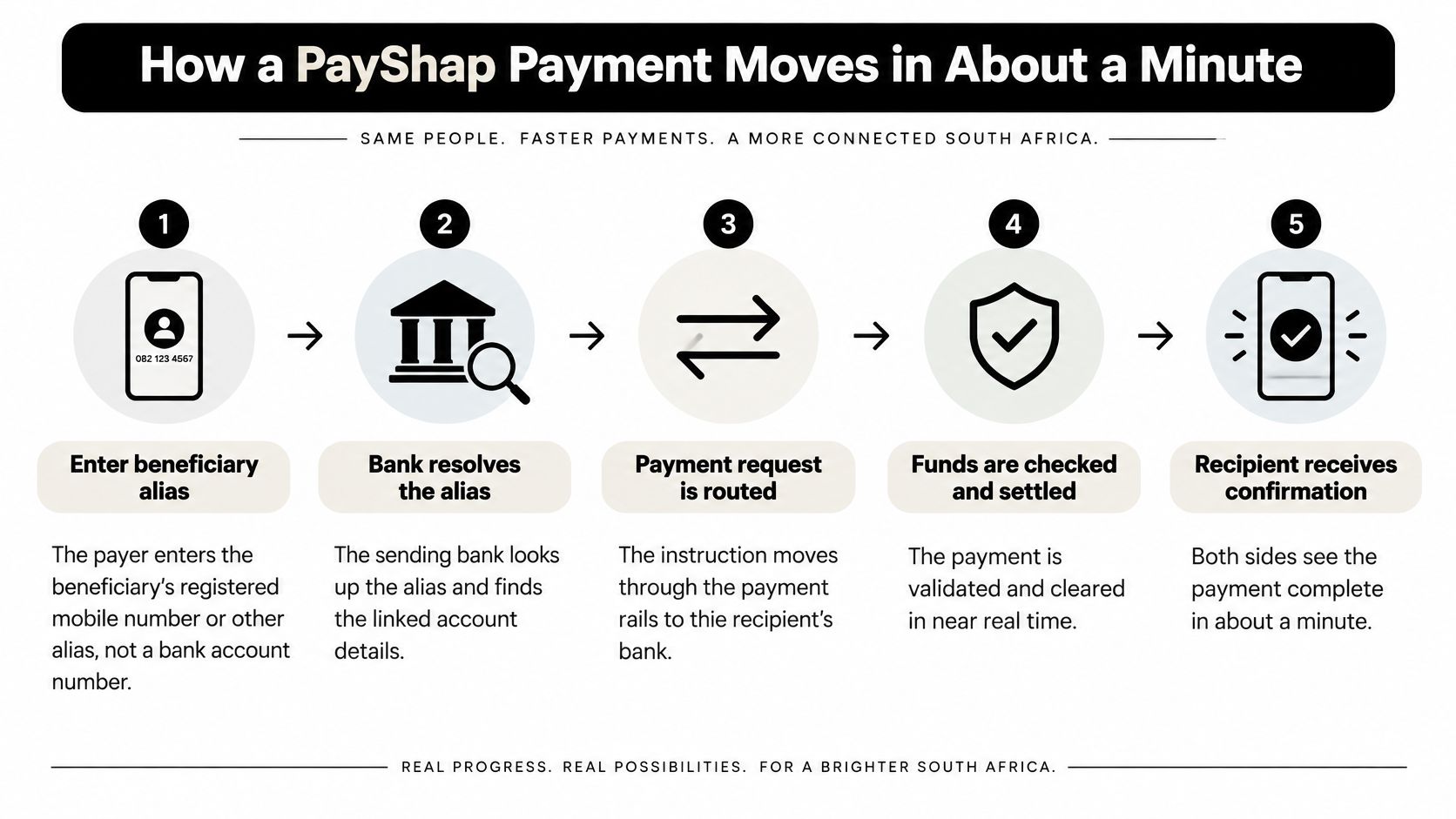
BankservAfrica's Rapid Payments Programme describes a PayShap processing target of approximately 60 seconds, with centralised clearing, participant reconciliation, settlement through the SARB settlement system and reporting. It also records an initial R3,000 per-payment cap, with early reporting citing a R5,000 daily aggregate limit; those are launch-era figures, not a substitute for checking today's bank rules.
The flow below gives a simplified overview of the payment journey.
What happens behind the instruction
The payer enters the beneficiary's registered alias. This might be a mobile number rather than banking details. An unregistered or incorrectly entered identifier can prevent the payment from proceeding.
The sending bank resolves the alias and checks eligibility. The bank identifies the linked account and applies relevant limits and controls. An unsupported receiving institution or an amount outside the permitted allowance can stop the instruction here.
The payment instruction goes to central clearing. The system routes the instruction between participating institutions. A connection failure or timeout needs an explicit status check, not an immediate second payment.
Clearing reconciles participant obligations. The participating institutions must account for what they owe and are owed. An exception at this stage requires operational investigation rather than a finance user guessing whether funds moved.
Interbank obligations settle through SARB's settlement infrastructure. This is the institutional settlement layer, distinct from what the customer sees on screen. Don't infer its exact timing or structure solely from an app's completion message.
The receiving bank credits the beneficiary. Customer availability is the outcome your supplier cares about. If credit hasn't been confirmed, establish whether the instruction is pending, rejected or completed before changing routes.
The banks retain transaction records. Your business should retain its own reference, approval history and returned status alongside those records. Missing identifiers make later reconciliation and dispute investigation harder.
Design the exception path before launch
The historical caps reflect the need to contain exposure when completed payments are difficult to reverse. Your own controls should also consider the beneficiary, purpose and user, not just whether the amount passes the bank's limit.
Configure business software to pre-validate limits, confirm identifiers and select an eligible rail. Keep EFT available for unsuitable payments, but trigger a replacement only after establishing the original instruction's status.
A timeout is an unknown outcome until checked. It isn't proof that no payment occurred.
Where Real-Time Payments Help Exporters and Finance Teams
Say a Cape Town packaging exporter needs to pay a transport subcontractor before a truck leaves. The beneficiary is local, the invoice is approved, and the amount falls inside the bank's current real-time allowance. Waiting for the next scheduled payment run would delay dispatch, so a real-time rand payment serves a clear operational purpose.
The same exporter receives a substantial monthly haulage invoice. There's no benefit in breaking it into smaller transfers merely to force it through an instant channel. Schedule the invoice through an appropriate bank-transfer route, preserve the invoice reference and keep the approval record intact.
Benefits that translate into operational value
For exporters and business process outsourcing firms, useful applications include:
- Urgent supplier releases. Pay an approved local subcontractor when confirmed receipt is necessary to keep work moving.
- Customer refunds. Return eligible domestic payments promptly without making the customer wait for a routine finance run.
- Contractor disbursements. Release approved payments when recipients need access to funds during their working day.
- Cash visibility. Reduce uncertainty between the payment instruction and confirmed receipt, then update the cash forecast using the actual outcome.
Better reconciliation isn't automatic, though. It comes from disciplined references and status records. Require an invoice or job identifier when staff initiate a payment, and carry that identifier into the accounting export.
Where the domestic benefit stops
The exporter's overseas receipt still needs its own workflow: identify the incoming currency, decide whether to hold or convert it, obtain the relevant documentation and establish when rand will be available. A quick local payout can't compensate for an unresolved foreign-currency receipt.
For teams mapping that upstream process, the international payment workflows explained by BroLabel provide useful context for distinguishing the international payment leg from the domestic disbursement.
Keep the operating model hybrid. Use real-time payments for eligible urgent local obligations, scheduled bank transfers for larger domestic invoices, and a controlled cross-border process for foreign suppliers or receipts.
Give each leg an owner. Treasury or the finance lead should control conversion decisions, accounts payable should validate the obligation, and the authorised approver should release payment. Urgency should change the route, not erase responsibility.
Fraud Risk and Controls to Set Before Going Live
Speed leaves less time to detect a wrong beneficiary before funds become available. An instruction can be technically successful and commercially disastrous if an employee has authorised payment to a fraudster.
Moneyweb's reporting on instant-payment scams cites South African industry findings that immediate-payment scams occur at ten times the rate of traditional-payment scams. It also reports 97,975 digital-banking fraud incidents in 2024, with losses of nearly R2 billion; that broader digital-banking figure isn't a PayShap-only loss total.
Mobile alerts deserve investigation, but prevention starts before the release screen.

Minimum payment controls for an SME
| Control | Risk it addresses | Practical setting |
|---|---|---|
| Beneficiary account verification | Wrong or fraudulent recipient | Verify before first payment and after any bank-detail change |
| Callback to a known number | Business email compromise and changed-detail scams | Confirm changes using a number already on file |
| Dual approval above a threshold | Single-user error or fraud | Require a second approver above the policy threshold |
| Daily limits per user | Compromised login or runaway batch | Match each user's daily allowance to their role |
| Segregation of duties | A person creating and releasing the same payment | Separate creator and approver permissions |
| Daily reconciliation | Unexplained debits and delayed error discovery | Match payment records to bank statements the same day |
Suppose a supplier emails new banking details just before an urgent delivery. Don't phone the number in that email or its attachment. Call the established contact using your supplier master record, verify the change, and record who confirmed it.
Ask your bank for written terms covering authorised push-payment losses, recall procedures and emergency escalation. Establish who must report an incident and what evidence the bank needs.
Monitor behaviour as well as permissions
A valid login doesn't establish a legitimate payment. Flag unfamiliar beneficiaries, unusual payment patterns and activity outside a user's normal responsibilities; Suby's practical transaction monitoring strategies for 2026 offer a resource for reviewing that monitoring design.
Use the video as a discussion prompt when training payment creators and approvers, alongside your written procedures.
Controlled instant settlement means rapid execution after verification and approval, with an audit trail and a prepared response when something goes wrong.
How Real-Time Rails Change FX Costs and Cash Flow
A domestic rand transfer and a foreign-exchange conversion are different services. The transfer moves money already denominated in rand. The conversion determines how much rand the exporter receives for foreign currency, and its price can include a spread as well as explicit charges.
That's why a cheap or fast domestic payment doesn't prove the complete transaction is economical. Finance teams need to compare the net usable rand received, not just the fee attached to the final payout.
Calculate the conversion separately
Take a hypothetical dollar export receipt and compare competing conversion quotes. Use the same receipt amount and capture the quotes at a comparable time, because an exchange-rate movement can otherwise look like a pricing difference.
The calculation is repeatable without assuming any particular bank's spread:
- Establish the benchmark. Multiply the dollar amount being converted by the contemporaneous mid-market USD/ZAR rate.
- Calculate quoted proceeds. Multiply that same dollar amount by the executable customer rate.
- Identify the rate cost. Subtract the quoted rand proceeds from the benchmark rand value.
- Add explicit charges. Include conversion, transfer and applicable intermediary charges without counting an embedded spread twice.
- Compare the deliverable amount. Check the rand expected to reach the account after charges, alongside the promised availability.
If a quote expresses its spread as a percentage, multiply the conversion amount by that percentage to estimate the spread cost in the base currency. Convert the result consistently before comparing it with rand-denominated fixed fees.
Treasury check: A quote with no visible transfer fee can still be expensive if the executable exchange rate is less favourable.
Timing changes working capital too
The conversion decision also affects liquidity. Converting on receipt makes rand available for local obligations, while holding dollars preserves foreign-currency balances for future dollar payments but leaves the business exposed to exchange-rate changes against rand expenses.
Neither approach is automatically better. Match the decision to known obligations, cash buffers and the business's treasury policy rather than speculating on tomorrow's exchange rate.
Distinguish receipt time, conversion time, value date and usable-funds time. A provider may acknowledge incoming money before the converted balance is available to spend, so put the relevant availability date into the cash forecast.
When reading a quote, capture the mid-market benchmark, executable rate, spread, fixed fees, possible intermediary deductions, settlement expectation and value date. A rapid domestic payout helps only once the upstream money is ready.
Confirm Your Payment Route Before You Move Money
Use a route check inside the approval workflow, not as a separate document that staff forget to open. Record the answers against the payment instruction so the approver can see why that route was selected.
Keep this visual prompt beside the payment-release procedure.
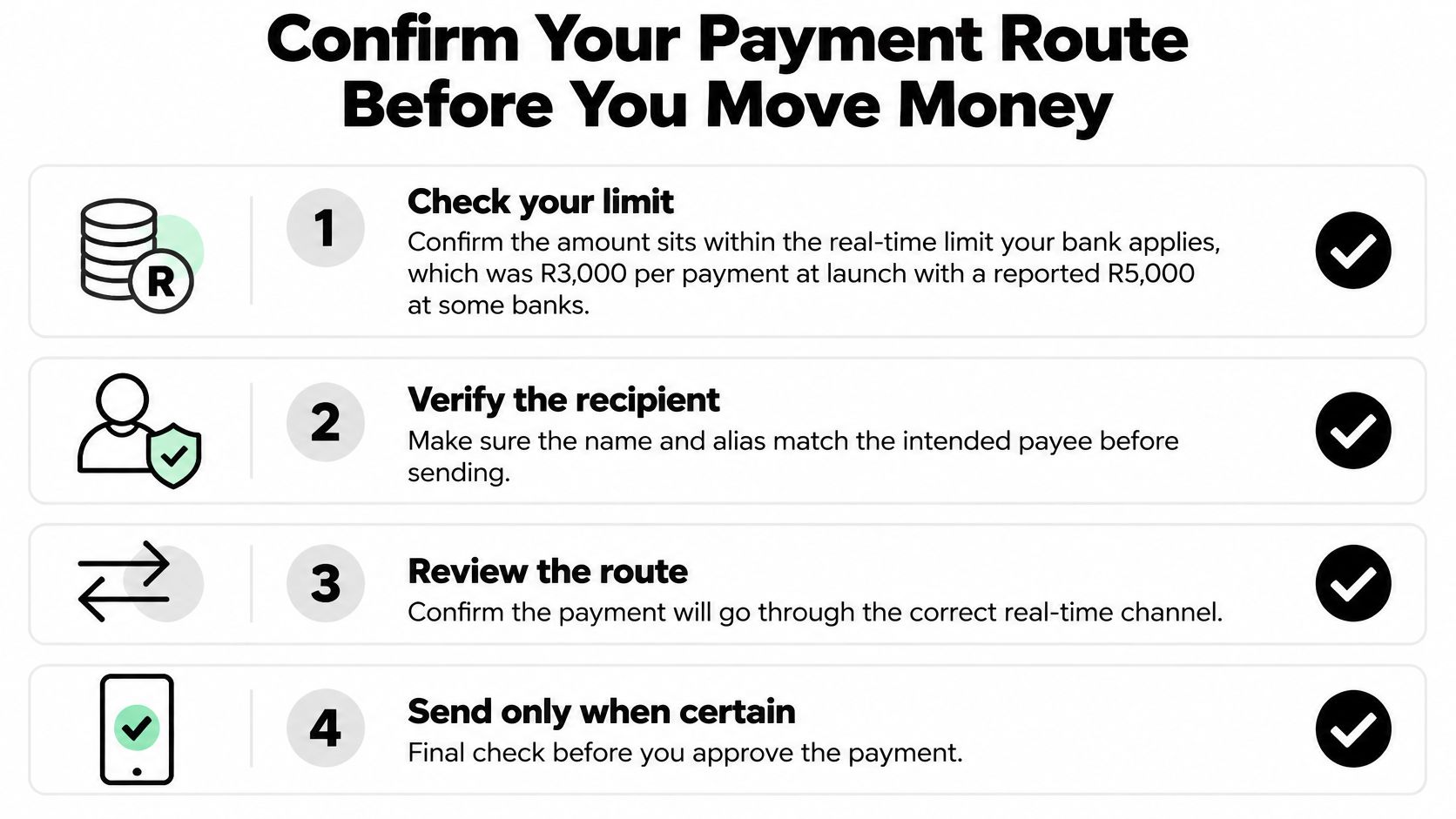
Pre-release route check
- Check the amount. Confirm current bank, account and user limits, including the remaining daily allowance.
- Check reachability. Validate the domestic beneficiary and registered alias, or select the appropriate bank-transfer route.
- Check the currency. Identify any conversion required before the payment can be funded.
- Check changed details. Complete the callback and retain evidence of verification.
- Check approval. Ensure the authorised second approver releases payments covered by your policy.
- Check reconciliation. Confirm the reference and assign responsibility for matching the bank entry.
If an invoice payment looks suspicious, stop further releases and contact the bank immediately. Keep the invoice scam recovery steps from MY CYBER GUARD in your incident-response resources.
Before accepting the next FX quote, use our free USD to ZAR converter to check the live mid-market rate and compare what a bank may take in spread and SWIFT fees. Obtain the executable spread, settlement time and value date in writing, then approve only when the quote, route and controls match the obligation.
Zaro offers business cross-border payments with a transparent FX spread, no SWIFT fees and applicable charges disclosed before confirmation. Visit Zaro to complete KYB verification, fund your ZAR and USD accounts by bank transfer, and assess your next export receipt or supplier payment against a clear quote.