
You're looking at a US invoice due next week, and the rate on the screen looks acceptable. Then the file comes back for a missing contract, a bank in the middle takes a slice, or the payment is a royalty and withholding applies. The cheapest exchange rate can still be the most expensive way to send money to USA once classification, documents, deductions and delays sit on the same page.
South African exporters, BPO teams and owner-managed firms hit this every month. A calm payment is one you classify, document and time before anyone locks a rate.
How to Send Money to the USA in Six Steps
South African businesses send US dollars routinely, so a USD payment is a normal part of running the business. The steps below follow the order a payment moves in practice.
In 2024, South African exports to the United States were valued at approximately USD 8.55 billion, up 0.74% from USD 8.49 billion in 2023, and imports from the United States totalled approximately USD 6.55 billion, according to the Wesgro US country factsheet. The United States was South Africa's second-largest export destination that year, after China. Dollar settlement is ordinary trade admin, not a specialist job you do once a year.
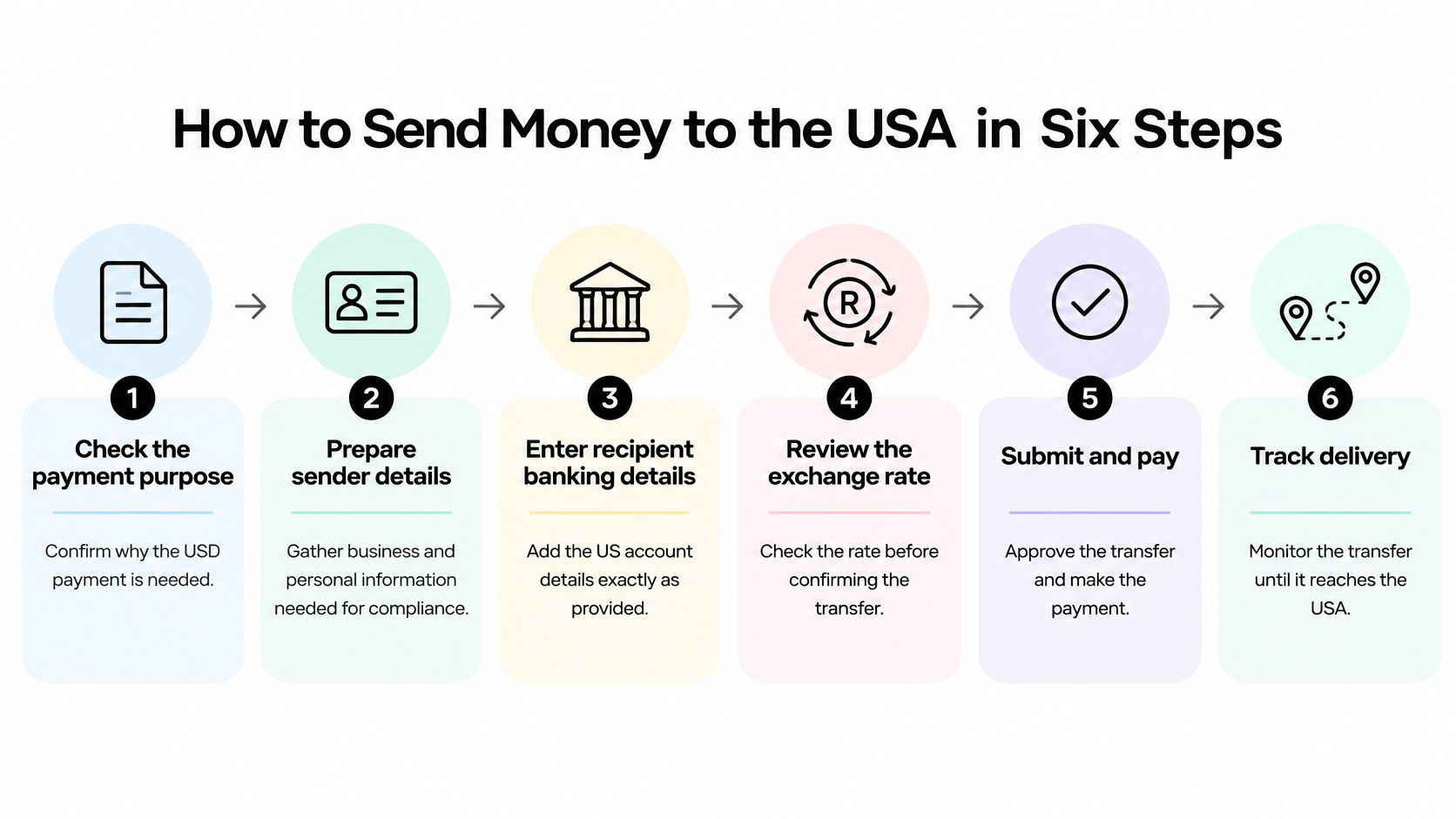
Confirm the payment type and its classification from the invoice or the signed contract. The pack of documents follows that label. The usual slip is working from a quote instead of the agreement you signed.
Choose an authorised dealer, usually a commercial bank, or a fintech that settles through one. Exchange control runs through those dealers. Treating a consumer payment app as if it were an authorised dealer is how a "sent" payment never leaves the country.
Collect the beneficiary's legal name, US routing number, account number and account type, or the SWIFT/BIC code for an international wire. Copy them from a current bank letter. One wrong digit is a common cause of returns.
Attach the invoice, contract, payment purpose and source of funds before submission. A purpose line that doesn't match the invoice wording is the first thing a reviewer queries.
Submit, and expect exchange-control and anti-money-laundering screening before release. Putting the payment in on the due date leaves no time for that screen, or for a repair if a field is wrong.
Confirm the beneficiary bank has credited the money, not merely that it left your account. An outgoing debit is not proof the supplier has been paid.
Log a transaction ID and the remittance advice for every payment, so any query can be answered from one record.
Do the classification before you shop for a rate. A goods invoice, a contractor fee and a licence fee don't travel with the same pack, and rebuilding that pack after a hold is slower than building it first.
Documents and Approvals Each Payment Type Needs
Each payment type needs its own file before an authorised dealer will release it. Match the row to the contract, not to the email subject.
| Payment type | Documents to have ready | Check before release |
|---|---|---|
| Supplier goods | Commercial invoice, purchase order, beneficiary bank letter | Invoice amount and beneficiary name match the bank letter |
| Contractor or service fee | Signed contract, invoice, contractor tax details | Payment purpose matches the contract scope |
| Software subscription | Vendor invoice or subscription receipt | Recurring amount matches the billing date |
| Royalty or licence fee | Licence agreement, royalty statement, tax treatment note | Withholding obligation confirmed before release |
| Dividend or shareholder payment | Board resolution, dividend declaration, tax records | Dual sign-off recorded |
| Personal remittance | ID, source of funds, annual allowance usage | R1 million allowance applies to individuals, not companies |
The SARS guide to taxation in South Africa states that South African residents remitting, investing or lending funds abroad are generally subject to exchange-control restrictions administered by the South African Reserve Bank, with commercial banks acting as authorised dealers. For individuals, transfers of up to R1 million per calendar year can generally use the single discretionary allowance without a Tax Compliance Status certificate. Larger individual transfers need an Approval International Transfer process through SARS eFiling.
That R1 million figure is a personal benchmark, not a company rule. A Pty Ltd paying a US supplier can't lean on a director's discretionary allowance. Corporate payments go through the dealer on the company's own instruction, with the company's source of funds.
What sends a file to manual review
- Incomplete source of funds: Bank statements that don't show where the rand came from.
- Mismatched beneficiary details: The name on the invoice differs from the bank letter, even by a comma or a trading name.
- Unexplained purpose: "Services" on the form, "software licence" on the invoice.
- Tax-status exceptions: A missing classification when the payment could be a royalty, dividend or contractor fee.
For a US contractor, tax details often include a Form W-9. Allied Tax Advisors' W-9 guide shows how a US person completes that form so you aren't guessing their status from an email signature.
Before release, reconcile the invoice amount, the beneficiary, the purpose and your cumulative outward transfers for the year. Keep statements, contracts and tax records in the file before you initiate. Hunting for them after a compliance hold is how a due date gets missed.
Where Fees and Exchange Rates Hide Your Costs
A payment to the United States isn't a local transfer between two South African banks. The US Government Accountability Office report explains that SWIFT is the communications system that carries the instruction, while the dollar movement is processed through the Clearing House Interbank Payments System (CHIPS). CHIPS was established in 1970 and, in 1988, connected 139 national and international institutions while processing about 34 million transfers with a value of USD 165 trillion. Correspondent banks still sit on that path, and each one can deduct a fee. The dollars credited can be lower than the dollars you thought you sent.
| Cost | Where it shows up | How to check it |
|---|---|---|
| FX spread or markup | Built into the rate you are quoted | Compare with the live mid-market rate on the same day |
| Intermediary bank deduction | Taken in transit, so the beneficiary receives less | Ask for the amount the beneficiary will receive |
| SWIFT or wire fee | Charged on the outgoing transfer | Request the full fee schedule before sending |
| Beneficiary bank charge | Taken from the credited amount in the US | Agree the charge code: OUR, SHA or BEN |
| Return or repair fee | Charged if details are wrong and the payment bounces | Verify routing and account details before release |
Charge codes decide who pays
OUR means you take the charges so the beneficiary should receive the principal, though some banks still deduct. SHA splits them: you pay your bank, they pay theirs. BEN loads the charges onto the beneficiary, so the credited amount falls. Write the code on the instruction. A cheap rate with BEN can still short-pay a supplier who then holds your shipment.
Say you convert R500,000. A 1% spread costs R5,000 before any wire fee. An intermediary deduction then comes off the amount the US account receives, on top of that rand cost. Compare the quoted rate with the live mid-market rate the same day, not with last month's screenshot.
Put three questions to any bank or provider. What is today's rate against mid-market? What amount will the beneficiary receive? Which fees come out in transit?
If the invoice is for a US contractor who works as a virtual assistant, the person's fee is separate from the corridor. A clear breakdown of virtual assistant cost shows what you're paying for the work before any bank takes its cut.
Tax Treatment That Can Outweigh the FX Spread
The cheapest FX quote isn't always the cheapest payment.
SARS guidance on tax and non-residents states that South African residents are generally taxed on worldwide income, while non-residents are taxed on South African-source income, and a double-taxation agreement may decide which country can tax a payment. The same guidance notes that royalties paid to non-residents can attract a final withholding tax of 15% on the gross amount in relevant circumstances.
A US payment might be a deductible business expense, a royalty, interest, a service fee, a dividend or a contractor payment. Each label can bring different documents, withholding or treaty analysis. Getting the label wrong creates rework that can cost more than the spread, and on a monthly payment the same mistake repeats.

Say the contract is a R100,000 royalty paid gross. At 15%, R15,000 can be withheld, leaving R85,000 before any FX or bank cost. A small saving on the rate doesn't cover that gap.
Build the landed cost in rand, not in the headline fee:
- Conversion: the spread against mid-market.
- Deductions: your bank, any intermediary, and the US bank.
- Withholding: where the classification requires it.
- VAT or imported services: where the supply is consumed in South Africa.
- Staff time: hours spent repairing the entry and the ledger.
- Classify the payment from the contract.
- Ask a tax adviser whether withholding or treaty relief applies before you pay gross.
- Budget the full rand cost, then accept a rate.
Economy-wide remittance averages don't identify South Africa to United States business payments. Don't use them to choose how you'll pay a supplier.
Settlement Delays and Monthly Payment Controls
The SARS payment rules guide notes that SWIFT foreign payments usually take three days to be processed by banks when all regulatory requirements are satisfied, and it recommends paying at least three days before a due date to avoid penalties or interest. That is a processing benchmark, not a guaranteed credit in a US account. Intermediary screening, US cut-offs, weekends, holidays and repair requests all add time.
| Delay trigger | What happens | Prevention |
|---|---|---|
| Beneficiary name or routing mismatch | Rejection, return fee or delayed credit | Check details against a current bank letter, not an old invoice |
| Incomplete source-of-funds evidence | Manual review hold | Attach bank statements and contract before initiating |
| Unexplained payment purpose | Compliance query | Use a purpose that matches the invoice wording |
| Intermediary bank screening | Extended settlement | Allow extra days for the first payment to a new beneficiary |
| US weekends and holidays | Credit lands on the next business day | Release early in the week, ahead of holidays |
| Paying on the due date | Late penalty or interest risk | Release at least three days before the due date |
Say a Durban importer owes a Michigan parts supplier on a Friday. If the instruction goes in on Thursday afternoon, US cut-off and the weekend can push credit into the next week. The supplier's system then shows the invoice open, even though your bank already shows a debit.
Three gates, then you stop calling it sent
Before you submit, check the routing number, account number, account type, legal entity and invoice currency yourself. Don't trust a detail copied from last year's remittance.
At approval, confirm the purpose and the documents match what the business does, and that the funding account covers principal and charges in rand. A payment that clears the rate check and fails the cash check still misses the due date.
After release, match the debit, the FX rate, the fees, the value date and the beneficiary receipt to the remittance advice. Query a gap the same day, while the trace is still easy to pull.
Treat "sent" as unfinished. Confirmation is a credit at the beneficiary bank, or a verified settlement trace, not an outgoing status on your app.
A monthly control set that holds
- Split the roles. One person prepares the payment and another releases it. Dual approval stops a single rushed click.
- Build an evidence pack per payment. Invoice, contract, bank letter, purpose, source of funds and the transaction ID live in one folder.
- Reconcile the month. Match debits, rates, fees and receipts before the ledger closes, not at audit time.
- Judge quotes on dollars received. Two "low fee" offers can credit different amounts once transit deductions land.
- Put the release on the calendar ahead of each due date, with extra days the first time you pay that beneficiary.
We set the process up so you sign up, complete Know Your Business verification, fund ZAR and USD accounts by bank transfer, and then send and receive cross-border payments, with cards coming soon. You still do the document and tax checks above. Pricing is a transparent spread and no SWIFT fees, quoted from volume and corridor when you sign up or speak with the team. Run one upcoming US payment through the gates this week, and write down any gap between what left your account and what was credited.
If your next US supplier or contractor payment needs a clear spread, no SWIFT fee, and ZAR and USD accounts you fund by ordinary bank transfer, open Zaro and complete KYB before the invoice week. You'll see the quote up front, send from the same place you receive dollars, and keep the evidence pack beside the payment instead of rebuilding it under a due date.