
A Johannesburg clothing exporter settles an overseas supplier invoice on Tuesday. The business account shows the full amount leaving, yet the supplier receives less several working days later. The missing value isn't a mysterious accounting error. It has been consumed by payment charges, intermediary deductions, and an exchange rate that includes a bank margin.
That is the central problem with SME cross-border payments in South Africa. They aren't merely transaction costs. They are a working-capital leak that affects supplier relationships, stock availability, contractor delivery, and the cash available for the next order. South Africa's formal remittance flows to the rest of SADC grew from just under R6 billion in 2016 to more than R19 billion in 2024, while transaction volumes rose from 4.8 million to 15.7 million, according to the South African Reserve Bank's SADC cross-border payments paper.
The practical question for an SME CFO isn't, “What fee does the bank charge?” It's, “How many rands leave, how many arrive, and how long does the settlement take?” The answer determines whether an international payment is predictable or becomes another margin surprise.
The R50,000 Invoice That Arrived as R41,000
The exporter had planned carefully. A supplier invoice for USD 2,750 was approved, the rand equivalent was available, and the payment was released on a Tuesday morning. Roughly R50,000 left the South African business account. Four working days later, the beneficiary in Dhaka confirmed receipt of only R41,000.
The bank statement showed the first deduction clearly: an international transfer or SWIFT charge. The next reduction appeared through the intermediary bank, which had taken its own lift before forwarding the funds. The largest gap came from the conversion itself. The bank's applied exchange rate sat above the mid-market rate, so the supplier received fewer dollars before the payment even entered the correspondent chain.
No single line explained the full R9,000 difference. That's why finance teams often classify the loss as “bank charges” and move on. The business, however, experiences the shortfall as a delayed purchase, an underfunded supplier settlement, or a new request to top up the invoice.
Working-capital rule: Measure the amount the beneficiary receives, not only the amount your bank debits.
The same exposure affects a business paying overseas software suppliers, remote contractors, freight agents, licensing partners, and royalty recipients. A payment can be correctly authorised and still be commercially inefficient. If the supplier must chase the missing balance, your accounts team spends time investigating a problem created by the payment route.
For owners trying to tighten collection and payment cycles together, a practical get paid faster course for firms can help connect invoicing discipline with cash-flow management. The payment rail still needs separate scrutiny, because faster collections don't help if international settlement strips value from every outgoing invoice.
The rest of this guide focuses on the leak itself, the compliance process behind it, and the payment infrastructure changes that give South African SMEs more room to choose a better route.
What Cross Border Payments Actually Mean for an SME
For an SME, a cross-border payment is the difference between what leaves the ZAR account and what the overseas beneficiary can use. SWIFT messages, correspondent banks, and compliance checks matter, but they don't define the commercial outcome. The settled amount does.
Think about buying fuel. The advertised price per litre resembles the mid-market foreign exchange rate, the neutral reference point between currencies. The amount you pay at the pump includes the station's markup, just as a bank's customer rate can include an FX spread. The litres available to you are the settled value, after the markup and any additional charges have been applied.
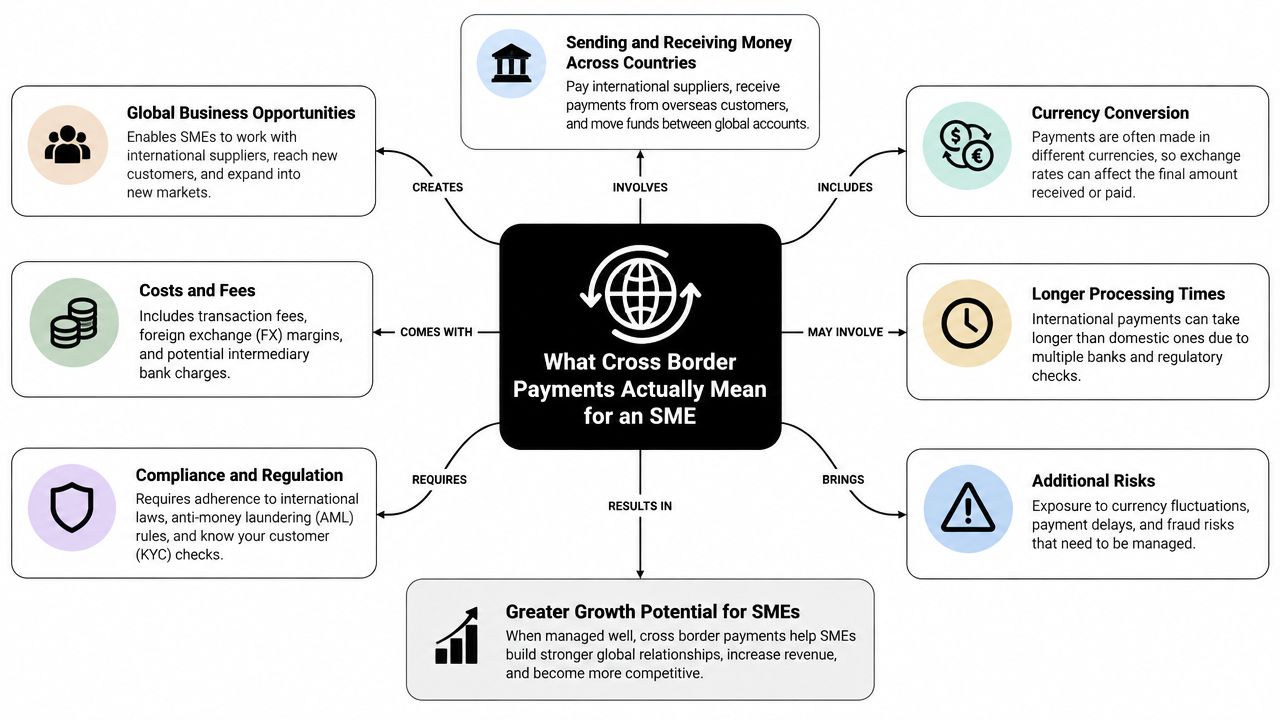
Every transfer from a South African account involves three separate events:
- Conversion: ZAR becomes the required foreign currency, with the provider's rate determining how much currency the beneficiary-side payment starts with.
- Movement: The instruction travels through payment networks and, in some cases, intermediary institutions.
- Settlement: The receiving bank credits the beneficiary after its own checks and deductions.
Separating those events makes the invoice easier to audit. A provider can advertise a low transfer fee while recovering margin through the conversion rate. Another can show a competitive exchange rate but pass intermediary charges to the sender or recipient. The right comparison is the full landed result.
South African SMEs with modest international flows feel these differences directly in gross margin. They don't have a large treasury department to negotiate every corridor or absorb timing surprises. A bookkeeper may have to decide whether to release a supplier payment, delay stock purchasing, or ask a customer for an early settlement.
If your business deals with multiple currencies, comparing providers by the same landed-amount method is more useful than comparing headline rates. Even a resource focused on how to compare currency exchange providers UAE reinforces the broader procurement principle: compare the actual delivered value, not the rate shown at the start of the transaction.
Where the Rands Disappear in a Bank Transfer
A bank transfer usually exposes only part of its cost. The visible instruction fee is easy to identify, while the exchange-rate margin and intermediary deductions may sit elsewhere in the payment chain.
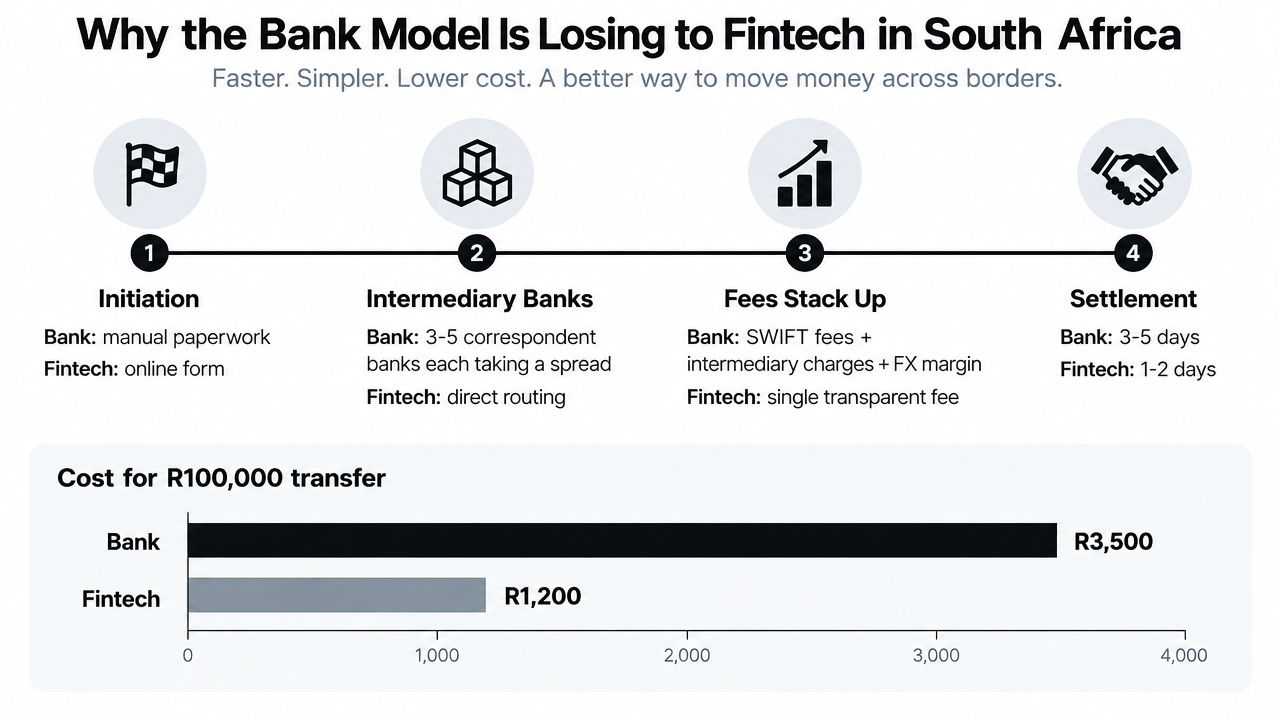
For a R100,000 transfer from South Africa to a UK beneficiary, a South African SME guide describes international transfers as taking 3–5 business days, with some financial institutions charging 5–10% of transaction value. The same guide cites an average 6.2% cost to send money to South Africa and says remittance pricing sits above the G20 average. Those figures don't describe every bank or corridor, but they show why a finance team should test the complete payment outcome rather than accept “standard charges” as an explanation. See the South African SME cross-border payments guide for that context.
The cost components
| Cost Component | Typical Amount | Visible on Statement? |
|---|---|---|
| SWIFT or international instruction charge | Explicit bank fee | Usually yes |
| Correspondent-bank deduction | Intermediary lift | Sometimes, often not clearly at initiation |
| Foreign-exchange spread | Embedded in the applied rate | Usually no separate line |
| Settlement delay | Working-capital exposure | No |
The visible fee is often the easiest cost to challenge, but it isn't necessarily the largest. A correspondent bank can deduct value while the payment passes through its network. The sending bank can also apply an exchange rate that differs from the relevant mid-market reference, reducing the foreign currency purchased for the same rand amount.
The delay has a commercial price
A payment that takes several business days can interrupt operations even when every document is correct. Stock may remain at a port, an overseas contractor may wait before starting work, or a supplier may place an order on hold until funds are credited. The accounting entry records a payment date, but the operating team lives with the settlement date.
Finance control: Record the debit date, beneficiary credit date, foreign currency delivered, and reference exchange rate for every material payment.
That four-part record lets you separate a genuine supplier discrepancy from a routing cost. It also gives management a better basis for selecting a provider, because the comparison uses actual settlement performance and landed value rather than a bank tariff sheet.
KYB and KYC Without the Compliance Theatre
Compliance shouldn't feel like an obstacle course. For an SME, Know Your Business and Know Your Customer checks should create a reusable payment profile that supports future transactions without forcing the finance team to rebuild the same file every time.
A non-bank fintech will generally need enough information to establish the legal entity, identify the people who control it, understand the business activity, and verify where it trades. Prepare the following before onboarding:
- Company identity: CIPC registration documents and the company's registered details.
- Ownership: Beneficial-owner information, including individuals who hold more than 25%, where applicable.
- Tax profile: SARS tax clearance or the relevant IT reference.
- Management identity: Identification documents for directors and authorised users.
- Operating address: Proof of the business's trading address.
- Payment purpose: A clear explanation of expected corridors, suppliers, customers, and transaction types.
The Financial Intelligence Centre Act applies to regulated institutions, including fintech providers operating within the relevant regulatory framework. A technology-led provider can apply the same underlying controls through digital identity verification, sanctions screening, risk scoring, and ongoing transaction monitoring rather than relying only on periodic manual file reviews.
The benefit isn't weaker compliance. It's better workflow design. Once the company profile is verified, the data can support later payments, subject to updated checks and transaction risk. That removes much of the repeated email exchange that makes bank onboarding feel disconnected from the actual size and nature of an SME's activity.
For a plain-language compliance reference, finance leaders can also review this Digital Footprint Check compliance resource. The useful question for any provider is not whether it asks for documents. Every responsible provider should. Ask how quickly it validates them, what triggers a review, and whether the finance team can see what remains outstanding.
A CFO should have the company documents, ownership details, director IDs, address evidence, and payment-purpose information organised before starting. That turns onboarding into a controlled finance task instead of an urgent scramble when an invoice is already overdue.
Why the Bank Model Is Losing to Fintech in South Africa
The bank model was built around correspondent relationships, manual controls, and payment instructions that can travel through several institutions. That structure remains useful for complex treasury activity, but it is a poor fit for many smaller supplier invoices and customer receipts. Every additional institution can introduce another compliance queue, fee, or exchange-rate decision.
The structural gap is visible in South Africa's regulatory position. The IMF notes that SME payments are primarily made through banks, and that Authorised Dealers with Limited Authority do not offer dedicated SME product options. That leaves many smaller firms using infrastructure designed for larger corporate treasury departments. The IMF assessment of South Africa's payment environment explains why access and product design matter alongside bank regulation.
TCIB changes the direction of travel
The South African Reserve Bank has classified low-value cross-border electronic funds transfers as transactions not exceeding R5 million. A 2025 directive starts moving low-value cross-border EFTs within the Common Monetary Area from SADC-RTGS to TCIB by 1 April 2027, according to the SARB cross-border regulation announcement.
That is more than a technical switch. It signals a move towards retail-oriented cross-border rails, payment pre-validation, payee confirmation, improved messaging, and interoperability. Those changes can help providers catch incorrect beneficiary information earlier and carry more useful data through the payment process.
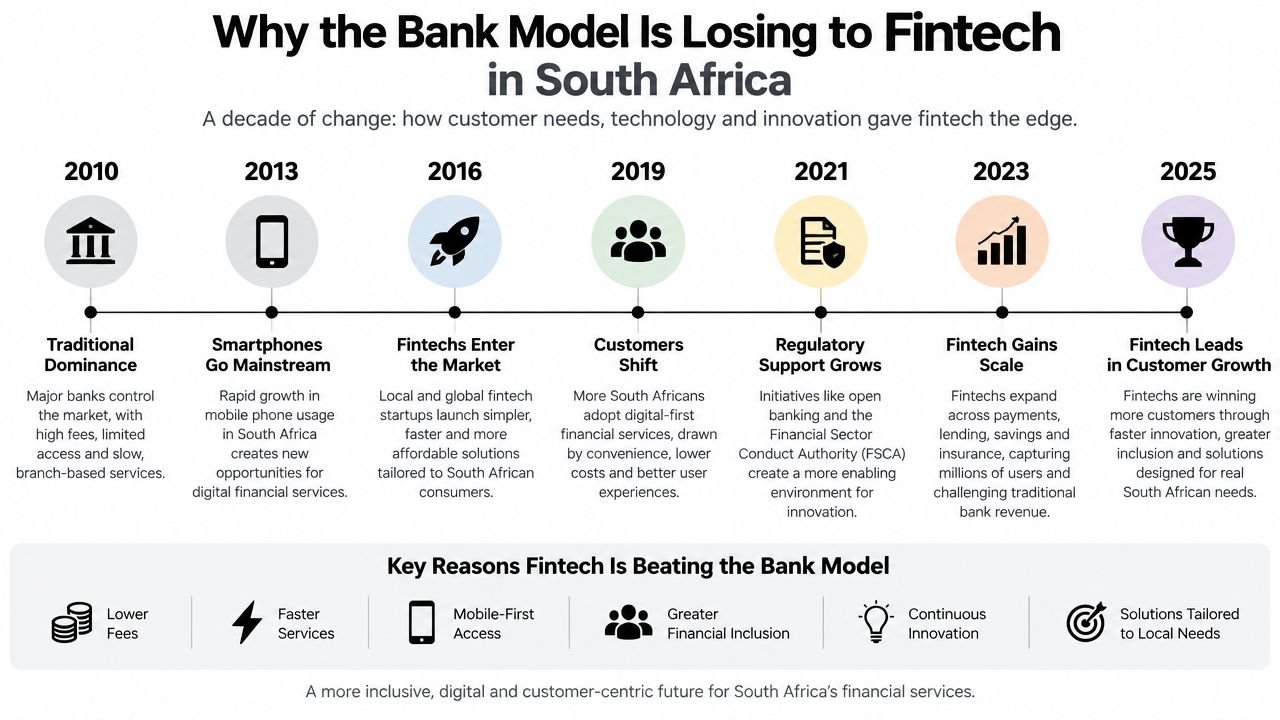
The reform won't automatically make every transfer cheaper or remove every compliance requirement. Banks and fintechs still need to manage sanctions, transaction purpose, liquidity, and corridor-specific rules. The change matters because it creates room for payment providers to shorten the route and build SME-focused controls around low-value flows.
South African SMEs should treat TCIB as a reason to review providers now, not as a promise to wait for. The winner will be the platform that converts the new rail into clearer pricing, reliable beneficiary data, and useful reconciliation for ordinary exporters, BPO firms, and importers.
Banks vs Modern Fintech Platforms for Cross Border Payments
A provider comparison should start with operating requirements, not brand familiarity. Banks still have strengths, particularly for large treasury operations, hedging, and offshore rand-account structures. A modern fintech platform can be more suitable when the business needs repeatable international payments, transparent FX, and finance-team controls.
South African SMEs can score providers against four practical dimensions:
| Dimension | Bank Rails | Fintech Platform |
|---|---|---|
| Settlement speed | Depends on correspondent routing, cut-off times, and compliance review | Can use direct or locally connected routes where available |
| Total cost | Separate bank charges, possible intermediary deductions, and an FX margin | Often presented as a consolidated rate and fee, which must still be verified |
| Governance controls | Dealer calls, email instructions, and bank approval workflows may be required | In-platform users, role permissions, beneficiary controls, and audit trails may be available |
| Foreign-currency spend | Often separate from the payment account | May include multi-currency accounts or cards, subject to provider capability |
The point isn't to assume that every fintech route is automatically superior. Ask for a worked quote using your own corridor, payment value, funding method, and beneficiary country. Require the provider to show the amount debited, the exchange rate, all fees, the expected arrival window, and what happens if an intermediary intervenes.
Where banks still fit
A bank may remain the right choice for a group that needs negotiated forward contracts, complex hedging, high-value treasury execution, or specialist offshore account arrangements. It may also be valuable as a funding relationship even when the operating team uses another provider for routine international settlement.
For recurring SME payments, however, the platform should reduce manual dependency. Beneficiary whitelists, dual approval, role-based access, and downloadable audit records matter because they give the financial controller evidence of who approved what and when.
Zaro is one example of a platform designed for South African businesses, with ZAR and USD business accounts, bank-transfer funding, international payments, multi-user controls, and foreign-currency debit cards. Treat it as a candidate to assess against the same landed-cost and governance checklist as any bank or competing fintech.
A Practical Workflow for Cheaper International Transfers
A Cape Town import manager or group-company bookkeeper can make the process repeatable by treating payment execution as a controlled workflow rather than a chain of urgent messages.
1. Build the KYB file first
Collect the CIPC documents, tax information, beneficial-owner details, director IDs, and proof of trading address. Give the provider a clear description of expected suppliers, customers, currencies, and payment purposes. A complete file reduces the chance that the first invoice becomes the first compliance investigation.
2. Choose the funding rail
Decide whether the payment will be funded from a ZAR business-account EFT, a permitted card route, or a multi-currency wallet load. The fastest option depends on the corridor and the provider's settlement design, so ask for the expected delivery time before committing to the supplier date.
3. Confirm the beneficiary
Capture the beneficiary's legal name, account details, SWIFT or BIC information, IBAN where relevant, intermediary details, and purpose-of-payment information. Confirm those details independently, especially when a supplier emails a change to banking instructions.
4. Apply internal approval
Use a dual-approval rule for material supplier payments. The person creating a beneficiary shouldn't be the only person releasing the transfer. Set role-based access so the bookkeeper can prepare the payment while the financial controller approves it.
5. Reconcile the landed result
Tag the payment with the purchase-order or deal reference, export the transaction record to Xero or Sage where supported, and compare the applied FX rate with the relevant daily reference rate. Save the beneficiary-credit confirmation, not only the South African debit notification.
This workflow removes the WhatsApp-to-treasury back-and-forth and gives management a clean record of the cost of every corridor. It also makes provider reviews evidence-based. If a route repeatedly misses its promised arrival window or produces unexplained deductions, the finance team has the records to challenge it.
Choosing a Provider That Protects Your Margin
Choose a provider for cash-flow predictability, not a marketing-page exchange rate. The right test is the number of rands required to deliver the agreed foreign-currency amount, the time required for the beneficiary to receive it, and the quality of the reconciliation record afterwards.
Put these questions to every bank and fintech before signing:
- What is the all-in landed cost? Ask for the debit amount, FX rate, explicit fee, intermediary treatment, and expected beneficiary value.
- What does settlement look like at month-end? Request a realistic delivery window for your ZAR-to-USD or other corridor when payment queues and liquidity conditions are less forgiving.
- Who owns reconciliation? Confirm whether your team gets downloadable statements, payment references, beneficiary confirmation, and accounting integrations.
- How is FX margin disclosed? Require the provider to show the rate used for each trade rather than relying on a generic “competitive rate” claim.
- Which governance controls exist? Look for dual approval, beneficiary whitelists, role-based access, transaction limits, and a complete audit trail.
Red flags should stop procurement immediately:
- Vague pricing: “Bank charges may apply” without a worked landed-cost quote.
- Hidden FX economics: No per-trade exchange-rate disclosure.
- Weak beneficiary controls: Manual additions with no independent approval.
- Unclear delivery: No committed ZAR-to-USD arrival window before compliance is complete.
South Africa's formal cross-border market is scaling in both value and transaction volume, while the policy environment is moving towards more interoperable retail rails. Your provider should therefore be able to explain not only its current route, but how it handles validation, messaging, compliance exceptions, and future rail changes.
For corridors under $1 million monthly, the predictable number of rands that arrives beats the rate advertised on a marketing page.
Zaro gives South African businesses a structured way to send and receive international payments through ZAR and USD business accounts, with transparent FX, bank-transfer funding, multi-user controls, and foreign-currency card access. Visit Zaro to assess whether its payment workflow can reduce the working-capital leakage in your own supplier, contractor, and export-revenue corridors.