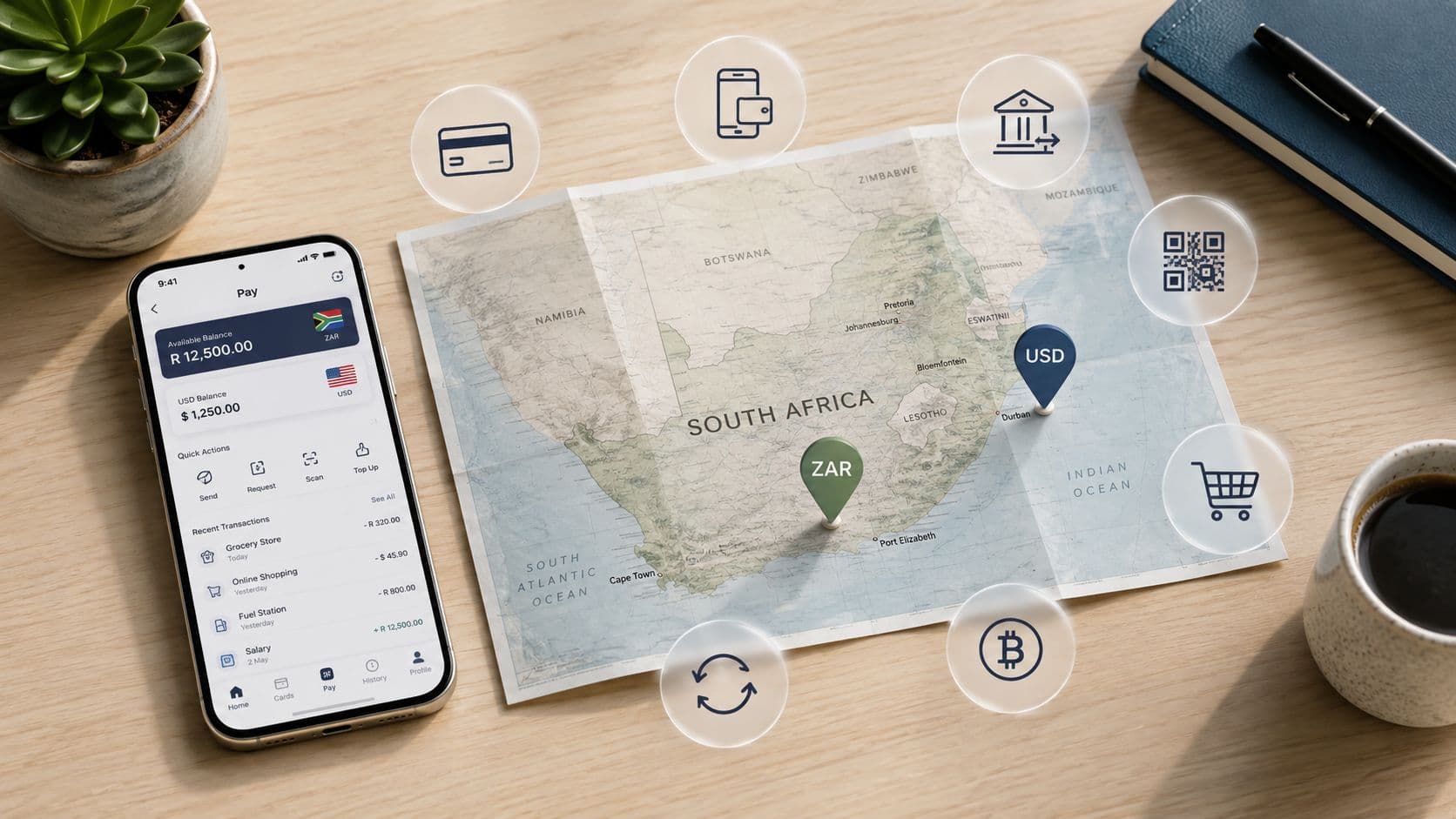
Choosing the right South Africa online payment methods is rarely a clean technical decision. It usually starts with a messy week, a customer wants to pay in the way they prefer, your finance team wants faster settlement, and your accountant is already asking why FX margins and payout fees are eating into cash flow. If you sell locally, the right stack needs to convert South African shoppers without friction. If you trade across borders, it needs to do that while keeping FX leakage, SWIFT delays, and compliance headaches under control.
For domestic checkout, the market is still anchored in cards, bank transfers, and increasingly instant bank-based payments. PPRO's South Africa breakdown shows cards at 43%, bank transfers at 22%, and e-wallets at 20%, while e-commerce spending reached US$8 billion in 2023 and is projected to reach US$11 billion by 2027 (PPRO South Africa payment-method data). On the consumer side, payment behaviour is far from static. Stitch reported that 93.3% of consumers tried a new payment method in the past year, and nearly one in four card transactions fails before reaching the bank (Stitch consumer research).
That means the best provider is not the one with the longest feature list. It's the one that fits your use case, your settlement needs, and your customer mix. For local e-commerce, speed and familiar rails matter. For exports, supplier payments, or BPO work, cross-border transparency matters even more.
1. Zaro
When your main issue is not collecting card payments in South Africa, but getting paid in dollars, converting those funds cleanly, and keeping more of the value when it settles locally, Zaro is the more targeted fit. It is built for South African businesses only, with KYB onboarding, enterprise controls, and compliance positioning that includes Authorised Financial Services Provider no. 55133 and FIC registration (Zaro).
For exporters and BPO teams, the value is practical. Traditional bank FX often hides cost in the spread and in transfer friction, while Zaro is positioned around transparent pricing, no SWIFT fees, and settlement that can land USD receipts into ZAR accounts in minutes according to its product positioning. That matters because cash flow is not just a finance metric, it decides whether you can pay payroll, settle suppliers, or fund the next campaign without waiting on a slow international transfer.
Why it stands out for cross-border finance
Zaro's edge is control as much as speed. Finance teams can use multi-user access, customisable permissions, and centralised visibility, so the product sits closer to a treasury tool than a consumer wallet. It also includes practical helpers such as an FX calculator, invoice templates in ZAR, USD, GBP, and EUR, and a BoP code checker, which cuts down the admin work that usually surrounds foreign receipts and supplier payments.
Practical rule: if your revenue or supplier base crosses borders, compare the FX spread and transfer path before you compare the user interface. The cheapest-looking bank quote often is not the cheapest settlement outcome.
Zaro is especially useful when your current process looks like this, a bank transfer leaves one account, a correspondent path adds delay, and the final amount received does not match the expected economics. It is less relevant if all you need is domestic card acceptance, but for international trade, that is the point. Visit the site, request access, and get a corridor-specific quote before you assume your bank is competitive.
2. Peach Payments
Peach Payments works best for merchants who want a broad domestic stack without stitching together five separate providers. It covers cards, Apple Pay, Google Pay, Pay by Bank, Capitec Pay, Scan to Pay, BNPL, subscriptions, payment links, and payouts, which makes it a practical fit for South African e-commerce operators who need both flexibility and local coverage (Peach Payments).
What stands out operationally is settlement rhythm. Peach positions its merchants for daily settlements to South African bank accounts, after the initial period, which helps reduce the cash gap between sale and usable cash. That matters in retail, because inventory, ads, and fulfilment costs usually hit before customer demand has fully paid for itself.
Where Peach is strong, and where it is less useful
The main advantage is breadth. If you're running a Shopify, WooCommerce, Wix, Magento, or Xero-based stack, Peach's plugin coverage makes implementation easier, and payment links give you a fast way to collect without building a full checkout flow. That can be useful for service businesses, pre-orders, or teams that sell across channels and don't want a heavy development project.
The trade-off is cost visibility. Peach's fee tables are volume-based, and exact pricing often requires sales contact, so finance teams need to do the work of comparing effective costs rather than assuming the headline rate will suit every product line. It also doesn't suit every business model. Dropshipping businesses aren't accepted, which makes it a poor match for operators who want a gateway that tolerates very broad merchant categories.
For domestic payments, Peach is a strong generalist. It's not the specialist answer for cross-border trade, but for South African online retail it gives you enough rails to avoid over-relying on cards alone.
3. Payfast
Payfast remains one of the more practical options for South African merchants that need broad local acceptance and pricing they can see upfront. It supports cards, Instant EFT, Capitec Pay, QR wallets, BNPL, subscriptions, split payments, refunds, and an immediate payout option, with 70+ ecommerce plugins helping merchants move quickly (Payfast).
That mix suits merchants who need a provider their web team can launch without a long integration cycle. On popular storefronts, maintained plugins cut implementation risk and shorten the gap between approval and live checkout.
The fee structure matters here
The trade-off is that visibility does not always equal low cost. Payfast publishes per-method pricing, which helps with planning, but card pricing at 3.2% + R2 can get expensive for businesses that process a lot of card payments. Immediate payout and per-payout charges can also add friction for merchants that move money out of the gateway often instead of leaving funds to settle on a slower schedule.
Merchant behaviour becomes critical here. South Africa's checkout mix still favours established rails, and analysts at Peach found that EFT and debit cards remain near-universal in many retail contexts in a 2025 report (Peach retail survey summary). If your customers already trust bank transfer flows, Payfast gives you a fast way to serve them without tying your economics to cards alone.
Payfast suits merchants that want reach, plugin support, and a wide menu of domestic methods, but it is not the cheapest choice for every basket size or payout pattern.
For businesses comparing South Africa online payment methods, Payfast earns its place by being familiar, flexible, and easy to deploy. The operational win is real, but it should be weighed against the effect on unit economics.
4. Yoco
Yoco suits merchants that want one provider for both in-store and online payments. Its online product supports payment links, invoices, website gateway use, and Apple Pay and Google Pay, which makes mobile checkout less awkward for customers who already pay with wallets on their phones (Yoco online payments).
The practical value shows up in the operator view. If your business already uses Yoco in person, the reporting side can be easier to manage. Finance teams get one view across channels, which cuts down reconciliation work and reduces the manual effort at month-end.
Good for simplicity, less strong for bank rails
Yoco's online acceptance comes with no monthly fees, which helps smaller merchants that are testing digital sales or moving online for the first time. The pricing is published as a band, 2.55% to 2.95% ex VAT, so you can estimate cost without the same method-by-method detail that more rail-specific providers show.
The trade-off is payment-method depth. Compared with platforms that focus on bank-to-bank rails, Yoco is less clearly built for Instant EFT or pay-by-bank workflows. If your customers prefer cards and wallets, that is a sensible fit. If a large share of your buyers use EFT, you may still need a second provider or a wider PSP stack.
Yoco is a practical answer for operators who value simplicity over specialisation. It is not the broadest domestic method mix in the market, but it can be a clean fit for omnichannel businesses that want one reporting layer and low setup friction.
5. Ozow
Ozow fits merchants that want bank-rail checkout to do more of the work at checkout, especially where customers already trust their banking app more than a card form. The platform focuses on Pay by Bank, Capitec Pay, Nedbank Direct EFT, Absa Pay, and PayShap Request, while also supporting cards, wallets, BNPL, vouchers, and crypto (Ozow).
For local merchants, the appeal is practical. Bank-rail payments can lower acceptance costs and match the habits of customers who prefer authenticating in their bank environment instead of typing card details into another site. Ozow's published pricing also gives finance teams a clearer way to estimate margin impact before moving traffic onto a new payment mix.
Why bank rails are more than a niche option
PayShap has moved well beyond an experimental use case in South Africa. Stitch's reporting shows more than R100 billion processed across over 136 million transactions, more than five million ShapIDs registered, and 12 participating banks, which helps explain why bank-based checkout is becoming part of normal consumer behaviour (Stitch PayShap reporting).
That matters for Ozow because it places bank-rail acceptance in the mainstream, not on the edge of the market. If you run an online store, the question is no longer whether customers can use bank-based checkout. It is whether your product mix, support process, and reconciliation flow are ready for it.
Ozow's pricing structure reflects that shift. Pay by Bank is often framed around roughly 1.5% in market terms, while card acceptance is less attractive for businesses that depend on tight payment margins. The platform also offers next-day settlements and no setup fees, which helps smaller merchants protect cash flow without taking on a heavy onboarding burden.
The trade-off is method balance. A card-heavy audience will still need more than Ozow alone. For buyers who prefer bank-authenticated flows and low-friction EFT-style checkout, it is one of the cleaner domestic options available.
6. Paystack
Paystack is a sensible option for teams that want a modern PSP with strong APIs and clean developer workflows. It supports cards, Apple Pay, Capitec Pay, and Ozow EFT through a single integration, which makes it useful when a business wants one checkout layer instead of juggling separate payment paths (Paystack South Africa).
The product feels especially suited to product-led businesses, SaaS, and merchants with in-house developers. Strong fraud tooling, 24/7 support, and free payouts simplify the operational side, while T+2 working day settlements make cash timing predictable.
Where Paystack fits in the South African stack
Its biggest advantage is cleanliness. You can accept multiple methods without making the checkout feel crowded, and the platform's local and international pricing is documented clearly enough for planning. That makes it a practical bridge between card acceptance and bank-rail options.
The limitation is multi-currency behaviour. International transactions settle in ZAR by default, so if you need true cross-border treasury handling, Paystack isn't the answer to that problem. It's built to help you collect online payments efficiently, not to solve the FX complexity of international receivables.
If the question is, “Can I get a clean checkout, developer-friendly integration, and predictable settlement?”, Paystack is a credible yes. If the question is, “Can I run cross-border trade without FX leakage?”, look elsewhere.
For businesses weighing South Africa online payment methods, Paystack sits in the middle ground. It's more developer-centric than some gateways, less specialised than bank-rail or treasury tools, and often a good fit when reliable execution matters more than bespoke payment design.
7. Stitch
A checkout can look polished and still create work for finance. Stitch is built for teams that want payments to sit inside the product stack, not sit beside it as an afterthought. It offers an API-first setup with cards, Apple Pay, Google Pay, Capitec Pay, bank API support, payouts, and a Pay Later option, with pricing that is published clearly enough for planning.
That makes it a practical fit for fintechs, subscription businesses, and merchants with in-house developers. The appeal is control, not just acceptance. You can shape the payment flow around recurring billing, one-click checkout, and bank-rail methods without forcing the customer into a generic template.
The real operational trade-off
Stitch's pricing clarity helps, but the payout structure still needs close attention. Standard payouts take 1 to 2 business days, while instant payouts cost more, so finance teams have to decide where faster access to cash justifies the extra fee. That choice affects working capital, especially if your margins are tight or your cash cycle is already stretched.
The platform also reflects how South African shoppers are changing. Stitch's consumer research found strong adoption of one-click wallets, BNPL, and bank-specific apps such as Capitec Pay and PayShap. Those findings explain why checkout design now has to support more than just cards, because buyers increasingly expect payment methods that match how they already move money.
Stitch works best when engineering control matters and bank-rail depth is part of the brief. It is not the easiest no-code option, and Pay Later fees can be high relative to bank rails, but for businesses that care about recurring flows and precise implementation, it is one of the stronger technical choices in the market.
Top 7 South African Online Payment Methods, Comparison
| Provider | Implementation complexity 🔄 | Resource requirements | Expected outcomes 📊 | Ideal use cases 💡 | Key advantages ⭐⚡ |
|---|---|---|---|---|---|
| Zaro | Medium 🔄, KYB business onboarding, portal/API access | Finance team adoption, ZAR/USD bank accounts, KYB docs; business‑only | Lower FX leakage; minutes‑scale US→ZA settlement; predictable receivables | SA exporters, SMEs, CFOs centralizing cross‑border FX | ⭐ Near‑mid‑market FX spreads & no SWIFT fees; ⚡ very fast settlement; enterprise controls |
| Peach Payments | Low–Medium 🔄, plugins + API options | Standard merchant onboarding; web plugins; minimal setup on Growth plan | Daily settlements; broad method acceptance; ecommerce readiness | Online retailers, SMEs, subscription/scale‑ups in SA | ⭐ Wide method coverage; ⚡ next‑business‑day settlements; strong SA tooling |
| Payfast | Low 🔄, quick plugin integrations and hosted options | Plugin integration, merchant account; optional immediate payout configuration | Fast go‑live; clear per‑method pricing; broad local payment support | Merchants on Shopify/WooCommerce needing quick integration | ⭐ Extensive local coverage & maintained plugins; ⚡ immediate payout option |
| Yoco | Low 🔄, simple online setup, best with existing POS | No monthly online fees; optional POS hardware for in‑store consolidation | Unified online/in‑store reporting; easy acceptance; fast onboarding | Brick‑and‑mortar SMEs adding online sales | ⭐ Unified reporting for store+online; ⚡ no monthly online fees; fast setup |
| Ozow | Low–Medium 🔄, bank‑rail integrations and APIs | Bank connectivity, merchant onboarding; enterprise package needs high volume | Low‑cost bank transfers; next‑day settlement; reduced EFT friction | Businesses prioritizing low‑cost Pay‑by‑Bank flows | ⭐ Competitive Pay‑by‑Bank fees; ⚡ next‑day settlements; transparent pricing |
| Paystack | Medium 🔄, developer‑centric API with rich tooling | Developer integration, fraud tooling configuration; standard onboarding | Single integration for cards/wallets/EFT; reliable fraud controls; T+2 settlements | Developer‑led teams, startups, multi‑method merchants | ⭐ Strong APIs & fraud controls; ⚡ predictable settlements; multi‑method checkout |
| Stitch | Medium–High 🔄, API‑first, banking‑API work required | Developer resources, banking‑API expertise; instant payouts cost extra | Seamless bank‑API payments; good recurring/one‑click flows; transparent fees | Fintechs, subscriptions, developer‑driven products | ⭐ Bank‑API focus & clear pricing; ⚡ optimized for recurring and instant bank flows |
From Local Sales to Global Trade Making the Right Choice
The right payment stack depends on what kind of business you run. For domestic e-commerce, Peach Payments, Payfast, Yoco, Ozow, Paystack, and Stitch all serve different slices of the same local market, and the best choice comes down to your basket mix, your checkout experience, and how quickly you need cash in the bank. South African consumers are clearly open to experimentation, but they still rely heavily on established rails, so a merchant that ignores cards and EFT is usually making life harder than it needs to be (PPRO South Africa payment-method data).
For domestic checkout, a mixed stack usually wins. Card acceptance covers broad trust, bank-transfer options capture customers who prefer direct account-based payments, and instant rails like PayShap and Pay by Bank can improve conversion where customers want confirmation without card entry. The operational lesson is simple. More payment methods are only useful if they match how your customers already pay.
International trade is a different game. The moment you invoice abroad, pay global contractors, or repatriate export revenue, the hidden costs change from gateway fees to FX spread, settlement timing, and transfer transparency. That is exactly where Zaro earns its place, because it is built around the cross-border pain point rather than domestic checkout alone.
A finance manager should ask two separate questions. First, which provider gives the best local conversion rate for South African customers. Second, which provider stops FX and SWIFT friction from eroding international margins. Those are not the same decision, and treating them as one is how businesses lose money without noticing.
If you're selecting a stack for a South African business today, start with your revenue path. Local sales want fast, trusted checkout. Cross-border revenue wants transparent FX and predictable settlement. Pick the provider that matches the cash flow you need, not the one with the longest feature list.
If your business sends or receives money across borders, Zaro is built to remove the hidden FX costs, SWIFT fees, and delay that make international payments harder than they should be. It gives South African teams a clearer way to manage cross-border cash flow, and you can see whether it fits your operation by visiting Zaro.