
You know the feeling. It's Thursday afternoon, the export order is moving, the team is chasing a supplier in the UK, someone has approved a lunch reimbursement in WhatsApp, and a USD payment for freight has already left the bank. On Friday morning, the CFO wants one clean answer, which rand went where, which currency moved, what was approved, and what still needs explaining.
That is the gap spend management closes. For a South African exporter, it's not a glossy procurement concept, it's the discipline that stops money from leaking through approvals, FX conversions, duplicate payments, and off-policy buys while the business is still trying to ship product and collect cash.
The Daily Reality of Spend Without a System
A small exporter rarely has a clean line between buying, paying, and explaining what happened. One person orders packaging in rand, another settles a foreign contractor in dollars, and a third forwards proof of payment for a courier invoice while everyone assumes finance will sort it out later. By month-end, finance is rebuilding the story from bank feeds, email threads, and half-finished spreadsheets.
That reconstruction takes time. The larger problem is control. When spend sits in too many places, there is no reliable moment to stop a bad payment before it clears, catch a duplicate before it is filed, or question a foreign-currency amount before the exchange rate shifts again.
What usually goes wrong first
The first failure is often small. An invoice is approved by the wrong person, a supplier is paid in the wrong currency, or a staff expense reaches finance without a proper receipt. Each issue looks minor on its own, which is why it is easy to ignore until the month-end close turns into a cleanup exercise.
Practical rule: if the team cannot answer who approved a payment, why it was allowed, and how it was matched, the business does not have spend control yet.
Public procurement data shows the same pattern at scale. In 2021 to 2022, public procurement was valued at about R931.5 billion, with 2.94 million transactions and 76,270 suppliers involved, while 83% of suppliers were SMMEs and EMEs but qualifying small enterprises received only 14.77% of payment value (National Treasury MAPS assessment). For a private exporter, the point is simpler. High volume without structure makes it hard to see where value is leaking.
A disciplined spend setup gives finance one ledger of truth, with rules attached. It makes casual spending harder, explanations easier, and the close less dependent on detective work. For smaller South African exporters dealing with mixed ZAR and USD flows, late customer payments, and no procurement team, that usually means the first gains come from preventing errors, FX leakage, and unauthorised purchases before anyone starts chasing supplier discounts.
What Spend Management Really Means
Spend management is the discipline of seeing every outgoing rand, deciding in advance who can spend what, recording the reason, and matching the payment back to budget and policy. It sits between procurement, accounts payable, and treasury, so the business doesn't treat buying, paying, and funding as three separate conversations.
Think of it as a flight control tower. Procurement is the runway, AP is the aircraft handling the payment, treasury is the fuel supply, and spend management is the tower that keeps the whole thing moving safely and in sequence.
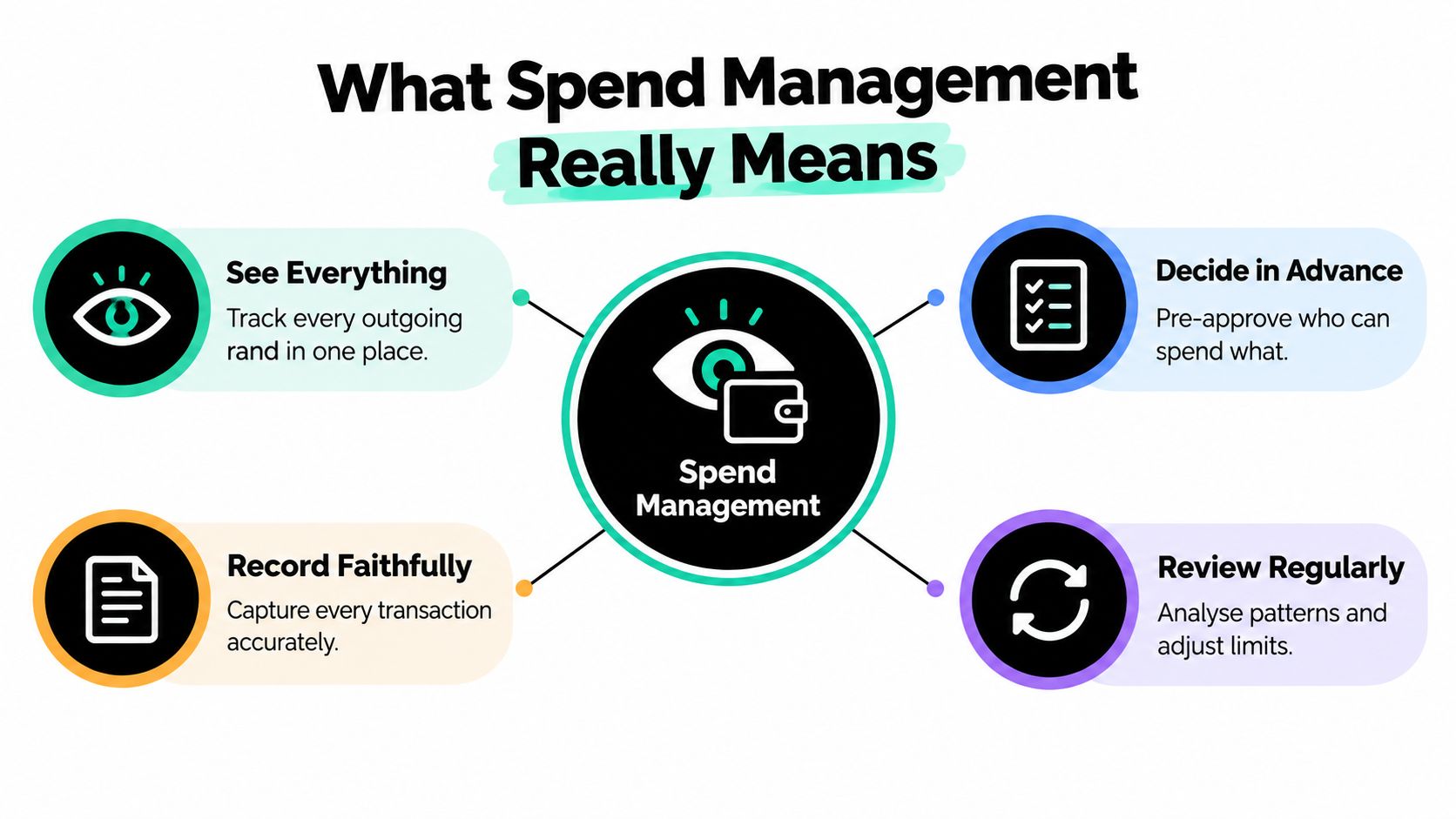
The four behaviours that matter
A working spend discipline does four things well.
- Sees everything: every outgoing payment sits in one place, whether it was made by card, EFT, or foreign transfer.
- Decides in advance: the company sets authority levels before anyone buys.
- Records faithfully: each payment keeps its supplier, reason, category, and currency.
- Reviews regularly: finance checks patterns, exceptions, and limits before they become habits.
For South African exporters, the definition has to stretch beyond local buying. A USD supplier advance, a foreign freight invoice, or a debit card purchase for a conference abroad still belongs inside the spend system, because those are the transactions most likely to hide FX leakage and unclear approvals.
If you want a practical perspective on digitised approval flows, expert guidance for digitised workflows is a useful reference point for teams trying to move away from email-based sign-offs without overcomplicating the process.
Spend management is not a software category first. It is a control discipline first, software second.
In a small company, finance usually owns it because finance sees the full picture, cash, policy, payment, and reporting. Procurement can shape supplier strategy, but finance needs the final say on rules, exceptions, and what gets paid when.
The Five Building Blocks of Effective Spend Control
The simplest systems fail for the same reason the clever ones do, they mix too many jobs into one spreadsheet. A spend system needs visibility, policy, approval workflows, payment rails, and reconciliation. Leave one out, and the rest start doing work they were never designed to do.
Visibility and policy
Visibility means one categorised ledger of everything going out, not a pile of bank exports with inconsistent labels. Policy means the company has already decided what needs sign-off, what does not, and who can approve which type of spend.
That distinction matters because a finance team cannot control what it cannot see, and it cannot enforce what it never wrote down. South African SMEs are still catching up on the basics of digital operations, and a 2025 study of 186 South African SME owners and managers found that e-procurement practices significantly predicted procurement performance, while more than 60% were still lagging in basic digital tools and e-commerce (study on South African SME e-procurement). The point isn't to buy a big platform on day one, it's to make the rules visible before automation enters the room.
Approval workflows, payment rails and reconciliation
Approval workflows should route decisions, not create inbox clutter. A clean workflow tells the team who approves a supplier, who approves a foreign payment, and what happens when the payment is urgent but outside policy.
Payment rails are where hidden costs often sit. Cards, EFTs, wallets, and cross-border payment services each carry different trade-offs in transparency, settlement, FX spread, and dispute handling. Reconciliation is the last line, matching what was approved, what was paid, and what was posted to the ledger.
| Payment instruments for South African exporters | Fee visibility | FX spread | Settlement | Control |
|---|---|---|---|---|
| Card | Usually clearer at point of use | Can be visible or built into the rate | Fast for purchases | Strong for approvals and limits |
| Local EFT | Usually clear in bank records | Not usually relevant locally | Can be slower than card | Good for supplier payments |
| Mobile wallet | Varies by provider | Usually indirect | Often fast | Depends on reporting quality |
| Cross-border payment service | Needs careful quote review | Can be the key hidden cost | Often designed for international transfers | Strong if permissions and records are built in |
The Visa study of South Africa's digital-payment scene reported that 84% of surveyed SMEs accepted cards, cards represented 48% of transaction volume among digitally enabled SMEs, cash still accounted for 40%, and wallets for 11%, while 65% of card-accepting merchants cited card fraud as a concern (Visa South Africa digital-payment study). That mix tells you why spend control has to consolidate multiple payment types, not assume one channel.
Minimum Viable Spend Management Without an ERP
A small exporter does not need an ERP to start. It needs a setup that catches the obvious mistakes and makes the next decision easier than the last one. A controller at a Cape Town or Durban exporter can usually feel the pain long before the board sees it, scattered invoices, mixed ZAR and USD spend, and payments made while customer cash is still in transit.
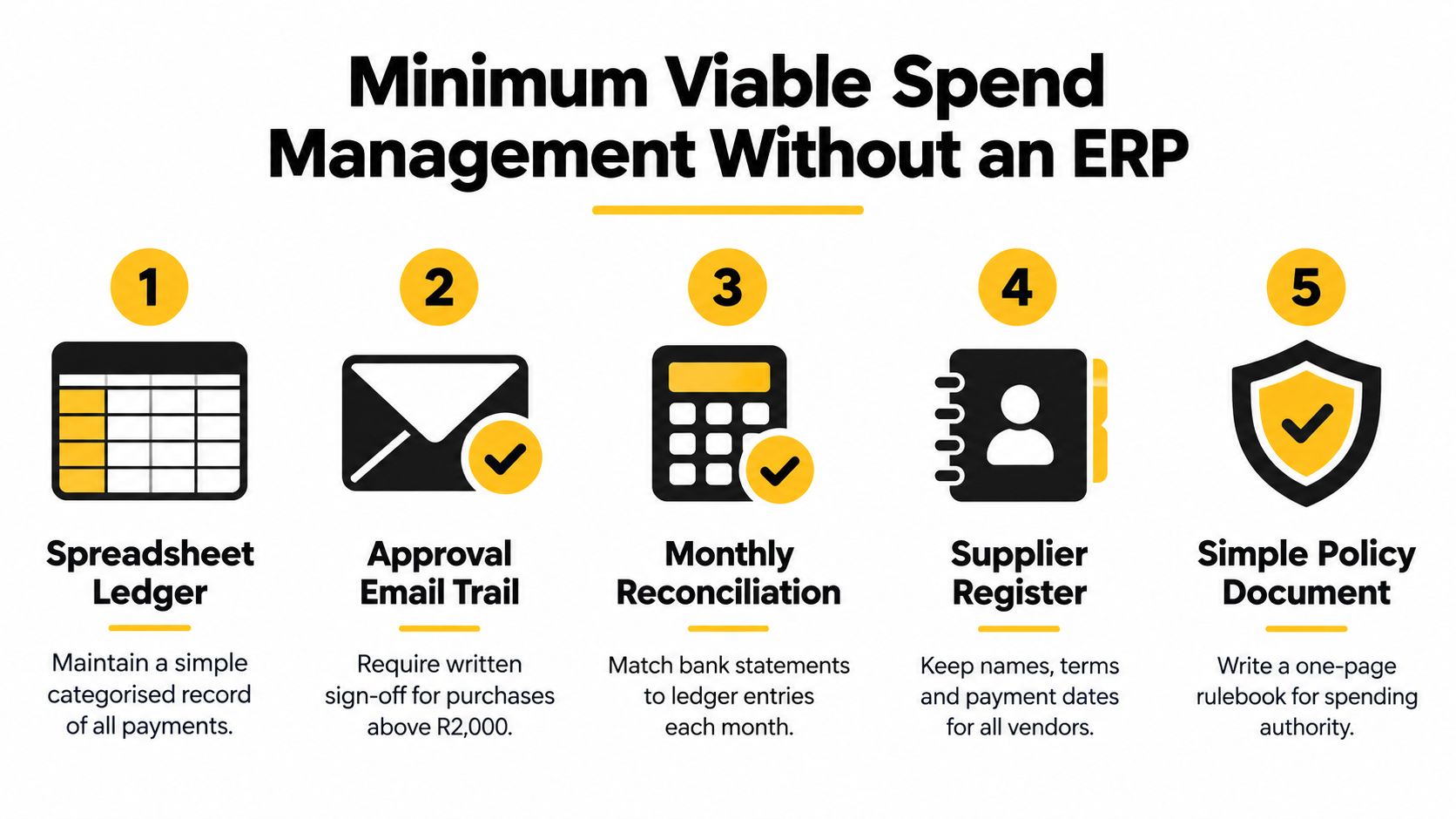
The minimum setup
Start with one inbox for invoices and receipts. If spend arrives through WhatsApp, email, and paper, someone has to gather it before it turns into a payment.
Build a simple category list that the team can use. Keep it narrow enough that people do not guess, but broad enough that the controller can see where money is going without rebuilding the chart every week.
- One inbox: every invoice, receipt, and supplier request lands in the same place.
- Two approval thresholds: one for routine spend, one for higher-risk or foreign-currency spend. For example, a low-value office purchase may need one sign-off, while a larger USD invoice or a cross-border freight charge may need a second review.
- One weekly reconciliation slot: same day, same time, same owner.
- One-page policy: a written rulebook for who approves, what evidence is needed, and what counts as urgent.
- Supplier register: names, terms, currency, and payment method in one place.
What to fix first
The first gains usually come from stopping duplicate payments, catching unauthorised purchases, and forcing the right approval before money leaves the bank. Supplier discounts matter, but they matter later. A company with weak controls often loses more through process errors and timing gaps than through pricing.
A controller can run this without a specialist team if the habits are consistent. Centralise the documents, record the category when the invoice arrives, and reconcile by supplier and currency every week.
One practical sequence matters here. Capture the invoice first, then route it for approval. If the amount or currency is wrong, or the supplier details are incomplete, the approval step becomes a rubber stamp and the error travels straight into payment.
Payment Instruments and Where Hidden Costs Hide
The instrument you use to pay is often the easiest place to lose money without realising it. Two payments with the same nominal amount can have very different true costs once fees, timing, FX spread, and control quality are added in.
Comparing the common options
A debit card can be useful for controlled purchases, especially when permissions are tight and the spend needs to be visible immediately. Local EFTs are familiar and good for domestic supplier payments, but they don't always give you the same speed or controls for cross-border spend. Wallets can be convenient for some operational purchases, though reporting and audit trails vary by provider. Cross-border payment services are where exporters need to read the quote carefully, because the actual exchange rate and the presence or absence of hidden fees can matter more than a small discount on an invoice.
The Visa data above shows why cards remain central in South Africa's SME payment mix, but it also highlights the need for security and reconciliation. If card fraud is a concern, the response is not to avoid cards altogether. The response is to set limits, permissions, and review cycles that make card use visible rather than casual.
A good payment tool does not just move money. It leaves a clean trail behind.
For exporters, the question is not “which method is cheapest?” It is “which method gives the cleanest total cost and the best evidence trail for this type of spend?” A flight booking, an import duty payment, and a foreign supplier advance should not all be treated the same way.
The spend management habit that helps most here is comparison by purpose. If a payment rail is unclear on fees, slow in settlement, weak on dispute support, or hard to reconcile, that hidden friction ends up in finance's lap later.
Connecting Spend Controls to Working Capital
Spend management gets harder the moment receivables slip. A bank balance can look fine on Monday, yet the cash for suppliers, tax, and foreign invoices is already tied up in customer payments that have not landed.

Cash first, then commitments
The habit that helps is simple. Age receivables and payables together, so finance can see what must be paid and what cash is available to fund it.
The South African Reserve Bank's procurement data shows total competitively procured supplier spend of R6.21 billion, with the 20 largest suppliers accounting for 61% of expenditure, 91% of spend going to local suppliers and 9% to foreign suppliers, and operating and capital expenditure split 51% and 49% (SARB procurement data). For a smaller exporter, that concentration is a reminder that a few suppliers can dominate cash planning, and foreign currency makes the timing tighter.
A Monday morning cash-stress routine
Start the week with a short review before spending starts.
- Check due payables by supplier and currency.
- Check overdue receivables by customer and invoice currency.
- Flag any foreign-currency gap.
- Decide what can wait without straining a key supplier relationship.
- Hold back nonessential spend if collections are slow.
A 2026 Banking Association South Africa report estimates the country's SME funding gap at R350 billion and cites evidence that 90% of SMEs reported late payments in one referenced survey and 80% still faced overdue invoices in a later source (Banking Association South Africa report). In that setting, spend control and cash control sit in the same drawer.
If receivables are stretched, the right payment run is the one that protects the next operating cycle, even if it looks less tidy on a calendar.
The cleanest design is to connect accounts payable to accounts receivable so payment timing reflects both supplier urgency and customer reality. A guide to AI in financial processes can help with matching and exception handling, but only after the cash logic is clear.
The Spend Cube and Why Category Visibility Pays
A flat payment list shows what left the account. A spend cube shows where the money went, why it went there, and what pattern sits underneath it. That matters because cost control rarely lives in one line item. It lives in the shape of the full book of spend.
Why the cube changes the conversation
The cube slices spend by supplier, category, entity, country, currency, contract status, and payment channel. Once those views sit side by side, finance can separate what is controllable from what is structural.
For smaller South African exporters, that matters quickly. Local operating spend, foreign supplier spend, and customer-related costs do not behave the same way. A dollar payment needs different controls from a local service invoice, and a contract-backed vendor should not be treated like a one-off emergency buy.
What finance learns when the data is sliced properly
The SARB split cited earlier shows why this view matters. It separates FX exposure from domestic sourcing, instead of mixing both into one number. The same idea helps with operating and capital spend too. If those buckets sit side by side, approval thresholds and sourcing rules can be set differently, rather than using one blunt rule for everything.
That is also where unusual transactions become easier to spot. Tools that help finance detect irregular spending patterns are useful once the cube exists, because the cube gives them context. The goal is to help finance notice what the flat ledger hides, with judgement staying firmly human.
A spend cube often matters more than a small supplier saving, because it changes the next decision, not just the last one.
Getting Started and Growing the Program
Start small, then make it repeatable. In the first 30 days, write a one-page policy, route invoices into one inbox, set two approval thresholds, and run the first weekly reconciliation. Add a simple supplier register after that, tag spend by category, and tighten reviews on foreign-currency payments so the ZAR and USD flows do not blur together.
For a smaller South African exporter, that is usually enough to catch the biggest leaks early. A missed approval, a duplicate invoice, or an unmanaged FX payment often costs more than a small supplier discount ever saves.
By six months, the aim should be a working contract register, cleaner category visibility, and a basic spend cube that shows supplier, currency, and channel together. As noted earlier, centralised approvals matter long before a company becomes large, because they give finance a way to separate routine spend from exceptions.
A practical milestone helps here. In month one, focus on stopping errors and getting visibility. By month three, tighten policy compliance and foreign-payment checks. By month six, review whether the manual setup still fits the volume and complexity of the business.
Some exporters can stay on a minimum setup for a while. Once approvals are being bypassed, foreign payments need more manual follow-up, or month-end becomes a hunt through inboxes and spreadsheets, it is time to move to a dedicated platform.
FAQ
How is spend management different from procurement? Procurement is about buying well. Spend management is about seeing, approving, paying, and reviewing all company outflow, including payments that never went through a formal procurement process.
What should I automate first? Start with invoice capture, approval routing, and reconciliation. If the process isn't defined, automation only makes the mess faster.
How do I justify this to a managing director? Tie it to fewer payment errors, better FX control, faster close, and clearer cash decisions. In a South African exporter, those are operational outcomes, not admin upgrades.
Zaro helps South African businesses manage cross-border payments with business ZAR and USD accounts, real exchange rates, and no SWIFT fees, which makes foreign supplier payments and export-related cash moves easier to track. If you're tightening spend controls across currencies and want cleaner visibility over outgoing payments, visit Zaro and see how its controls fit into a finance team's day-to-day workflow.